
Why Bid Preparation Costs Matter for Government Contractors
Bid preparation costs are not a minor line item you can afford to ignore. They are allowable indirect expenses under FAR 31.205-18 that directly affect your profitability, your audit exposure, and your ability to compete for federal contracts. Contractors who track and manage these costs recover more, bid smarter, and protect their indirect rates. Those who don’t often discover the problem during a DCAA audit.
Here is what you need to know about why bid preparation costs matter in 2026:
- They represent real, recoverable expenses whether or not you win the contract.
- FAR 31.205-18 and CAS 9904.420-40(b) govern how you accumulate and allocate them.
- Misclassifying them as marketing costs creates audit findings and lost recovery.
- Proper documentation is the difference between a clean indirect rate and a disallowed cost.
- Tracking them at the project level informs better bid/no-bid decisions over time.
Why bid preparation costs matter: scope and definition
Bid and proposal (B&P) costs are the expenses you incur preparing, submitting, and supporting bids or proposals on potential government or non-government contracts. That definition comes directly from FAR 31.205-18, and it is broader than most contractors initially expect.
The scope covers solicited and unsolicited proposals alike. It does not cover costs tied to grants, cooperative agreements, or work already required under an existing contract. Understanding that boundary matters because costs on the wrong side of it are unallowable.
Key cost elements that fall within B&P include:
- Direct labor: proposal writers, cost estimators, project managers, and executives who contribute time to the proposal effort.
- Direct materials: printing, graphics production, and software licenses used specifically for the proposal.
- Consultant and subcontractor fees tied exclusively to the proposal, not to future contract performance.
What falls outside B&P is equally important. Go/no-bid decision activities, general marketing, and promotional expenses are classified as selling costs, not B&P. That distinction is not just semantic. Misclassifying marketing costs as B&P is one of the most common triggers for audit findings. You can learn more about where that line sits in the context of construction market research for bidding.
What drives bid preparation costs up or down?
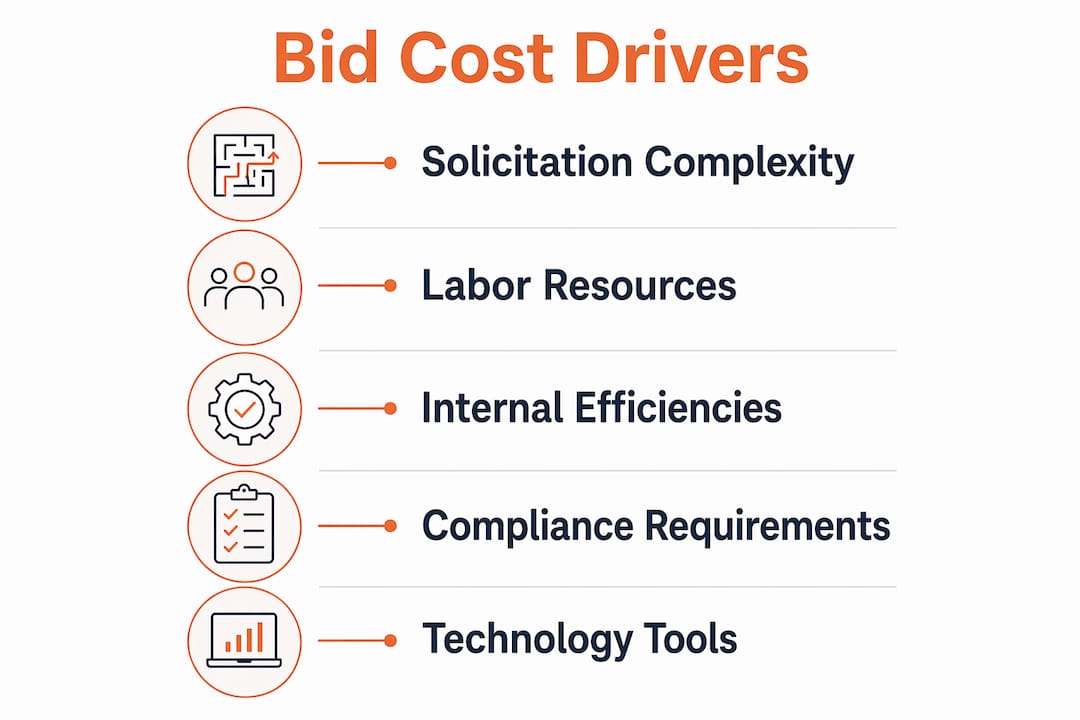
Solicitation complexity is the single biggest cost driver. A technically demanding proposal requiring detailed cost breakdowns, past performance narratives, and subcontractor data will cost far more to prepare than a straightforward low-bid solicitation. Research confirms that higher technical complexity and detailed proposal requirements significantly raise bid costs.
FAR 15.402 actually addresses this from the government side, requiring contracting officers to request only the data necessary to establish a fair and reasonable price. Requesting unnecessary data inflates preparation costs and extends acquisition timelines for both parties. When a solicitation asks for more than it needs, your costs go up with no corresponding benefit to your proposal’s competitiveness.
| Cost Category | Typical Elements | Key Driver |
|---|---|---|
| Direct labor | Writers, estimators, PMs, executives | Hours × labor rate |
| Direct materials | Printing, graphics, software | Proposal volume and complexity |
| Consultant fees | Technical advisors, pricing specialists | Solicitation requirements |
| Subcontractor costs | Teaming partner proposal inputs | Number of subs, data requirements |
Poorly scoped solicitations and internal process inefficiencies compound these costs. Contractors who lack a repeatable proposal process often duplicate effort across pursuits, driving up labor hours without improving win rates. Reviewing your bid win rate data alongside B&P spend is one of the clearest ways to spot where your process is leaking money.

How bid preparation cost recovery actually works
The most important thing to understand about B&P cost recovery is this: you can recover these costs whether you win or lose the contract. FAR 31.205-18 makes no distinction between successful and unsuccessful bids for allowability purposes. Costs are allowable as indirect expenses as long as they are reasonable and allocable.
The prior dollar caps on B&P costs have been removed. As of 2026, there is no regulatory ceiling on the amount you can recover, provided the costs meet the reasonableness and allocability standards.
Recovery depends on proper accumulation. CAS 9904.420-40(b) requires contractors to accumulate B&P costs at the project level, not lumped together in a general pool. That project-level tracking is what allows auditors to verify that costs are properly classified and allocated through your indirect rate structure rather than inflating your G&A or overhead pools incorrectly.
Compliance tips that protect your recovery:
- Charge all proposal labor to a dedicated B&P cost code, not to overhead or G&A.
- Capture executive time on proposals. Failing to do so depresses B&P costs and artificially inflates your G&A pool.
- Keep B&P costs separate from IR&D costs, even though both share similar accounting treatment under DCAA guidance.
- Document the start and end dates of each proposal effort to establish the period of accumulation.
How to manage bid preparation costs as a strategic tool
Treating B&P costs purely as a compliance obligation leaves money and competitive intelligence on the table. Financial compliance experts recommend viewing these costs as a strategic lever that informs bidding decisions and profitability, not just a regulatory checkbox.

Pro Tip: Track B&P costs by pursuit from day one. After six months, you will have real data showing your average cost per bid type, your win rate by contract category, and which pursuits consume resources without producing awards. That data drives better go/no-bid decisions than gut instinct alone.
Practical steps to manage costs without sacrificing proposal quality:
- Use dedicated cost codes in your accounting system for each active pursuit.
- Set a budget for each proposal before work begins, tied to the estimated contract value and probability of award.
- Review solicitation requirements early. If the government is asking for data you cannot provide efficiently, that is a go/no-bid signal, not just a cost problem.
- Control scope creep on proposal teams. Every hour added to a pursuit that does not improve the proposal’s competitiveness is a recoverable cost you still have to justify.
Software tools like Deltek Costpoint and Unanet provide real-time labor tracking and expense visibility that manual timesheets cannot match. They also generate the reports your accounting team needs to allocate costs correctly and prepare for indirect rate negotiations. Integrating bid cost data into your annual planning cycle lets you set realistic B&P budgets based on your pipeline, not guesswork. For contractors pursuing federal set-aside opportunities, that planning discipline is especially valuable given the volume of proposals some programs require. See the federal set-aside categories guide for context on how proposal volume varies by program type.
How to manage the financial risks tied to bid preparation spending
Uncontrolled B&P spending creates two distinct risks. The first is direct: you spend more preparing bids than you recover through your indirect rate, compressing margins on awarded contracts. The second is indirect: poorly classified or undocumented costs trigger audit findings that disallow previously recovered amounts and damage your relationship with the contracting officer.
The bid/no-bid decision is your primary risk management tool. A pursuit that requires extensive proposal investment against a low probability of award is a financial risk, not just a lost opportunity. Contractors who track historical B&P costs by contract type can quantify that risk before committing resources.
Scope discipline matters too. When a solicitation’s data requirements under FAR 15.402 seem excessive, engaging the contracting officer early through questions or clarifications can reduce your preparation burden. That is not just good practice. It is explicitly encouraged by the regulation. Subcontractor compliance documentation is another area where costs can escalate quickly. Platforms that help civil subcontractors submit compliance docs faster reduce the administrative burden that flows back to your proposal team.
Best practices for documenting and justifying bid preparation costs
Documentation is what converts a recoverable cost into an actually recovered one. Inaccurate or missing records are the most common cause of audit findings on B&P costs. The standard is straightforward: every cost charged to a B&P code needs a paper trail that connects it to a specific proposal effort.
What that documentation looks like in practice:
- Timesheets that identify the specific proposal by name or number, not just a generic B&P code.
- Invoices and receipts for all direct material costs, with a note linking each to the proposal.
- Subcontractor agreements or statements of work that define the scope of their proposal contribution.
- Executive time records showing hours worked on the proposal, reviewed and approved by someone other than the executive.
- Proposal start and completion dates to establish the accumulation period and prevent costs from bleeding across fiscal periods.
The separation of pre-go/no-bid activities from post-go B&P efforts is a documentation requirement, not just an accounting preference. If your records cannot show when the go decision was made and that all charged costs occurred after that point, auditors will reclassify the early costs as marketing, and you will lose the recovery.
Which tools help you control bid preparation costs efficiently?
Purpose-built government contracting platforms give you cost visibility that general accounting software cannot. Deltek Costpoint and Unanet are the two most widely used systems among federal contractors for this purpose. Both provide project-level cost coding, real-time labor tracking, and indirect rate calculation that align directly with CAS and FAR requirements.
For contractors not yet on an enterprise platform, even a structured approach using project-specific cost codes in QuickBooks, combined with a disciplined timesheet process, is far better than lumping B&P costs into overhead. The goal is traceability: every dollar charged to a B&P code should be traceable to a specific proposal with supporting documentation.
Proposal management tools like Loopio or RFPIO help teams reuse past proposal content efficiently, which reduces labor hours per pursuit without sacrificing quality. That efficiency directly lowers your average cost per bid. Tracking bid cost data in a spreadsheet or dashboard alongside your win rate by contract type gives you the ROI picture that informs annual budget decisions. Contractors who understand their competitive pricing position relative to their B&P investment are better equipped to set realistic targets and allocate pursuit resources where they produce results.
How Federal-rconstructionsolutions helps you manage bid costs and win more contracts
Federal-rconstructionsolutions built a specialized Pillar specifically for construction contractors navigating federal procurement. The team handles RFP writing, compliance documentation, and cost classification support so your proposal effort is both competitive and audit-ready. Contractors working with Federal-rconstructionsolutions achieve a high level of compliance on bid submissions, which means fewer disallowed costs and stronger indirect rate positions.
Whether you are pursuing your first federal contract or managing a full pipeline of government pursuits, federal procurement services from Federal-rconstructionsolutions give you the structure to recover every allowable dollar and position each proposal for award.
Key Takeaways
Bid preparation costs are fully recoverable indirect expenses under FAR 31.205-18, but only when contractors track them at the project level, classify them correctly, and document every charge with a clear audit trail.
| Point | Details |
|---|---|
| Costs are always recoverable | FAR 31.205-18 allows B&P cost recovery on both winning and losing bids when costs are reasonable and allocable. |
| Project-level tracking is required | CAS 9904.420-40(b) mandates accumulating B&P costs per proposal, not in a general pool. |
| Misclassification is the top audit risk | Charging marketing or go/no-bid activities to B&P codes triggers disallowances and audit findings. |
| Executive time must be captured | Omitting executive labor from B&P records inflates G&A pools and distorts indirect rates. |
| Documentation protects recovery | Timesheets, invoices, and subcontractor records tied to each proposal are required for audit readiness. |
FAQ
What is a bid and proposal cost under FAR?
A bid and proposal (B&P) cost is any expense incurred preparing, submitting, or supporting a bid or proposal on a potential government or non-government contract, as defined by FAR 31.205-18. It excludes costs tied to grants, cooperative agreements, or existing contract performance.
Are bid preparation costs recoverable if you lose the contract?
Yes. FAR 31.205-18 allows recovery of B&P costs regardless of whether the contract is awarded, provided the costs are reasonable, properly classified, and accumulated at the project level per CAS 9904.420-40(b).
What is the difference between bid preparation costs and marketing costs?
Bid preparation costs begin after the go/no-bid decision is made and cover direct proposal work. Marketing costs, including the go/no-bid analysis itself and general promotional activities, are classified separately and are not recoverable as B&P.
What are the most common mistakes in bid cost documentation?
Missing or vague timesheets, failure to capture executive labor, and charging pre-go/no-bid activities to B&P codes are the most frequent causes of audit findings, according to government contracting compliance guidance.
When preparing a bid, which costs are considered overhead?
B&P costs are allocated as indirect expenses through your overhead or G&A pool, depending on which profit center incurs them, per FAR 31.205-18. They are not direct contract costs, but they must be accumulated at the project level before allocation.