
Competitive Pricing for Federal Bid Submissions in 2026
Competitive pricing in federal bid submissions is the practice of using historical contract data, agency benchmarks, and fully loaded cost structures to craft bids that satisfy government evaluation criteria while protecting your profit margin. The industry term for this discipline is government contract pricing, and it sits at the intersection of cost accounting, market intelligence, and procurement strategy. Construction firms that master this process win contracts at rates of 28 to 35 percent, compared to just 12 percent for those who bid without a structured approach. Tools like FPDS.gov, USASpending.gov, and Fed-Spend give you the data you need to price with precision. Frameworks like FAR 15.404-1 and evaluation methods like Lowest Price Technically Acceptable (LPTA) and Best Value define the rules of the game.
How to benchmark competitive pricing for federal bid submissions
Accurate benchmarking starts with the right data sources. FPDS.gov and USASpending.gov are the two primary public repositories for federal award data. You can filter by NAICS code, agency, contract type, and place of performance to find awards that closely resemble your target opportunity. This filtering step is what separates a useful benchmark from a misleading one.
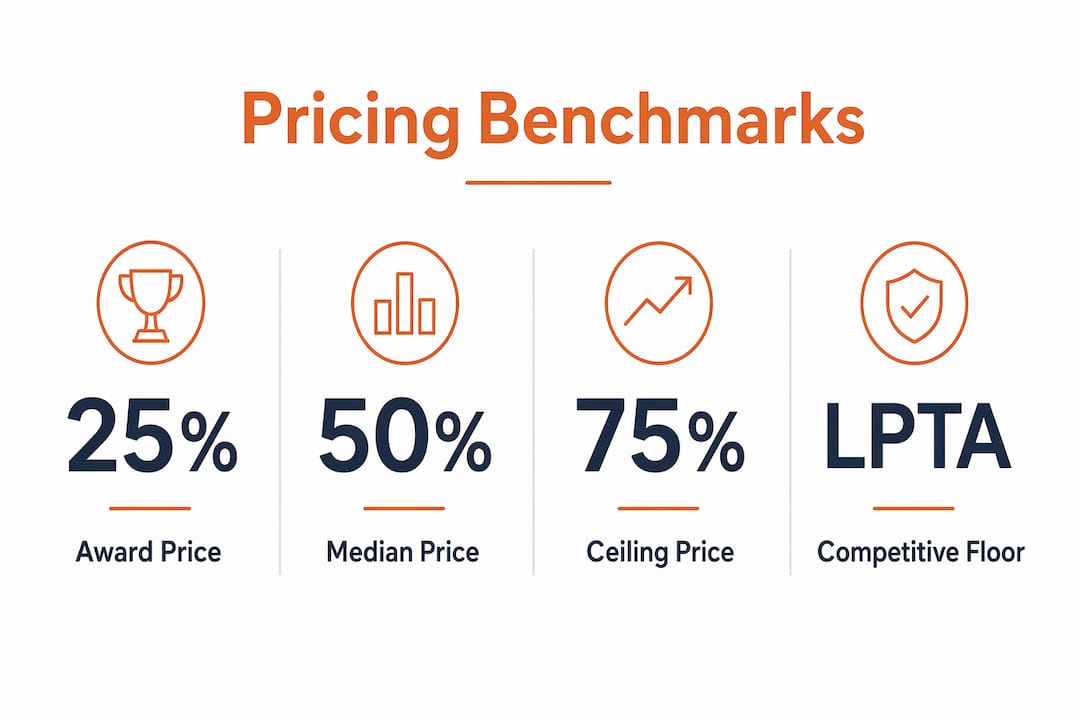
Once you have a filtered dataset, extract three price points for each comparable award:
- 25th percentile: The floor of competitive pricing, typical for LPTA awards
- 50th percentile (median): The baseline for Best Value bids
- 75th percentile: The ceiling, appropriate only when strong technical differentiators justify the premium
Incumbent pricing deserves special attention. Public contract modifications and GSA Schedule rates often reveal what the current contractor charges, and incumbent pricing can be reverse-engineered to establish a competitive bidding ceiling. This is one of the most underused tactics in federal construction contracting.
Pro Tip: Fed-Spend’s Pricing Intelligence Engine filters historical awards by NAICS code, agency, and labor category simultaneously, cutting research time significantly and improving the accuracy of your price range. Using professional pricing tools like this one is now standard practice among top-performing contractors.

The table below illustrates how to organize your benchmark data before building your bid price:
| Data Point | What It Tells You |
|---|---|
| 25th percentile award price | Competitive floor; typical LPTA target range |
| 50th percentile award price | Median market rate; Best Value baseline |
| 75th percentile award price | Upper competitive range; requires technical justification |
| Incumbent contract modifications | Reveals actual labor rates and escalation patterns |
| GSA Schedule rates by labor category | Provides a cross-check for labor pricing reasonableness |
How do you calculate a compliant floor price for a federal bid?
Your floor price is the minimum you can charge without losing money or violating federal cost accounting standards. Building it correctly requires four cost components, calculated in sequence.
- Direct labor costs: Start with fully burdened hourly rates for each labor category. Apply Davis-Bacon Act wage determinations for construction contracts, which set mandatory minimums by trade and geography.
- Fringe benefits: Add fringe costs as a percentage of direct labor. This typically runs 25 to 35 percent for construction trades, covering health insurance, retirement contributions, and paid leave.
- Overhead and G&A: Apply your overhead rate to direct labor and your General and Administrative (G&A) rate to total costs. Overhead rates for construction firms commonly range from 15 to 40 percent; G&A rates typically fall between 8 and 15 percent.
- Fee (profit): Add your target profit margin last. Federal contracts generally allow 5 to 12 percent fee on cost-plus vehicles, though fixed-price contracts let you set fee independently.
The combination of these rates produces your wrap rate, which is the multiplier applied to a base labor hour to arrive at a fully loaded billing rate. For example, a base labor rate of $40 per hour with a combined wrap rate of 1.85 yields a billing rate of $74 per hour.
Below-floor pricing is financially unsustainable and likely to be rejected as non-responsible by the contracting officer. Pricing more than 20 percent below market also raises red flags during price analysis. On the other end, pricing 15 to 20 percent above market requires strong technical justification to survive evaluation.
Pro Tip: Audit-ready documentation for your indirect rates is not optional. FAR requires contractors to substantiate their cost structures, and a contracting officer who cannot verify your rates will question your price reasonableness, which can eliminate your bid entirely.
The distinction between contract types also matters here. Cost-plus contracts require you to expose your full cost structure and accept audit scrutiny. Fixed-price contracts give you more flexibility but transfer financial risk to you if your cost estimates are wrong. Most federal construction contracts are firm-fixed-price, which makes accurate floor price calculation non-negotiable.
LPTA vs. best value: which pricing strategy fits your bid?
The evaluation method written into a solicitation determines your entire pricing strategy. Getting this wrong is one of the most common and costly mistakes construction firms make.
LPTA (Lowest Price Technically Acceptable) awards go to the lowest bidder who meets the minimum technical requirements. There is no credit for exceeding those requirements. Under LPTA, your target is the 25 to 35th percentile of historical awards for that agency and NAICS code. Spending time and money on a superior technical proposal under LPTA is wasted effort.
Best Value evaluations score both price and technical merit, then make a tradeoff decision. Under Best Value, lowest price does not always guarantee award because technical strengths can justify a higher price. Your target here is the 40 to 60th percentile, paired with a technical proposal that clearly articulates your differentiators.
Agency behavior adds another layer of complexity. DOD tends to pay 12 to 18 percent above median labor rates, while the VA typically pays below median. Pricing a VA construction contract the same way you would price a DOD contract is a structural error. Always filter your benchmark data by the specific awarding agency, not just the NAICS code.
The table below summarizes how to adjust your pricing approach by evaluation type:
| Evaluation Method | Price Target Percentile | Technical Proposal Priority | Key Risk |
|---|---|---|---|
| LPTA | 25th to 35th | Meet minimums only | Underbidding below floor |
| Best Value | 40th to 60th | High; differentiators matter | Overpricing without justification |
| Recompete (incumbent present) | 30th to 50th | Critical to displace incumbent | Insufficient lead time for intelligence |
For recompete contracts, note that incumbents win 70 to 80 percent of the time. Challengers who start capture planning 18 months before RFP release, and who use public modification data to reverse-engineer incumbent pricing, are the ones who break that pattern.
How does bid/no-bid discipline improve your federal win rate?
A formal bid/no-bid process is one of the highest-return investments a construction firm can make in its federal contracting program. The data is direct: small businesses with disciplined bid selection win 28 to 35 percent of federal contracts, versus 12 percent for those who bid indiscriminately. That gap represents real revenue and real overhead savings.
A pricing-informed bid/no-bid framework evaluates each opportunity against four criteria:
- Pricing viability: Can you hit the competitive price range while covering your floor price and a minimum acceptable fee?
- Incumbent status: Is there an incumbent? If so, do you have 12 to 18 months of lead time to build relationships and gather pricing intelligence?
- Set-aside eligibility: Does your NAICS code and business size qualify you for a small business, 8(a), HUBZone, or SDVOSB set-aside that reduces competition?
- Agency relationship: Have you engaged the agency through sources sought responses, industry days, or pre-solicitation meetings?
Early engagement is particularly powerful. The median time to first award for new SAM.gov registrants is 12 to 18 months, but active engagement on set-asides and sources sought notices can compress that to 6 to 9 months. Agencies share pricing expectations, scope preferences, and evaluation priorities in pre-solicitation communications that never appear in the formal RFP. Contractors who show up to those conversations price their bids with far more precision than those who wait for the solicitation to drop.
You can review the federal procurement lifecycle to map your engagement strategy to each phase of the acquisition process, from market research through award.
Key takeaways
Winning federal construction contracts requires pricing that is grounded in real award data, calibrated to the specific evaluation method, and supported by audit-ready cost documentation.
| Point | Details |
|---|---|
| Benchmark with real award data | Use FPDS.gov, USASpending.gov, and Fed-Spend to extract 25th, 50th, and 75th percentile prices by agency and NAICS code. |
| Build a defensible floor price | Calculate direct labor, fringe, overhead, G&A, and fee in sequence; never bid below this number. |
| Match price to evaluation method | Target the 25th to 35th percentile for LPTA and the 40th to 60th for Best Value bids. |
| Price by agency, not just by category | DOD pays 12 to 18 percent above median; VA pays below. Agency-specific benchmarks are non-negotiable. |
| Use bid/no-bid discipline | Structured opportunity selection raises win rates from 12 percent to 28 to 35 percent for small businesses. |
What I’ve learned about pricing federal construction bids the hard way
After working with construction firms across a range of federal procurement programs, the pattern I see most often is this: contractors price from the inside out. They calculate their costs, add a margin, and submit. That approach ignores the single most important variable in federal pricing, which is what the agency has actually paid for comparable work.
The contractors who consistently win are the ones who price from the outside in. They start with the market, identify the competitive range for that specific agency and evaluation type, and then work backward to see whether their cost structure can deliver a compliant bid within that range. If it cannot, they either pass on the opportunity or invest in reducing their indirect rates before the next bid cycle.
I also want to address the misconception that Best Value evaluations are primarily about price. They are not. I have seen technically superior proposals lose to lower-priced competitors because the technical narrative failed to connect specific capabilities to specific agency priorities. Price and technical merit are evaluated together, and a mediocre technical proposal at the 45th percentile price will lose to a strong technical proposal at the 55th percentile price in most Best Value competitions.
One more thing: do not underestimate the value of understanding why contractors underbid. The psychology of underbidding, the fear of losing to a lower price, drives more failed contracts than almost any other factor. A bid that wins but cannot be performed profitably is worse than a bid that loses.
— Rowena
How Federal-rconstructionsolutions supports your federal pricing strategy
Federal-rconstructionsolutions, through the RCS 5551 Pillar program, provides construction firms with the pricing intelligence, compliance support, and bid strategy development they need to compete effectively in federal procurement. The team brings deep knowledge of FAR requirements, agency-specific pricing patterns, and cost structure analysis to every engagement.
Whether you are preparing your first federal bid or refining a recompete strategy, Federal-rconstructionsolutions helps you build price positions that are both competitive and defensible. Clients benefit from 90 percent compliance rates on bid submissions and access to market intelligence that most construction firms cannot build on their own. Explore the federal procurement services offered through RCS 5551 Pillar, or get started with bid opportunity support to identify and price your next federal construction contract.
FAQ
What is competitive pricing in federal bid submissions?
Competitive pricing in federal bid submissions is the process of setting a bid price that falls within the agency’s historical award range for comparable contracts while covering all direct and indirect costs. It requires benchmarking against real award data from sources like FPDS.gov and USASpending.gov.
How do LPTA and Best Value affect my pricing strategy?
LPTA awards go to the lowest technically acceptable bidder, so you should target the 25th to 35th percentile of historical awards. Best Value evaluations weigh price against technical merit, making the 40th to 60th percentile the appropriate target range.
What does FAR 15.404-1 require for price analysis?
FAR 15.404-1 governs price analysis and establishes that adequate price competition overrides the need for detailed cost audits. When multiple offerors submit competitive bids, the contracting officer can use that competition as evidence of price reasonableness.
How can I find out what an agency has paid for similar work?
Filter FPDS.gov or USASpending.gov by your NAICS code, the specific awarding agency, and contract type to pull comparable awards. Tools like Fed-Spend’s Pricing Intelligence Engine automate this process and extract percentile price points by labor category.
What win rate can I expect with a structured bid process?
Small businesses that apply formal bid/no-bid processes and engage agencies early win 28 to 35 percent of federal contracts. That compares to a 12 percent win rate for firms that bid without a structured selection process.