
Why Past Performance Matters in Federal Bids
Federal agencies do not award construction contracts on optimism. They award them based on evidence, and the most scrutinized piece of that evidence is your past performance record. Understanding why past performance matters federal bids is not just useful knowledge. It is the difference between a proposal that advances and one that gets set aside. Past performance, formally evaluated under the Federal Acquisition Regulation, functions as a predictor of future risk. Whether you are a seasoned GC or bidding your first federal project, what you have done before speaks louder than almost anything else in your proposal.
Table of Contents
- Key Takeaways
- Why past performance matters in federal bids
- Construction-specific factors that shift bid outcomes
- Overcoming limited federal experience
- How the 2026 Executive Order changes the equation
- Applying past performance strategically in proposals
- My perspective on what actually moves the needle
- How Federal-rconstructionsolutions helps you compete
- FAQ
Key Takeaways
| Point | Details |
|---|---|
| Past performance is mandatory | FAR 15.304 requires past performance evaluation on most negotiated competitive acquisitions above the simplified acquisition threshold. |
| Relevance and recency drive scoring | Agencies focus on the last 3 to 5 years of work, weighting projects that closely match the scope and scale of the current solicitation. |
| New contractors receive a neutral rating | A neutral rating does not disqualify you, but it shifts more weight onto your technical approach and price proposal. |
| Problem resolution matters as much as outcomes | Agencies value documented accountability over a flawless but unexplained track record. |
| Fixed-price contracts raise the stakes | The 2026 Executive Order shift to fixed-price defaults means your cost control history is now more scrutinized than ever before. |
Why past performance matters in federal bids
The formal term agencies use is “past performance evaluation,” and it sits at the center of how federal construction contracts are awarded. Under FAR 15.304, past performance is a mandatory evaluation factor for most negotiated competitive acquisitions above the simplified acquisition threshold. That means the rules apply to virtually every major federal construction bid you will pursue.
What agencies are actually measuring is this: given everything this contractor has done before, how likely are they to succeed on this project? It is a risk assessment, not a résumé review. Evaluators look at three core dimensions.
- Relevance: Does the prior work match the scope, scale, and complexity of the current requirement?
- Recency: Was the work completed within the last 3 to 5 years? Older projects carry less weight regardless of how impressive they were.
- Results: Did the contractor deliver on time, within budget, and at the required quality level? How were problems handled?
The two primary tools agencies use to gather this data are the Contractor Performance Assessment Reporting System (CPARS) and Past Performance Questionnaires (PPQs). CPARS ratings are recorded by the government after contract completion and are visible across agencies. PPQs are solicited directly from your references and give evaluators a more detailed picture of specific project outcomes.
There is also an important distinction between how past performance is applied. Some solicitations use it as a pass/fail screen. Others score it as a weighted evaluation factor in a best-value tradeoff. Knowing which approach applies to a given bid changes how you should frame your narrative.
| Evaluation Type | How It Works | What It Means for You |
|---|---|---|
| Pass/Fail | Satisfactory record required to proceed | Marginal or unsatisfactory ratings can eliminate you |
| Scored/Weighted | Performance rated against a scale and compared to competitors | Higher ratings directly improve your competitive position |
| Best-Value Tradeoff | Past performance traded off against price and technical | Strong record can justify a higher price proposal |
Construction-specific factors that shift bid outcomes
Federal construction projects carry complexity that most commercial work does not. You are dealing with Davis-Bacon Act wage requirements, strict quality control plans, safety documentation, and scope changes in government-occupied facilities. Federal evaluators know this, and they look for evidence that your firm can manage it.

A strong past performance record in construction reduces the agency’s perceived risk, especially on firm-fixed-price contracts where the government transfers cost and schedule responsibility to you. Agencies value documented problem resolution over perfect history without accountability. A contractor who completed a $4M federal renovation on time after a subcontractor default, documented the corrective action, and maintained client satisfaction scores is more credible than one who claims a flawless record but cannot substantiate it.
Here is what construction evaluators focus on most:
- On-time completion percentage across multiple projects
- Budget performance, especially on fixed-price work
- Quality control compliance and inspection results
- Safety record and OSHA incident rates
- How scope changes and disputes were managed
- Subcontractor oversight and coordination
Commercial and subcontractor projects can constitute valid past performance if properly documented to federal expectations. A firm that built a $6M municipal water treatment plant under a state contract has highly relevant experience, even without a single federal contract reference. The key is documentation that mirrors what federal evaluators are trained to look for.
Pro Tip: When you complete any significant project, whether federal, state, or private, request a detailed written evaluation from the client within 30 days of closeout. Use your own PPQ-style form to capture the data. These become your reference assets.
Overcoming limited federal experience
New entrants to federal contracting face a specific challenge. Under FAR 15.305(a)(2)(iv), contractors without relevant past performance receive a neutral rating, which neither adds to nor subtracts from their score. That sounds fair, and it is. But in a best-value procurement with multiple experienced competitors, neutral puts you at a structural disadvantage. The solution is not to wait until you have federal experience. The solution is to build a credible record now from what you already have.
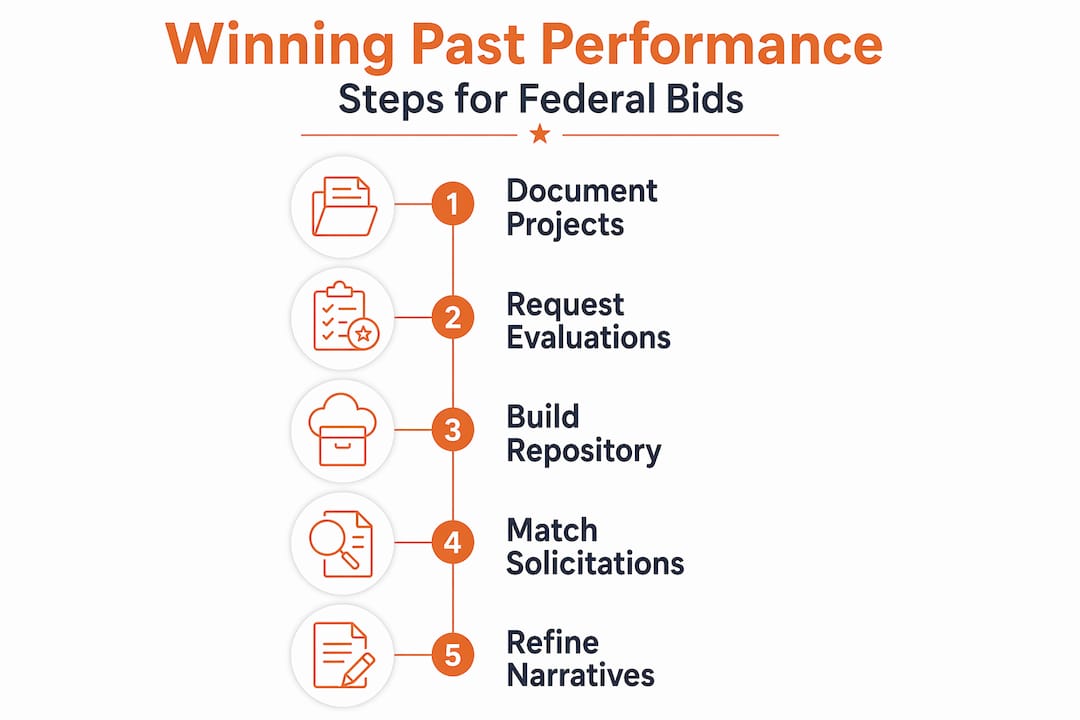
Here is a practical approach to building your past performance foundation:
- Catalog all relevant work from the last five years. Include federal, state, local government, and commercial projects. Flag any projects that involved government funding, public infrastructure, or regulated environments.
- Document subcontractor performance. If you have served as a subcontractor on federal projects, prime contractors can provide documented ratings that build your federal track record.
- Target smaller contracts first. Simplified acquisition threshold procurements typically carry less past performance weight, making them ideal entry points to build CPARS ratings.
- Prepare and brief your references in advance. Contact your references before you submit a proposal. Walk them through the solicitation requirements so their answers align with the specific evaluation criteria, not just generic praise.
- Build a past performance library. Maintain a living document with project sheets for each reference: contract value, scope, schedule performance, key challenges, and measurable outcomes. Update it after every project.
Read about getting a federal construction contract for a broader view of what the entry process looks like end to end.
Pro Tip: Neutral ratings keep you in the competition, but they shift the burden to your technical volume and price. If your past performance section is thin, invest more time in your technical approach narrative to compensate.
How the 2026 Executive Order changes the equation
The April 2026 Executive Order mandating fixed-price and performance-based contracts as the government default is not a minor policy shift for construction firms. It is a structural change that directly amplifies why past performance counts in contracts. Under firm-fixed-price terms, maximum cost and schedule risk falls on the contractor. If you underestimate a project, the loss is yours.
Evaluators are acutely aware of this. When they review your past performance under this new framework, they are asking a specific question: has this contractor demonstrated the cost discipline and schedule management to absorb that risk without project failure?
“The shift to fixed-price contracts forces contractors to demonstrate strong performance and cost discipline in past work to win awards.” — JD Supra, 2026
Here is how past performance narratives should respond to this change:
| Past Performance Element | What Evaluators Look For Now |
|---|---|
| Budget performance | Proof you delivered at or under contract price on similar scope |
| Schedule management | On-time completion rates, especially on multi-phase projects |
| Scope change management | Evidence you managed modifications without cost overruns |
| Subcontractor control | Demonstrated oversight that prevented downstream delays |
Contractors need to maintain meticulous performance and cost records for every current project. Those records become your competitive evidence for the next bid. See the architectural due diligence guidance developed for federal officers to understand what reviewers are trained to look for in construction documentation.
Applying past performance strategically in proposals
Knowing your record is strong is one thing. Presenting it in a way that scores well is another. Federal bid evaluation criteria are specific, and your past performance volume needs to map directly to the language in Section M of the solicitation.
Start with a close read of Section M. Every evaluation factor listed there is a signal for what your references and project narratives need to address. If the solicitation emphasizes safety performance and on-time delivery, your project write-ups should lead with those data points, not bury them.
- Select projects by relevance, not prestige. A $1.5M renovation of a federal office building is often more relevant than a $10M private commercial project if the solicitation is for facility maintenance work.
- Structure each project narrative around three elements: the challenge you faced, the specific actions your team took, and the measurable results. Evaluators seek proven outcomes aligned with solicitation requirements, not just a list of completed contracts.
- Align your narrative with your CPARS ratings. Inconsistencies between your story and official ratings degrade evaluator trust quickly. If a CPARS rating is lower than expected, address it directly and explain the corrective actions taken.
- Review CPARS records before submission. You have 14 calendar days after CPARS notification to submit a rebuttal or comment. Use that window. An unrebutted marginal rating follows you into every future evaluation.
Pro Tip: Create a master past performance repository with at least eight to ten project profiles ready to deploy. When a new solicitation drops, you pull the three to five most relevant profiles rather than writing new ones under deadline pressure.
My perspective on what actually moves the needle
I have reviewed dozens of past performance volumes submitted by construction firms, and the pattern that holds is consistent. The proposals that score highest are not from contractors with the longest federal history. They are from contractors who know how to tell a performance story that directly answers the agency’s fear: “Will this firm make my project a problem?”
What I have learned is that agencies do not expect perfection. They expect accountability. A firm that had a subcontractor default mid-project, documented the recovery plan, brought the project in two weeks late but under budget, and retained a Satisfactory CPARS rating is a better candidate than a firm claiming zero issues on every project with no supporting detail.
The mistake I see most often is generic project descriptions. “Completed renovation of 40,000 SF federal office building on time and on budget.” That tells an evaluator almost nothing. The version that wins looks like this: “Managed a $3.2M interior renovation of a GSA-occupied facility in an active work environment, coordinating 14 subcontractors across 22 months, delivering final punch list acceptance 11 days ahead of schedule and 1.4% under contract value.”
With the fixed-price contracting mandate now in effect, cost discipline history is no longer a nice-to-have. It is table stakes. Firms that have been documenting their project financials rigorously will have a real advantage. Those who have not need to start now, even if the data will only appear in proposals two or three cycles from now.
If you are entering federal contracting without a federal track record, do not underestimate what you have. A well-documented state infrastructure project, a Davis-Bacon compliant commercial job, or a solid subcontractor record on a federal prime can all be structured to compete. The work is in the framing and the documentation. Every credible experience counts if you present it correctly.
— Rowena
How Federal-rconstructionsolutions helps you compete

Building a competitive past performance record requires more than good project work. It requires a documentation strategy, reference management, and proposal writing that speaks directly to federal evaluation criteria. Federal-rconstructionsolutions, through the RCS 5551 Pillar, specializes in exactly this for construction firms. The team helps you identify which projects in your history carry the most weight for specific solicitations, structure compelling narratives that align with Section M criteria, and prepare your references so evaluators hear a consistent story. Whether you are bidding your first federal contract or strengthening an existing record, explore the federal procurement services that have helped construction firms achieve 90% compliance rates on bid submissions and win work they were told they were not ready for.
FAQ
What is past performance in federal contracting?
Past performance refers to a contractor’s record of completing prior contracts successfully, evaluated by federal agencies under FAR 15.304 based on relevance, recency, and results from the last 3 to 5 years.
Can commercial construction work count as past performance for federal bids?
Yes. Commercial, state, and local government projects can be used as past performance evidence if properly documented, provided they demonstrate scope and complexity relevant to the federal solicitation.
What happens if you have no past performance for a federal bid?
Under FAR 15.305(a)(2)(iv), contractors with no relevant past performance receive a neutral rating, which keeps them in the competition but places greater emphasis on their technical approach and price.
How does the 2026 Executive Order affect past performance evaluations?
The April 2026 Executive Order mandating fixed-price contracts as the default means evaluators now scrutinize cost control and schedule management history more closely, since contractors bear maximum financial risk under these contract types.
How do you improve a weak CPARS rating before submitting a bid?
You cannot change a finalized CPARS rating, but you have 14 calendar days after notification to submit a rebuttal or comment. Addressing issues proactively in your proposal narrative and showing corrective actions is the most effective response.