
Construction Market Research for Bidding Explained
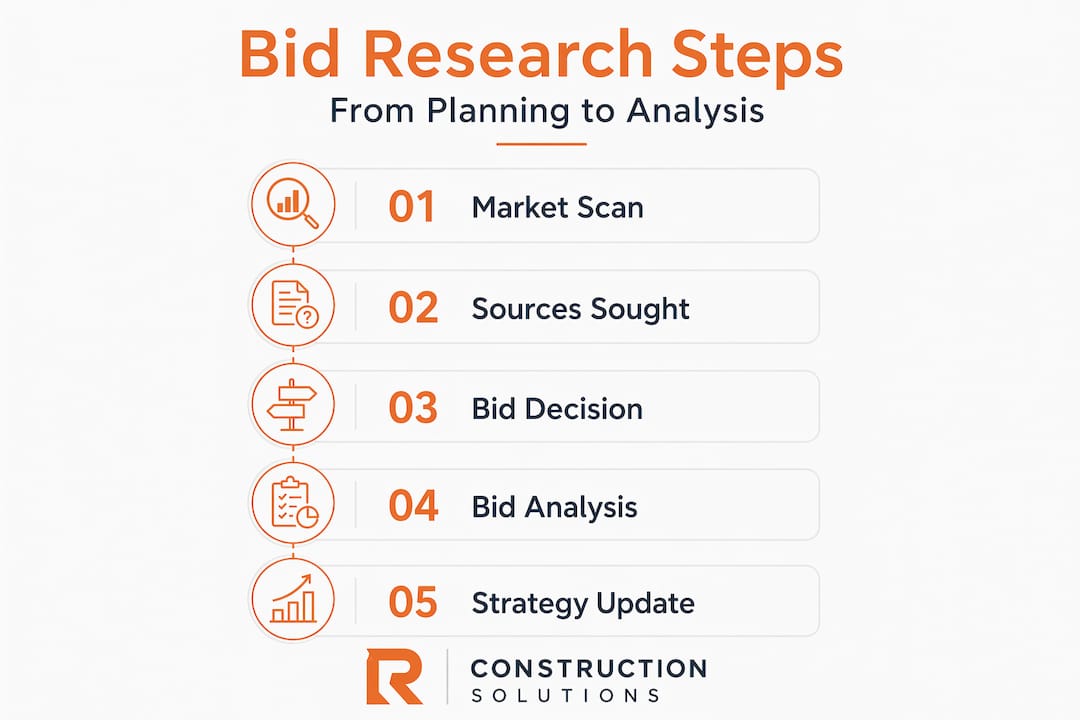
Most contractors lose bids before they ever submit a proposal. The reason is rarely price. Construction market research for bidding, known formally as pre-bid market intelligence, is the structured process of gathering and analyzing data on projects, clients, competitors, and sector trends before committing resources to a bid. Done right, it transforms guesswork into a disciplined pursuit strategy. This article covers the full workflow: federal Sources Sought notices, go/no-go decision frameworks, bid analysis, and forecasting tools that tell you where the real opportunities are.
Table of Contents
- Key Takeaways
- Understanding the construction market research process for bidding
- Building a go/no-go decision framework
- Bid analysis and what it teaches you about your market
- Using market intelligence platforms and forecasting data
- My take on what most contractors get wrong
- How Federal-rconstructionsolutions can support your pursuit strategy
- FAQ
Key Takeaways
| Point | Details |
|---|---|
| Market research precedes solicitations | Begin intelligence gathering before RFPs drop to shape your win strategy proactively. |
| Sources Sought notices matter | Responding to federal notices can influence set-aside decisions and NAICS code assignments in your favor. |
| Go/no-go frameworks protect resources | Weighted scoring criteria prevent teams from wasting time on bids with low win probability or poor margins. |
| Bid analysis sharpens future pricing | Post-bid evaluation of labor rates, overhead, and compliance gaps feeds directly into more accurate future estimates. |
| Sector forecasting guides pursuit planning | Construction spending forecasts and expansion indexes help you target regions and sectors with the strongest pipeline. |
Understanding the construction market research process for bidding
Pre-bid market intelligence is not a single task. It’s a sequential process that runs parallel to your business development cycle, and it covers both federal and private sector opportunities. The goal is to understand demand before a solicitation exists, so you can position your firm rather than react to an RFP at the last minute.
In federal procurement, this process is codified. FAR Part 10 mandates that contracting officers conduct market research before issuing solicitations, which includes publishing Sources Sought notices on SAM.gov. These notices are not contract awards. They are requests for capability information, and your response shapes how the agency structures the eventual procurement.
Here is what a solid market research workflow covers:
- Project pipeline data: Track project types, estimated values, and geographic concentration using platforms like ConstructConnect or Dodge.
- Client and funding verification: Confirm that projects have secured funding and a realistic schedule before investing pursuit time.
- Competitor mapping: Identify which firms are winning in your target sector and geography, and analyze their apparent pricing behavior.
- Regulatory and compliance review: Flag Davis-Bacon Act wage requirements, bonding thresholds, and NAICS code alignment early.
- Sources Sought monitoring: Watch SAM.gov regularly for notices in your NAICS codes, which are the federal classification codes that define your business category.
Sources Sought responses directly impact set-asides, evaluation criteria, and contract types. That means a well-crafted, two-page capability statement submitted weeks before an RFP drops can determine whether the procurement is restricted to small businesses or opens to full competition.
Pro Tip: Set up SAM.gov keyword alerts for your top three NAICS codes and review them every Monday morning. Fifteen minutes of weekly monitoring gives you a consistent edge over firms that only check when a colleague forwards something.
Building a go/no-go decision framework
Responding to every bid you find is one of the most common and costly mistakes in construction. A structured go/no-go framework, sometimes called a bid/no-bid decision matrix, applies scoring criteria to each opportunity before you commit estimating hours, proposal writers, or subcontractor outreach.

Effective frameworks score multiple dimensions with weighted values, and then apply threshold rules. A score of 80 to 100 points might mean GO. A score below 60 means no, regardless of how attractive the contract looks on paper.
Here is a practical sequence for applying the framework:
- Capability fit: Does your firm hold the licenses, certifications, and past performance records required? If the answer is no to any hard requirement, stop here.
- Win probability: Have you worked with this agency or client before? Do you have an incumbent relationship, or are you starting cold?
- Margin and contract terms: What is the realistic profit margin after Davis-Bacon wages, bonding, insurance, and overhead? Are payment terms acceptable?
- Capacity check: Do you have the crew, equipment, and subcontractor relationships available during the contract period of performance?
- Compliance and risk: Does the contract include terms that expose you to unusual liability, liquidated damages, or ambiguous scope?
- Strategic alignment: Does winning this contract open doors to more work in this sector or agency, or is it a one-off that diverts focus?
Hard gate rules are non-negotiable thresholds. If your firm lacks the required bonding capacity or does not hold the relevant security clearance, no score in the other categories compensates for that gap.
Pro Tip: Build a conditional bid category into your framework. If a bid scores 65 to 79, require a mitigation plan before proceeding. This forces your team to identify and address specific weaknesses rather than bidding blind on marginal opportunities.
Bid analysis and what it teaches you about your market
Most firms treat a submitted bid as the end of the process. The smarter move is to treat it as data. Bid analysis, as described in Autodesk’s construction guide, separates evaluation into two distinct tracks: technical compliance and commercial pricing.
The table below illustrates how these two tracks differ in focus and what each reveals:
| Evaluation track | Key factors examined | What it tells you |
|---|---|---|
| Technical compliance | Scope interpretation, spec adherence, qualifications | Whether your team reads and executes requirements accurately |
| Commercial pricing | Unit prices, labor rates, overhead allocation, margin | Where your pricing is competitive, high, or unrealistically low |
| Post-qualification checks | References, bonding capacity, financial standing | Whether your firm clears the baseline threshold to perform |
Understanding why you won or lost a bid requires access to the right data. On federal contracts, you can request a debrief after award. This debrief tells you how evaluators scored your technical submission and whether your price was within the competitive range. On private jobs, post-bid conversations with the owner or general contractor often reveal similar insights if you ask directly.
The real value of bid analysis is cumulative. After three to five cycles, patterns emerge. You may discover that your labor rates run 8% above market in a specific trade, or that your overhead allocation consistently pushes total price out of range on smaller contracts. These patterns feed directly back into your market research process, refining both your cost model and your pursuit criteria.
One underestimated factor is client viability signals. Contractors who invest time in bids for projects that never break ground lose real money. Verifying funding status, permit approvals, and owner financial health before bidding reduces that exposure significantly.
Using market intelligence platforms and forecasting data
Knowing where to bid is as important as knowing how to bid. Construction market intelligence platforms aggregate project data by geography, sector, and project type, letting you analyze your pipeline relative to your crew capacity and profit targets.
The macro numbers back up the case for data-driven pursuit planning. U.S. construction spending is forecast at $2.27 trillion in 2026, with nonresidential building outpacing residential growth. Private office construction and data center work are two of the fastest-moving segments. If your firm has relevant experience in either, those sectors deserve a dedicated pursuit lane.
| Sector | 2026 trend signal | Opportunity type |
|---|---|---|
| Data centers | Rapid growth driven by private investment | New construction, MEP, site work |
| Nonresidential buildings | Outpacing residential in dollar volume | General contracting, specialty trades |
| Public infrastructure | Steady federal and state funding | Federal contracts, IDIQ vehicles |
| Residential | Slower growth relative to nonresidential | Subcontracting, multifamily |
Regional signals matter just as much as sector trends. ConstructConnect’s May 2026 Expansion Index reports a 48% year-over-year increase in ideated construction investment across all verticals, with more than 34 states recording investment growth above 20%. That is a strong indicator that bid volume will remain elevated across a wide geographic spread for the near term.
The practical application is straightforward. Pull project pipeline data for your target region and filter by project type and estimated value range. Compare that pipeline against your current backlog and crew availability. The gap between your capacity and the available pipeline tells you exactly how aggressively to pursue and in which sectors. Firms that adjust pursuit strategies based on current market conditions consistently outperform those working from last year’s assumptions.
My take on what most contractors get wrong
I’ve spent years watching construction firms leave federal contracts on the table not because of price, but because they treated market research as something you do after the RFP drops. That backwards approach puts you permanently in reactive mode. By the time a solicitation is public, the agency has already formed opinions about the market, the ideal contract structure, and which firms they expect to see respond.
The contractors I’ve seen win consistently do one thing differently. They respond to Sources Sought notices early and treat each response as a capability conversation, not a proposal. When the Rule of Two applies, meaning an agency only needs two capable small businesses to respond to set a contract aside, a single well-timed response can determine whether you compete in a restricted pool or a full-and-open field with 40 other firms.
Go/no-go discipline is the other piece most firms skip. I’ve watched teams spend 200 hours on a proposal for a contract they had a 15% win probability on because no one wanted to say no. That’s 200 hours that could have gone toward an opportunity with a 60% win rate. The framework is not a bureaucratic exercise. It’s how you protect your team’s time and your company’s cash flow.
The firms that integrate market forecasting data, go/no-go rigor, and federal market research into a repeatable process are the ones building backlogs. The ones who skip this work are bidding hard and winning randomly.
— Rowena
How Federal-rconstructionsolutions can support your pursuit strategy
You now have a clear picture of what construction market intelligence requires and how a disciplined process leads to more consistent wins. Putting that process in place takes time, tools, and experience navigating both federal and private sector procurement cycles.
Federal-rconstructionsolutions, through the RCS 5551 Pillar, supports construction firms at every stage of that process. From federal procurement services that include RFP writing and FAR compliance review, to private sector bidding support designed to add 30% more revenue consistency, the team brings proven results to firms that are ready to bid smarter. If you want to stop reacting to solicitations and start shaping them, the right starting point is a conversation with a team that has done it before.
FAQ
What is construction market research for bidding?
Construction market research for bidding, formally called pre-bid market intelligence, is the process of gathering data on project pipelines, clients, competitors, and sector trends before deciding whether and how to pursue a contract. It informs both bid/no-bid decisions and proposal strategy.
How do Sources Sought notices affect federal bidding strategy?
Sources Sought notices are published on SAM.gov before solicitations and allow contractors to demonstrate capability early, influencing whether a contract is set aside for small businesses under the Rule of Two.
What should a go/no-go decision framework include?
A solid framework scores capability fit, win probability, margin, capacity, compliance risk, and strategic alignment, with weighted thresholds that create a clear GO, conditional, or no-bid outcome.
Why does bid analysis improve future market research?
Post-bid analysis reveals pricing gaps, compliance weaknesses, and evaluation patterns that refine both your cost model and your pursuit criteria for future opportunities.
Which construction sectors offer the most bidding opportunity in 2026?
Nonresidential buildings and data center construction are leading growth categories, with total U.S. spending forecast at $2.27 trillion in 2026 and private office construction driving significant new work volume.