
Bid-No Bid Decision Guide for Federal Contractors
A bid-no bid decision in construction projects is the formal process contractors use to evaluate whether pursuing a specific federal contract is worth the time, cost, and risk before committing estimating resources. The industry standard term for this process is the “go/no-go decision,” and both terms are used interchangeably across federal procurement circles. A single mid-value public sector bid requires 40–120 hours of skilled staff time. That figure alone explains why undisciplined bidding destroys margins. Contractors who apply a structured bid or no bid process consistently outperform those who chase every opportunity, with selective pipelines achieving win rates of 40–50% compared to 10–15% for indiscriminate bidders.
What key criteria should drive your bid-no bid decision?
Every federal construction bid evaluation starts with three categories: strategic fit, capacity, and risk. Skipping any one of them produces a flawed decision.
Strategic Fit

Strategic fit measures how well the project aligns with your firm’s core strengths, geographic reach, and client relationships. Federal agencies like the U.S. Army Corps of Engineers (USACE) and the Department of Transportation (DOT) award contracts to firms with demonstrated past performance in specific project types. If your firm specializes in water infrastructure and the solicitation covers vertical construction, that misalignment is a disqualifier regardless of contract value. Reviewing your past performance record before scoring any bid is not optional. It is the foundation of your strategic fit assessment.
Capacity and Resources
Capacity covers estimating staff availability, bonding limits, subcontractor relationships, and equipment. A firm that is already running three active federal projects at 80% bonding capacity cannot absorb a fourth without real financial exposure. Assess your current backlog honestly before scoring any new opportunity.
Risk Factors Specific to Federal Bids
Federal projects carry compliance layers that private sector work does not. Key risk factors include:
- Davis-Bacon Act compliance: Federal contracts require wage determinations verified through the Department of Labor’s official database. Misclassified trades can generate back pay liability exceeding $100,000 per project.
- Contract terms: Federal Acquisition Regulation (FAR) clauses, liquidated damages provisions, and differing site conditions language all affect risk exposure.
- Project complexity: Phased construction, occupied facilities, and environmental restrictions add schedule risk.
- Client relationship: A prior relationship with the contracting officer or agency reduces uncertainty and improves your ability to ask clarifying questions.
Scoring Thresholds
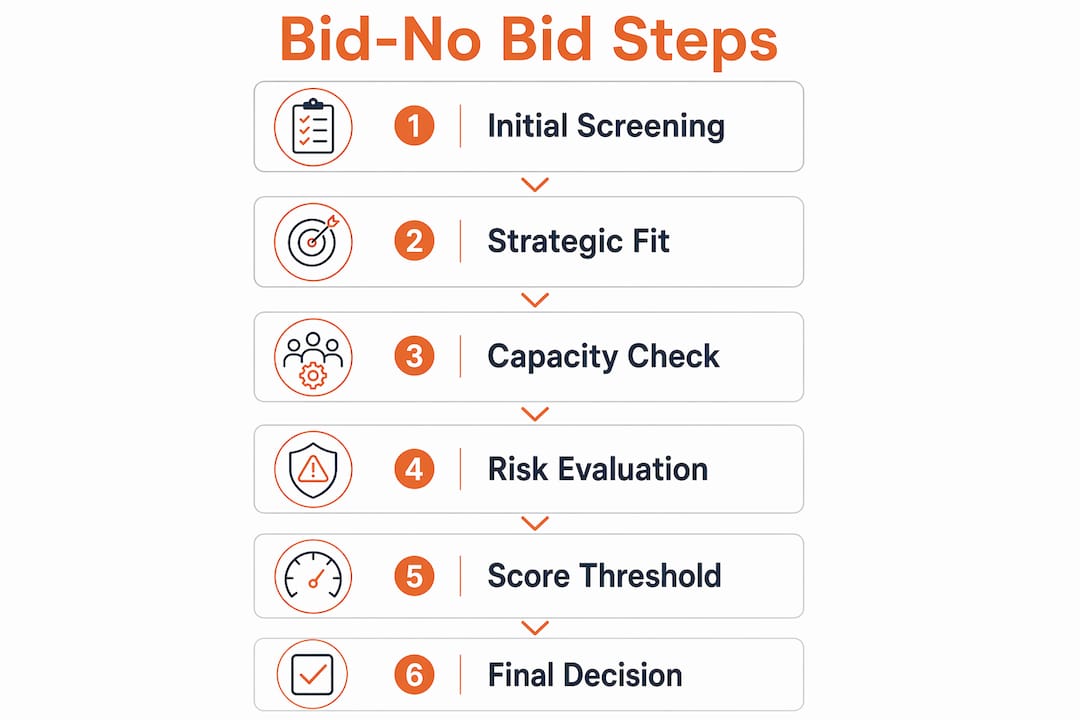
A weighted scoring matrix with defined thresholds removes subjectivity from the process. The standard industry benchmark works as follows: scores below 2.5 trigger an automatic no-bid, scores between 2.5 and 3.4 require executive review, and scores above 3.5 authorize pursuit. That structure forces your team to quantify gut feelings and defend them with data.
How do scoring matrices create consistent bid decisions?
A weighted scoring matrix assigns numerical weights to each evaluation criterion based on its importance to your firm’s strategy. For example, a federal contractor might weight client relationship at 25%, project type fit at 20%, bonding capacity at 20%, risk profile at 20%, and geographic location at 15%. Each criterion receives a score of 1–5, multiplied by its weight, and the totals are summed for a composite score.
| Criterion | Weight | Score (1–5) | Weighted Score |
|---|---|---|---|
| Client relationship | 25% | 4 | 1.00 |
| Project type fit | 20% | 3 | 0.60 |
| Bonding capacity | 20% | 5 | 1.00 |
| Risk profile | 20% | 2 | 0.40 |
| Geographic location | 15% | 4 | 0.60 |
| Total | 100% | 3.60 |
A composite score of 3.60 in this example clears the 3.5 threshold and authorizes pursuit. The matrix also tells you where the weaknesses are. A low risk profile score at 0.40 signals that your bid team needs to address specific risk mitigation strategies before submission.
Calibrating the Matrix Over Time
The matrix only improves when you feed it real data. After each bid cycle, record your score alongside the outcome: win, loss, or no-bid. Over 12–18 months, patterns emerge. You will likely find that projects scoring below 3.0 rarely convert to wins, which validates tightening your threshold. Tools like Bid Track help contractors manage multiple scoring records and track bid pipeline performance across federal opportunities.
Automatic Disqualifiers
Certain conditions should trigger an immediate no-bid regardless of the composite score. These include: bonding capacity already at maximum, no qualified subcontractors available for major trades, active disputes with the contracting agency, and solicitation timelines that do not allow adequate bid preparation.
Pro Tip: Calibrate your scoring matrix weights every six months using your actual win/loss data. If you consistently win projects that score 3.2 but lose those that score 3.8, your weights are misaligned with reality.
What strategic benefits come from stricter bid selectivity?
Tighter bid selectivity produces measurable financial results. Raising go/no-go criteria increases net profit margins by 3–5 percentage points without adding estimating staff. That improvement comes from concentrating your best people on the bids most likely to win at acceptable margins.
Contractors who focus on fewer, well-understood project types report 15–25% higher win rates with no price reduction. The explanation is straightforward: deeper familiarity with a project type produces more accurate estimates, sharper scopes, and stronger technical proposals. Federal evaluators notice the difference between a generic proposal and one written by a contractor who clearly knows the work.
“Declining projects outside firm expertise is a strategic win that preserves resources for better-fit opportunities.” — Bid/No-Bid Decision Framework
Common Mistakes That Undercut Selectivity
- Bidding projects to “keep the estimating team busy” rather than to win
- Pursuing large contracts outside your firm’s NAICS code experience to grow quickly
- Ignoring geographic constraints that inflate mobilization costs and reduce competitiveness
- Treating every federal solicitation as equally worth pursuing because it appears on SAM.gov
The firms that grow sustainably in federal markets understand that bid volume does not equal growth. Profitability and team morale both improve when your estimators work on projects your firm can actually execute well.
How to apply subcontractor coordination and compliance checks
Subcontractor management and compliance verification are not administrative tasks. They are risk management activities that directly affect your bid accuracy and legal exposure on federal projects.
Follow this sequence during bid preparation:
- Identify major trades early. Within 48 hours of deciding to pursue, list every trade that represents more than 10% of estimated project cost. These are your critical subcontractor categories.
- Solicit multiple quotes per trade. Requiring multiple subcontractor bids for major trades improves cost accuracy and sharpens your competitive pricing. A single quote from one sub is not a price. It is a placeholder.
- Confirm scopes in writing. Locking subcontractor scopes in writing before finalizing your bid prevents disputes that cost $15,000–$40,000 per project. Verbal agreements do not hold up when a sub claims they excluded a specific line item.
- Verify Davis-Bacon wage determinations. Pull the applicable wage determination from the Department of Labor’s SAM.gov-linked database for every federal bid. Confirm that each trade classification matches the work description in the solicitation. Misclassification is the most common and most expensive compliance error on federal projects.
- Confirm bonding and insurance capacity. Verify that your surety can issue the required performance and payment bonds for this specific contract value before you submit. Do not assume capacity based on prior projects.
- Document all compliance checks. Maintain a written record of every verification step. Federal contracting officers and inspectors can request compliance documentation at any point during contract performance.
Pro Tip: Request a written scope confirmation from every subcontractor quoting more than $50,000 in work. Include a simple one-page scope summary and ask them to sign and return it before you use their number in your bid.
What is the ideal workflow for federal bid-no bid decisions?
The go/no-go decision must be finalized within 24–48 hours of receiving the solicitation. Early decisions preserve your ability to submit clarification questions to the contracting officer, engage subcontractors while they still have capacity, and influence project requirements before the solicitation closes. Waiting until day 10 of a 21-day solicitation window to decide whether to bid is a structural disadvantage.
Recommended Workflow
- Day 1: Opportunity receipt and initial screening. Review the solicitation for scope, NAICS code, bonding requirements, and submission deadline. Flag any automatic disqualifiers.
- Day 1–2: Scoring matrix completion. Assign scores across all weighted criteria. Present the composite score to the principal or project executive for a go/no-go authorization.
- Day 2–3: Subcontractor invitations. Issue requests for quotes to at least two qualified subs per major trade. Include the scope summary and the submission deadline.
- Day 3–10: Bid development. Assign the estimating lead, begin quantity takeoffs, and draft the technical proposal sections in parallel.
- Day 10–14: Compliance review. Verify Davis-Bacon wage rates, confirm bonding capacity, and review all FAR clause requirements.
- Day 14–20: Final assembly and review. Compile subcontractor quotes, finalize pricing, and conduct an internal price review before submission.
| Phase | Timeline | Key Output |
|---|---|---|
| Initial screening | Day 1 | Disqualifier check complete |
| Scoring and authorization | Day 1–2 | Go/no-go decision documented |
| Subcontractor invitations | Day 2–3 | RFQs issued to qualified subs |
| Bid development | Day 3–10 | Estimate and technical draft |
| Compliance review | Day 10–14 | Davis-Bacon and FAR verified |
| Final submission | Day 14–20 | Bid submitted on time |
Reviewing your common federal bidding mistakes before starting this workflow helps you avoid the errors that most often derail otherwise competitive bids. Avoiding the sunk cost fallacy is equally critical. If a bid scores poorly at day 2 but your team has already invested 20 hours, the correct decision is still no-bid. Throwing good hours after bad does not improve your win probability.
Key takeaways
A disciplined bid-no bid decision process in federal construction projects is the single most reliable way to raise win rates and protect margins without adding estimating staff.
| Point | Details |
|---|---|
| Score every opportunity | Use a weighted matrix with thresholds below 2.5 for no-bid and above 3.5 to pursue. |
| Decide within 48 hours | Early go/no-go decisions preserve clarification rights and subcontractor availability. |
| Lock subcontractor scopes | Written scope confirmations before bid submission prevent disputes costing $15,000–$40,000. |
| Verify Davis-Bacon compliance | Misclassified trades on federal projects can generate back pay liability above $100,000. |
| Selectivity raises margins | Tighter bid criteria increase net profit margins by 3–5 points without additional staff. |
The discipline most contractors learn too late
By Rowena
After working with federal contractors across USACE, DOT, and GSA project categories, the pattern I see most often is this: firms that struggle with profitability are not bad at construction. They are bad at saying no.
The sunk cost problem is real and it is expensive. I have watched estimating teams spend 80 hours on a bid they knew on day three was a poor fit, simply because stopping felt like admitting failure. That thinking costs firms hundreds of thousands of dollars per year in misdirected labor. The go/no-go decision is not a bureaucratic checkpoint. It is the moment where discipline either exists or it does not.
What I have found actually works is treating the scoring matrix as a non-negotiable step, not a suggestion. Firms that require a documented score before any estimating hours are logged report better morale, sharper bids, and fewer losses on projects they should never have pursued. The federal bidding environment is only getting more competitive. Agencies are issuing more performance-based solicitations, and evaluators are scrutinizing past performance records more carefully than ever. Contractors who understand why underbidding happens and address it structurally will outperform those who rely on instinct alone. Selectivity is not timidity. It is the most profitable strategy available to a federal contractor.
— Rowena
How Federal-rconstructionsolutions supports your bid strategy
Federal-rconstructionsolutions brings specialized federal procurement expertise to contractors who want a structured, repeatable bid evaluation process without building it from scratch.
The RCS 5551 Pillar team supports contractors pursuing USACE, DOT, and other federal agency contracts with federal procurement services that cover RFP analysis, compliance verification, and bid strategy development. For contractors who need help identifying and evaluating opportunities before the scoring stage, ConstructConnect bid support provides lead generation and project evaluation tools calibrated to your firm’s profile. Federal-rconstructionsolutions also assists with MBE and WBE certification to strengthen your competitive positioning on set-aside and small business federal solicitations. Contact Federal-rconstructionsolutions to build a bid evaluation process that protects your margins and improves your win rate on the projects that actually fit your firm.
FAQ
What is a bid-no bid decision in construction?
A bid-no bid decision is the formal process a contractor uses to evaluate whether a specific project is worth pursuing before committing estimating resources. The process typically uses a weighted scoring matrix to assess strategic fit, capacity, and risk.
How long does a federal construction bid typically take to prepare?
A mid-value federal construction bid requires 40–120 hours of skilled staff time. That resource commitment makes the go/no-go decision one of the highest-leverage choices a contractor makes.
What score should trigger a no-bid on a federal project?
Industry practice sets the no-bid threshold at composite scores below 2.5 on a weighted scoring matrix. Scores between 2.5 and 3.4 require executive review before authorizing pursuit.
How does davis-bacon compliance affect bid decisions?
Davis-Bacon wage determinations are mandatory on federal construction contracts, and misclassified trades can generate back pay liability exceeding $100,000. Verifying wage rates during the bid evaluation stage is a required compliance check, not an optional one.
When should a contractor decide to bid on a federal project?
The go/no-go decision should be finalized within 24–48 hours of receiving the solicitation. Early decisions allow time for subcontractor engagement, clarification questions, and thorough bid development.