
Private Sector Bid Solicitation Process for Contractors
Many construction contractors assume the private sector bid solicitation process is simpler than public bidding. Submit a number, win the job. That assumption costs firms real contracts. In practice, private sector solicitation, formally known as private procurement, involves structured evaluation phases, weighted scoring criteria, and strict administrative protocols that can eliminate even the strongest proposals before an evaluator reads a single page. This article breaks down the stages, compliance requirements, and strategic positioning tactics you need to win in today’s competitive private bidding environment.
Table of Contents
- Key takeaways
- Understanding the private sector bid solicitation process
- Administrative compliance: the first cutoff
- Strategic proposal development that wins
- Managing your bid timeline effectively
- Private vs. public sector solicitation: key differences
- My take on what contractors consistently get wrong
- How Federal-rconstructionsolutions helps you win more bids
- FAQ
Key takeaways
| Point | Details |
|---|---|
| Two-stage process is standard | Most larger private projects filter firms through RFQ before inviting full RFP submissions. |
| Price alone does not win bids | Owners score qualifications, team, approach, and schedule alongside cost in weighted evaluations. |
| Compliance is the first cutoff | Administrative failures in formatting or structure disqualify bids before evaluators review content. |
| Prequalification readiness pays off | Keeping financials, safety records, and references current accelerates your ability to respond and win. |
| Calendar discipline is non-negotiable | Missing question deadlines or submitting late ends your bid regardless of proposal quality. |
Understanding the private sector bid solicitation process
The term “bid solicitation” in private construction refers specifically to the formal process an owner uses to invite, evaluate, and award contracts to contractors. It is not a casual price request. The process typically moves through two distinct phases, and understanding both is critical before you invest time in any proposal.
The first phase is the Request for Qualifications (RFQ). Owners use the RFQ to filter the field down to a shortlist of capable firms. At this stage, you are not pricing the job. You are demonstrating experience, financial stability, safety performance, and team credentials. Larger projects typically use RFQ filtering to limit full proposal effort to a small group of shortlisted firms, which protects both the owner and the bidding contractors from wasted resources.
The second phase is the Request for Proposals (RFP). Once shortlisted, your firm submits a full proposal covering technical approach, project schedule, team assignments, quality and safety plans, and cost. Critically, owners score qualifications, team, approach, and schedule alongside cost using a weighted scoring model. Price often accounts for only 20 to 30 percent of the total evaluation score on larger projects. This is where private sector bidding fundamentally differs from what many contractors expect.
Two-phase procurement like the design-build services RFP used by PBC Chicago treats Phase I as a paper interview. Your technical and team qualifications must be sufficiently complete and compelling to survive initial selection before your cost is ever reviewed. You should track four key dates in any solicitation: the pre-proposal conference date, the question submission deadline, the addenda release date, and the final submission deadline.
Pro Tip: Build a bid calendar the day you download a solicitation document. Log every deadline immediately and work backward to assign internal due dates for each section.
Administrative compliance: the first cutoff
Here is a reality that eliminates more strong proposals than any other factor. Evaluators run an administrative compliance check before they read your content. If your submission does not follow the prescribed document structure, your bid is disqualified. Not penalized. Disqualified.

This is not a technicality. Improper section ordering or missing elements cause elimination at the first review stage. Evaluators use the solicitation’s prescribed structure to locate specific information quickly. When that structure is absent or reordered, your bid is flagged as non-responsive regardless of how strong your qualifications are.
Follow these steps to protect your submission from administrative failure:
- Download and read the full solicitation document before writing a single word. Note every required section, required format (font size, page limits, file type), and certification or attachment called out in the bid submission requirements.
- Build a compliance matrix. Create a spreadsheet with every solicitation requirement in column one and your response location in column two. Internal compliance matrices help teams track section-by-section coverage and catch gaps before submission.
- Check certifications and attachments separately. Insurance certificates, bonding letters, safety statistics, and signed acknowledgment forms are common knockout items. Treat them as a separate checklist from your written proposal.
- Confirm file naming conventions and upload formats. Many e-procurement portals reject submissions with incorrect file names or formats. Early platform registration and test uploads are the only reliable protection against technical submission failures.
- Have someone who did not write the proposal conduct the final compliance review. Writers become blind to their own structure. A fresh reviewer catches missing sections that the writer assumed were included.
Pro Tip: Print the table of contents from the solicitation document and use it as a physical checklist when assembling your final submission package. Do not rely on memory.
For additional guidance on specific compliance checks within construction-related submissions, the architectural compliance checks framework provides a useful model for structuring your internal review process.
Strategic proposal development that wins
Treating an RFP like a price-only bid is the single most common strategic error in private sector bidding. Many contractors miss the importance of demonstrating qualifications and approach in detail, focusing almost entirely on their bottom-line number. That approach fails in weighted evaluations.
Winning the qualitative sections requires deliberate strategy across several dimensions:
- Respond to the owner’s stated priorities, not your own strengths. Read the evaluation criteria section carefully. If the solicitation weights schedule reliability at 25 percent, your proposal must address schedule management with specific examples, tools, and team accountability structures. Generic descriptions of your general capabilities do not score points.
- Use relevant project examples with quantified outcomes. “Completed on time” is weak. “Delivered a 47,000 square foot warehouse 12 days ahead of schedule with zero change orders” is specific and credible. Evaluators remember numbers.
- Address risk mitigation explicitly. Owners fear cost overruns, schedule slippage, and safety incidents. A dedicated risk section that identifies project-specific risks and your mitigation plan for each one demonstrates maturity and builds owner confidence.
- Present your team with purpose. Include short, focused bios for key personnel that directly connect their experience to this specific project. A project manager with three relevant completed projects in the same building type is more compelling than a resume listing years of general experience.
- Submit questions within the solicitation window. Failing to engage early during the question period risks bid rejection due to assumptions built into your proposal that contradict the owner’s actual intent. Questions also signal your seriousness and engagement to the issuing owner.
Understanding why some firms consistently underbid construction projects reveals a pattern: they focus on cost reduction instead of value demonstration. The private procurement strategies that consistently win do both.
Managing your bid timeline effectively
A structured timeline separates firms that win from firms that scramble. The typical private sector bidding window runs three to six weeks from solicitation release to submission deadline, though design-build RFPs with technical components often extend to eight weeks or more.
- Register on the submission portal within 24 hours of discovering the solicitation. Portals often require email verification, organizational setup, and sometimes approval from the issuing owner. Registration problems discovered the day before submission are unrecoverable.
- Set your internal submission deadline 48 hours before the actual deadline. This buffer absorbs printing issues, file size problems, last-minute reviewer feedback, and upload errors. Question deadlines and final submission cutoffs in structured solicitations are enforced without exception.
- Assign section owners on day one. Each section of your proposal needs a named person responsible for its completion. Unassigned sections are the ones that get done the night before submission.
- Monitor the solicitation portal for addenda daily. Owners issue addenda to clarify requirements, correct errors, or adjust deadlines. Missing an addendum can mean your proposal is based on superseded information, which is a grounds for non-responsive determination.
- Prepare standard documents in advance and keep them current. Financials, insurance certificates, safety logs (EMR rates), bonding capacity letters, NAICS code documentation, and key personnel resumes should exist as a ready-to-assemble package before any solicitation hits. Maintaining prequalification-ready documents dramatically reduces your response time and improves the quality of your RFQ submissions.
Private vs. public sector solicitation: key differences
Knowing which set of rules governs your bid shapes everything from your proposal tone to your evaluation strategy. The differences between private and public sector solicitation are significant, and they affect how you should allocate proposal development time.
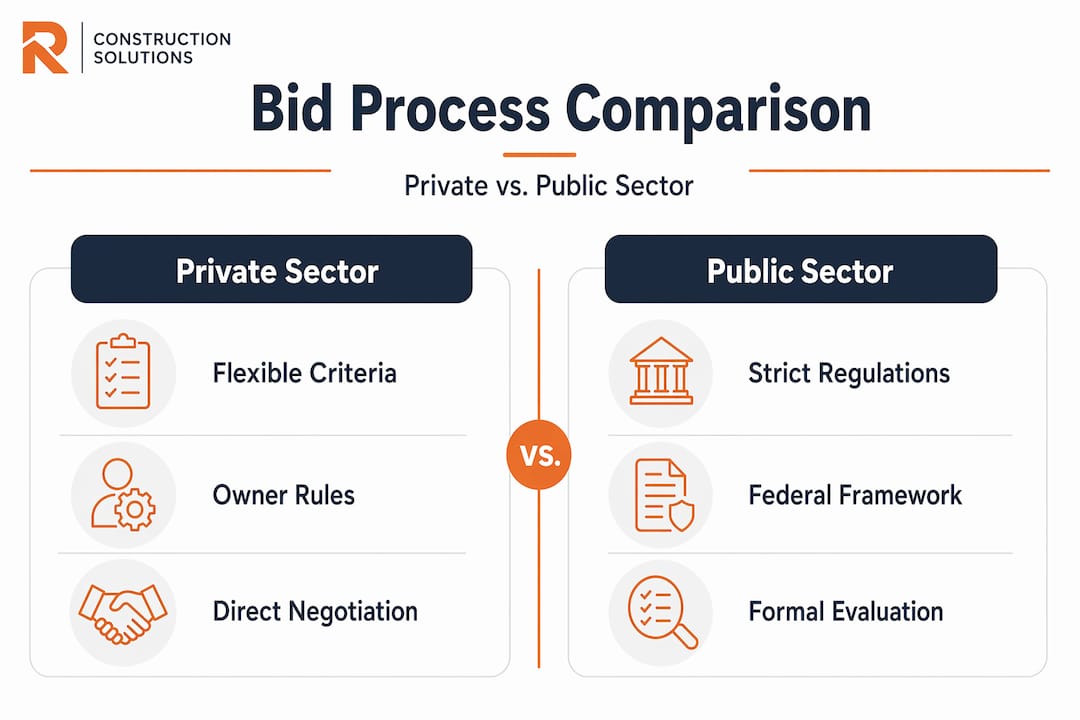
Private owners can set their own rules and criteria, contrasting with public bids that operate under strict federal and state regulations. This means private solicitations vary more widely in structure, evaluation rigor, and award criteria. It also means you cannot assume any two private solicitations work the same way. Read every document fresh.
| Feature | Private sector | Public sector |
|---|---|---|
| Regulatory framework | Owner-defined rules | Governed by FAR, state procurement codes |
| Evaluation method | Weighted qualitative and cost criteria | Often sealed, price-driven |
| Award flexibility | Owner discretion on best value | Typically lowest responsive bidder |
| Transparency | Limited; owner controls disclosure | High; public record requirements apply |
| Process consistency | Varies by owner and project type | Standardized by jurisdiction |
| Contractor considerations | Tailor proposals to owner priorities | Focus on compliance and pricing accuracy |
Pro Tip: When shifting from public to private sector bidding, resist the impulse to write proposals in the compliance-heavy style common to federal submissions. Private owners typically prefer concise, direct responses that demonstrate understanding of their specific project over bureaucratic documentation.
My take on what contractors consistently get wrong
I’ve worked with construction firms at every stage of the bid process, and the pattern that concerns me most is how routinely contractors underestimate private sector solicitation complexity. The assumption that private means informal is genuinely damaging.
What I’ve seen most often is this: a firm submits an excellent proposal, strong team, real experience, competitive pricing. Then they get eliminated in the first round because they put their cover letter where the executive summary was supposed to go. Or they missed that the solicitation required a separate cost envelope. These are not small errors. They are fatal ones, and they happen because contractors treat administrative compliance as a formality rather than a gate.
The other thing I’ve learned from direct experience is that prequalification readiness separates high-volume bidders from occasional participants. The firms that win consistently keep their document packages current year-round. When an RFQ drops, they respond in days, not weeks. That speed signals to owners that you are organized, capable, and serious. The firms that scramble to assemble financials and resumes every time a solicitation appears are already behind.
Proactive calendar discipline and a genuine effort to understand what the owner actually values in evaluation criteria will outperform last-minute pricing adjustments every time. If you only read the cost section of an RFP, you are reading the wrong section first.
— Rowena
How Federal-rconstructionsolutions helps you win more bids
Winning in private sector construction requires more than reading a solicitation. It requires proposal strategy, compliance systems, and a team that knows how evaluation scoring actually works.
Federal-rconstructionsolutions delivers exactly that support. Through the RCS 5551 Pillar program, contractors gain access to RFP writing expertise, compliance frameworks, and procurement strategy built for both federal and private markets. Clients consistently achieve 90% compliance rates on bid submissions, and firms that expand into private sector construction through RCS report 30% more consistent revenue and 20% higher overall profitability. If you are ready to stop guessing and start winning, connect with Federal-rconstructionsolutions for a strategy consultation tailored to your firm.
FAQ
What is the private sector bid solicitation process?
The private sector bid solicitation process is the formal method private owners use to invite, evaluate, and award construction contracts. It typically includes an RFQ phase for qualifications screening followed by an RFP phase for full technical and cost proposals.
How does private sector bidding differ from public sector bidding?
Private sector bidding allows owner discretion on rules, criteria, and award decisions, while public sector bids are governed by strict regulations like the FAR and typically favor the lowest responsive price. Private evaluations place greater weight on qualifications and approach.
What are the most common reasons bids get disqualified?
Administrative non-compliance is the leading cause, including incorrect document structure, missing certifications, and late submissions. Improper section ordering or missing required elements can eliminate a bid before evaluators review its content.
How should contractors prepare for a two-stage RFQ/RFP process?
Maintain a prequalification-ready document package including current financials, safety records, and personnel resumes. Respond to the RFQ with precision, then use the shortlisting window to develop a tailored, criteria-specific full proposal for the RFP phase.
Why does price alone rarely win private construction contracts?
Because private owners use weighted scoring that evaluates team credentials, methodology, schedule reliability, and risk management alongside cost. Owners score qualifications and approach as part of a best-value determination, not simply a lowest-price selection.