
Why Small Contractors Lose Their First Federal Bid
Small contractors lose their first federal bid primarily because their proposals are legally nonresponsive, not because their pricing is too high or their technical approach is weak. Noncompliance with solicitation amendments and SBA eligibility requirements disqualifies bids before evaluators ever review technical merit or cost. The Federal Acquisition Regulation (FAR), Government Accountability Office (GAO) rulings, and 2026 Small Business Administration (SBA) enforcement actions all confirm this pattern. If you are preparing your first federal bid, understanding these compliance traps is the single most important step you can take. Reviewing common federal bidding mistakes before you submit can save months of wasted effort.
Why small contractors lose first federal bid: the amendment trap
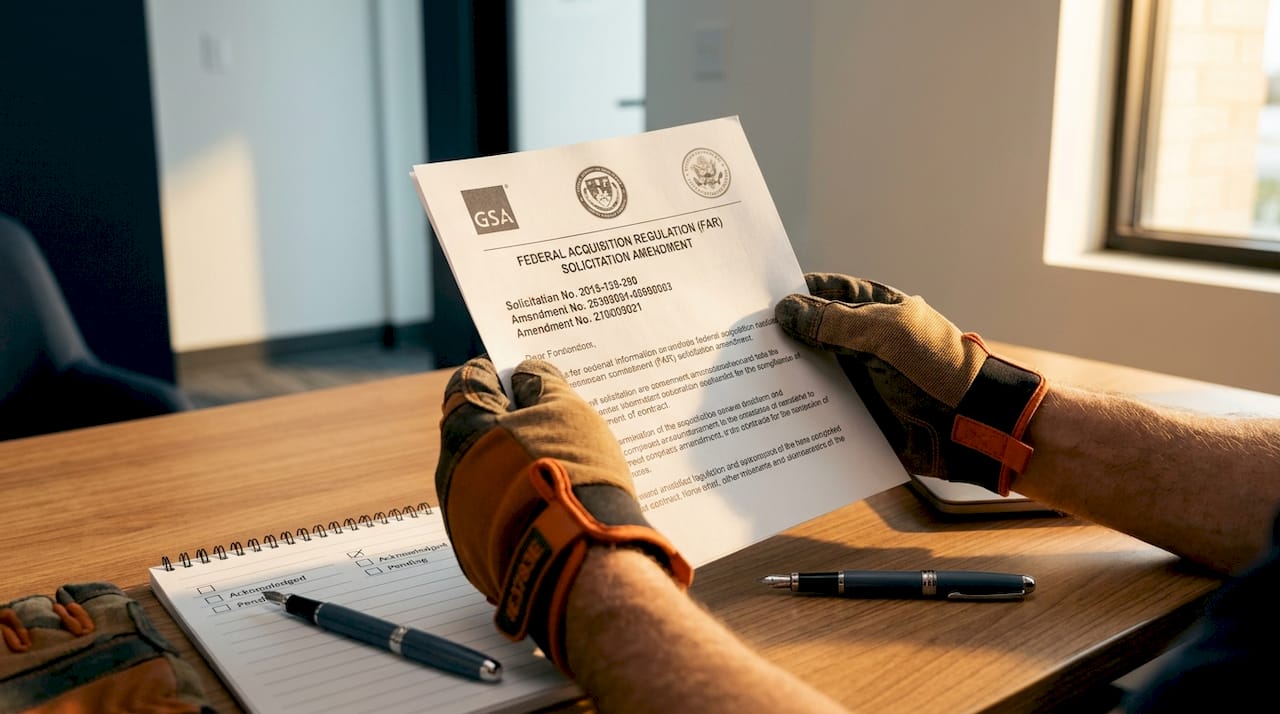
Solicitation amendments are formal modifications to an Invitation for Bids (IFB) or Request for Proposals (RFP) that change scope, specifications, deadlines, or terms. Acknowledging each amendment is not a formality. It is a binding legal act that confirms you accept the updated contract terms. Skipping this step creates a gap in legal obligation that the GAO treats as fatal to your bid.
The distinction between a material and immaterial amendment determines whether missing an acknowledgment disqualifies you. A material amendment is one that substantively changes performance requirements, specifications, or evaluation criteria. Materiality is not determined solely by price impact. An amendment that changes a structural specification by a small margin can still be material if it alters what the contractor must deliver.
A 2026 GAO case involving a steel pile platform construction contract illustrates exactly how this plays out. The contractor failed to acknowledge a third amendment and was disqualified despite the price impact being minor. The GAO sustained the protest, confirming that failure to acknowledge a material amendment renders a bid nonresponsive. That disqualification had nothing to do with the contractor’s pricing, experience, or technical capability.
Some contractors assume they can rely on the minor informality waiver under FAR 14.405 to excuse a missed acknowledgment. That assumption is legally risky. Minor informality waivers apply only to defects that do not prejudice other bidders and are not material. Amendment acknowledgment failures rarely qualify, and contracting officers are not required to grant them.
Here is a practical process for tracking amendments on every bid:
- Register on SAM.gov and set up automated notifications for every solicitation you are tracking.
- Create an amendment log for each bid, recording the amendment number, issue date, subject matter, and acknowledgment deadline.
- Review each amendment against your proposal to identify any section that needs to be revised before submission.
- Confirm acknowledgment in writing on the bid form itself, not just in a cover letter.
- Conduct a final compliance check within 24 hours of submission to verify every amendment is acknowledged.
Pro Tip: Print the full amendment log and attach it to your internal bid file. If a protest arises, your documentation of acknowledgment is your first line of defense.
“Acknowledging every solicitation amendment correctly is one of the most common but avoidable failures leading to bid disqualification.” — Lexology, Spring Cleaning Your Proposals
How SBA eligibility and program integrity affect your bid
SBA small business programs, including the 8(a) Business Development Program, the HUBZone Program, and the Women-Owned Small Business (WOSB) Program, each carry specific eligibility requirements. Failing to meet those requirements at the time of bid submission is a direct path to disqualification. The government does not grade eligibility on a curve.
The 2026 enforcement environment has made this more consequential than ever. The Department of Defense announced heightened scrutiny of 8(a) and other small business contracts following SBA program integrity reviews. Those reviews resulted in 154 8(a) contractors suspended or terminated in 2026 for failing economic disadvantage criteria. These contractors had collectively received nearly $1.3 billion in contracts from FY 2021 to 2024. The scale of that enforcement action signals that eligibility compliance is now a front-line issue, not a background administrative task.
For new contractors, the most common eligibility pitfalls include:
- Affiliation rule violations. The SBA’s ostensible subcontractor rule can disqualify your bid if a large subcontractor performs the primary contract duties. This means your subcontracting plan must keep primary performance clearly within your firm’s control.
- Economic disadvantage documentation gaps. 8(a) participants must demonstrate that the socially disadvantaged owner also faces economic disadvantage. Missing or outdated financial documentation triggers review.
- Size standard miscalculations. NAICS code selection determines which size standard applies. Selecting the wrong NAICS code, or miscalculating your average annual receipts or employee count, can make you ineligible without realizing it.
- Ownership and control issues. The SBA requires that the disadvantaged individual genuinely controls day-to-day operations. Arrangements where a non-disadvantaged partner holds operational authority create disqualification risk.
If your small business status is challenged after bid submission, awards are delayed pending SBA size determination or 15 business days after the protest. That delay can cost you the contract even if you ultimately win the size challenge, because contracting officers may proceed with other options.
Pro Tip: Build a “challenge-proof” file that includes current ownership documents, personal financial statements, organizational charts, and your most recent tax returns. Seasoned contractors keep this file updated quarterly so they can respond to SBA challenges within days, not weeks.
Compliance failures vs. pricing and performance: what actually loses bids
Many new contractors believe federal bids are won or lost on price. That belief leads to a misallocation of preparation time. Price and technical quality are evaluation factors, but they are only considered after a bid clears the responsiveness threshold. A nonresponsive bid is rejected before anyone reads your cost proposal.
The table below contrasts the most common reasons small contractors lose federal bids and their actual impact on bid outcomes:
| Loss reason | Stage of rejection | Correctable after submission? |
|---|---|---|
| Unacknowledged material amendment | Responsiveness review | No |
| SBA eligibility failure | Pre-award compliance check | No |
| Price too high | Technical/price evaluation | Sometimes, via negotiation |
| Weak past performance | Technical evaluation | No, but improvable for next bid |
| Incomplete technical approach | Technical evaluation | No |
| Post-award mistake discovered | FAR 14.407-4 process | Severely limited |
The data in this table reflects a clear pattern. Compliance failures eliminate bids at the earliest stage, before any competitive evaluation begins. Post-award corrections to proposals are severely limited under FAR, which means thorough pre-award compliance is the only reliable protection.
GAO protest decisions reinforce this hierarchy. The GAO examines whether evaluations are consistent with the solicitation’s announced evaluation criteria. Contractors who win protests against competitors typically do so by proving a material noncompliance, not by demonstrating their own bid was technically superior. This means compliance discipline protects you both as a bidder and as a protester.
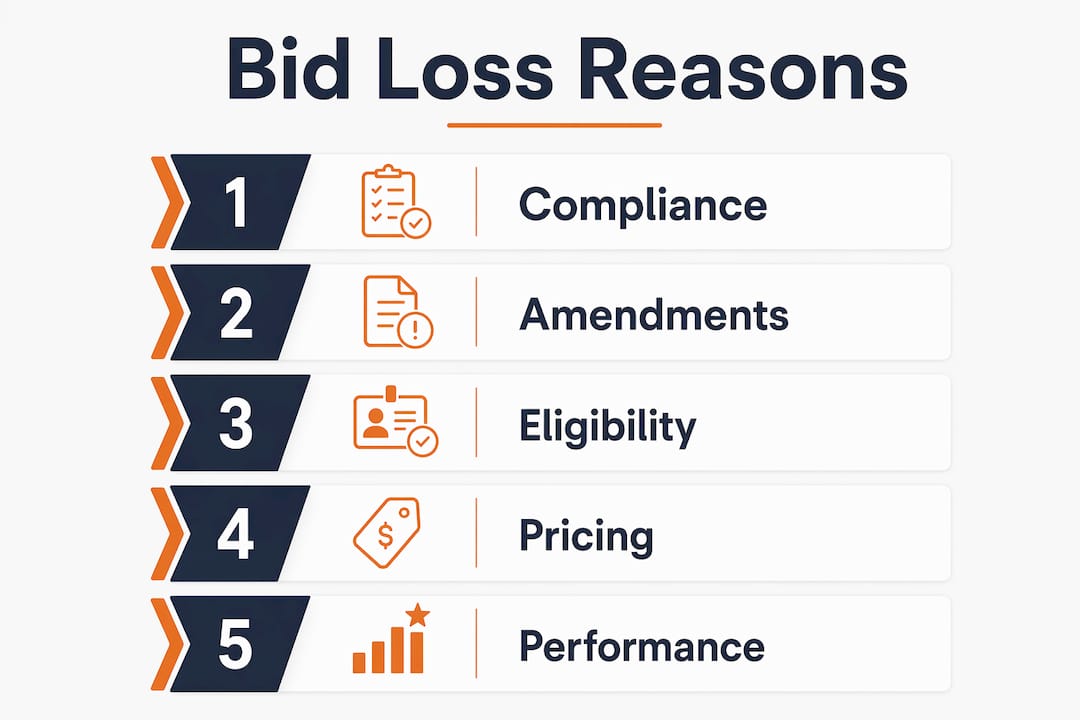
The practical implication is direct: allocate at least as much preparation time to compliance review as you do to pricing. A perfectly priced bid that fails the responsiveness check earns nothing.
Practical steps to avoid common federal bid pitfalls
Winning your first federal contract requires a structured approach to bid preparation. The following steps address the specific compliance and eligibility issues that cause most first-bid failures.
-
Run a compliance-only proposal review before your technical review. Assign one person to check only for compliance: amendment acknowledgments, required certifications, SAM.gov registration currency, and signature requirements. Do not combine this with technical editing.
-
Verify your SAM.gov registration is active. An expired SAM.gov registration disqualifies your bid automatically. Check your registration expiration date at least 30 days before any submission deadline.
-
Confirm your NAICS code and size standard. Cross-reference the solicitation’s NAICS code against your SAM.gov profile and calculate your size against the applicable standard. Use the SBA’s size standards tool to verify.
-
Maintain your challenge-proof eligibility file. As noted earlier, keeping current documentation on ownership, staffing, and economic disadvantage proof allows you to respond promptly to SBA challenges. Update this file every quarter.
-
Use amendment tracking software. Tools like Deltek GovWin IQ and Periscope S2G send automated alerts when solicitation amendments are posted. Manual tracking on active bids is a reliable source of missed acknowledgments.
-
Train every person who touches your proposals. Amendment acknowledgment failures often happen because a team member assembles the final bid package without knowing which amendments were issued. A one-page amendment checklist attached to every bid folder prevents this.
-
Monitor competitor compliance for protest opportunities. If you lose a bid, review the award decision. If the winner failed to acknowledge a material amendment or has an eligibility issue, you have grounds for a GAO protest. Protests that succeed often hinge on proving a competitor’s material noncompliance.
Pro Tip: Review the step-by-step federal contracting guide from Federal-rconstructionsolutions before your first submission. It covers SAM.gov registration, NAICS code selection, and bid preparation in a sequence designed specifically for construction contractors.
Key takeaways
Small contractors lose their first federal bid because compliance failures disqualify proposals before evaluators ever reach pricing or technical quality.
| Point | Details |
|---|---|
| Amendment acknowledgment is mandatory | Failing to acknowledge a material amendment renders your bid nonresponsive under GAO and FAR rules. |
| SBA eligibility must be current | Affiliation violations, size miscalculations, and documentation gaps cause disqualification at the pre-award stage. |
| Compliance precedes evaluation | Price and technical quality are only reviewed after a bid clears the responsiveness threshold. |
| Pre-award accuracy is your only protection | Post-award corrections are severely limited under FAR 15.508, making pre-submission review non-negotiable. |
| Protest rights have real value | Monitoring competitor compliance gives you grounds for a GAO protest if a noncompliant bid wins the award. |
What I’ve learned after years of watching contractors lose winnable bids
I have reviewed enough failed bid submissions to recognize a pattern that most contractors never see coming. The contractors who lose their first federal bid are rarely the least qualified. They are often the most motivated, the most price-competitive, and the most technically capable firms in the pool. They lose because they treated the federal bid process like a private sector proposal, where the quality of your work carries the day.
Federal procurement does not work that way. The FAR creates a structured legal framework where responsiveness and eligibility are threshold requirements, not factors to be weighed against your strengths. A missed amendment acknowledgment is not a minor oversight that a contracting officer will overlook because your price is good. It is a legal defect that requires rejection.
What I find most frustrating is that these failures are entirely preventable. The 2026 DoD enforcement actions against 8(a) contractors are a clear signal that the compliance environment is tightening, not loosening. New contractors who build compliance discipline into their bid process from day one will have a structural advantage over competitors who treat it as an afterthought.
My advice to any contractor preparing their first federal bid: spend your first hour of preparation reading the solicitation for compliance requirements, not for scope of work. Understand what amendments have been issued, confirm your eligibility, and verify your SAM.gov registration before you write a single line of your technical approach. The contractors who win consistently are not necessarily the best builders. They are the most disciplined proposal managers.
— Rowena
How Federal-rconstructionsolutions helps you avoid fatal bid errors
Federal-rconstructionsolutions, through the RCS 5551 Pillar program, provides compliance coaching and bid preparation support built specifically for small construction contractors entering the federal market. The team reviews solicitation amendments, verifies SBA eligibility documentation, and conducts pre-submission compliance checks designed to catch the exact errors that disqualify most first bids.
If you are preparing your first federal bid or have already lost one and want to understand why, the federal procurement services page outlines how RCS 5551 Pillar supports contractors from SAM.gov registration through final submission. The program has helped clients achieve 90% compliance rates on bid submissions, with results that include secured contracts on public water infrastructure projects. You can also explore the federal contract growth plan to see how compliance discipline translates into long-term contract pipeline growth.
FAQ
What makes a federal bid nonresponsive?
A bid is nonresponsive when it fails to meet a material requirement of the solicitation, such as failing to acknowledge a solicitation amendment, missing required certifications, or submitting after the deadline. Nonresponsive bids are rejected before any evaluation of price or technical merit occurs.
How do solicitation amendments affect small contractors specifically?
Small contractors are more vulnerable to amendment errors because they often lack dedicated proposal managers who track every amendment posting. Failing to acknowledge a material amendment is a fatal defect under GAO precedent, regardless of how competitive the bid is on price or technical quality.
Can SBA size challenges delay or kill a contract award?
Yes. When a small business status is challenged, contracting officers generally cannot proceed with the award until the SBA resolves the size determination or 15 business days pass after the protest. This delay can result in the contract being awarded to another bidder.
What is the ostensible subcontractor rule?
The SBA’s ostensible subcontractor rule disqualifies a bid if a large subcontractor performs the primary and vital requirements of the contract, effectively making the small business a pass-through. This rule is a primary focus of the 2026 DoD scrutiny on 8(a) contracts.
Is it worth filing a GAO protest if you lose your first bid?
Yes, if you have evidence that the winning bidder failed to meet a material compliance requirement. GAO protests that succeed typically prove a competitor’s noncompliance rather than the protester’s own bid superiority, making compliance monitoring a legitimate competitive strategy.

