
Federal Contract Growth Plan for Construction Firms
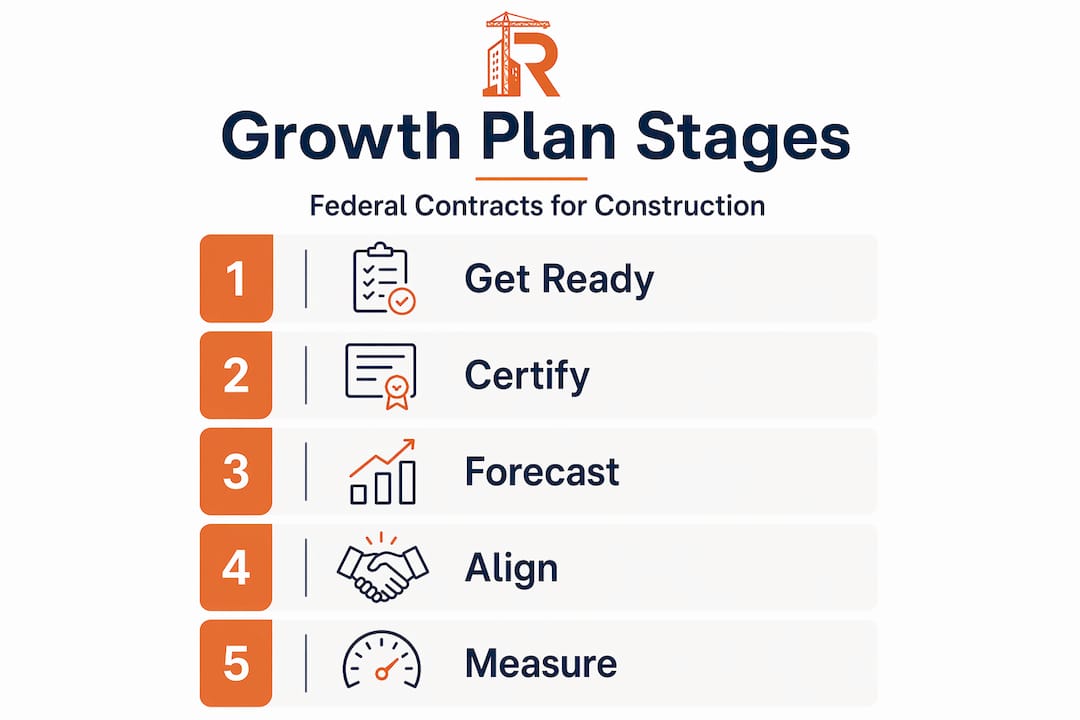
Building a federal contract growth plan in construction is one of the most disciplined, high-reward strategies a contractor can pursue. The federal government spends hundreds of billions annually on construction, yet most firms lose ground by bidding reactively rather than planning systematically. A structured approach, what procurement professionals call a capture management plan, combines certification strategy, pipeline forecasting, and funding cycle awareness into a repeatable system. This article breaks down exactly how to build and execute that system, from foundational prerequisites through the timing windows that matter most in 2026.
Table of Contents
- Key Takeaways
- Your federal contract growth plan starts with prerequisites
- Using GSA forecasting tools for early pipeline building
- Aligning your growth plan with IIJA funding windows
- Integrating 8(a) certification into your long-term strategy
- Executing and measuring your growth plan
- My take on what actually separates winners from the rest
- How Federal-rconstructionsolutions helps you build and execute your plan
- FAQ
Key Takeaways
| Point | Details |
|---|---|
| Build your foundation first | Bonding capacity, SAM.gov registration, and the right NAICS codes must be in place before pursuing federal bids. |
| Use GSA forecasting tools early | The GSA Forecast of Contracting Opportunities shows award dates and set-aside status months before solicitations post to SAM.gov. |
| Align bids with IIJA funding peaks | FY2025 and FY2026 are peak obligation years for infrastructure funding, making now the highest-priority window for pipeline building. |
| Treat 8(a) as a runway, not a guarantee | The 8(a) program builds capability over 9 years; firms that use it strategically outperform those that treat it as a contract source. |
| Track pipeline health with metrics | Win rate by agency, bid-to-award ratio, and days-to-solicitation are the numbers that tell you whether your growth plan is working. |
Your federal contract growth plan starts with prerequisites
Before you submit a single bid, your business infrastructure needs to be competition-ready. This is where most small and mid-size construction firms underestimate the work involved.
Certifications and registrations form the entry point. Your SAM.gov registration must be active and accurate, with NAICS codes that match the work you actually perform. If you target federal building construction, NAICS 236220 is your primary code. For highway and bridge work, 237310 applies. Mismatched codes are a silent disqualifier that many firms never diagnose.
Bonding capacity is the second gating factor. The Miller Act requires bonds for federal construction contracts exceeding $150,000, covering both performance and payment. Building bonding capacity is a multi-year process that depends on timely project completion and strong financial statements. If your current surety line limits your bid size, the SBA Surety Bond Guarantee Program can extend coverage up to $10 million for qualifying small contractors.
Beyond certifications and bonding, consider these capacity-building pathways:
- SBA 8(a) enrollment: Provides access to set-aside and sole-source contracts, plus one-on-one business development assistance over a 9-year program term.
- Mentor-Protégé programs: An underused path that connects small contractors with larger primes, offering support in project management, equipment access, and subcontracting on set-aside infrastructure work. The Mentor-Protégé program is particularly valuable for firms without a federal project history.
- Joint ventures: Teaming with a qualified firm allows you to pursue contracts above your current bonding or experience threshold while building your own past performance record.
- Davis-Bacon Act compliance readiness: Federal construction contracts require certified payroll reporting. Having your payroll systems set up for Davis-Bacon compliance before your first bid saves weeks of scrambling.
Pro Tip: Request a pre-qualification meeting with your surety broker annually, not just when you need a bond. Brokers who understand your growth plan will advocate for higher single-project limits as your financials improve.
Using GSA forecasting tools for early pipeline building
Most contractors discover federal opportunities by browsing SAM.gov after a solicitation posts. By that point, the best-positioned competitors have already been preparing for months. The firms winning consistently do something different. They start with the GSA Forecast of Contracting Opportunities.
The FCO tool shows upcoming procurements before they appear as formal solicitations. For each opportunity, it provides the NAICS code, estimated award date, acquisition strategy (competitive set-aside, sole-source, full and open), and the contracting officer’s contact information. That last detail is significant. It means you can reach out, ask questions, and make your firm known to the agency before the solicitation drops.
Here is how to build an early pipeline using the FCO:
- Filter by NAICS code and agency. Start with the two or three NAICS codes that match your core capabilities. Narrow by the agencies most active in your region or specialty.
- Flag opportunities 6 to 12 months out. These are your highest-priority targets. You have time to assess fit, build teaming relationships, and prepare compliance documentation.
- Make a bid/no-bid decision early. Evaluate each opportunity against your bonding capacity, past performance, and current workload. Declining early is not failure. It preserves resources for the bids you can win.
- Contact the agency point of contact. A brief, professional email introducing your firm and asking about small business set-aside considerations is appropriate and welcomed by most contracting officers.
- Build a pursuit calendar. Map each target opportunity to a timeline with milestones: teaming decision, capability statement submission, draft review, and final bid submission.
The following table shows how FCO data maps to specific planning decisions:
| FCO Data Field | Planning Decision It Drives |
|---|---|
| Acquisition strategy | Determines whether to pursue solo, as a prime, or as a sub |
| Estimated award date | Sets your pursuit timeline and resource allocation |
| NAICS code | Confirms eligibility and set-aside qualification |
| Set-aside designation | Identifies whether 8(a), SDVOSB, or WOSB status applies |
| Contracting officer contact | Opens the door for pre-solicitation engagement |
Pro Tip: Early capture activities using GSA forecast data improve your positioning significantly compared to reacting after a solicitation posts. Set a recurring calendar block every two weeks to review FCO updates for your target agencies.
Aligning your growth plan with IIJA funding windows
Timing matters in federal construction contracting. Right now, it matters more than usual. The Infrastructure Investment and Jobs Act (IIJA) authorized formula funding primarily through FY2026, with discretionary grants extending through 2028. As of early 2026, $312 billion of new IIJA spending has already been disbursed, with $238 billion remaining and actively flowing into the market.

FY2025 and FY2026 are the peak obligation years. Agencies are under pressure to commit funds or lose them. That pressure creates a higher volume of solicitations in a compressed window. For contractors with a ready pipeline, this is the most productive bidding environment in a generation.
The key funding programs to track by sector:
- FHWA Bridge Formula Program: The largest single pot of IIJA road and bridge money. State DOTs are the primary channel. State DOT lettings are published months in advance and represent the biggest pipeline for roads and bridges work.
- EPA Water Infrastructure (CWSRF and DWSRF): Flowing through state revolving funds to municipalities. Contractors pursuing water and wastewater construction should be tracking state environmental agency procurement calendars alongside federal ones.
- NEVI EV Charging Infrastructure: Administered through state DOTs under Federal Highway Administration oversight. Smaller contracts, but high volume and often set aside for small businesses.
- Federal Buildings and GSA Construction: GSA’s own capital program continues independent of IIJA and includes courthouses, federal office buildings, and land ports of entry.
The practical implication is this: if your firm is not actively bidding in FY2026, you are missing the peak of a once-per-decade funding surge. Aligning your construction growth opportunities with these funding windows is not optional for firms serious about federal revenue growth.
Integrating 8(a) certification into your long-term strategy
The SBA’s 8(a) Business Development program is widely misunderstood. Contractors often pursue it expecting a pipeline of guaranteed work. The reality is more nuanced, and more useful, if you approach it correctly.
The 8(a) program offers eligibility for set-aside and sole-source contracts, not a guarantee of either. Sole-source thresholds for construction contracts go up to $4.5 million for most acquisitions and $7 million for manufacturing NAICS codes. Above those thresholds, contracts must be competed among 8(a) firms. That distinction shapes how you use the program.
Think of the 9-year term in two phases:
- Years 1 through 4 (developmental stage): Focus on winning smaller sole-source contracts to build past performance. Past performance is the currency of federal contracting. Every completed project adds to a record that makes future bids more competitive.
- Years 5 through 9 (transitional stage): Scale bid volume, pursue competed 8(a) set-asides, and expand teaming relationships. Use the SBA’s business development assistance to sharpen your pricing, proposal writing, and financial management.
Experienced contractors treat 8(a) as a runway to build relationships and capability, not a shortcut. The firms that exit the program with a sustainable federal practice are the ones that used every year intentionally.
Pro Tip: Apply for 8(a) certification before you need it. The application process takes 90 days or more. Starting early means you enter the program with time to build, not scrambling to catch up.
Executing and measuring your growth plan
A plan without execution metrics is just a document. The firms that grow federal contract revenue consistently treat pipeline management as an ongoing operational discipline, not a quarterly review exercise.
Start with these capture planning milestones:
- Opportunity identification: Log every target opportunity in a CRM or tracking spreadsheet within 48 hours of discovery.
- Bid/no-bid decision: Make a formal go/no-go call at least 30 days before the proposal due date for larger contracts.
- Teaming confirmation: Lock in teaming partners at least 60 days before submission for any contract requiring capabilities beyond your own.
- Compliance review: Verify FAR clause compliance, Davis-Bacon wage determinations, and bonding requirements at least two weeks before submission.
- Debrief and record: After every award decision, request a debrief from the contracting officer. Win or lose, the feedback improves your next bid.
Maintaining compliance rigor is non-negotiable, especially under the current emphasis on fixed-price contracts. Disciplined project management and diversified agency portfolios are what separate high-performing federal contractors from the rest. Cost overruns on fixed-price work come directly out of your margin.
Track these pipeline health metrics monthly:
- Bid-to-award ratio: How many bids result in awards. A ratio below 1 in 5 signals a targeting or proposal quality problem.
- Win rate by agency: Some agencies will be a better fit for your capabilities. Track where you win and concentrate resources there.
- Days from forecast to solicitation: Helps you calibrate how far in advance to begin pursuit activities for each agency.
- Pipeline value vs. capacity: Total value of active pursuits compared to your bonding and staffing capacity. Overextension is a common and costly mistake.
Common pitfalls to avoid: underestimating proposal preparation time (federal RFPs are detailed and unforgiving), relying too heavily on a single contract type or agency, and neglecting to update SAM.gov registrations annually.
My take on what actually separates winners from the rest
I’ve worked with construction firms at every stage of federal contracting, from first-time bidders to firms managing multi-agency portfolios. The pattern I see most often among firms that stall is not a lack of capability. It’s a reactive posture.
They wait for solicitations to post, then scramble. They treat certifications as checkboxes rather than strategic tools. They bid on everything that looks like a fit and win far less than they should. The firms that grow consistently do the opposite. They plan 12 months out. They know which agencies are spending, on what, and when. They build relationships with contracting officers before the competition starts.
What I’ve learned is that the combination of early forecasting, disciplined 8(a) use, and IIJA timing awareness is not complicated. It’s just uncommon. Most firms don’t do the work because it requires consistent effort over months, not weeks. The ones that commit to it see a compounding effect. Each completed federal project builds past performance. Each past performance record opens doors to larger contracts. Each larger contract expands bonding capacity.
The other thing I’d push back on is the idea that federal contracting is too complex for smaller firms. It’s detailed, yes. But the tools are public, the funding is real, and the competition is beatable with preparation. The contractors losing federal RFPs are often losing on proposal quality and past performance documentation, not on price or technical capability.
— Rowena
How Federal-rconstructionsolutions helps you build and execute your plan
Federal-rconstructionsolutions, operating as R. Construction Solutions’ 5551 Pillar, specializes in exactly the kind of structured planning this article describes. From SAM.gov registration and NAICS code alignment to RFP writing and compliance support, the team brings deep federal procurement expertise to construction firms at every stage of growth. Their approach achieves 90% compliance rates on bid submissions, which directly translates to more competitive proposals and fewer disqualifications.
Whether you are building your first federal pipeline or scaling an existing one, their federal procurement services include customized capture planning, teaming strategy, and ongoing bid management support. They also help contractors integrate private sector opportunities alongside federal work, a combination that clients report delivers 30% more consistent revenue and 20% higher overall profitability. If you are serious about growing your federal contract portfolio, this is the team to have in your corner.
FAQ
What is a federal contract growth plan for construction?
A federal contract growth plan is a structured strategy that combines certification readiness, pipeline forecasting, and bid execution to grow a construction firm’s federal contract revenue over time. It is also called a capture management plan in federal procurement practice.
How does the GSA Forecast of Contracting Opportunities help contractors?
The GSA FCO tool shows upcoming federal procurements months before they appear on SAM.gov, including NAICS codes, acquisition strategies, and estimated award dates, giving contractors time to prepare and engage agencies early.
Is 8(a) certification worth it for construction firms?
Yes, when used strategically. The 8(a) program provides access to sole-source contracts up to $4.5 million and set-aside competitions, plus nine years of business development assistance. It builds past performance and relationships that outlast the program itself.
When is the best time to bid on IIJA-funded construction projects?
FY2025 and FY2026 are the peak obligation years for IIJA formula funding. Contractors who have their pipeline and compliance infrastructure ready now are positioned to capture the highest volume of available opportunities before the funding window narrows.
What metrics should I track to measure my federal growth plan?
Track bid-to-award ratio, win rate by agency, pipeline value versus bonding capacity, and days from forecast to solicitation. These four numbers give you a clear picture of where your strategy is working and where it needs adjustment.

