
Federal Set-Aside Categories in Construction: 2026 Guide
Federal set-aside categories in construction are designated contracting programs that reserve federal construction contracts exclusively for qualifying small and socioeconomically disadvantaged businesses. These programs exist because congressional mandates require federal agencies to meet specific contracting goals for disadvantaged groups, driving billions in annual set-aside awards. For construction firms, understanding these categories is the difference between competing for every contract and competing only where you have a structural advantage. This guide covers the primary programs, the regulatory framework, compliance requirements, and the bidding strategies that actually move the needle.
What are the primary federal set-aside categories in construction?
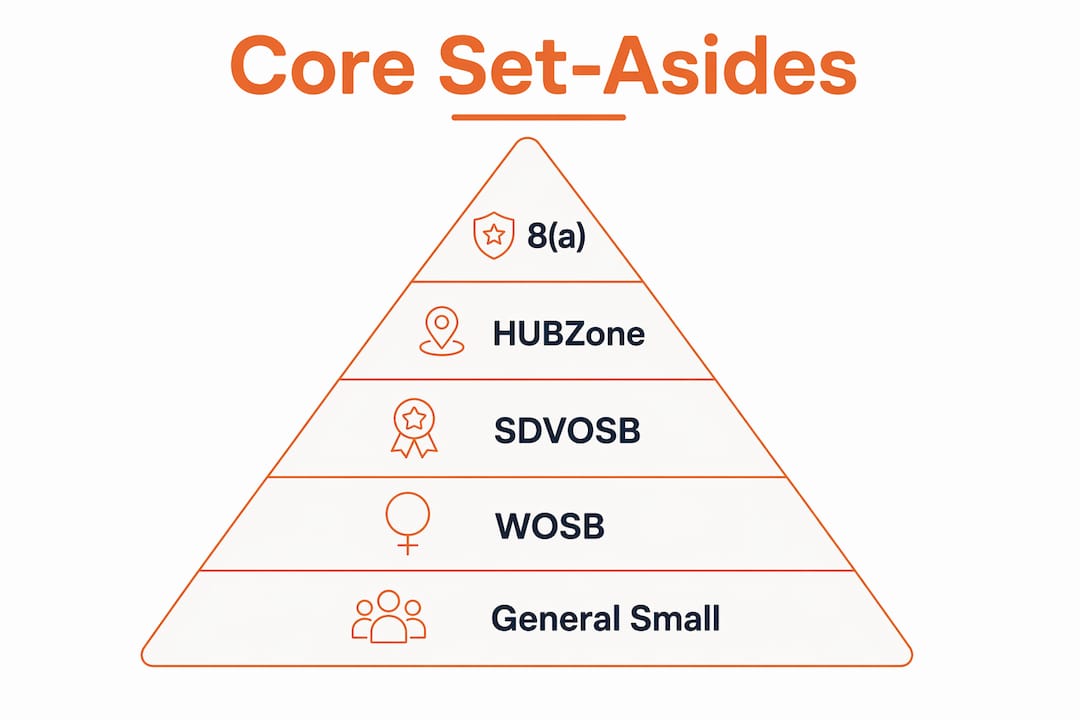
Federal set-aside programs fall into five main categories, each with distinct eligibility criteria and advantages. Contracting officers follow a specific order of precedence, starting with the 8(a) Business Development program and working down to General Small Business set-asides. That order matters because it determines which program gets first consideration on any given contract.
The five core set-aside programs
8(a) Business Development targets small businesses owned and controlled by socially and economically disadvantaged individuals. Participants receive sole-source awards up to $4.5 million for construction and competitive set-asides above that threshold. The program runs for nine years and includes mentorship and business development support.
HUBZone (Historically Underutilized Business Zone) applies to firms with a principal office and at least 35% of employees residing in a federally designated HUBZone. These firms receive a 10% price evaluation preference in full and open competitions, plus access to set-aside contracts.

SDVOSB (Service-Disabled Veteran-Owned Small Business) reserves contracts for firms where a service-disabled veteran owns at least 51% of the business and controls daily operations. The Department of Veterans Affairs applies a strict verification process through its Vendor Information Pages database.
WOSB and EDWOSB (Women-Owned Small Business and Economically Disadvantaged Women-Owned Small Business) apply to industries where women are underrepresented. Construction falls into several NAICS codes covered by the WOSB program, making this a growing avenue for women-led firms.
General Small Business set-asides apply when a contract falls between $10,000 and $250,000, where the Rule of Two mandates a set-aside if at least two small businesses are expected to bid at a fair price.
| Set-Aside Program | Core Eligibility | Key Advantage | Typical Use |
|---|---|---|---|
| 8(a) Business Development | Socially and economically disadvantaged owner | Sole-source awards up to $4.5M | New market entrants |
| HUBZone | Office and 35% staff in HUBZone | 10% price preference | Geographically targeted bids |
| SDVOSB | 51% service-disabled veteran ownership | VA-specific set-asides | VA and DoD construction |
| WOSB / EDWOSB | 51% women-owned, underrepresented NAICS | Expanding program coverage | Commercial and federal builds |
| General Small Business | Small business size standard by NAICS | Broadest eligibility | Contracts under $250,000 |
Construction is a particularly set-aside-friendly market because projects can be divided into manageable scopes that fit small business capacity. That natural scalability broadens participation across all five programs.
How do federal regulations govern set-aside use in construction?
The regulatory framework for set-aside construction contracts sits inside the Federal Acquisition Regulation (FAR) and several specific statutes. Contractors who miss these rules face bid rejection, contract termination, or debarment.
The Rule of Two and its construction impact
The Rule of Two requires a contracting officer to set aside any contract when at least two responsible small businesses are expected to submit offers at a fair market price. Construction projects are especially fertile ground for this rule because their divisible scope means agencies can structure solicitations to fit small business capacity. If you are a small business in a market with even one other qualified competitor, the Rule of Two works in your favor.
Bonding requirements under the Miller Act
Contracts exceeding $100,000 require both a performance bond and a payment bond under the Miller Act. These bonds protect the government and subcontractors if the prime contractor defaults. New firms often lose bids not because of price or qualifications but because they have not established surety relationships. Bonding capacity signals financial stability to contracting officers, so building that relationship before you bid is not optional. You can review the full bonding framework in this contractor bonding guide.
Davis-Bacon Act wage compliance
The Davis-Bacon Act requires contractors on covered federal construction contracts to pay workers the prevailing local wage rates published by the Department of Labor. Contractors must also submit certified payrolls to the contracting agency. Failure to comply creates financial exposure through back-wage liability and can trigger contract suspension.
Limitations on subcontracting
FAR 52.219-14 sets the minimum self-performance thresholds for set-aside construction contracts. For general construction, the prime must perform at least 15% of the contract cost with its own employees. For specialty trade work, that floor rises to 25%. These thresholds prevent firms from winning set-aside contracts and then subcontracting the entire scope to ineligible businesses.
| Compliance Requirement | Threshold / Rule | Consequence of Non-Compliance |
|---|---|---|
| Miller Act Bonding | Contracts over $100,000 | Bid rejection or contract default |
| Davis-Bacon Wages | Federal construction contracts | Back-wage liability, suspension |
| FAR 52.219-14 Self-Performance | 15% general / 25% specialty trade | Bid disqualification, debarment risk |
| Rule of Two | Two qualified small businesses available | Mandatory set-aside required |
Pro Tip: Request the wage determination for your project’s county before you price the bid. Davis-Bacon rates vary significantly by location and trade, and underestimating labor costs is one of the fastest ways to lose money on a federal construction contract.
How can construction firms optimize bidding strategies for set-aside contracts?
Winning set-aside contracts requires more than holding a certification. The firms that consistently win treat federal procurement as a year-round discipline, not a reactive search for open solicitations.
Use SAM.gov and the GSA Forecast of Contracting Opportunities
SAM.gov registration is the non-negotiable first step. Without an active SAM.gov registration, you cannot receive a federal award. Beyond registration, the GSA Forecast of Contracting Opportunities (FCO) publishes planned procurements before they are formally solicited. Firms that track the FCO can build relationships with contracting officers, prepare capability statements, and position themselves months ahead of a solicitation. Get step-by-step guidance on SAM.gov registration to avoid common setup errors that delay eligibility.
Build your certification portfolio strategically
Each socioeconomic certification you hold expands the pool of contracts you can pursue. A woman-owned firm that also qualifies for HUBZone can compete in two separate set-aside pools, which multiplies federal construction opportunities. Review your NAICS codes carefully. Many construction firms hold codes that qualify for WOSB coverage but have never applied for the certification.
Plan subcontracting to meet FAR thresholds
Structure your subcontracting plan before you bid, not after award. Identify which scopes you will self-perform to meet the 15% or 25% thresholds under FAR 52.219-14. Firms that plan this upfront avoid the scramble of trying to restructure work assignments after contract award, which can trigger compliance reviews.
Best practices for set-aside bidding
- Register and maintain an active SAM.gov profile with current NAICS codes and bonding information.
- Track the GSA Forecast of Contracting Opportunities at least 12 months ahead of target projects.
- Obtain all applicable socioeconomic certifications before bidding, not during the bid cycle.
- Pre-establish surety relationships so bonding can be issued within the contracting officer’s required timeframe.
- Engage with Small Business Technical Advisors at target agencies to understand procurement priorities.
- Submit capability statements tailored to each agency’s construction mission and project type.
- Review government bid eligibility requirements annually, as size standards and program rules change.
Pro Tip: Firms that engage with insurance and bonding regulations early in their federal market entry consistently close the gap between bid submission and award faster than firms that treat bonding as an afterthought.
What are common challenges contractors face in set-aside construction contracts?
Most compliance failures in set-aside construction contracts are predictable. The same mistakes appear repeatedly across firms of every size.
Misreading subcontracting limitations
FAR 52.219-14 is the most frequently misunderstood rule in set-aside construction. Contractors assume they can subcontract freely as long as the prime holds the certification. That assumption is wrong. The minimum self-performance requirement applies regardless of how the work is structured. A firm that subcontracts 90% of a general construction contract to a large business will face disqualification even if the prime is a certified 8(a) firm.
Neglecting bonding until the last minute
Bonding is not a form you fill out after winning a contract. Surety companies evaluate financial statements, credit history, and project track records before issuing bonds. New construction firms that wait until they receive an award notice often cannot meet the bonding turnaround requirement, which costs them the contract. Build the surety relationship 6–12 months before you plan to bid on contracts above $100,000.
Underestimating Davis-Bacon compliance costs
Davis-Bacon prevailing wages are frequently higher than local market rates, especially for specialty trades. Contractors who price bids using their standard labor rates without checking the applicable wage determination routinely underbid federal construction contracts. The result is either a loss on the contract or a wage violation when they try to cut costs.
Common compliance risks at a glance
- Failing to update SAM.gov registration annually, which voids contract eligibility.
- Bidding under the wrong NAICS code, which disqualifies the firm from the set-aside pool.
- Missing certified payroll submission deadlines, which triggers Davis-Bacon audits.
- Allowing certifications to lapse between contract cycles, which removes the firm from the set-aside pool mid-pursuit.
- Ignoring the GSA Forecast tools and reacting only to posted solicitations, which leaves no time for relationship building or bid preparation.
Key Takeaways
Federal set-aside categories in construction give qualified small and disadvantaged firms a direct path to federal contracts, but only when contractors understand the rules, meet compliance thresholds, and bid with preparation rather than reaction.
| Point | Details |
|---|---|
| Five core set-aside programs | 8(a), HUBZone, SDVOSB, WOSB/EDWOSB, and General Small Business each serve distinct eligibility groups. |
| Rule of Two drives opportunity | Contracting officers must set aside contracts when two qualified small businesses can compete at fair prices. |
| Miller Act bonding is mandatory | Performance and payment bonds are required on all federal construction contracts exceeding $100,000. |
| Self-performance thresholds apply | FAR 52.219-14 requires primes to self-perform at least 15% of general construction and 25% of specialty trade work. |
| Early preparation wins contracts | SAM.gov registration, FCO tracking, and surety relationships built before bidding determine who wins set-aside awards. |
What I’ve learned from watching contractors miss set-aside contracts they should have won
The most common mistake I see is not a compliance error. It is timing. Contractors discover a set-aside solicitation, scramble to get certified, and submit a bid that was never competitive because the agency’s preferences were already shaped by conversations with other firms. The Rule of Two does not just protect small businesses. It rewards the firms that showed up early.
The second pattern I see is treating certifications as a one-time task. Programs like HUBZone have annual recertification requirements. Firms that let certifications lapse mid-pursuit lose eligibility at the worst possible moment. I have seen firms disqualified from contracts they were positioned to win simply because an administrative deadline slipped.
The third issue is subcontracting strategy. Many contractors think of FAR 52.219-14 as a compliance checkbox. The smarter approach is to use it as a bid structuring tool. Knowing exactly which scopes you will self-perform before you price the job gives you cost certainty and compliance certainty at the same time. That combination is rare, and contracting officers notice it.
Federal set-aside construction contracts are genuinely accessible to well-prepared firms. The barrier is not the programs themselves. The barrier is the gap between knowing the rules and building the systems to execute them consistently.
— Rowena
Federal-rconstructionsolutions can help you win set-aside contracts
Federal-rconstructionsolutions brings specialized federal procurement expertise to construction firms ready to compete for set-aside contracts. The team supports contractors through every stage, from federal procurement services covering DOT and agency-specific requirements to USACE procurement support for Army Corps of Engineers contracts. Federal-rconstructionsolutions also provides MBE certification assistance to help firms qualify for minority business enterprise set-aside pools.
With a 90% compliance rate on bid submissions and a track record that includes public water infrastructure contracts, Federal-rconstructionsolutions gives construction firms the preparation and documentation support needed to compete with confidence in federal set-aside markets.
FAQ
What is a federal set-aside in construction?
A federal set-aside in construction is a contract reserved exclusively for qualifying small or socioeconomically disadvantaged businesses, preventing large businesses from competing for that award.
What is the Rule of Two in federal contracting?
The Rule of Two requires a contracting officer to set aside a contract when at least two responsible small businesses are expected to submit competitive offers. Construction projects frequently meet this threshold because project scopes can be sized to fit small business capacity.
Do set-aside construction contracts require bonding?
Yes. Federal construction contracts exceeding $100,000 require performance and payment bonds under the Miller Act, regardless of the set-aside program involved.
How much work must a small business prime self-perform?
Under FAR 52.219-14, a small business prime must self-perform at least 15% of the cost on general construction contracts and at least 25% on specialty trade contracts using its own employees.
How do I find federal set-aside construction opportunities?
Register on SAM.gov and use the GSA Forecast of Contracting Opportunities to identify upcoming projects. Engaging with lead generation tools and agency Small Business Technical Advisors also surfaces opportunities before formal solicitations are posted.

