
Government Bid Eligibility for Small Contractors: 2026 Guide
Government bid eligibility for small contractors is defined by three non-negotiable requirements: meeting the SBA size standard for the specific NAICS code assigned to a solicitation, holding an active SAM.gov registration, and satisfying any certification or compliance conditions attached to that contract. Federal agencies are legally required to award at least 23% of prime contract dollars to small businesses each year. That statutory goal creates real opportunity. The question is whether your business is positioned to claim it. This guide walks you through every layer of contractor eligibility requirements, from size standards to cybersecurity compliance, so you can bid with confidence.
What is government bid eligibility for small contractors?
Government bid eligibility is not a single certification or a one-time application. It is a contract-by-contract determination based on size, registration status, and compliance. The SBA administers the size standards program, and the Federal Acquisition Regulation (FAR) governs how agencies apply those standards when awarding contracts. Most federal contracts do not require facility or personnel clearances, which means unclassified work is widely accessible for contractors entering the market for the first time. Certifications like 8(a), HUBZone, WOSB, and SDVOSB go further by unlocking set-aside contracts with reduced competition.
How do NAICS codes and size standards determine eligibility?
The NAICS code assigned to each solicitation controls which size standard applies. This is the single most misunderstood rule in small business government contracts. Many contractors assume their general small business status carries across all bids. It does not.

How size standards actually work
Size standards vary by NAICS code, ranging from $1 million to over $47 million in annual revenue, or from 100 to 1,500 employees depending on the industry. A construction company with $12 million in revenue might qualify as small under one NAICS code and not qualify under another. The SBA’s Table of Size Standards is the authoritative reference, and you must check it for every solicitation you pursue.
Why NAICS code selection is the most common eligibility mistake
Eligibility is set per contract solicitation NAICS code, not by your primary NAICS code or your general business profile. Selecting the wrong code when registering in SAM.gov, or failing to verify the code listed in a solicitation, leads directly to disqualification. Federal-rconstructionsolutions sees this error repeatedly among contractors who are otherwise fully prepared to bid.
| Scenario | Result |
|---|---|
| Revenue under size standard for solicitation NAICS code | Eligible as small business |
| Revenue over size standard for solicitation NAICS code | Ineligible, even if small under primary NAICS |
| Wrong NAICS code listed in SAM.gov profile | Missed set-asides, potential disqualification |
| Correct NAICS code, expired SAM.gov registration | Bid rejected at submission |
Pro Tip: Before submitting any bid, look up the exact NAICS code in the solicitation and cross-reference it against the SBA size standards table. Do not rely on your primary NAICS code alone.
How do you register and certify your business on SAM.gov?
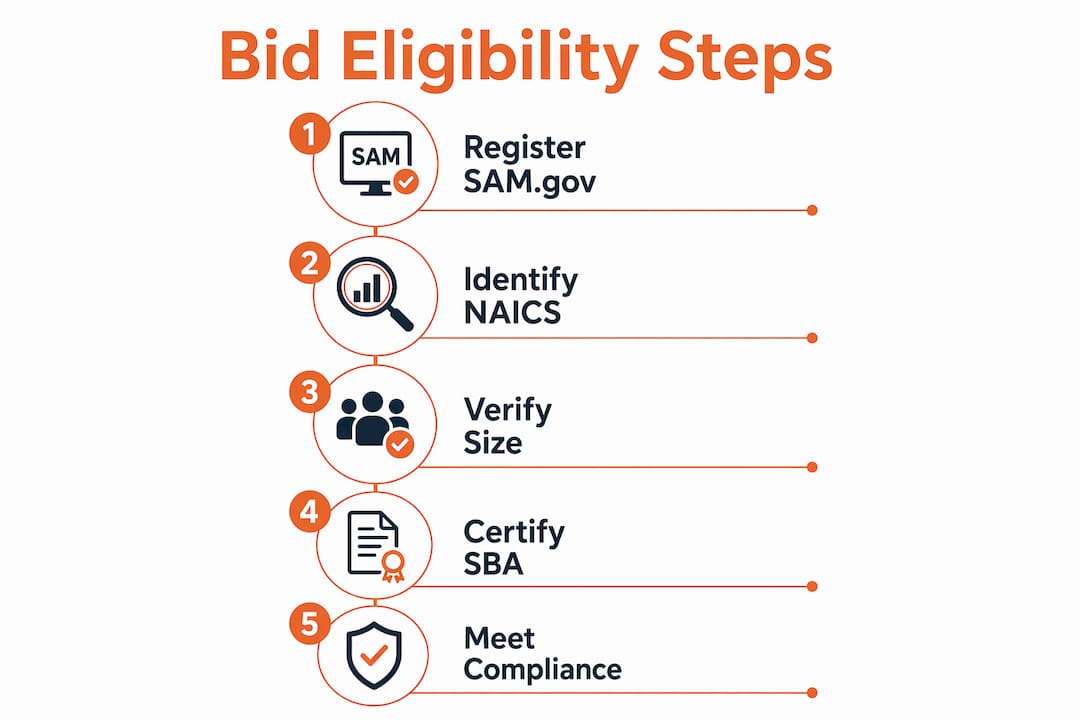
SAM.gov registration is the mandatory first step for bidding on government projects. No active registration means no bid. The process is free, but it takes time, and starting late is one of the most preventable reasons small contractors miss bid deadlines.
Step-by-step registration process
- Obtain a Unique Entity Identifier (UEI). SAM.gov issues the UEI directly during registration. This number replaces the old DUNS number and is required on all federal contract submissions.
- Complete your SAM.gov entity registration. Enter your business legal name, address, NAICS codes, banking information for electronic funds transfer, and representations and certifications under FAR.
- Allow 7–15 business days for activation. SAM.gov registration activation takes this long before your profile becomes searchable by contracting officers. Plan accordingly.
- Pursue SBA certifications based on your eligibility. Certifications like 8(a), HUBZone, WOSB, and SDVOSB grant access to exclusive set-aside contracts with significantly less competition. Each has its own application process through the SBA.
- Update your profile annually. Representations and certifications in SAM.gov must be renewed every year or whenever ownership or control of your business changes. An expired profile disqualifies you automatically.
The SAM.gov registration process involves more detail than most contractors expect. Getting it right the first time saves weeks of delays.
Pro Tip: Apply for relevant SBA certifications while your SAM.gov registration is processing. The 8(a) program alone can take several months to approve, so starting early puts you ahead of the timeline.
What operational compliance requirements affect bid eligibility?
Registration and size status are necessary. They are not sufficient. Federal contracts, particularly those with the Department of Defense, now carry operational compliance requirements that directly affect whether your bid is accepted.
Cybersecurity Maturity Model Certification (CMMC)
CMMC certification is a contracting eligibility requirement for DoD construction contracts. Failure to meet the required CMMC level disqualifies a bidder regardless of size status or registration. This is a significant shift in how eligibility is evaluated for defense-related work.
“Operational compliance, especially cybersecurity like CMMC, increasingly impacts eligibility beyond just business size.” This means small contractors pursuing DoD work must treat cybersecurity readiness as a bid requirement, not an IT afterthought.
Practical steps to address operational compliance:
- Identify the CMMC level required in the solicitation. Level 1 covers basic cyber hygiene. Level 2 and Level 3 require third-party assessments.
- Conduct a gap assessment against the required NIST SP 800-171 controls before bidding on any DoD contract.
- Document your System Security Plan (SSP). Contracting officers review this as part of the award process.
- Engage a Registered Practitioner Organization (RPO) if your team lacks internal cybersecurity expertise. This is a recognized path for small contractors.
Beyond CMMC, contractors must also comply with the Davis-Bacon Act for prevailing wage requirements on federally funded construction, and Buy American Act provisions on materials. Each of these can affect bid eligibility if not addressed in your proposal.
How do you strategically pursue government bids as a small contractor?
Knowing the requirements for small contractors is only half the work. Winning requires a deliberate approach to market engagement, proposal quality, and timing.
Understanding the timeline for your first award
The median time to first award for a new small business is 12–18 months. That timeline is compressible to 6–9 months by responding consistently to Sources Sought notices and Requests for Information (RFIs). These are market research tools agencies use before issuing formal solicitations. Responding to them costs far less than writing a full proposal, and they put your name in front of contracting officers early.
Proven steps to accelerate your first win
- Start with contracts under the simplified acquisition threshold. Contracts under $250,000 have fewer compliance requirements and faster award cycles. They are the right entry point for most new federal contractors.
- Respond to every relevant Sources Sought notice. Responding to Sources Sought and RFIs increases your visibility with contracting officers and demonstrates capability before competition begins.
- Build a strong capability statement. This one-page document is your federal resume. It must list your NAICS codes, past performance, differentiators, and contact information clearly.
- Attend agency industry days and small business events. Direct contact with contracting officers is legal and encouraged during the pre-solicitation phase.
- Avoid common bid mistakes. Review the most common reasons small contractors lose bids before submitting your first proposal.
| Bid strategy | Impact on timeline |
|---|---|
| Responding to Sources Sought notices | Reduces time to first award by up to 6 months |
| Starting with simplified acquisition contracts | Faster award cycles, lower compliance burden |
| Submitting without capability statement | Reduces competitiveness significantly |
| Missing SAM.gov renewal deadline | Automatic disqualification from active bids |
The step-by-step federal contracting guide from Federal-rconstructionsolutions covers each of these phases in detail for construction-specific contractors.
Key takeaways
Government bid eligibility for small contractors requires verified size status under the solicitation-specific NAICS code, active SAM.gov registration, relevant SBA certifications, and full operational compliance before a bid is submitted.
| Point | Details |
|---|---|
| NAICS code controls eligibility | Check the solicitation NAICS code against SBA size standards for every bid, not just your primary code. |
| SAM.gov registration is mandatory | Allow 7–15 business days for activation and renew your profile annually to stay eligible. |
| Certifications unlock set-asides | Pursue 8(a), HUBZone, WOSB, or SDVOSB certification to access contracts with less competition. |
| CMMC affects DoD bids | Cybersecurity compliance is now a hard eligibility requirement for Department of Defense construction contracts. |
| First award takes 6–18 months | Responding to Sources Sought notices consistently is the most effective way to shorten that timeline. |
What I’ve learned from watching small contractors get this wrong
Rowena’s perspective:
After working with construction businesses across the federal procurement process, the pattern I see most often is not a lack of effort. It is a lack of sequencing. Contractors register in SAM.gov, assume they are ready, and then submit bids without verifying the solicitation NAICS code, without any SBA certification, and without a capability statement that reflects their actual work.
The size standard issue is the one that surprises people most. A contractor who has been in business for 20 years, with a solid revenue base and real project history, gets disqualified because their revenue exceeds the size standard for one specific NAICS code on one specific solicitation. That is not bad luck. It is a gap in preparation that could have been closed in an afternoon.
The other thing I would push back on is the instinct to go after large contracts first. The simplified acquisition threshold exists for a reason. Smaller contracts build past performance, and past performance is the currency of federal contracting. A $150,000 contract you win and execute well is worth more to your next bid than a $2 million proposal you lose.
Certifications like HUBZone and SDVOSB are genuinely underused. If you qualify, the competitive pool shrinks dramatically. That is not a minor advantage. That is the difference between competing against 40 contractors and competing against 8.
Start early, engage before solicitations drop, and treat compliance as a prerequisite rather than a last-minute checklist item.
— Rowena
How Federal-rconstructionsolutions helps you meet eligibility requirements
Federal-rconstructionsolutions specializes in helping small construction contractors clear every eligibility hurdle before a bid goes out the door.
The federal procurement services offered through the RCS 5551 Pillar cover SAM.gov registration support, SBA certification guidance, NAICS code verification, and full proposal writing with 90% compliance rates on submissions. Whether you are preparing your first bid or recovering from a disqualification, the team at Federal-rconstructionsolutions provides the structured support that turns eligibility requirements into a completed checklist. Contact Federal-rconstructionsolutions today for a personalized consultation and find out exactly where your business stands before the next solicitation drops.
FAQ
What is the first step to qualify for government bids as a small contractor?
The first step is registering your business in SAM.gov with a valid Unique Entity Identifier (UEI). Active SAM.gov registration is mandatory before any federal bid can be submitted.
How does my NAICS code affect my small business eligibility?
The NAICS code listed in each solicitation determines which SBA size standard applies to that specific contract. Your general small business status does not transfer across different NAICS codes automatically.
What certifications help small contractors win more government contracts?
SBA certifications including 8(a), HUBZone, WOSB, EDWOSB, and SDVOSB grant access to set-aside contracts reserved exclusively for certified businesses, reducing competition significantly.
Does my construction company need CMMC certification to bid on federal contracts?
CMMC certification is required specifically for Department of Defense construction contracts. The required CMMC level is stated in the solicitation, and failure to meet it results in disqualification.
How long does it take to win a first government contract?
The median timeline for a new small business to win its first federal contract is 12–18 months, but consistent responses to Sources Sought notices and RFIs can shorten that to 6–9 months.