
Federal Marketplace Small Business Entry: 2026 Construction Guide
Federal marketplace small business entry is the process that allows small construction businesses to access and compete for government contracts by meeting registration, certification, and compliance requirements set by federal agencies. The federal government is the largest single buyer of construction services in the United States, and small businesses hold a protected position in that market through set-aside programs, subcontracting mandates, and dedicated procurement channels. Whether you are a general contractor, specialty trade firm, or emerging construction startup, the path into federal procurement runs through three core pillars: SAM.gov registration, SBA certifications, and a clear understanding of how subcontracting works. This guide breaks down each step with the specificity your business needs to move forward in 2026.
How to register and prepare your small construction business for federal contracting
Registration in SAM.gov is the mandatory first step before your business can bid as a prime contractor or search for federal opportunities. The System for Award Management, known as SAM.gov, serves as the federal government’s central database for all contractors. Without an active SAM registration, your business is invisible to contracting officers and ineligible for award. The SBA confirms that registration in SAM is required before bidding as a prime contractor.
Preparing your registration correctly matters as much as completing it. Here is what your SAM profile and supporting documentation must include:
- NAICS codes: Select every North American Industry Classification System code that accurately reflects your construction services. Common codes for construction firms include 236220 (commercial building construction), 237310 (highway and street construction), and 238910 (site preparation contractors). Selecting the right codes determines which solicitations your business appears in.
- Business size standards: The SBA assigns size standards by NAICS code, typically measured in average annual receipts. Confirm your business qualifies as “small” under each code you claim.
- GSA Schedules: The General Services Administration’s Multiple Award Schedules program allows pre-approved vendors to sell directly to federal agencies. Construction firms offering facilities maintenance, repair, or certain specialty services can pursue a GSA Schedule contract to reduce the competitive bidding burden on individual projects.
- Complete business profile in SBA’s Small Business Search: The SBA advises that complete profiles with certifications and NAICS codes significantly improve your visibility to prime contractors seeking subcontractors. Think of this profile as your federal resume.
Pro Tip: APEX Accelerators offer free federal contracting assistance to small businesses, including help with SAM registration, opportunity identification, and proposal preparation. Every state has at least one APEX Accelerator location, and their services cost you nothing.
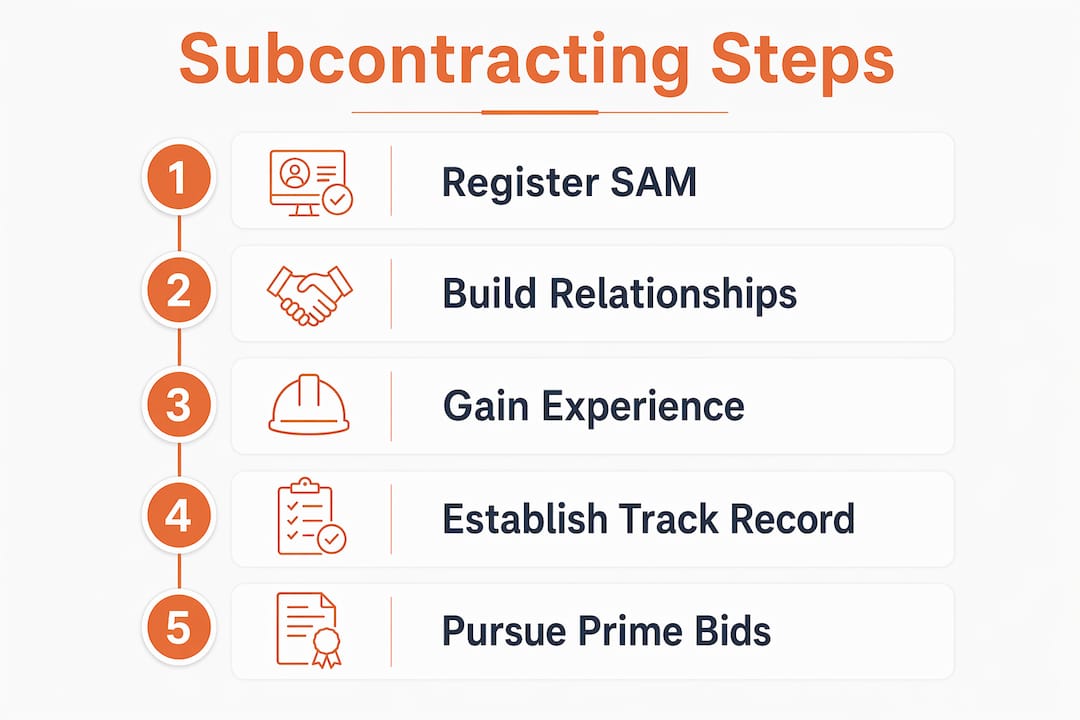
Once your SAM registration is active and your SBA profile is complete, you are positioned to pursue both prime contracts and subcontracting opportunities. Most construction firms find that starting with subcontracting builds the track record needed to win prime awards later.

What is subcontracting and why is it the best entry path for small construction firms
Subcontracting is the arrangement where a small business performs work under a contract held by a larger prime contractor, rather than holding the federal contract directly. The prime contractor signs the agreement with the federal agency and bears full legal and performance responsibility. The subcontractor delivers specific scopes of work, such as electrical, concrete, or site grading, under the prime’s direction. This distinction matters because subcontracting carries far fewer administrative and compliance burdens than prime contracting.
The SBA identifies subcontracting as a practical entry path for small firms not yet ready to compete as prime contractors. Here is why this strategy works particularly well for construction businesses:
- Lower compliance threshold: As a subcontractor, you are not required to hold an active SAM registration or submit a full bid package to the federal agency. Your relationship is with the prime, not the government directly.
- Past performance development: Federal contracting officers weigh past performance heavily in source selection. Subcontracting roles generate documented project experience that you can reference in future prime bids.
- Relationship building: Working alongside established primes introduces your firm to their project management standards, federal reporting expectations, and agency relationships. Many small construction firms build capabilities through subcontracting before pursuing prime awards.
- Access through SUBNet and Small Business Search: The SBA’s SUBNet database lists subcontracting opportunities posted by prime contractors with active subcontracting plan obligations. SBA’s Small Business Search allows primes to find your firm by NAICS code, certification, and location.
Starting as a subcontractor builds relationships and a track record that directly supports future prime contracting bids. The federal market rewards demonstrated performance above almost every other factor.
What set-aside programs give small construction businesses a competitive edge
Federal agencies set aside contracts exclusively for small businesses or specific socioeconomic categories, which narrows competition and significantly increases your probability of award. For construction firms, these programs are not optional extras. They are the primary mechanism through which small businesses win federal work without competing against large defense contractors and national construction firms.
The SBA administers the major set-aside programs. Here is how the most relevant ones compare for construction firms:
| Program | Eligibility requirement | Primary benefit for construction firms |
|---|---|---|
| 8(a) Business Development | Socially and economically disadvantaged individuals; SBA approval required | Sole-source awards up to $4.5 million for construction; nine-year program term |
| HUBZone | Business located and majority of employees working in a Historically Underutilized Business Zone | Competitive preference and price evaluation adjustments on set-aside bids |
| WOSB / EDWOSB | At least 51% owned and controlled by women; EDWOSB requires economic disadvantage | Set-asides in industries where women are underrepresented, including several construction NAICS codes |
| SDVOSB / VOSB | At least 51% owned and controlled by a service-disabled or other veteran | VA contracts and governmentwide set-asides; strong demand in facilities and infrastructure work |
Several points about these programs deserve emphasis:
- Certifications stack: A woman-owned, service-disabled veteran firm located in a HUBZone qualifies for multiple set-aside categories simultaneously, which multiplies the number of solicitations your firm can target.
- Filtering on SAM.gov: You can filter federal opportunities on SAM.gov by set-aside type, allowing your team to focus only on solicitations your firm is eligible to win.
- Certification timing: The 8(a) program requires SBA approval, which can take several months. Apply before you need it, not after you find an opportunity.
Filtering federal opportunities using set-aside categories allows construction firms to narrow competition to a fraction of the full bidder pool. A certified HUBZone construction firm competing against three other HUBZone firms faces a fundamentally different market than one competing open market against hundreds of bidders.
Understanding subcontracting plan compliance requirements for construction contracts
Federal construction contracts above $1.5 million trigger subcontracting plan requirements under FAR 52.219-9, which mandates that large prime contractors establish written goals for small business participation. This threshold is specific to construction and differs from the $750,000 threshold that applies to other federal contracts. The practical implication: if you are pursuing subcontracting work under a large prime on a federal construction project, that prime almost certainly has a legal obligation to include small businesses in their supply chain.
FAR 52.219-9 requires primes to set measurable percentage goals for multiple small business categories, including small disadvantaged businesses, women-owned small businesses, HUBZone firms, and service-disabled veteran-owned firms. These goals are not aspirational. They are contractual commitments that contracting officers evaluate during performance reviews.
The compliance structure includes several layers that affect small construction firms directly:
| Compliance element | What it means for your firm |
|---|---|
| Flow-down requirements | Primes must include subcontracting clauses in agreements with their subcontractors, extending obligations down the supply chain |
| eSRS reporting | Primes report subcontracting achievements through the Electronic Subcontracting Reporting System; your invoices and certifications feed this data |
| Goal categories | Plans must address SB, SDB, WOSB, HUBZone, SDVOSB, and VOSB separately, meaning certified firms fill specific slots in a prime’s compliance picture |
| Recordkeeping | Primes must document outreach efforts to small businesses, making your firm’s visibility in SBA databases directly relevant to being found |
Pro Tip: When approaching a prime contractor for subcontracting work, ask directly whether they have an active subcontracting plan. If they do, your certified status as a WOSB, HUBZone, or SDVOSB firm makes you a compliance asset to them, not just a vendor. That changes the conversation entirely.
Small construction firms with active SBA certifications become strategically valuable to primes managing subcontracting plan obligations. Understanding this dynamic gives you leverage in outreach conversations that most small businesses never use.
Key takeaways
Successful federal marketplace small business entry for construction firms requires SAM registration, SBA certification, and a deliberate subcontracting strategy before pursuing prime contracts.
| Point | Details |
|---|---|
| SAM registration is non-negotiable | Your business cannot bid as a prime contractor or appear in federal searches without an active SAM.gov registration. |
| Subcontracting is a proven entry path | Starting as a subcontractor builds past performance and relationships without the full compliance burden of prime contracting. |
| Set-aside certifications multiply opportunity | Programs like 8(a), HUBZone, WOSB, and SDVOSB narrow competition and open sole-source award channels unavailable to uncertified firms. |
| FAR 52.219-9 creates demand for certified firms | Construction contracts above $1.5 million require primes to include small businesses, making your certification a compliance asset to large contractors. |
| Profile completeness drives visibility | A complete SBA Small Business Search profile with accurate NAICS codes and certifications directly increases how often primes find and contact your firm. |
What I have learned working with construction firms entering federal contracting
After working with construction businesses at various stages of federal market entry, the single most consistent mistake I see is treating SAM registration as the finish line rather than the starting line. Firms complete their registration, list their NAICS codes, and then wait for contracts to appear. Federal contracting does not work that way. The firms that win work are the ones actively building relationships with prime contractors, attending industry days hosted by agencies like the Army Corps of Engineers or the Naval Facilities Engineering Systems Command, and positioning their certifications as solutions to a prime’s compliance obligations.
The subcontracting path is genuinely underrated. I have watched small construction firms with no federal past performance land meaningful subcontracts within six months of registration by targeting primes with active subcontracting plans and presenting their certifications clearly. That first subcontract becomes the past performance reference that opens the door to a prime bid twelve months later. The sequence matters more than most people realize.
Certifications take time, and that time cost is real. The 8(a) program in particular requires documentation, SBA review, and approval that can stretch across several months. My advice is to start the certification process before you have a specific opportunity in mind. The firms that wait until they find a perfect set-aside solicitation to begin their 8(a) application miss the window every time.
The one pitfall I see most often in construction specifically is underestimating the Davis-Bacon Act wage requirements on federally funded construction projects. These prevailing wage rules affect your labor cost estimates directly, and bids that ignore them either lose on compliance or lose money on execution. Build Davis-Bacon rates into your estimating process from day one.
— Rowena
How Federal-rconstructionsolutions helps construction firms enter federal contracting
Federal-rconstructionsolutions specializes in guiding small construction businesses through every stage of federal market entry, from initial SAM registration to subcontracting strategy and SBA certification support.
The team at Federal-rconstructionsolutions brings direct experience with federal procurement requirements specific to construction, including FAR compliance, RFP writing, and subcontracting plan support. Their federal procurement services are designed to reduce the time and guesswork involved in registration, certification, and bid preparation. For construction firms ready to pursue federal contracts with a structured plan behind them, Federal-rconstructionsolutions offers the specialized support that general business advisors cannot provide. You can also explore their USACE procurement support services for Army Corps of Engineers contract opportunities specifically.
FAQ
What is the first step for small construction businesses entering federal contracting?
Registration in SAM.gov is the mandatory first step. Without an active SAM registration, your business cannot bid as a prime contractor or appear in federal contractor searches.
Do small construction businesses need SAM registration to work as subcontractors?
SAM registration is required for prime contractors but not always for subcontractors. However, completing your SAM profile and SBA Small Business Search listing significantly increases how often prime contractors find and contact your firm for subcontracting opportunities.
What federal construction contracts require a subcontracting plan?
Federal construction contracts above $1.5 million require large prime contractors to submit a subcontracting plan under FAR 52.219-9, setting measurable goals for small business participation across multiple socioeconomic categories.
Which SBA set-aside program is best for a small construction firm?
The right program depends on your firm’s ownership and location. The 8(a) program offers the most direct path to sole-source awards, while HUBZone certification provides competitive advantages if your business and workforce are located in a qualifying zone. Many firms pursue multiple certifications simultaneously.
How long does it take to get an SBA certification like 8(a) or HUBZone?
The 8(a) program typically takes several months from application to approval due to SBA review requirements. HUBZone certification is generally faster. Both require documentation of ownership, control, and eligibility, so beginning the process well before you need the certification is the most practical approach.