
Why VA Contracts Prioritize SDVOSB Firms: A Construction Guide
The Department of Veterans Affairs is legally required to prioritize service-disabled veteran-owned small businesses (SDVOSBs) above every other small business category. That mandate comes directly from 38 U.S.C. 8127(h) and the Veterans First Contracting Program, which instructs contracting officers (COs) to consider SDVOSBs before 8(a) firms, HUBZone businesses, women-owned small businesses, or any other preference category. The operational trigger is the Rule of Two: if a CO can reasonably expect two or more verified, capable SDVOSBs to submit offers at a fair and reasonable price, a set-aside is mandatory, not optional.
The scale of this market matters. According to the Congressional Research Service, the VA attained 19.6% of its total procurement in VOSB/SDVOSB awards in FY2023, exceeding its own stated goals. Only the Department of Defense awards more contract dollars to veteran-owned firms. For construction businesses, that volume represents a concrete pipeline of facility renovation, infrastructure, and VA Medical Center (VAMC) projects where SDVOSB status changes your competitive position entirely.
Key entities to know before you read further:
- Department of Veterans Affairs (VA): the agency administering Veterans First and the largest civilian buyer of SDVOSB construction services
- Veterans First Contracting Program: the VA-specific preference program codified at 38 U.S.C. 8127–8128
- Center for Verification and Evaluation (CVE) / SBA VetCert: the verification body whose database COs check before making set-aside determinations
- Congressional Research Service (CRS): provides the most authoritative public analysis of SDVOSB program performance and legislative history
Table of Contents
- Why did Congress create the Veterans First priority for VA?
- How does the Rule of Two actually work for set-asides?
- What is the exact priority order under 38 U.S.C. 8127(h)?
- When can a VA CO award a sole-source contract to an SDVOSB?
- Does using a GSA schedule let the VA skip SDVOSB priorities?
- What does the VA priority mean for your construction business?
- Quick compliance checklist before responding to VA solicitations
- What timelines and pricing should you expect for VA construction work?
- Common pitfalls that cost bids or create compliance risk
- Your 30–90 day action plan for pursuing VA contracts
- Key Takeaways
- The part most construction firms get wrong about Veterans First
- How Federal-rconstructionsolutions helps you compete for VA work
- Useful sources and further reading
- FAQ
Why did Congress create the Veterans First priority for VA?
The Veterans First Contracting Program traces its legal foundation to Sections 502 and 503 of Public Law 109-461, the Veterans Benefits, Health Care, and Information Technology Act of 2006, which amended 38 U.S.C. 8127–8128. That legislation gave the VA specific authority to restrict competition to SDVOSBs and VOSBs, creating a preference hierarchy unique among federal agencies.
The legislative arc started earlier. The Veterans Entrepreneurship and Small Business Development Act of 1999 (P.L. 106-50) established the original government-wide 3% SDVOSB procurement goal. The Veterans Benefits Act of 2003 then authorized COs to award sole-source contracts to SDVOSBs to help reach that goal. Most recently, P.L. 118-31, the National Defense Authorization Act for FY2024, raised the government-wide SDVOSB goal to 5% of all prime and subcontract award dollars.
“The VA maintains a program limited to its agency, which reflects its long-standing commitment to contracting with veteran-owned small businesses. The prioritization of certain types of small business concerns is not a feature of government-wide small business contract preference programs and is unique to the VA.” — Congressional Research Service, CRS Report R47226
What makes the VA’s program distinct is that no government-wide procurement goal for nondisabled VOSBs exists. The VA created that layer itself, voluntarily, as an expression of its institutional mission.
How does the Rule of Two actually work for set-asides?
The Rule of Two is the practical gateway to every SDVOSB set-aside. Here is the process a CO follows:
- Market research: The CO surveys the VIP/SBA VetCert database and beta.SAM.gov to identify verified SDVOSBs with relevant NAICS codes and past performance.
- VIP verification check: Only firms certified in the SBA Veterans Small Business Certification (VetCert) portal count toward VA goals. Unverified firms do not satisfy the Rule of Two.
- Rule of Two determination: If the CO reasonably expects two or more eligible, capable, verified SDVOSBs to submit offers at a fair and reasonable price, a set-aside is mandatory under VAAR subpart 819.70.
- Award or escalation: If the Rule of Two is met, the CO issues an SDVOSB set-aside. If not, the CO may consider a sole-source award or step down to VOSB competition.
Scenario A — Set-aside triggered: A VAMC needs a $1.2 million HVAC renovation. The CO searches VetCert and finds three verified SDVOSB mechanical contractors with relevant past performance. Rule of Two is met; the solicitation is restricted to SDVOSBs only.
Scenario B — Sole source used: A VA clinic needs a $3 million emergency generator replacement. Market research surfaces only one verified SDVOSB with the required bonding capacity and past performance. The CO cannot meet the Rule of Two and instead documents a sole-source justification, awarding directly to that firm within the applicable threshold.

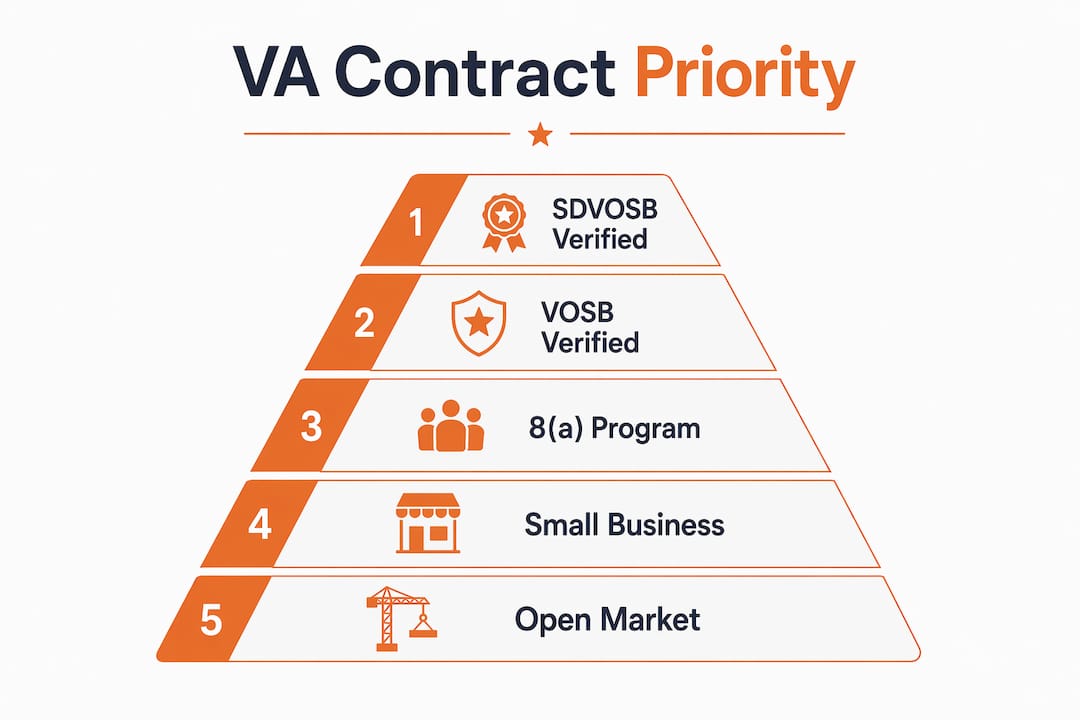
What is the exact priority order under 38 U.S.C. 8127(h)?
The VA’s priority hierarchy is fixed by statute and applies to every VA procurement above the micro-purchase threshold:
- (1) SDVOSB — small business owned and controlled by a veteran with a service-connected disability
- (2) VOSB — small business owned and controlled by a veteran without a service-connected disability
- (3) 8(a) or HUBZone — SBA-certified disadvantaged or historically underutilized business zone firms
- (4) Other small businesses — with due deference to women-owned small businesses (WOSB) per FAR 19.203.
This ordering supersedes FAR Part 19 preferences for VA procurements. A CO cannot skip to an 8(a) set-aside simply because an 8(a) firm is already on contract. The CO must document why SDVOSB and VOSB options were considered and exhausted first. For construction bidders, that documentation trail is your signal: if you are verified and capable, you belong at the top of the CO’s evaluation sequence.
When can a VA CO award a sole-source contract to an SDVOSB?
Sole-source authority gives COs a path to award without full competition when the Rule of Two cannot be met. The conditions are specific:
- The award value must not exceed $5 million including options under Veterans First rules
- The SDVOSB must be a responsible contractor capable of performing the work
- The CO must determine the price is fair and reasonable
- The CO must prepare a written justification documenting all three conditions
One nuance that affects construction firms: the CRS analysis notes that earlier legislation set a $5 million ceiling for manufacturing contracts and $3 million for nonmanufacturing. Current VA regulations consolidate the sole-source ceiling at $5 million including options for VA-specific awards, which covers most small renovation and repair scopes. Larger construction projects typically go to competitive set-asides rather than sole source, so your bonding capacity and past performance become the deciding factors at that scale.
Does using a GSA schedule let the VA skip SDVOSB priorities?
No. This is one of the most common misconceptions in federal construction procurement. Using a GSA Federal Supply Schedule, a multiple-award contract (MAC), or any other government-wide acquisition vehicle does not relieve a VA CO from applying Veterans First rules. Per 48 CFR guidance, the attainment of goals or the use of interagency vehicles does not exempt the CO from SDVOSB/VOSB set-asides and preferences under VAAR subpart 819.70.
In practice: if a VA facility places a task order under a GSA schedule for a $400,000 interior renovation, the CO must still check whether an SDVOSB set-aside is warranted before issuing the order to any schedule holder.
Pro Tip: If your firm holds a GSA schedule, make sure your SDVOSB certification is current in the SBA VetCert portal and that your schedule profile includes VA-relevant NAICS codes and past performance narratives. COs searching schedule holders for SDVOSB set-aside candidates will filter by both.
What does the VA priority mean for your construction business?
SDVOSB status changes the competitive math. Instead of competing against every small business in your NAICS code, you compete in a restricted pool where the CO is legally required to award to you first if two verified firms can perform the work. That is a structural advantage worth building your VA strategy around.
Concrete steps to translate that advantage into awards:
- Verify and maintain certification in the SBA VetCert portal; your status must be current at both offer submission and award
- Align your SAM.gov profile with the NAICS codes and PSC codes that match VA construction requirements (facility maintenance, renovation, utilities)
- Tailor your capability statement to VA-specific technical requirements: Davis-Bacon Act compliance, VA safety standards, and past performance on federal or VAMC-like projects
- Prepare bonding documentation in advance; COs evaluating Rule of Two feasibility will consider whether firms can bond the full contract value
- Document subcontracting plans using VA Form 0896A, expressing SDVOSB/VOSB subcontracting goals as a percentage of subcontract dollars per VA subcontracting requirements
Firms pursuing federal contracting as mid-sized builders will find that SDVOSB status amplifies every other competitive factor already in their favor.
Pro Tip: Send a brief capability statement directly to the VAMC or VA facility’s small business specialist before a solicitation drops. COs conducting market research rely on their own databases. A firm that has already introduced itself and demonstrated capability is far more likely to be counted in a Rule of Two determination.
Quick compliance checklist before responding to VA solicitations
Run through this list before submitting any offer or initiating CO outreach:
- Confirm SDVOSB certification is active in the SBA VetCert portal (veterans.certify.sba.gov)
- Verify SAM.gov registration is current, with matching legal name, NAICS codes, and cage code
- Confirm your government bid eligibility documentation is complete and up to date
- Prepare a current capability statement (one page, VA-focused, with past performance summaries)
- Obtain a current bonding letter from your surety covering the anticipated contract value
- Compile past performance references that include federal or VA-like projects with contact information
- Document your VetCert database query date and results in your procurement file
- Designate a single point of contact for VA CO outreach and solicitation questions
- Review subcontracting plan requirements if the contract value triggers a plan under FAR 19.702
- Confirm pricing reflects fair and reasonable market rates with cost backup documentation
For SBA role and CVE verification details, review the SBA’s VetCert guidance before your next solicitation cycle.
What timelines and pricing should you expect for VA construction work?
Set-aside competitions and sole-source awards follow different timelines. Here is a realistic picture:
- Market research and set-aside determination: 2–4 weeks before solicitation release for routine projects; longer for complex scopes requiring pre-solicitation notices
- Solicitation response window: typically 15–30 days for construction set-asides; shorter for simplified acquisitions below the simplified acquisition threshold (SAT)
- Evaluation and award: 30–60 days post-close for competitive set-asides; 15–30 days for sole-source awards once justification is approved
A small renovation set-aside (under $500,000) can move from solicitation to award in 45–60 days. A larger sole-source award at the $5 million ceiling typically takes 60–90 days because the CO must complete and approve the written justification before award.
On pricing: the fair and reasonable standard applies to every VA award, competitive or sole source. COs will compare your price against market data, independent government estimates, and prior awards. Pricing too high relative to the independent government estimate is the most common reason a sole-source justification fails. Build your estimate from documented labor rates, Davis-Bacon wage determinations, and current material costs, and keep that backup in your file.
Common pitfalls that cost bids or create compliance risk
- Misaligned SAM/VetCert entries: If your legal name, NAICS codes, or cage code differ between SAM.gov and VetCert, a CO may not count you in a Rule of Two determination. Audit both profiles quarterly.
- Inadequate past performance: A capability statement with no quantified past performance (contract value, scope, client contact) gives a CO no basis to assess capability. Include at least three references with dollar amounts and completion dates.
- Misuse of SDVOSB status in teaming: If you team with a non-SDVOSB prime and represent the team as SDVOSB-eligible, you expose both firms to misrepresentation liability. The prime must be the verified SDVOSB.
- Failure to document price reasonableness: For sole-source awards, the CO cannot proceed without a fair and reasonable price determination. If you cannot support your price with market data, the award stalls.
- Willful misrepresentation: Per VA regulations, the VA may debar a business and its principals for at least five years for willful misrepresentation of SDVOSB or VOSB status. That consequence ends your federal contracting career.
Review why small contractors lose their first federal bid for a broader look at avoidable mistakes before you submit.
Your 30–90 day action plan for pursuing VA contracts
- Days 0–30: Confirm SBA VetCert certification is active. Align SAM.gov profile with VA-relevant NAICS codes. Draft a one-page VA-focused capability statement with past performance summaries and bonding capacity.
- Days 30–60: Identify your target VAMC or VA facility. Contact the facility’s small business specialist or OSDBU representative. Search beta.SAM.gov and VetBiz for active solicitations matching your NAICS codes. Begin identifying teaming partners if your bonding or past performance has gaps.
- Days 60–90: Respond to your first solicitation or submit an unsolicited capability statement to a CO conducting market research. Refine your pricing templates against Davis-Bacon wage determinations and current material costs. Prepare a subcontracting plan template you can adapt quickly. Engage Federal-rconstructionsolutions for targeted proposal support if your first submission needs compliance review.
For a step-by-step entry framework, the federal marketplace construction guide covers the full sequence from registration through award.
Key Takeaways
The VA’s legal obligation to prioritize SDVOSBs under 38 U.S.C. 8127(h) makes verified SDVOSB status the single most powerful competitive tool a construction firm can hold when pursuing VA work.
| Point | Details |
|---|---|
| Statutory mandate | VA COs must follow the SDVOSB-first hierarchy under 38 U.S.C. 8127(h) before any other small business preference. |
| Rule of Two gateway | A set-aside is mandatory when two or more verified, capable SDVOSBs can compete at a fair and reasonable price. |
| Sole-source ceiling | VA sole-source awards to SDVOSBs are capped at $5 million including options; price justification is required. |
| GSA schedules included | Using a GSA Federal Supply Schedule does not exempt a VA CO from applying Veterans First set-aside rules. |
| Federal-rconstructionsolutions | RCS 5551 Pillar supports construction firms with SAM/VetCert alignment, capability statement development, and VA CO outreach to improve bid readiness and compliance. |
The part most construction firms get wrong about Veterans First
The conventional wisdom treats SDVOSB status as a checkbox: get certified, submit bids, win contracts. That framing misses the actual bottleneck. The Rule of Two is not just a legal test the CO applies. It is a test your firm either passes or fails before the solicitation is even written.
If a CO conducts market research and cannot find two verified, capable SDVOSBs in your trade, the set-aside never happens. Your competitors who are not SDVOSBs enter the competition. The preference that should have protected your position evaporates because you were not visible at the right moment.
The firms that consistently win VA set-asides are not necessarily the ones with the best technical proposals. They are the ones whose VetCert profiles are current, whose capability statements are already in the CO’s file, and who have had at least one substantive conversation with the facility’s small business specialist before the requirement hits beta.SAM. Verification is the entry ticket. Visibility is what gets you counted.
How Federal-rconstructionsolutions helps you compete for VA work
Construction firms that know they qualify for SDVOSB set-asides still lose VA bids because their compliance infrastructure is not ready when a solicitation drops. Federal-rconstructionsolutions’ federal procurement services address exactly that gap: SAM.gov and VetCert profile alignment, VA-focused capability statement development, subcontracting plan preparation, and direct CO outreach support.
R. Construction Solutions’ 5551 Pillar has supported clients through 90% compliance rates on bid submissions and has secured awards on public infrastructure projects where proposal quality and documentation accuracy made the difference. Whether you need a full proposal package or a targeted compliance review before your next VA solicitation, the VAMC construction support team is ready to work through the specifics with you.
Schedule a consultation to assess your current verification status and identify the VA opportunities best matched to your firm’s capabilities.
Useful sources and further reading
- 38 U.S.C. 8127–8128: The statutory foundation for Veterans First; use for legal citation verification and understanding CO authority
- VAAR Subpart 819.70 (acquisition.gov): The VA’s implementing regulations for Veterans First, including set-aside and sole-source procedures
- CRS Report R47226 (congress.gov): The Congressional Research Service’s analysis of SDVOSB/VOSB contracting programs; the most comprehensive public overview of program history, goals, and performance data
- 48 CFR Part 819 (govinfo.gov): Federal acquisition regulations governing small business programs, including VA-specific provisions
- SBA VetCert portal (veterans.certify.sba.gov): The active certification database COs check for Rule of Two determinations; keep your profile current here
- VetBiz portal (vetbiz.va.gov): VA’s small business program resources, including verification guidance and subcontracting plan requirements
- beta.SAM.gov: Primary source for active VA solicitations, contract awards, and market research data
- VA Form 0896A: Required for subcontracting plan submissions to OSDBU; download from the VA Office of Acquisition and Logistics
FAQ
What is the Veterans First Contracting Program?
The Veterans First Contracting Program is a VA-specific preference program codified at 38 U.S.C. 8127–8128 that requires VA contracting officers to prioritize SDVOSBs and VOSBs above all other small business categories before making any award.
What triggers an SDVOSB set-aside at the VA?
A set-aside is mandatory when a CO reasonably expects two or more verified, capable SDVOSBs to submit offers at a fair and reasonable price — the Rule of Two. Both firms must be certified in the SBA VetCert database at the time of offer and award.
How much can a VA sole-source award to an SDVOSB be worth?
VA sole-source awards to SDVOSBs may not exceed $5 million including options, and the CO must document that the price is fair and reasonable and that the firm is capable of performance.
Does SDVOSB status help if the VA uses a GSA schedule?
Yes. VA COs must still apply Veterans First set-aside rules when placing orders under GSA Federal Supply Schedules or other government-wide vehicles; using a schedule does not bypass the SDVOSB priority requirement.
What happens if a firm misrepresents its SDVOSB status?
The VA may debar the business and its principals for at least five years for willful misrepresentation of SDVOSB or VOSB status, effectively ending the firm’s ability to receive new federal contract awards for that period.