
SBA Role in Federal Contracting for Construction Firms
The Small Business Administration (SBA) is the federal agency responsible for certifying, supporting, and advocating for small businesses competing in the federal contracting marketplace. For small and mid-sized construction firms, understanding the role of SBA in federal contracting is the difference between winning government work and watching larger competitors take every contract. The federal government targets awarding 23% of all contracts to small businesses by statute. SBA administers the programs, certifications, and oversight mechanisms that make that goal achievable for firms like yours.
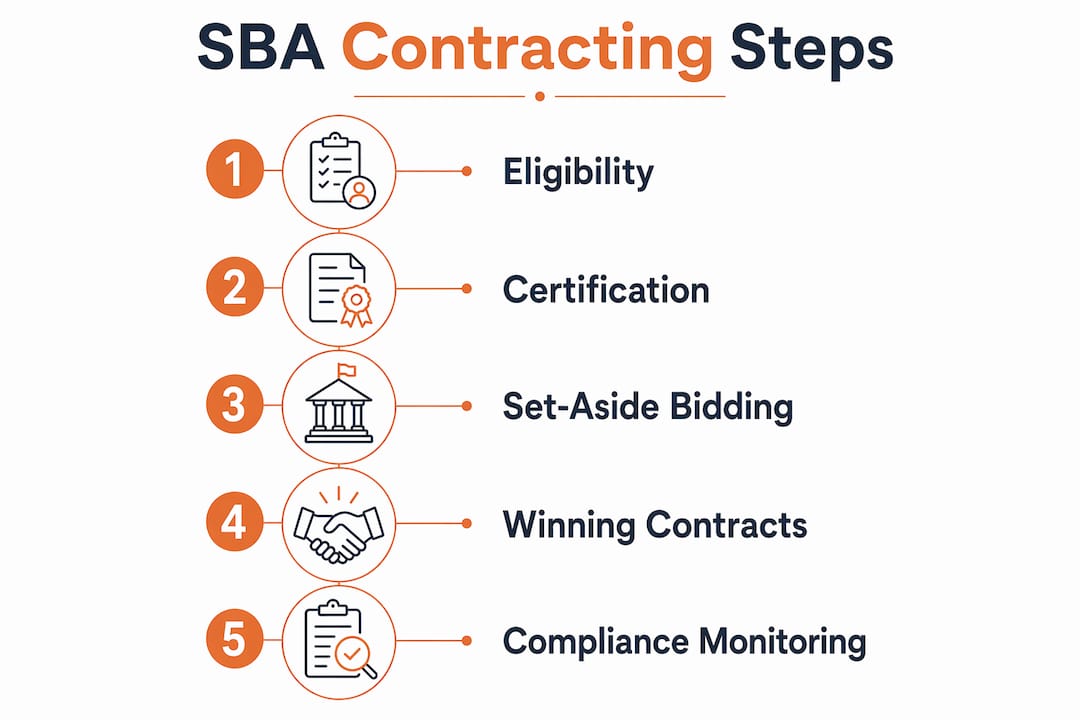
How SBA certification programs and set-aside policies work
SBA certification programs create reserved pathways into the federal market. Without them, large contractors with established agency relationships would dominate every procurement. SBA programs reduce competitive barriers through set-asides and sole-source awards, shrinking the competitive field so small construction firms can win on merit rather than volume.
The four major SBA certification programs each serve a distinct segment of the small business community:
- 8(a) Business Development Program: Designed for socially and economically disadvantaged business owners. Participants gain access to sole-source contracts and competitive set-asides for up to nine years. Construction firms in the 8(a) program can receive contracts without competing against the full market.
- Women-Owned Small Business (WOSB) Program: Targets industries where women are underrepresented, which includes several construction NAICS codes. The federal sub-goal for WOSB contracts is 5% of all prime and subcontract dollars.
- HUBZone Program: Rewards firms located in Historically Underutilized Business Zones with a 10% price evaluation preference and access to set-aside contracts. The federal sub-goal for HUBZone firms is 3%.
- Service-Disabled Veteran-Owned Small Business (SDVOSB) Program: Carries a 3% federal sub-goal and provides set-aside and sole-source access for qualifying veteran-owned construction companies.
Set-aside contracts are not optional preferences. Federal contracts above the micro-purchase threshold must be set aside for small businesses when there is a reasonable expectation of two or more competitive small business offers. That rule applies directly to construction task orders, design-build projects, and facility maintenance contracts across federal agencies.
The distinction between sole-source awards and competitive set-asides matters for your bid strategy. Sole-source awards go to a single firm without competition, typically under the 8(a) program for contracts below specific dollar thresholds. Competitive set-asides require at least two qualified small business offers but still exclude large businesses entirely.

SBA size standards for construction firms are calculated using average annual receipts. The specific threshold varies by NAICS code. A general building contractor may face a different size standard than a specialty trade contractor. Verify your NAICS code before certifying.
Pro Tip: Use the SBA’s free Size Standards Tool at sba.gov to confirm your firm qualifies as small under your specific construction NAICS code before submitting any certification application.
How does SBA enforce federal contracting goals?
SBA does not simply set targets and walk away. The agency negotiates agency-specific procurement goals with every federal department, and those individual goals sum to the statutory 23% small business target. That negotiation process gives SBA direct influence over how agencies like the Army Corps of Engineers, the Department of Veterans Affairs, and the General Services Administration structure their construction solicitations.
The Small Business Procurement Scorecard is SBA’s primary accountability tool. SBA publishes annual scorecards grading each agency on whether it met its small business contracting goals. Agencies that score poorly face pressure to restructure upcoming procurements to include more set-asides. For construction firms, this means agencies with low scores are actively looking for ways to increase small business awards, which creates real opportunity.
“SBA acts as an oversight entity ensuring agencies are held accountable for meeting small business procurement goals, creating incentives to increase small business participation.” — Congress.gov, An Overview of Small Business Contracting
Procurement Center Representatives (PCRs) are SBA employees stationed at major federal buying agencies. Their job is to review upcoming solicitations and push for set-aside designations when small businesses can realistically compete. If you are pursuing a large federal construction contract and believe it should be set aside, a PCR is the person to contact at that agency.
The over $700 billion federal procurement marketplace is accessible through SBA assistance programs. That scale means even a fraction of a percent shift in small business awards represents hundreds of millions of dollars in construction contracts.
What SBA resources help construction firms win federal contracts?
SBA provides free tools and counseling that reduce the cost of entering federal contracting. Construction firms that use these resources avoid paying consultants thousands of dollars for guidance that SBA offers at no charge.
-
SCORE Mentoring and Small Business Development Centers (SBDCs): SBA funds a national network of SBDCs and SCORE chapters. These centers provide one-on-one counseling on SAM.gov registration, proposal writing, and FAR compliance. Many SBDC advisors have direct federal contracting experience.
-
SBA SUBNet Database: SBA’s SUBNet database lists subcontracting opportunities posted by large prime contractors. Construction firms new to federal work use SUBNet to find subcontract roles on active projects, build past performance records, and establish relationships with primes before pursuing their own prime contracts.
-
Size Standards Tool: Available at sba.gov, this tool lets you enter your NAICS code and instantly see whether your firm qualifies as small. Knowing your size standard before you bid prevents disqualification and compliance violations.
-
Procurement Technical Assistance Centers (PTACs): PTACs are SBA-affiliated offices that provide direct bid preparation support. A PTAC counselor can review your technical proposal, check your pricing structure against federal norms, and confirm your compliance with Davis-Bacon Act wage requirements before submission.
-
SBA Learning Center: Free online courses cover federal acquisition regulations, contract lifecycle management, and certification program requirements. Construction owners who complete these courses understand the Federal Acquisition Regulation (FAR) well enough to write compliant proposals without outside help.
Pro Tip: Register on subcontract trade bidding platforms alongside SBA SUBNet to maximize your visibility to prime contractors actively seeking qualified small construction firms.
Past performance is the single biggest barrier for construction firms entering federal contracting. SBA’s subcontracting pathway directly solves that problem. A firm that completes two or three federal subcontracts has documented past performance it can cite on prime contract bids. That record is worth more than any certification alone.
Key compliance pitfalls for construction firms in SBA programs
Compliance failures in SBA programs carry serious consequences. Misrepresenting your business size or certification status is not a paperwork error. Under 13 CFR 121.108, knowingly misrepresenting size or status carries criminal penalties. Construction firms must calculate and document their size standard compliance carefully before every bid.
The most common compliance mistakes construction firms make include:
- Incorrect size standard calculation: SBA calculates construction size standards using average annual receipts over five fiscal years, combining total income and cost of goods sold. Firms that use only net income or calculate over three years instead of five will get the wrong number.
- Outdated SAM.gov registration: Federal contracts require an active SAM.gov registration. An expired registration disqualifies your bid automatically, regardless of your technical qualifications.
- Failing to update certifications after growth: A firm that grows past its size standard must stop representing itself as small. Continuing to bid as a small business after exceeding the threshold is a federal violation.
- Missing 8(a) eligibility documentation: The 8(a) program shifted to a fact-based eligibility standard in 2026, requiring applicants to prove verifiable social disadvantage with documented evidence rather than relying on presumptions. Applications without thorough documentation now face rejection.
“The changed 2026 eligibility criteria for the 8(a) program requires meticulous collection of evidence of social disadvantage, impacting application success rates and compliance strategies.” — SBA, 8(a) Program Reform
Proactive compliance means keeping a running file of your firm’s annual receipts, ownership documentation, and certification renewal dates. Federal contracting officers conduct size protests, and firms without clean records lose contracts they already won.
Key Takeaways
The SBA is the most direct path small and mid-sized construction firms have to compete in the $700+ billion federal procurement market through certifications, set-asides, and free counseling resources.
| Point | Details |
|---|---|
| Federal contracting goal | The government targets 23% of all contract dollars for small businesses by statute. |
| Certification programs | 8(a), WOSB, HUBZone, and SDVOSB each reduce competition and open set-aside contracts. |
| SBA enforcement tools | Annual scorecards and Procurement Center Representatives hold agencies accountable to small business goals. |
| Free SBA resources | SBDCs, PTACs, SUBNet, and the Size Standards Tool reduce entry costs for construction firms. |
| Compliance risk | Misrepresenting size or status under 13 CFR 121.108 carries criminal penalties. |
What I have learned about using SBA as a construction contractor
After working with construction firms across the federal procurement space, the pattern I see most often is this: firms that treat SBA as a one-time certification box to check rarely win consistently. Firms that treat SBA as an ongoing resource, returning to SBDCs for proposal reviews and monitoring scorecard data to identify agencies with low small business scores, build sustainable federal revenue streams.
The 2026 changes to the 8(a) program caught many applicants off guard. Firms that had relied on presumptive eligibility had to rebuild their applications from scratch with documented evidence of social disadvantage. The lesson is not to avoid the program. The lesson is to document everything from day one, before you apply, not after a rejection.
I also see mid-sized firms underuse SUBNet. A $15 million construction firm that thinks it is too large for subcontracting is leaving past performance records on the table. Federal prime contractors actively post opportunities on SUBNet for firms with exactly that capacity. One solid subcontract on a GSA facility project can anchor your past performance section for the next five years of prime bids.
The federal procurement lifecycle is long and structured. SBA’s role inside that lifecycle is to keep doors open for your firm at every stage. Use it that way.
— Rowena
Federal-rconstructionsolutions supports your SBA contracting path
Construction firms that understand SBA programs still need support translating certifications into winning bids. Federal-rconstructionsolutions provides federal procurement services built specifically for construction contractors, covering RFP writing, compliance documentation, and certification navigation.
The team at Federal-rconstructionsolutions has helped contractors achieve 90% compliance rates on federal bid submissions, including public water infrastructure projects where SBA set-aside designations were central to the award strategy. Whether you are pursuing your first federal construction contract or scaling an existing federal portfolio, the RCS 5551 Pillar procurement services give you the technical support to compete at the level SBA programs make possible.
FAQ
What is the role of SBA in federal contracting?
The SBA certifies small businesses, administers set-aside and sole-source programs, and enforces government-wide contracting goals to increase small business participation in the federal market.
What is the federal small business contracting goal?
The federal government targets awarding 23% of all prime contract dollars to small businesses, with sub-goals of 5% for women-owned, 3% for HUBZone, and 3% for service-disabled veteran-owned firms.
How does the SBA 8(a) program work for construction firms?
The 8(a) program gives qualifying construction firms access to sole-source contracts and competitive set-asides for up to nine years. As of 2026, applicants must provide documented evidence of social disadvantage to qualify.
What is SBA SUBNet and how does it help construction companies?
SBA SUBNet is a free database where large prime contractors post subcontracting opportunities. Construction firms use it to build past performance records before pursuing prime contracts independently.
What happens if a construction firm misrepresents its size status?
Knowingly misrepresenting business size or certification status violates 13 CFR 121.108 and carries criminal penalties. Firms must calculate and document size standard compliance accurately before every federal bid.

