
Why Compliance Failures Disqualify Bids on Federal Contracts
Compliance failures disqualify federal construction bids by rendering them nonresponsive under the Federal Acquisition Regulation (FAR), which triggers immediate rejection before any price or technical evaluation begins. In federal procurement, “nonresponsive” is the official industry term for a bid that does not meet mandatory solicitation requirements. Contracting officers apply this standard without exception. A missing bond, an unacknowledged amendment, or a late submission each carry the same consequence: your bid goes no further. Understanding why compliance failures disqualify bids is the first step toward building a submission process that actually wins contracts.
Why compliance failures disqualify bids before evaluation begins
A federal bid fails compliance when it does not satisfy every mandatory requirement stated in the solicitation. Contracting officers conduct an administrative compliance review before any technical or price scoring takes place. If your submission does not pass that review, evaluators never see your qualifications or your price.
The FAR governs this process through Parts 14 and 15. FAR Part 14 covers sealed bidding, where the rules are absolute. FAR Part 15 covers negotiated procurement, where limited discussions are sometimes possible. In sealed bidding, no discussions are permitted, which means your bid stands or falls exactly as submitted. There is no opportunity to correct an error after the fact.

Section L of the solicitation defines the instructions to offerors. Section M defines the evaluation factors. Contracting officers treat Section L requirements as binding, not as suggestions. Violating either section’s requirements can remove your bid from consideration entirely.
What are the most common compliance failures that disqualify federal bids?
Bid rejection almost always traces back to one of a predictable set of errors. Knowing these errors by name lets you build a checklist that catches them before submission.
- Missing bonds and certifications. Performance and payment bonds are mandatory on most federal construction contracts. Omitting required bonds causes immediate disqualification. Bonding costs run approximately 2–3% of contract value, so failing to include them wastes the entire bid investment.
- Unacknowledged solicitation amendments. Agencies issue amendments to update scope, pricing schedules, or submission deadlines. Failing to acknowledge amendments is the most frequent cause of fatal bid errors, according to GAO bid protest rulings.
- Late submissions. FAR 52.215-1 defines the late proposal rule with no flexibility. Submissions arriving late, even by minutes, face automatic rejection. Time zones and designated submission inboxes matter critically.
- Formatting and page limit violations. Section L specifies font size, page limits, and volume structure. Exceeding page limits or missing required volumes can disqualify the entire submission, not just the affected section.
- Improper or missing signatures. The SF-1442 is the standard solicitation form for federal construction contracts. Unsigned or incorrectly authorized forms make a bid nonresponsive and invalid under FAR rules.
- Missed pre-bid site visits. Some solicitations require attendance at a mandatory site visit. Missing it disqualifies your firm regardless of how strong the rest of your bid is.
- Pricing schedule errors. Math errors or incomplete pricing schedules create ambiguity that contracting officers cannot resolve in sealed bidding. The bid is rejected rather than clarified.
Pro Tip: Read Section L line by line and build your compliance checklist directly from its requirements. Treat every “shall” as a hard requirement, not a preference.
How does the federal evaluation process handle compliance failures?
Contracting officers follow a two-stage review. The first stage is administrative compliance. The second stage is technical and price evaluation. A bid that fails stage one never reaches stage two.
| Review stage | What is checked | Consequence of failure |
|---|---|---|
| Administrative compliance | Bonds, certifications, signatures, amendments, deadlines | Immediate rejection, no further review |
| Technical evaluation | Approach, qualifications, past performance | Low score or disqualification |
| Price evaluation | Pricing schedule, math accuracy, reasonableness | Rejection or negotiation (negotiated only) |
| Final ranking | Combined technical and price score | Award decision |
The distinction between sealed bidding and negotiated procurement matters here. Under FAR Part 14 sealed bidding, contracting officers cannot hold discussions or request corrections. Under FAR Part 15 negotiated procurement, limited exchanges are possible, but agencies are not required to raise every deficiency. Relying on the agency to catch your mistakes is not a viable strategy.
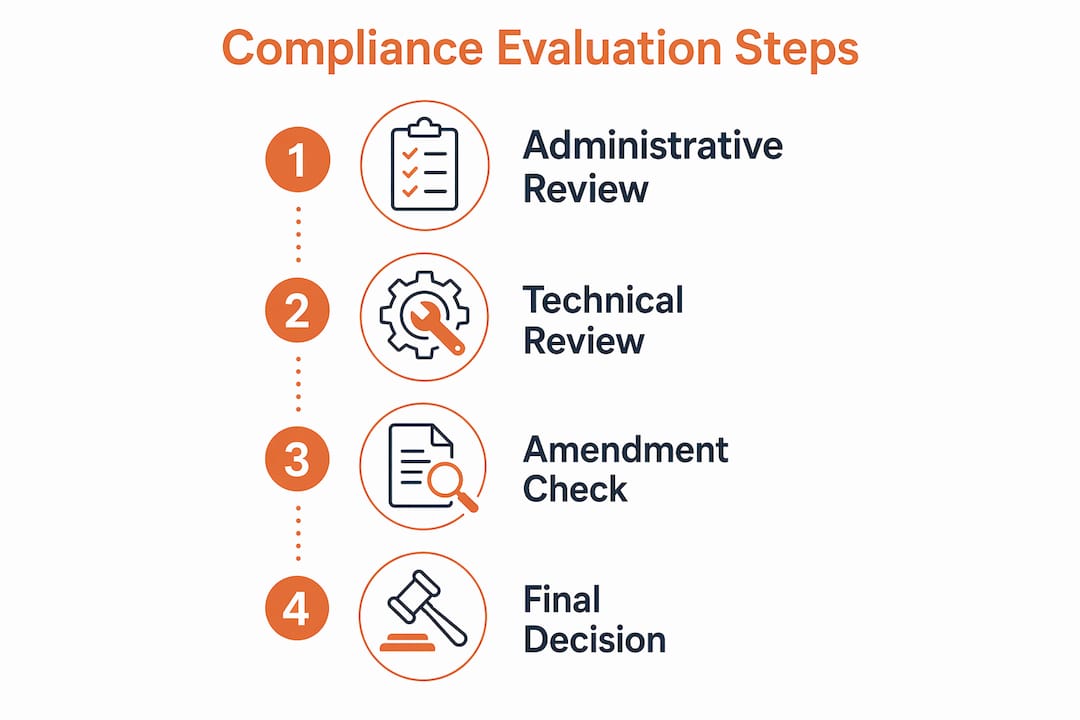
Evaluation teams score only what appears in the written submission. Clear documentation and cross-referencing to RFP requirements are vital because evaluators cannot credit work that is implied but not stated. A contractor who completes every required task but fails to document it in the correct section receives no credit for that work.
Why is acknowledging amendments critical and what counts as a material amendment?
A solicitation amendment is material when it affects price, quantity, quality, delivery, or any other term that could influence a bidder’s decision to compete or how they price their offer. Failing to acknowledge a material amendment makes a bid nonresponsive, regardless of how minor the change appears on the surface.
The Government Accountability Office (GAO) has sustained bid protests specifically on this issue. In a february 2026 ruling, GAO found that failure to acknowledge an IFB amendment was fatal to the bid, even when the contractor believed the change was insignificant. The ruling confirmed that materiality is determined by the nature of the change, not the contractor’s assessment of its importance.
Contractors frequently underestimate amendment materiality. A change to a wage determination under the Davis-Bacon Act, a revised delivery schedule, or a corrected drawing set each qualifies as material. Any one of these, left unacknowledged, renders the entire bid nonresponsive.
Best practices for managing amendments include:
- Assign one person to monitor SAM.gov daily for amendment postings throughout the solicitation period.
- Log each amendment by number, date, and the specific sections it modifies.
- Confirm acknowledgment on the bid form before submission, not as an afterthought.
- Review whether the amendment changes your price, scope, or schedule, and update your submission accordingly.
Contractors who treat amendment tracking as a clerical task rather than a compliance requirement pay for that mistake with a rejected bid. The impact of compliance failures in this area is direct and unrecoverable once the submission deadline passes.
How can contractors build a submission process that prevents disqualification?
A repeatable compliance process is the most reliable defense against bid rejection. The goal is to make compliance a structured habit, not a last-minute scramble.
-
Download Section L on day one. Pull the instructions to offerors immediately when the solicitation is released. Build your compliance checklist from its exact requirements before you write a single word of the proposal.
-
Create a master document list. Identify every required form, certification, bond, and attachment. The federal procurement compliance checklist approach works best when it mirrors the solicitation’s own structure.
-
Assign submission roles. One person owns the technical volume. One person owns the pricing schedule. One person owns the compliance package, including bonds, certifications, and signatures. Shared ownership creates gaps.
-
Set an internal deadline 48 hours before the agency deadline. Late submissions face automatic rejection under FAR 52.215-1. Submitting early eliminates time zone errors, portal failures, and last-minute file problems.
-
Cross-reference every response to Section M. Evaluation factors in Section M define how your bid is scored. Every claim in your technical volume should reference the specific evaluation criterion it satisfies. Evaluators score only written submissions, so make the connection explicit.
-
Conduct a compliance audit 72 hours before submission. Have someone who did not write the proposal read Section L and verify that every requirement is met. Fresh eyes catch errors that writers overlook.
-
Verify amendment acknowledgments last. Check SAM.gov the morning of your internal deadline to confirm no new amendments were posted. Acknowledge every amendment on the bid form.
Pro Tip: Treat your compliance audit like a pre-flight checklist. A pilot does not skip checklist items because the flight seems routine. Neither should you skip compliance steps because the solicitation seems familiar.
Contractors new to federal work often learn these lessons the hard way. Reviewing why small contractors lose their first federal bid reveals that most first-time disqualifications trace back to exactly these preventable errors. Winning builder contracts in any market, including competitive construction markets, depends on the same discipline: read the requirements, meet every one of them, and submit on time.
Key Takeaways
Compliance failures disqualify federal construction bids because contracting officers reject nonresponsive submissions before technical or price evaluation begins, with no opportunity for correction under FAR Part 14 sealed bidding rules.
| Point | Details |
|---|---|
| Nonresponsiveness triggers immediate rejection | A bid that fails administrative compliance is rejected before evaluators see your price or qualifications. |
| Amendment acknowledgment is non-negotiable | GAO rulings confirm that failing to acknowledge a material amendment is a fatal, unrecoverable error. |
| Section L is legally binding | Formatting violations, missing volumes, and page limit breaches can disqualify an entire submission. |
| Late submissions have no exceptions | FAR 52.215-1 mandates automatic rejection for late proposals; submit at least 48 hours early. |
| Compliance requires a structured process | A checklist built directly from Section L, with assigned roles and an internal deadline, prevents most disqualifications. |
What I’ve learned about compliance after years in federal procurement
By Rowena
The contractors I’ve seen lose the most bids are not the ones with weak technical proposals. They are the ones who treat compliance as the last box to check rather than the first. Federal procurement does not reward good intentions. It rewards complete, timely, and correctly formatted submissions.
The 2026 GAO ruling on amendment acknowledgment is a perfect example of how unforgiving this system is. A contractor submitted a strong bid, missed one amendment acknowledgment, and lost the contract. The agency had no authority to waive the deficiency. The GAO upheld the rejection. That outcome is not unusual. It is the rule.
What I tell every contractor I work with is this: read Section L as if it were a legal contract, because it is. Every “shall” is an obligation. Every page limit is a hard cap. Every deadline is absolute. The federal government does not grade on a curve.
The good news is that compliance is entirely within your control. You do not need to be the lowest bidder to win. You do need to be the most compliant bidder to stay in the competition. Build the process once, refine it on every bid, and disqualification becomes rare rather than routine.
— Rowena
Federal-rconstructionsolutions can help you submit with confidence
Compliance support is one of the most valuable investments a federal contractor can make. Federal-rconstructionsolutions brings deep expertise in federal procurement to construction businesses that want to stop losing bids to preventable errors.
Through the RCS 5551 Pillar, Federal-rconstructionsolutions helps contractors achieve 90% compliance rates on bid submissions. The team reviews Section L requirements, tracks amendments, verifies required documents, and audits submissions before the deadline. For contractors pursuing U.S. Army Corps of Engineers work, the USACE procurement support program provides specialized compliance and quality control assistance tailored to USACE solicitation standards. If you are ready to submit bids that pass administrative review every time, Federal-rconstructionsolutions is the partner built for that work.
FAQ
What makes a federal bid nonresponsive?
A bid is nonresponsive when it fails to meet a mandatory solicitation requirement, such as missing a required bond, an unacknowledged amendment, or an unsigned form. Contracting officers reject nonresponsive bids before any technical or price evaluation takes place.
Can a contractor fix a compliance error after submission?
Under FAR Part 14 sealed bidding, no corrections or discussions are permitted after submission. The bid stands exactly as submitted, and any compliance failure results in automatic rejection.
How material does an amendment have to be to require acknowledgment?
An amendment is material if it affects price, quantity, quality, delivery, or any term that could influence a bidder’s decision to compete. GAO rulings confirm that failing to acknowledge a material amendment is a fatal error, regardless of how minor the change appears.
What is the penalty for submitting a bid late?
FAR 52.215-1 mandates automatic rejection for late proposals, with very narrow exceptions. Even a submission that arrives minutes after the deadline is rejected without review.
Where should contractors start when building a compliance process?
Start with Section L of the solicitation. Build a compliance checklist directly from its requirements on the day the solicitation is released, assign clear ownership for each required document, and set an internal submission deadline at least 48 hours before the agency deadline.