
What Is a Pre-Bid Conference? A Practical Guide
A pre-bid conference is a formally scheduled meeting between a procuring agency and prospective bidders, held before proposals are due, to clarify solicitation requirements and reduce ambiguity before bids are submitted. Its primary purpose is to give all competing contractors the same accurate information so that bids reflect actual project scope rather than guesswork. Under FAR 14.207, federal agencies may convene pre-bid conferences for complex acquisitions, with the explicit caveat that a conference cannot substitute for amending an ambiguous solicitation. State agencies follow similar logic: the Texas Department of Transportation and the GSA both treat the pre-bid conference as a structured clarification tool, not a venue for informal deal-making.
Table of Contents
- What happens during a pre-bid conference?
- Who runs the meeting and who should attend?
- When should you schedule a pre-bid conference?
- Is attendance mandatory or optional?
- How should bidders prepare for a pre-bid conference?
- How should minutes, Q&A, and addenda be handled?
- What are the biggest risks agencies face, and how do you reduce them?
- Sample agenda and minutes template you can use today
- Key Takeaways
- The part most agencies and bidders get wrong
- Federal-rconstructionsolutions helps you get pre-bid right
- Useful sources and further reading
- FAQ
What happens during a pre-bid conference?
Most conferences follow a predictable sequence, and knowing it in advance helps you use the time well. The contracting officer opens with introductions and a scope overview, then walks through key contract clauses, schedule milestones, and any unusual technical requirements. After the formal presentation, the floor opens for contractor questions. Those questions are recorded verbatim, and official answers are issued in writing after the meeting.
Pre-bid meetings improve bidders’ ability to estimate accurately by allowing direct Q&A with the owner and design team, which surfaces issues that would otherwise cause under- or over-pricing. A site walk, when included, typically follows the indoor session so that questions raised during the walk can be documented alongside the conference Q&A.
Common agenda items include:
- Project scope overview and contract type
- Key schedule milestones and phasing requirements
- Submittal and RFI procedures
- Site access rules and safety requirements
- Bonding, insurance, and wage determination requirements
- DBE/MBE subcontracting goals and documentation
- Addenda process and bid opening logistics
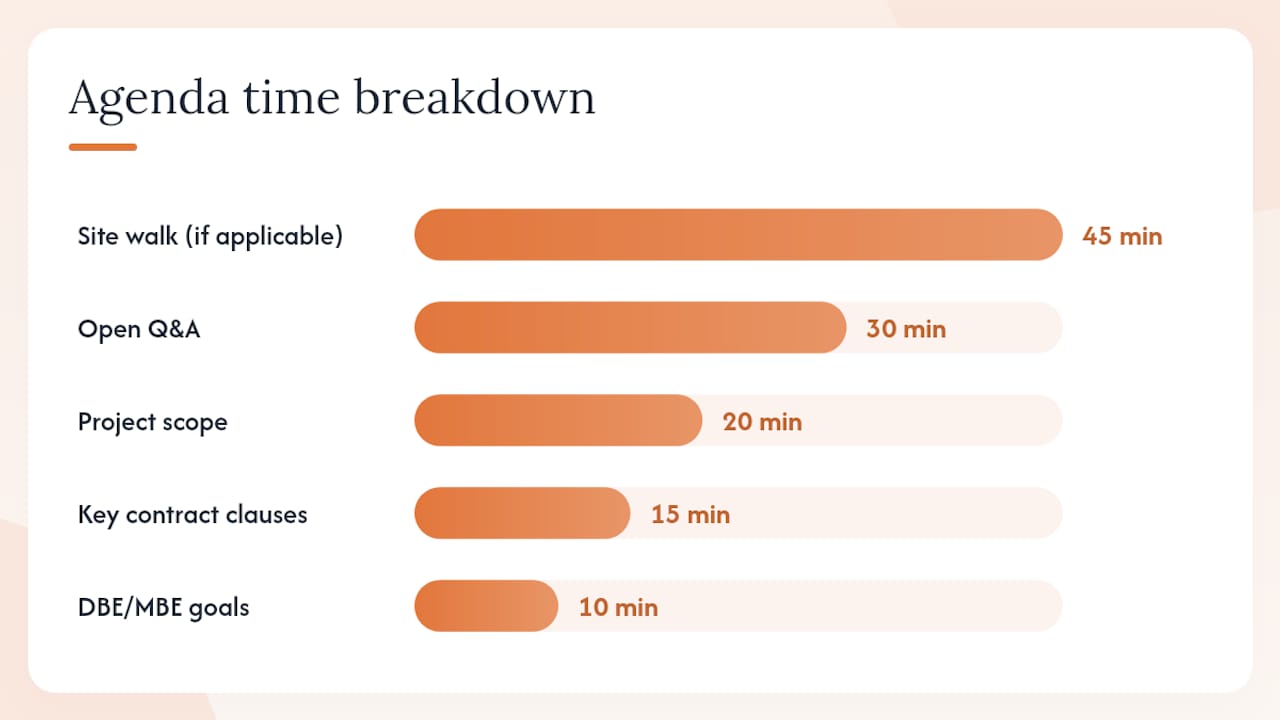
A brief sample agenda might run: 8:00 AM introductions and scope overview; 8:30 AM contract clause review; 9:00 AM open Q&A; 9:45 AM site walk (if applicable); 10:30 AM close and next steps.
Who runs the meeting and who should attend?
The contracting officer or contracting officer’s representative (COR) chairs the conference and controls what goes on the record. The project manager or lead engineer handles technical questions. Procurement officers manage logistics, and subject matter experts (SMEs) for disciplines like geotechnical, environmental, or IT sit in when the project demands it.
On the bidder side, the right attendees depend on project complexity. For a federal construction contract, that typically means an estimator, a project manager, and representatives from key specialty subcontractors. A safety or QA representative adds value on projects with unusual site hazards.
MRSC recommends that agencies provide written agendas and sign-in sheets, and that technical SMEs attend mandatory meetings. Attendance also ties directly to bidder responsibility screening: agencies can note which firms showed up, which signals genuine interest and organizational capacity.
| Role | Typical Responsibilities | Why Attendance Matters |
|---|---|---|
| Contracting Officer / COR | Chairs meeting, controls official record | Sole authority to issue binding clarifications |
| Project Manager / Engineer | Answers technical scope questions | Reduces misinterpretation of drawings and specs |
| Procurement Officer | Manages logistics, sign-in, minutes | Ensures procedural compliance |
| Technical SMEs | Address discipline-specific questions | Prevents costly scope assumptions |
| Bidder Estimator | Identifies pricing ambiguities | Produces more accurate bid |
| Bidder Project Manager | Assesses schedule and execution risks | Flags execution constraints early |
| Specialty Subcontractor Reps | Clarify trade-specific scope | Reduces subcontractor scope gaps |
When should you schedule a pre-bid conference?
Timing is one of the most consequential decisions an agency makes. TxDOT schedules pre-bid conferences approximately two weeks before bid letting to allow enough time to draft, review, and distribute addenda before the bid opening. That two-week window is a practical floor, not a ceiling: highly complex projects benefit from even more lead time.
When both a site visit and a conference are on the agenda, hold the site visit first. Bidders who have walked the site ask sharper, more specific questions during the conference, which produces better official answers and fewer post-award disputes.
Location and format decisions matter too. In-person conferences remain standard for projects with complex sites, but hybrid and fully virtual formats have become common for services and IT procurements. Regardless of format, require a sign-in sheet with full contact information. Late arrivals should be accommodated when possible, and agencies should document their arrival time.
Pro Tip: If you are making attendance mandatory, offer at least two session options or a virtual alternative. A single mandatory session held at an inconvenient time or location can inadvertently restrict competition and create protest exposure.
Is attendance mandatory or optional?
Mandatory attendance is justified in a narrow set of circumstances: projects with restricted site access, highly technical scopes where uninformed bids create execution risk, or situations where the agency needs to verify bidder qualifications in person. Outside those scenarios, most procurement guidance cautions against it.
The reason is practical. Under 48 CFR § 1352.270-71, failure to attend a pre-bid conference does not in itself create grounds for a protest or claim. Making attendance mandatory without a defensible rationale can shrink your bidder pool, invite procedural challenges, and complicate the award process. MRSC notes that agencies sometimes use mandatory meetings as a functional filter to screen serious bidders, but the fairness and competition trade-offs deserve careful consideration before going that route.
When mandatory attendance is announced, the solicitation should include:
- A clear statement that attendance is required to submit a bid
- Date, time, location, and virtual access details
- A deadline for registering or confirming attendance
- Instructions for requesting accommodations
- A contact name for questions about the requirement itself
- A statement that late arrivals will be documented
How should bidders prepare for a pre-bid conference?
Preparation before the meeting separates contractors who leave with usable answers from those who leave with more questions. Start by reading the full solicitation, marking every ambiguity, undefined term, or scope gap. If the agency accepts advance written questions, submit them early: written questions submitted before the conference are more likely to receive thorough official answers.
Bring the right people and the right documents. An estimator without the drawings cannot price a clarification on the spot. A project manager without the spec sections cannot evaluate a schedule constraint.
| What to Bring | Why It Matters |
|---|---|
| Full solicitation package (drawings, specs, amendments) | Lets you cross-reference answers against actual documents |
| List of pre-written questions by spec section | Keeps your questions organized and on the record |
| Estimating notes and preliminary takeoff | Helps you identify pricing ambiguities in real time |
| Subcontractor contact list | Allows immediate follow-up on trade-specific clarifications |
| Notebook or recording device (if permitted) | Captures nuance that minutes may abbreviate |
After the meeting, do not rely on memory or informal notes. Confirm any verbal answer that matters to your bid in writing to the contracting officer, and wait for the official addendum before adjusting your price. Contractors who skip this step often discover at award that the verbal answer they priced was never officially issued.
Suggested question categories:
- Site conditions: access restrictions, utility conflicts, soil reports available
- Schedule: phasing constraints, liquidated damages, weather days
- Key specifications: substitution approval process, submittal lead times
- Procurement process: addenda timeline, bid form requirements, award criteria
How should minutes, Q&A, and addenda be handled?
Verbal comments made during a pre-bid conference are not contractually binding until the agency issues a written addendum. This is the single most important procedural fact for both agencies and bidders. FAR 14.207 is explicit: a pre-bid conference cannot substitute for amending an ambiguous solicitation. The written addendum is the only document that changes the solicitation.
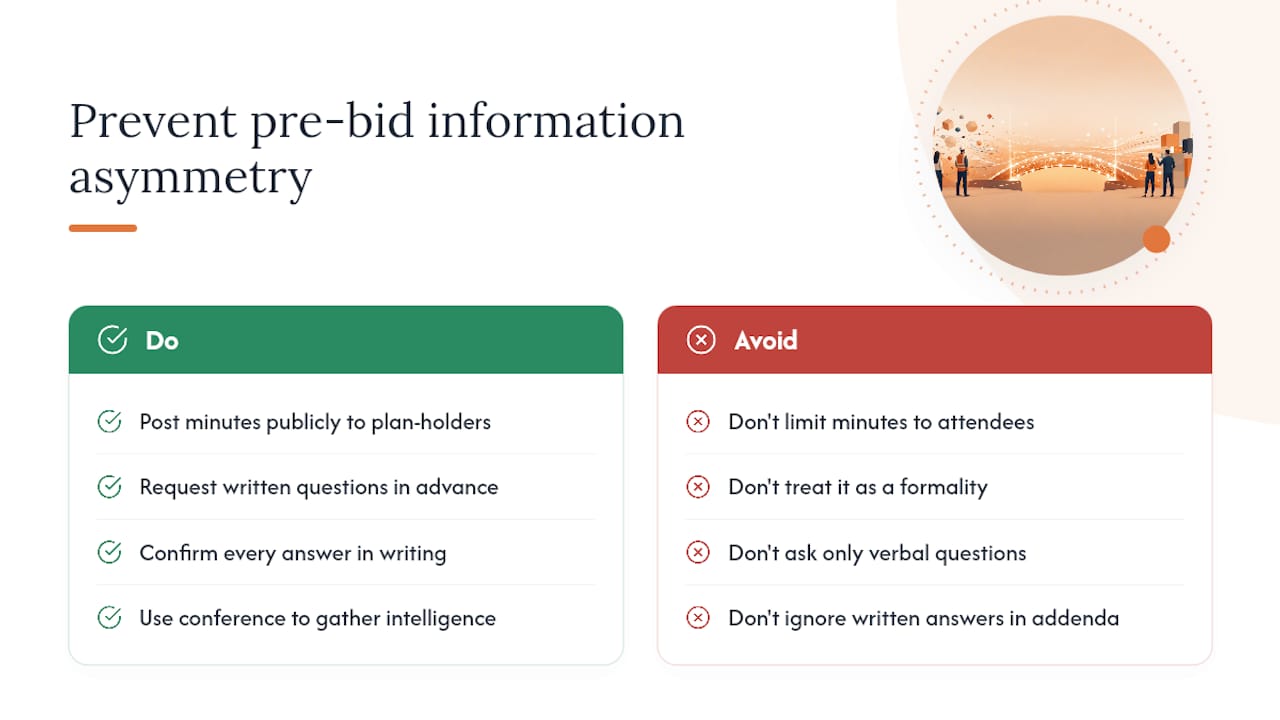
TxDOT requires minutes for all pre-bid conferences and mandates distribution to all attendees. Best practice extends that distribution to the full plan-holders list, not just those who attended. Minutes should capture: the attendance list with contact information, each question asked (verbatim when possible), the agency’s official response or a notation that a written addendum will follow, and any clarifying statements about solicitation interpretation.
Poorly managed pre-bid meetings frequently create protest risk, with inconsistent answers and failure to issue addenda as the two leading causes. Posting minutes publicly on the agency’s procurement portal, SAM.gov, or the project’s plan-holders page closes that gap. Every bidder, whether they attended or not, receives the same information.
What are the biggest risks agencies face, and how do you reduce them?
The most common agency failures at pre-bid conferences are preventable. Inconsistent verbal answers given to different bidders, failure to convert those answers into addenda, and scheduling that leaves too little time for addenda before the bid opening are the top three. Each one creates protest exposure.
Agency best-practice checklist:
- Issue a written agenda before the conference
- Require advance written questions when the project is technically complex
- Keep a sign-in sheet with full contact information for every attendee
- Record all questions and answers verbatim in the minutes
- Distribute minutes to the full plan-holders list within 48 hours
- Issue addenda for every substantive verbal clarification before the bid opening
- Offer multiple sessions or virtual access if attendance is mandatory
- Include explicit language in minutes stating that only written addenda alter the solicitation
A compliant pre-bid process under FAR and common state practices looks like this: written agenda distributed in advance, sign-in sheet maintained, minutes issued to all plan-holders, and addenda posted publicly before the bid deadline. Consistent written follow-up and equal distribution of minutes are the two practices that most reliably reduce protest risk.
Sample agenda and minutes template you can use today
Sample Pre-Bid Conference Agenda
Project: [Project Name and Contract Number] Date/Time: [Date], [Start Time] – [End Time] Location: [Address / Virtual Link]
- Welcome and introductions (10 min)
- Project scope and contract overview (20 min)
- Key contract clauses: schedule, bonding, insurance, wage determinations (15 min)
- DBE/MBE goals and subcontracting requirements (10 min)
- Submittal, RFI, and addenda procedures (10 min)
- Open Q&A (30 min)
- Site walk (if applicable) (45 min)
- Closing remarks and next steps (5 min)
Note: Only written addenda issued by the contracting officer alter the terms of the solicitation. Verbal statements made during this conference are not binding.
Sample Minutes Template
Project: [Project Name and Contract Number] Conference Date: [Date] Prepared by: [Name, Title] Distribution: All plan-holders
Attendance: [Attach sign-in sheet]
| # | Question (Verbatim) | Official Response | Addendum Required? |
|---|---|---|---|
| 1 | [Question text] | [Response text] | Yes / No |
| 2 | [Question text] | [Response text] | Yes / No |
Closing statement: All verbal responses above are subject to written confirmation. Any change to the solicitation will be issued as a formal addendum and distributed to all plan-holders. Bidders should not adjust their proposals based on verbal statements alone.
Post minutes to: [Agency procurement portal / SAM.gov / plan-holders email list] within 48 hours of the conference.
Key Takeaways
A pre-bid conference clarifies solicitation requirements for all bidders, but only a written addendum makes any clarification legally binding.
| Point | Details |
|---|---|
| Verbal answers are not binding | Only written addenda issued by the contracting officer change the solicitation. |
| Schedule at least two weeks out | Allow enough time to draft and distribute addenda before the bid opening date. |
| Distribute minutes to all plan-holders | Send minutes to every firm on the plan-holders list, not just conference attendees. |
| Mandatory attendance carries risk | Requiring attendance without a defensible rationale can restrict competition and invite protests. |
| Federal-rconstructionsolutions supports the full process | From FAR-compliant RFP writing to addenda management, Federal-rconstructionsolutions helps construction firms navigate pre-bid procedures and submit compliant bids. |
The part most agencies and bidders get wrong
Pre-bid conferences get treated as a formality when they are actually one of the highest-leverage moments in the entire procurement cycle. The agency that runs a tight, well-documented conference reduces its change order exposure downstream. The contractor who prepares seriously and confirms every answer in writing prices more accurately and protests less.
What gets overlooked most often is the distribution step. Agencies that issue minutes only to attendees create an information asymmetry: bidders who could not attend, perhaps because of travel costs or scheduling conflicts, are now pricing a different project than those who were in the room. That asymmetry is both unfair and legally fragile. Posting minutes publicly, to the full plan-holders list, is not optional best practice. It is the procedural floor.
For bidders, the underrated move is submitting written questions before the conference rather than waiting to ask them in the room. Advance questions get more considered answers, and those answers are more likely to make it into a formal addendum. A question asked verbally in a crowded room is easy to abbreviate in the minutes. A question submitted in writing is harder to ignore.
The firms that treat pre-bid conferences as a genuine intelligence-gathering exercise, rather than a box to check, consistently produce better bids. That preparation also feeds directly into stronger RFP responses because the answers you collect become the foundation of your technical approach.
Federal-rconstructionsolutions helps you get pre-bid right
Running a compliant, well-documented pre-bid process takes more than showing up. It requires FAR-aligned solicitation language, a defensible minutes protocol, and addenda management that holds up to scrutiny. Federal-rconstructionsolutions brings that expertise directly to construction companies pursuing federal contracts, handling RFP writing, FAR and Davis-Bacon compliance, plan-holder management, and addenda support so your team can focus on pricing the work.
Whether you are a contractor preparing for your first federal pre-bid conference or an agency looking to tighten your procurement procedures, Federal-rconstructionsolutions offers the hands-on support that turns a confusing process into a repeatable one. The federal procurement consulting services at RCS 5551 Pillar cover the full pre-award cycle, from opportunity identification through compliant bid submission. For Corps of Engineers projects specifically, the USACE procurement support team handles conference planning and compliance documentation. Schedule a consultation to see where your current process has gaps.
Useful sources and further reading
These are the primary regulatory and practitioner references to consult when drafting agendas, minutes, and addenda for pre-bid conferences:
- 14.207 Pre-bid conference. — FAR
- Pre-Bid Conference — TxDOT CST CAH
- Bidding and Awarding a Public Works Contract — MRSC
- How pre-bid meetings impact construction bidding — Procore
- Pre-Bid Meetings Raise Compliance Concerns – Procurement Office
- Pre-Bid Meetings and Site Visits: A Complete Guide
- § 1352.270-71 - Pre-bid/pre-proposal conference and site visit. — 48 CFR
For construction software terminology that comes up during technical pre-bid discussions, the construction software glossary at DesignFlow Build covers scheduling, takeoff, and ERP terms in plain language.
This article provides general procurement guidance and is not legal advice. Confirm current regulatory requirements with your agency’s legal counsel or the applicable primary source before finalizing pre-bid procedures.
FAQ
What happens during a pre-bid conference?
The contracting officer opens with a scope overview and contract clause review, then facilitates an open Q&A session where bidders ask questions that are recorded for the official minutes. A site walk may follow if the project involves complex field conditions.
How should you prepare for a pre-bid meeting?
Review the full solicitation before attending, mark every ambiguity, and submit written questions in advance if the agency allows it. Bring your estimator, key subcontractor representatives, and a complete set of drawings and spec sections.
What is the point of a pre-bid conference?
A pre-bid conference gives all competing bidders the same accurate information about project scope, schedule, and requirements before bids are due, reducing pricing errors and post-award disputes. Under FAR 14.207, it also serves as a formal mechanism for surfacing solicitation ambiguities that must then be resolved through written addenda.
Is a pre-bid conference mandatory?
Attendance is mandatory only when the agency explicitly requires it in the solicitation, typically for projects with restricted site access or highly technical scopes. Under 48 CFR § 1352.270-71, failure to attend does not in itself create grounds for a protest, and agencies that impose mandatory attendance without a defensible rationale risk restricting competition.
Do verbal answers at a pre-bid conference change the solicitation?
No. Verbal statements made during a pre-bid conference are not binding until the agency issues a written addendum. Bidders should confirm any answer that affects their price in writing and wait for the official addendum before adjusting their proposal.