
Building a Bid Pipeline for Your Construction Business
A bid pipeline is the organized system a construction business uses to identify, qualify, track, and pursue project opportunities before they reach a final award decision. Without a managed pipeline, your estimating team reacts to whatever lands in the inbox, which produces inconsistent revenue and wasted effort. The industry average win rate sits at 20%, but firms that apply data-backed pipeline management push that figure above 35%. Building a bid pipeline for your construction business is the single most controllable factor in your revenue growth, whether you pursue federal contracts, private commercial work, or both.
How to build a bid pipeline for your construction business
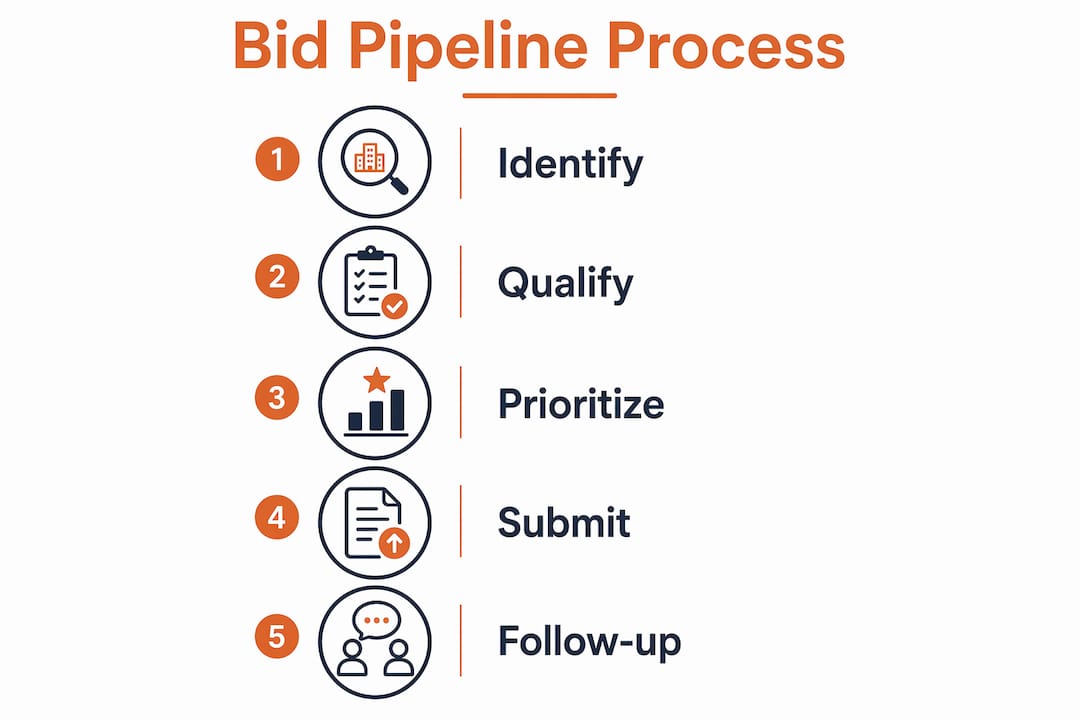
A bid pipeline, also called a pursuit pipeline or project pipeline, is not a spreadsheet of open bids. It is a living system that tracks every opportunity from first identification through contract award. The pipeline gives you forward visibility so you can plan staffing, bonding capacity, and cash flow weeks or months ahead of a project start.
The core insight is this: firms that treat pipeline development as a daily operational discipline win more work at better margins. Federal-rconstructionsolutions reports that clients who add private sector opportunities to a federal-focused pipeline can achieve 30% more consistent revenue and 20% higher overall profitability. That combination of public and private work smooths the revenue gaps that kill smaller firms.

What tools and prerequisites do you need first?
Before you source a single bid, you need three foundational elements in place: verified data sources, a tracking system, and a clear capacity model.
Verified project data sources
Public sector opportunities appear on SAM.gov for federal contracts, state procurement portals for state-funded work, and local government websites for municipal projects. Private sector leads require a different approach. Planning permit databases, architectural design-phase reports, and owner relationship networks surface private commercial projects 12+ months before a formal bid invitation goes out. Most firms lose early advantage by waiting for reactive bid invitations. Scanning design-phase data lets you engage owners and architects before the project is even priced.
Tracking and CRM tools
Your tracking system must log every opportunity with consistent fields: project name, owner, estimated value, bid date, decision status, and assigned estimator. Entry-level field apps handle basic logging. Enterprise platforms add weighted pipeline views, automated deadline alerts, and integration with estimating software. The right choice depends on your volume. A firm bidding 10 projects per month needs different infrastructure than one bidding 50.
| Pipeline element | What to track | Why it matters |
|---|---|---|
| Project identification | Source, owner, location, project type | Filters fit from noise early |
| Bid qualification | NAICS code, bonding limit, capacity fit | Prevents wasted estimating hours |
| Submission status | Bid date, submitted amount, competitors | Enables post-bid analysis |
| Award outcome | Win/loss, award amount, reason for loss | Sharpens future bid decisions |
Capacity and bonding thresholds
Your pipeline should never exceed what your bonding limit and staffing can support. Construction executives should trigger staffing reviews when staff utilization reaches 80%. Bonding capacity sets a hard ceiling on the total value of work you can pursue simultaneously. Know your numbers before you fill the pipeline.
How do you source, qualify, and prioritize construction bids?
Sourcing bids without a qualification filter produces bid bloat. Bid bloat is the condition where your estimating team is always busy but rarely winning, because they are pricing projects that were never a good fit.
Step 1: Use multiple sourcing channels
- Federal portals: SAM.gov, beta.SAM.gov, and agency-specific procurement pages publish solicitations under FAR-governed contracts.
- State and local portals: Most states maintain public bid boards. Many require registration under a specific NAICS code.
- Private sector networks: Owner relationships, architect contacts, and general contractor prequalification lists surface private work before public advertising.
- Planning and permit data: Building permit filings and zoning applications reveal projects 6–18 months before bid. This is the highest-value sourcing channel most firms underuse.
Pro Tip: Set up automated alerts on SAM.gov filtered by your NAICS codes and geographic region. You will receive new solicitations the day they post, giving you maximum preparation time.
Step 2: Apply a formal bid/no-bid decision
A formal bid/no-bid process is the most efficient tool for protecting your estimating team’s time. Successful firms pass on 30–50% of incoming leads using a rigorous qualification framework. That is not lost opportunity. That is focused effort on projects where you have a real competitive advantage.
Score each opportunity against these criteria before committing estimating hours:
- Project type fit: Does this match your license, bonding, and experience history?
- Geographic reach: Can you staff and supervise this project profitably?
- Owner relationship: Do you know the owner, architect, or GC? Relationships win negotiated work.
- Margin potential: Public projects carry margins of 2%–5% with 5–10 competing bidders. Private negotiated work often yields better margins with fewer competitors.
- Capacity availability: Does your current workload allow you to execute this project without overextending?
Step 3: Prioritize by fit and profitability
Rank qualified opportunities by probability of win multiplied by estimated gross profit. A $2 million project with a 40% win probability and a 6% margin outranks a $5 million project with a 10% win probability and a 3% margin. This weighted view prevents your team from chasing volume at the expense of profitability.
How do you track and manage your pipeline for consistent results?
Systematic tracking gives you 60–90 days of forward revenue visibility, which is the minimum needed for sound management decisions. Without that visibility, you cannot plan hiring, equipment purchases, or bonding renewals with confidence.
Key metrics to monitor
- Win rate: Total contracts awarded divided by total bids submitted. The industry average is 20%. Target 35% or higher with disciplined qualification.
- Bid-to-build ratio: The ratio of estimated project value to actual awarded value. A wide gap signals pricing or scope problems.
- Average project value: Tracks whether your pipeline is moving toward larger, more profitable work over time.
- Pipeline weighted value: Each open bid multiplied by its estimated win probability. This is your forward revenue forecast.
Pro Tip: Color-code your bid log by stage: red for opportunities not yet qualified, yellow for active bids in progress, and green for submitted bids awaiting award. A single glance tells you where your pipeline is healthy and where it needs attention.
Review cadence
A weekly pipeline review with a formal go/no-go process prevents missed deadlines and stale opportunities. The weekly meeting should cover new opportunities entered, bids due within 14 days, and any submitted bids with pending award decisions. A monthly review adds a broader look at win rate trends, capacity utilization, and pipeline value against revenue targets.
| Review type | Frequency | Focus |
|---|---|---|
| Operational review | Weekly | Active bids, deadlines, go/no-go decisions |
| Pipeline health review | Monthly | Win rate, weighted value, capacity vs. backlog |
| Strategic review | Quarterly | Market mix, client concentration, NAICS targeting |
A bid pipeline should function as a revenue engine with standardized workflows and technology infrastructure. As your volume grows, informal tracking collapses. Assign one person, typically a VP of Preconstruction or a senior estimator, to own pipeline integrity. That ownership prevents data gaps that distort your forecasts.
What follow-up strategies convert pipeline opportunities into contracts?
Submitting a bid is not the end of the pursuit. Post-submission follow-up is critical for capturing client feedback and competitive intelligence, and it directly increases your rate of negotiated work wins.
Most estimators submit and wait. The firms that win more work call the owner or GC within 48 hours of submission to confirm receipt, ask about the evaluation timeline, and offer to clarify any scope questions. That call keeps your name in front of the decision-maker while competitors go silent.
Relationship-building strategies that convert pipeline to contracts include:
- Request debrief meetings after every loss. Ask specifically what the winning firm did differently on price, scope, or qualifications. This intelligence sharpens your next bid.
- Track competitor pricing patterns. Maintaining a detailed bid log that captures competitors’ winning bids and reasons for loss enables you to target future opportunities where your pricing is competitive.
- Build owner and architect relationships during design. Firms that engage owners at the design phase, before a bid is ever issued, position themselves as trusted advisors rather than anonymous bidders.
- Assign senior leadership as pursuit champions. For high-value opportunities, the CEO or VP of Business Development should make personal contact with the owner. That signal of commitment differentiates you from firms that send only estimators.
- Maintain subcontractor relationships actively. Top contractors win more bids because deep subcontractor networks produce better pricing and faster responses, which directly improves bid competitiveness.
Key Takeaways
A disciplined bid pipeline built on qualified leads, systematic tracking, and proactive follow-up is the most reliable path to improving your construction business win rate above the industry average of 20%.
| Point | Details |
|---|---|
| Define your pipeline early | Treat every opportunity as a tracked record from first identification, not from bid day. |
| Apply bid/no-bid discipline | Pass on 30–50% of leads to protect estimating capacity for high-probability projects. |
| Track key metrics weekly | Monitor win rate, weighted pipeline value, and capacity utilization every week. |
| Follow up after every submission | Contact the owner within 48 hours to gather feedback and stay visible. |
| Combine federal and private work | Mixing public and private contracts produces more consistent revenue across market cycles. |
Why pipeline discipline is the real competitive advantage
I have worked with construction business owners who run excellent field operations but treat business development as an afterthought. They bid everything that comes in, track nothing consistently, and wonder why revenue swings wildly from quarter to quarter. The problem is never the quality of their work. The problem is the absence of a managed pipeline.
The firms I have seen grow steadily share one habit: they treat the pipeline as a core operational function, not a sales activity. They assign ownership, hold regular reviews, and make go/no-bid decisions with the same rigor they apply to a project schedule. That discipline is what separates a firm that reacts to the market from one that shapes its own backlog.
The uncomfortable truth about construction bidding strategies is that winning more bids is not about bidding more. It is about bidding smarter. A firm that submits 20 well-qualified bids per year and wins 7 of them outperforms a firm that submits 60 bids and wins 10. The first firm spends less on estimating, carries less risk, and builds deeper relationships with the owners it pursues. That is the model worth copying.
The construction bid win rate conversation always comes back to qualification. The firms that qualify ruthlessly win consistently. The firms that chase volume burn out their estimating teams and erode margins. Choose the first path.
— Rowena
How Federal-rconstructionsolutions supports your pipeline growth
Federal-rconstructionsolutions helps construction businesses build and manage bid pipelines across both federal and private sector markets.
Federal procurement carries compliance requirements under FAR, Davis-Bacon Act wage determinations, and agency-specific prequalification standards that can slow down even experienced contractors. Federal-rconstructionsolutions’ 5551 Pillar delivers federal procurement services that support RFP writing, compliance documentation, and bid submission with a 90% compliance rate for successful submissions. For firms ready to expand beyond government work, the private sector services team provides bid sourcing, qualification support, and pursuit management to help you capture the higher margins that private commercial work offers. Reach out to Federal-rconstructionsolutions to build a pipeline that works in both markets.
FAQ
What is a bid pipeline in construction?
A bid pipeline is a tracked system of project opportunities at various stages from identification through contract award. It gives construction businesses forward visibility into revenue and workload so they can plan staffing and resources.
How many bids should a construction firm submit per month?
Volume depends on your capacity and qualification criteria. Successful firms pass on 30–50% of incoming leads and focus estimating effort on projects with the highest probability of winning at a profitable margin.
What is a good construction bid win rate?
The industry average win rate is 20%. Firms that apply data-backed pipeline management and rigorous bid/no-bid qualification consistently achieve win rates above 35%.
How far in advance should you identify construction opportunities?
Early identification via planning permits and design-phase data can surface opportunities 12 or more months before a formal bid is issued. That lead time allows relationship building with owners and architects before competitors engage.
How often should you review your construction bid pipeline?
A weekly operational review covers active bids and upcoming deadlines. A monthly review examines win rate trends, weighted pipeline value, and capacity against backlog targets.