
Construction SEO That Wins Residential vs Commercial Bids, 90 Day Plan
Three levers drive most of the qualified leads construction companies get from search: a fully optimized Google Business Profile, three to five high-intent service pages, and detailed project case studies. GBP fixes can shift map-pack visibility within 30 to 90 days, while organic leads from service pages usually take several months to build momentum. Start this week by locking in the right GBP primary category, uploading five recent project photos, and asking three past customers for a review that mentions the specific service performed.
TL;DR:
- Focusing on optimizing your Google Business Profile with an accurate primary category, regular photo updates, and review management can produce visible results within 30 to 90 days.
- Building or rewriting 3-5 service-specific pages with unique content and clear calls-to-action is essential, but organic lead growth typically takes three to six months or longer.
- Producing detailed project case studies that highlight measurable results and add schema markup can significantly improve conversion and trust signals over the next two months.
- Addressing technical issues such as site speed, mobile responsiveness, and citation consistency should follow after initial profile and content improvements, with ongoing social media activity supporting site authority.
- Analyzing competitors’ local search presence and backlinks reveals opportunities to differentiate your website and acquire relevant, industry-specific links for sustainable growth.
Table of Contents
- Why GBP, Service Pages, and Case Studies Move the Needle
- Your 90-Day Action Plan, Step by Step
- The Technical Checklist That Stops Silent SEO Failures
- Building Content for Residential vs. Commercial Buyers
- How to Track ROI and Know SEO Is Working
- Publishing Proof That Google and Buyers Actually Trust
- Backlink Building Techniques Tailored to Construction Businesses
- Competitor Analysis in Construction Industry SEO
- Utilizing Social Media Platforms to Support SEO
- Deciding Whether to Hire or Do SEO Yourself
- Sources
- FAQ
Why GBP, Service Pages, and Case Studies Move the Needle
Each of these three levers works on a different part of the buyer’s decision, which is why together they cover more ground than a scattershot content calendar. Construction SEO done right combines technical optimization, localized pages, and proof, and a small, focused set of assets tends to produce the bulk of the valuable leads for most firms.
Google Business Profile is often the fastest-moving piece. Choosing the most specific primary category available (Roofing Contractor instead of General Contractor, for instance) tells Google exactly which searches you should appear for. From there:
- Fill out every service and hours field completely, no placeholders.
- Upload fresh project photos weekly, not just once at setup.
- Answer the Q&A section proactively before customers post confusing questions.
- Respond to every review, good or bad, within a few days.
Service pages need one target keyword each, a clear H1 and meta description, and a short FAQ block that answers real buyer questions. Skip the temptation to clone a single page across ten cities with find-and-replace. That approach rarely holds up in search results because the content offers nothing unique to any single location.
Project case studies should walk through the challenge, scope, approach, timeline, and measurable value, backed by real photos. Adding Project or CreativeWork schema markup and a clear call to action turns a portfolio piece into a page that actually converts.
Your 90-Day Action Plan, Step by Step
Trying to fix everything at once is how most SEO efforts stall. Sequence the work instead.
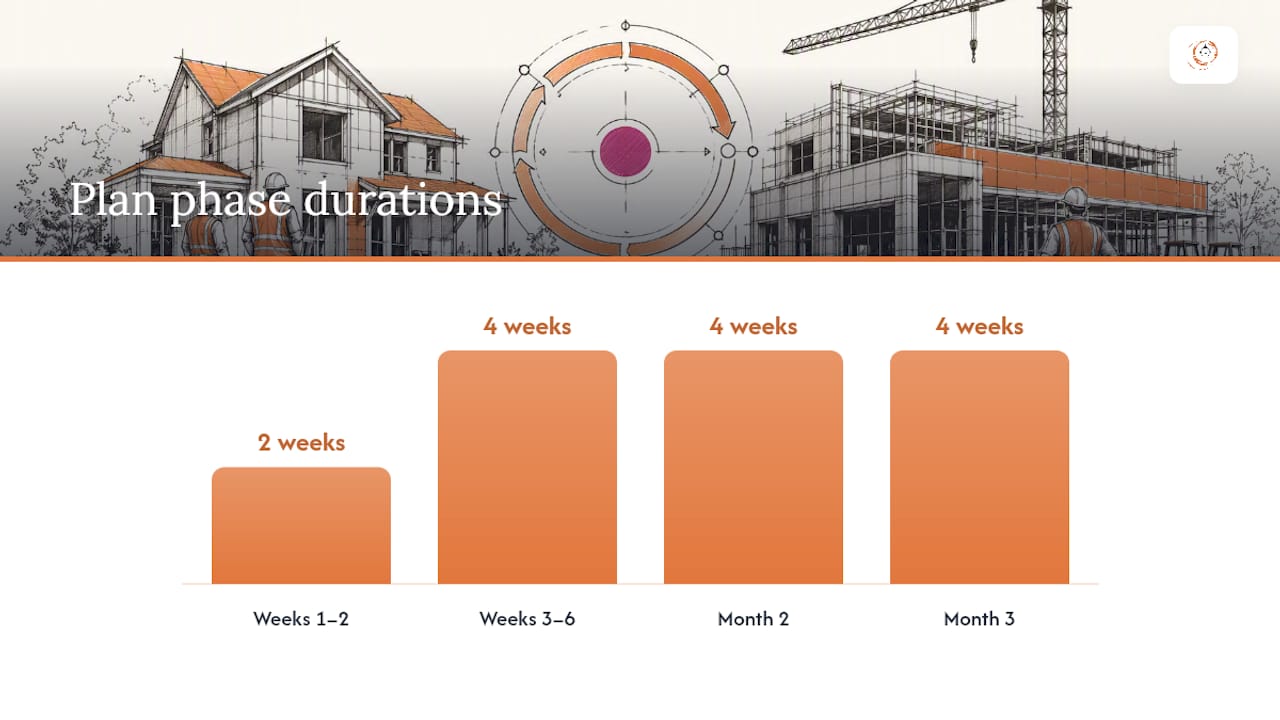
- Weeks 1 to 2: Audit your GBP listing, fix the primary category, add five project photos, and request reviews from three recent customers, each mentioning the specific service completed.
- Weeks 3 to 6: Publish or rewrite three to five focused service pages, each with a distinct CTA and, where it makes sense, a genuine service-area variant rather than a copy-paste clone.
- Month 2: Produce two detailed project case studies with real, verifiable facts. Add Project or CreativeWork schema markup so search engines and AI tools can parse the details.
- Month 3: Fix site speed and mobile issues, clean up your top 20 citations for name, address, and phone (NAP) consistency, and run one outreach push, whether that’s local press coverage or a supplier feature.
- Ongoing: Keep posting GBP photos weekly and update your case studies or blog monthly so the site never goes stale.
Pro Tip: Batch your project photos the day a job wraps, before the crew leaves the site. Waiting even a week means you’ll likely forget the shots that actually sell the work, like the before-and-after angle on a foundation pour.
This isn’t a one-and-done sprint. Treat these 90 days as the foundation you build on every quarter after, with GBP updates and case study production becoming a permanent part of your marketing rhythm.
The Technical Checklist That Stops Silent SEO Failures
Plenty of construction sites lose leads to technical problems nobody notices until it’s too late.
- Indexing: Confirm your sitemap is submitted, robots.txt isn’t blocking key pages, canonical tags point where they should, and Google Search Console shows no crawl errors.
- Speed: Watch Largest Contentful Paint and Cumulative Layout Shift. Compress images and enable server caching for quick wins.
- Mobile: Every page needs a responsive layout, large readable CTA buttons, and a tap-to-call number that actually works.
- Schema: Add LocalBusiness or Organization markup site-wide, plus Service and Project/CreativeWork schema on relevant pages.
- Avoid: Thin, duplicate service-area pages built by swapping city names into the same template. That pattern is one of the most common reasons contractor sites underperform.
A professionally built website handles most of this by default, which is worth factoring in if your current site was thrown together years ago.
Building Content for Residential vs. Commercial Buyers
Residential and commercial buyers research jobs completely differently, and your content should reflect that. Residential SEO leans on local intent and map-pack visibility, while commercial SEO depends on trust built over a long pre-RFP research window.
- Residential: Local service-plus-city pages, straightforward cost and timeline pages, and quick portfolio photos with local context (the neighborhood, the permit process, the typical project length).
- Commercial: Long-form case studies, project pages that disclose budgets and timelines where permitted, industry-specific pages (healthcare facilities, hospitality, municipal work), and links to relevant construction market research that shows you understand their sector.
- Priority order for both tracks: cost pages, permit and timeline pages, a how-we-work page, and two to three deep case studies with real numbers attached.
How to Track ROI and Know SEO Is Working
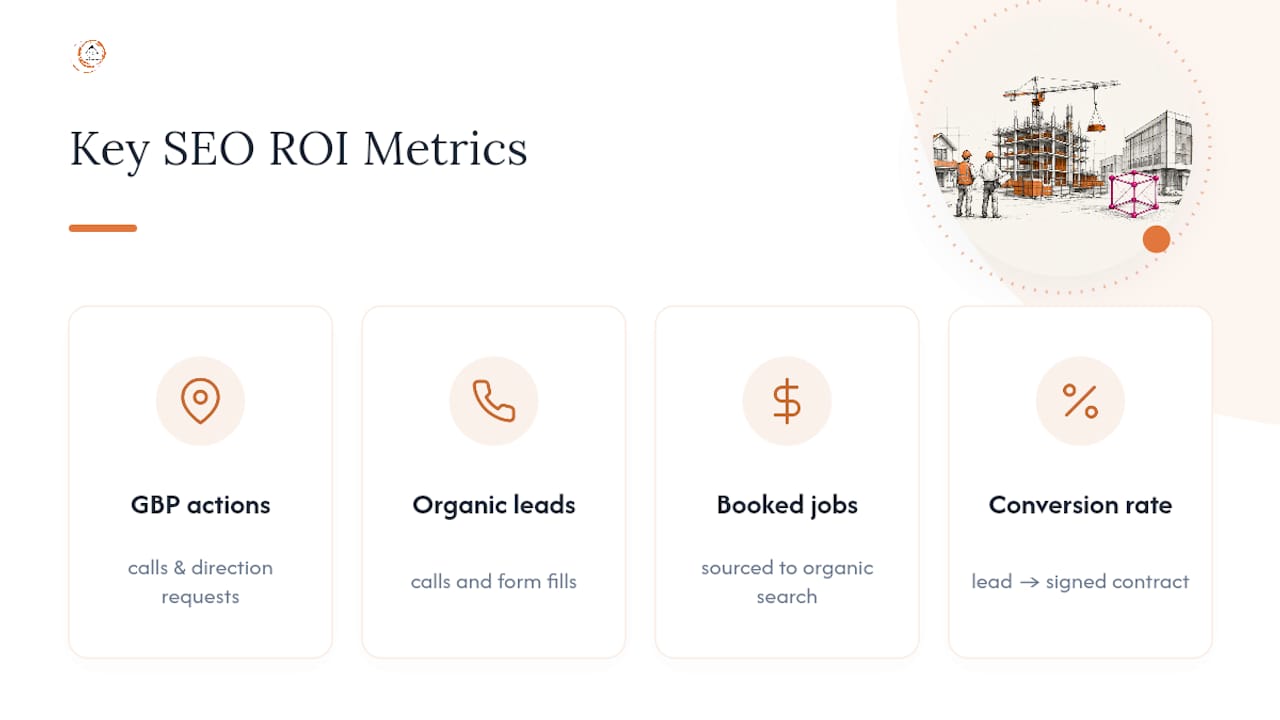
Watch four numbers: GBP actions (calls and direction requests), organic calls and form fills, booked jobs sourced back to organic search, and your overall conversion rate from lead to signed contract.
A break-even calculation makes the value concrete: divide your monthly SEO spend by your average profit per booked job to find how many jobs per month you need SEO to deliver before it’s paying for itself. Most contractor SEO budgets run $500 to $3,500 or more per month, with GBP improvements often showing results within 30 to 90 days and organic service pages typically needing three to six months, sometimes longer in competitive markets.
Publishing Proof That Google and Buyers Actually Trust
Generic portfolio galleries don’t convert commercial buyers the way project pages with verifiable facts do. Every case study should show square footage, contract value where you’re allowed to share it, the timeline, the technical challenges you solved, and the measurable outcome.
Feature your credentials in more than one place:
- Homepage: a short trust line near the top of the page.
- Service pages: a credibility note near the CTA.
- Case studies: specific certifications tied to that exact project.
- A dedicated compliance or certifications page, including SAM.gov registration status where applicable.
Use structured placeholders as you build these pages so nothing gets lost between drafts, including entries like [brand_signal] for verified metrics and for author or reviewer bios. Treating proof as a template, not an afterthought, keeps every new case study consistent.
Backlink Building Techniques Tailored to Construction Businesses
Construction backlinks tend to come from relationships you already have, not cold outreach to random blogs. Suppliers, architects, engineers, and subcontractors you’ve worked with often have websites willing to link to a completed project, especially if you supply photos and a short write-up they can use themselves.
Local and trade organizations are another underused source. Chambers of commerce, homebuilder associations, and trade unions frequently maintain member directories with linkable listings, and many accept sponsored project spotlights for a modest fee. Getting featured in a local business journal after completing a notable project, such as a public infrastructure job or a large commercial build, tends to earn a far stronger link than any directory submission.
Software and platform partners can help too. Publishing a joint case study with a project management or estimating tool you use, for example through a partner like Buildberry, gives both sides a legitimate reason to link to each other’s sites.
Avoid link farms and paid link networks aimed at construction niches specifically. Google’s algorithms flag unnatural link patterns quickly, and a handful of relevant, earned links from real industry relationships will outperform a hundred low-quality directory links every time.
Competitor Analysis in Construction Industry SEO
Start by identifying who actually ranks in your local map pack and organic results for your top five services, not just who you consider your biggest rival on the ground. The businesses beating you in search results aren’t always the ones beating you on bids.
Pull up their Google Business Profile and note their primary category, review count, review response rate, and photo frequency. If a competitor has 150 reviews and posts new project photos every week, that’s the bar you need to clear, not guess at.
Check their service pages for structure: do they have dedicated pages for each service, or one thin “services” page trying to cover everything? Gaps in their content are opportunities for you. If no competitor in your market has published a detailed cost or timeline page for a specific service, that’s a page worth writing first.
Finally, look at where their backlinks come from using a free tool like Google Search Console’s link report on your own site combined with manual searches for their business name plus “featured” or “project.” Patterns in who links to them (certain suppliers, certain local papers) often reveal outreach opportunities you can pursue too.
Utilizing Social Media Platforms to Support SEO
Social media doesn’t directly boost rankings, but it feeds the signals that do. Sharing completed project photos on platforms like Instagram and Facebook drives traffic back to your case study pages, and that traffic, plus the engagement it generates, reinforces the authority signals search engines already weigh.
Video matters more here than most contractors assume. A short walkthrough of a finished job, posted natively and also embedded on your project page, tends to keep visitors on-site longer, which is itself a quality signal. YouTube also functions as its own search engine, so titling videos with the service and location (“Kitchen Remodel Timeline in [Your Market]”) captures search traffic your website alone might miss.
Consistency matters more than volume. Posting three well-documented projects a month, each linked back to a case study page, does more for your visibility than daily generic updates with no destination for the traffic to land. Treat every social post as a small advertisement for a page that already exists on your site, not as content that has to stand alone.
Deciding Whether to Hire or Do SEO Yourself
If your team already struggles to keep the website updated monthly, hire it out. Budget roughly $500 to $3,500 or more per month depending on market competition, and expect GBP work to show results before organic content does. When you shoot project photos, request a mix of crews and clients across race and gender. It reads as more authentic to the industry your business actually serves.
— Rowena
Sources
- Construction SEO tips — ServiceTitan
- Is SEO worth the cost for contractors? — ElypticRise
- Construction Company SEO: What actually moves the needle — BuilderLeadConverter
FAQ
What Is SEO in Construction?
Construction SEO is the practice of optimizing a contractor’s website, Google Business Profile, and content so potential clients find the business while researching a project, combining technical fixes, local pages, and authority-building.
Is It Worth Paying Someone for SEO?
For most construction companies without in-house marketing capacity, yes. Budgets typically run $500 to $3,500 or more monthly, and the break-even math is simple: divide that cost by your profit per booked job to see how many jobs per month justify the spend.
How Long Does Construction SEO Take to Work?
Google Business Profile fixes can show visibility gains in 30 to 90 days, while organic service pages and case studies usually need three to six months or longer to build authority.
Should Residential and Commercial Contractors Use the Same SEO Approach?
No. Residential SEO centers on local map-pack visibility and fast conversions, while commercial SEO needs to build trust over a much longer research window before a decision-maker ever fills out a form.
What’s the Single Best First Step for Construction SEO?
Fix your Google Business Profile primary category and add fresh project photos. It’s the fastest-moving lever available to most contractors and requires no technical skill to execute.
Recommended
- Elements of Winning Construction RFP Responses in 2026
- Construction Bid Win Rate Explained for Contractors in 2026
- Bid Strategy Best Practices for Contractors: 2026 Guide
- Private Sector Bid Solicitation Process for Contractors
Working in the public sector? One short email a week — prevailing wage, certified payroll, bid protests, agency procurement rules. Free, no pitch. Subscribe.
Free and unconditional. No call required, no obligation, unsubscribe anytime.