
Benefits of a Professional Website for Construction Firms
Hiring a professional website construction company is worth the investment — especially if your firm competes for federal contracts, pursues private-sector bids, or wants to stop losing shortlist spots before a single conversation happens. Contracting officers and primes treat your website as a pre-qualification tool. They check for NAICS codes, CAGE numbers, SAM.gov registration status, and downloadable capability statements before they ever pick up the phone. A generic or outdated site signals operational risk; a bid-ready contractor website signals a firm that understands procurement.
The three outcomes that matter most:
- Shortlist inclusion: Procurement teams confirm credentials on your site before inviting bids. Missing certifications or a weak portfolio removes you silently.
- Higher-value inquiries: Structured RFQ forms and detailed project evidence attract decision-ready buyers, not price shoppers.
- Faster RFQ qualification: When scope, bonding, and past performance are visible on arrival, the pre-qualification conversation is already half done.
Table of Contents
- What are the core benefits of hiring a professional website team?
- What does a construction-focused professional web build actually include?
- What do procurement teams scan for on your site?
- How do you evaluate and select the right website provider?
- How Federal-rconstructionsolutions delivers bid-ready web outcomes
- Key Takeaways
- Why bid-ready websites change the outcome before you submit a single proposal
- Federal-rconstructionsolutions supports firms that need a bid-ready site and federal procurement backing
- FAQ
What are the core benefits of hiring a professional website team?
Federal buyers avoid risk, and a weak or generic website signals operational instability. Professional web development shifts the buyer’s focus from price to proven capability — and that shift has direct revenue consequences.
- Brand trust: — Consistent branding, fast load times, and mobile responsiveness signal that your operations are equally well-managed.
Construction buyers treat websites as commercial evaluation tools — they expect evidence, not marketing claims. A site that leads with capability proof rather than a mission statement positions your firm as a serious contender before any proposal is submitted.
What does a construction-focused professional web build actually include?
A professional build for a construction firm is not a brochure site with a contact form. It is a structured evidence platform, and the deliverables reflect that.
Portfolio architecture goes beyond a photo gallery. Each project entry should carry scope, contract value range, delivery method, timeline, geographic location, and measurable outcomes. Filterable taxonomy by sector, project type, and geography lets evaluators find relevant comparables fast. Hosting detailed, searchable project case studies lets you link from formal proposals to deeper proof points, extending your RFP response without exceeding page limits.

Federal-ready pages include a web-based capability summary and a downloadable capability statement PDF. These pages display NAICS codes, CAGE numbers, socioeconomic statuses (8(a), SDVOSB, HUBZone), and bonding capacity where disclosed. A federal marketplace entry guide outlines exactly what contracting officers expect to find.
Verification-ready accreditation display presents CHAS, Constructionline, ISO certifications, and state license numbers with certificate numbers and renewal dates — formatted so procurement can verify without making a call.
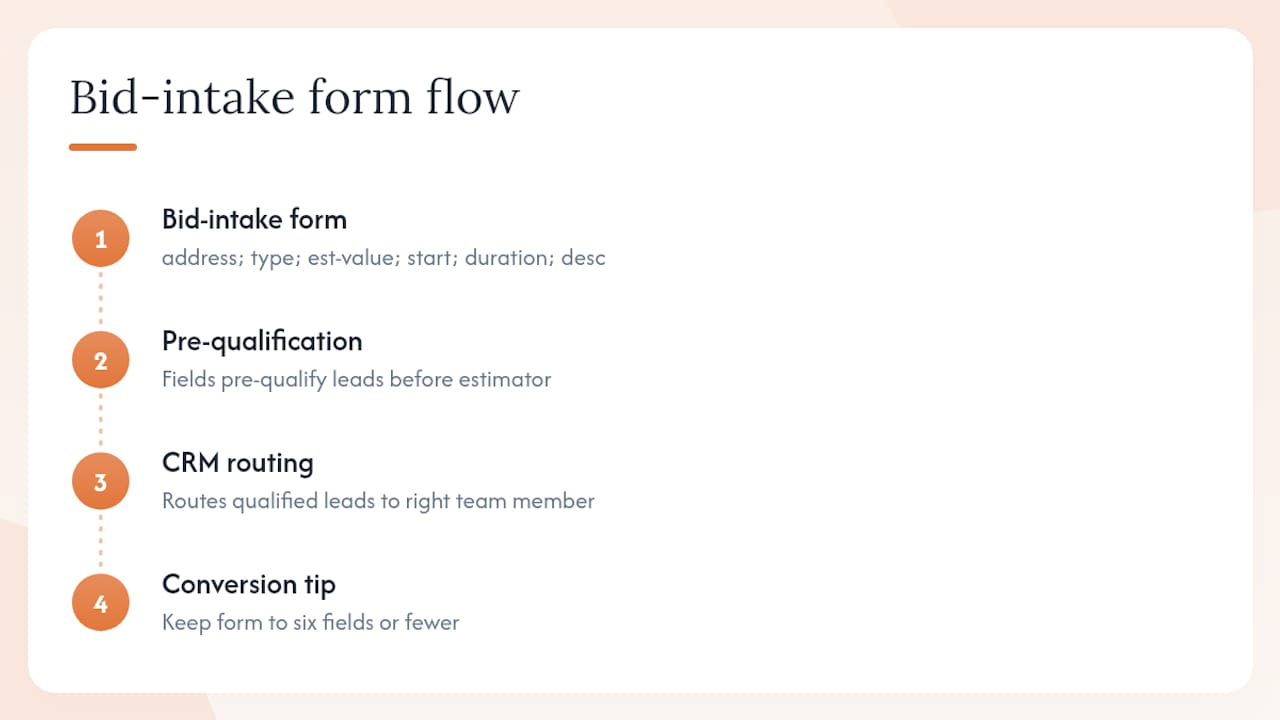
Bid-intake and RFQ flows use structured forms that collect project address, scope description, timeline, and budget range. These fields do the pre-qualification work before your estimator gets involved. CRM integration routes qualified leads directly to the right team member. Specialized bid-request forms that capture address, scope, timeline, and budget filter leads and make first conversations higher value.
Technical foundation covers mobile responsiveness, fast load times, accessibility basics, secure hosting, and clean HTML structure that supports discovery by Google, AI-powered search, and generative models like ChatGPT. Concise summaries, labeled certifications, and scannable past performance all improve visibility in AI-driven search results.
Pro Tip: Keep your bid-intake form to six fields or fewer: project address, project type, estimated scope value, preferred start date, project duration, and a brief description. More fields kill conversion; fewer fields reduce pre-qualification value. Six is the balance point.
What do procurement teams scan for on your site?
Use this checklist to audit your current site before your next bid cycle.
Immediate visibility items
- Certifications and license numbers on the homepage or a dedicated trust bar
- Downloadable capability statement (PDF, current year)
- Named client references or project owner logos
- NAICS, CAGE, and SAM.gov registration status
Project evidence items
- Contract value range per project (even a range is better than nothing)
- Delivery method, schedule performance, and outcome summary
- Representative photos with descriptive captions (use diverse photos showing women and people of color on the job site — not stock imagery of the same demographic)
- Geographic coverage and project location data
Operational items
- EMR/safety figures or a link to your site safety documentation
- Self-perform trades and equipment lists
- Bonding capacity (if your firm discloses it)
Process items
- Structured bid-request form with clear field labels
- Expected response timeline stated on the contact page
- Downloadable documents (capability statement, safety plan, insurance certificates)
| Audit Category | Pass Threshold |
|---|---|
| Certifications visible | All current certs with numbers and renewal dates |
| Project evidence | Multiple case studies with value, scope, and outcome |
| Federal-ready page | NAICS, CAGE, capability PDF present |
| Bid-intake form | Several structured fields with CRM routing |
| Technical performance | Mobile-responsive, loads under 3 seconds |
A site that clears all five rows passes a procurement scan. Missing two or more rows is a shortlist risk.
How do you evaluate and select the right website provider?
The right vendor understands procurement, not just design. Great construction websites translate expertise into clarity and prioritize trust signals over aesthetics.
Questions to ask during shortlisting:
- How do you display NAICS and CAGE codes on the site?
- Do you build downloadable capability statements as part of the scope?
- How do you handle certificate verification formatting?
- What CRM do you integrate with, and how do you route bid-intake leads?
- Can you show a sample case-study template from a previous construction client?
Red flags to watch for:
- Generic templates with stock photography (especially non-diverse imagery)
- No CRM integration or lead routing plan
- Missing accreditation verification structure
- Long-form-only contact routes with no structured bid-intake form
- No project-level data structure in the portfolio
Trust signals to require in your SOW: a sample case-study template, anonymized past performance metrics, a delivery timeline with milestones, acceptance criteria for content, and three references from construction clients.
Pro Tip: Scope a 30/60/90 post-launch plan in the contract. At 30 days: site indexed, all pages live. At 60 days: first six high-intent keywords tracked. At 90 days: two new project case studies published and lead-routing confirmed in CRM. Hold the vendor to these milestones, not just launch day.
How Federal-rconstructionsolutions delivers bid-ready web outcomes
Federal-rconstructionsolutions’ 5551 Pillar was built around a single objective: federal procurement readiness for construction firms. The core deliverables mirror the checklist above — capability statement pages with NAICS and CAGE visibility, structured past performance sections, accreditation display with certificate numbers and renewal dates, and a bid-intake RFQ flow integrated with CRM lead routing.
The approach achieves a 90% bid-compliance rate for clients pursuing federal contracts, and the firm has secured contracts including public water infrastructure projects. Private sector expansion services complement the federal work, with clients reporting more consistent revenue and higher overall profitability when they diversify across both markets.
Key deliverables in the 5551 Pillar build:
- Federal-ready capability page with downloadable PDF and web-based summary
- Past performance section structured for contracting officer review
- Accreditation and certification display with verification details
- Structured RFQ form with CRM integration and lead routing
- Ongoing SEO and bid-support services post-launch
The site also functions as a living supplement to formal RFP responses — linking proposals to detailed project case studies that provide evaluators with deeper proof within the page limits of any solicitation. This is a replication-ready approach you can request in your own vendor RFP.
Key Takeaways
A bid-ready construction website is a procurement evaluation tool first and a marketing asset second — firms that treat it as the former win more shortlists.
| Point | Details |
|---|---|
| Procurement readiness is the priority | NAICS, CAGE, certifications, and capability statements must be visible and verifiable on first visit. |
| Content prep is a separate budget line | Photography and content preparation are separate line items and require 20–40 hours of internal staff time. |
| Post-launch SEO matters | Budget — annually for SEO and maintenance to sustain visibility and lead quality. |
| Vendor selection requires construction knowledge | Ask for a sample case-study template and CRM integration plan before signing any SOW. |
| Federal-rconstructionsolutions | The 5551 Pillar delivers capability pages, RFQ flows, and CRM integration with a 90% bid-compliance rate for federal contractors. |
Why bid-ready websites change the outcome before you submit a single proposal
Most firms underestimate how early they are removed from consideration. A contracting officer or prime’s BD team often visits five to ten websites before issuing an RFI. If your certifications are buried, your project evidence is thin, or your imagery shows the same demographic on every page, you signal a firm that hasn’t thought carefully about how it presents itself. That impression transfers directly to assumptions about how carefully you manage a project.
The firms that win consistently aren’t always the lowest bidders. They’re the ones whose websites answer every due-diligence question before the evaluator has to ask. Diverse project photos — women in hard hats, crews that reflect the communities where you build — also matter. Procurement teams at federal agencies and large primes notice when a firm’s imagery reflects the workforce and communities it serves. Use real photos from your job sites, not stock images.
Run the procurement checklist in this article against your current site today. If you clear fewer than four of the five audit rows, you have a shortlist problem that a professional build can fix.
Federal-rconstructionsolutions supports firms that need a bid-ready site and federal procurement backing
Federal-rconstructionsolutions gives construction firms a faster path from “we need a better website” to “we’re winning federal bids” — because the website build and the procurement strategy are handled together, not separately. The 5551 Pillar packages capability statement pages, RFQ intake flows, CRM integration, and ongoing bid-compliance support into a single engagement, so you’re not coordinating a web agency and a procurement consultant across two separate contracts.
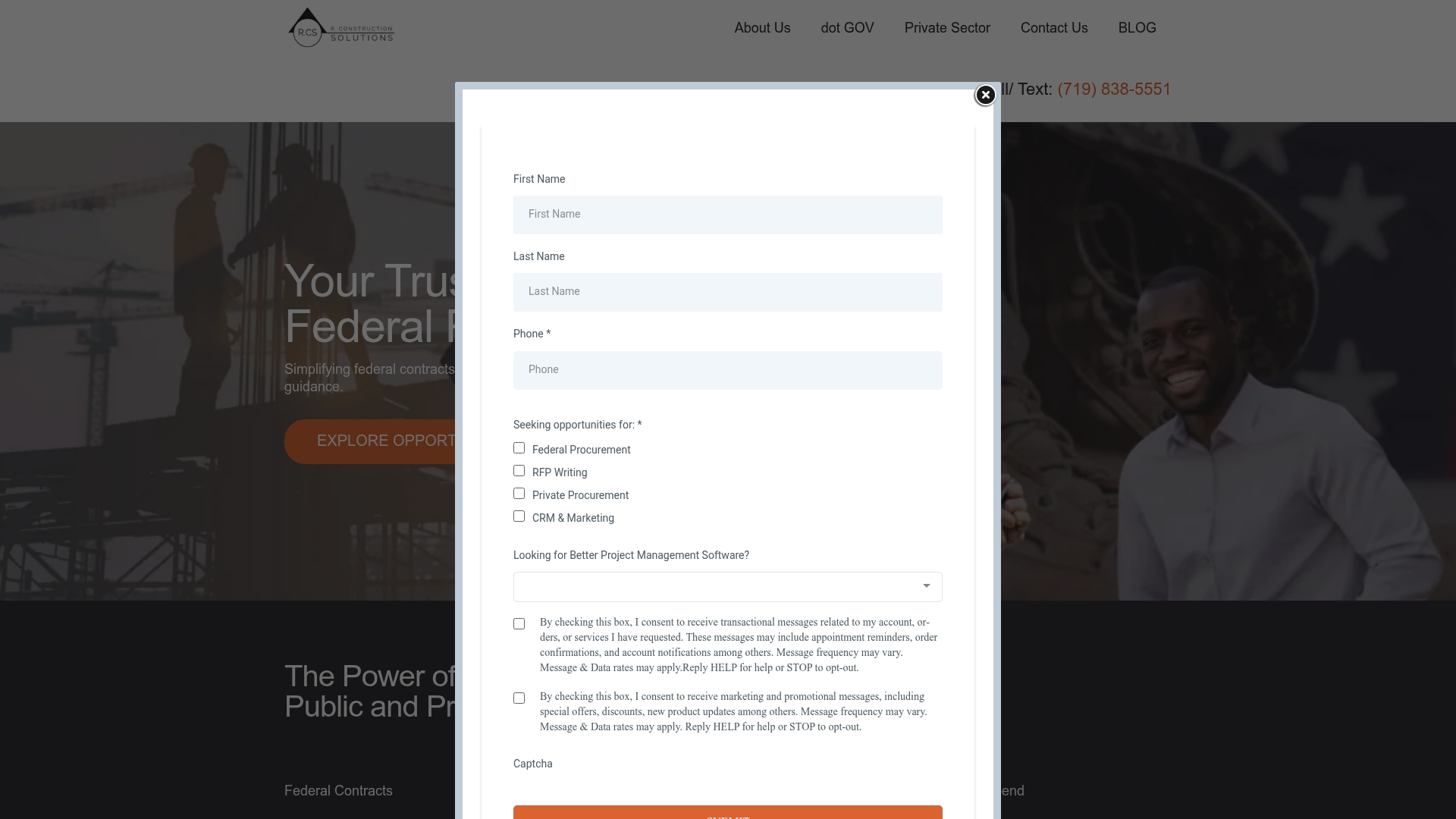
The federal procurement services include SAM.gov registration, FAR and Davis-Bacon compliance support, RFP writing, and the federal-ready website architecture that contracting officers expect. For firms also pursuing private-sector growth, the bid pipeline support extends to ConstructConnect lead identification and private-sector opportunity sourcing. Book a discovery call to walk through your current site against the procurement checklist and identify the gaps costing you shortlist spots.
FAQ
What makes a construction website “bid-ready”?
A bid-ready site displays NAICS codes, CAGE numbers, certifications with renewal dates, a downloadable capability statement, and structured project case studies with scope, value, and outcomes — all visible without a phone call.
How long does a professional construction website take to build?
Timelines range from 1–2 weeks for a starter build to 3–6 weeks for a fully custom, federal-ready site. Content preparation by your team is the most common cause of delays.
Why does website quality affect federal contract bids?
Federal contracting officers use websites to screen for operational stability and compliance readiness. A generic or incomplete site signals risk and can remove your firm from consideration before the formal evaluation begins.
What questions should I ask a web vendor before hiring them?
Ask how they display NAICS and CAGE codes, whether they build downloadable capability statements, how they integrate CRM lead routing, and whether they can provide a sample construction case-study template.
Can Federal-rconstructionsolutions handle both the website and procurement support?
Yes. The 5551 Pillar combines federal-ready website development with RFP writing, FAR compliance support, SAM.gov registration, and ongoing bid-compliance services — achieving a 90% bid-compliance rate for clients pursuing federal contracts.