SBA Size Standards for Construction: $19M, $45M, $34M and a Checklist
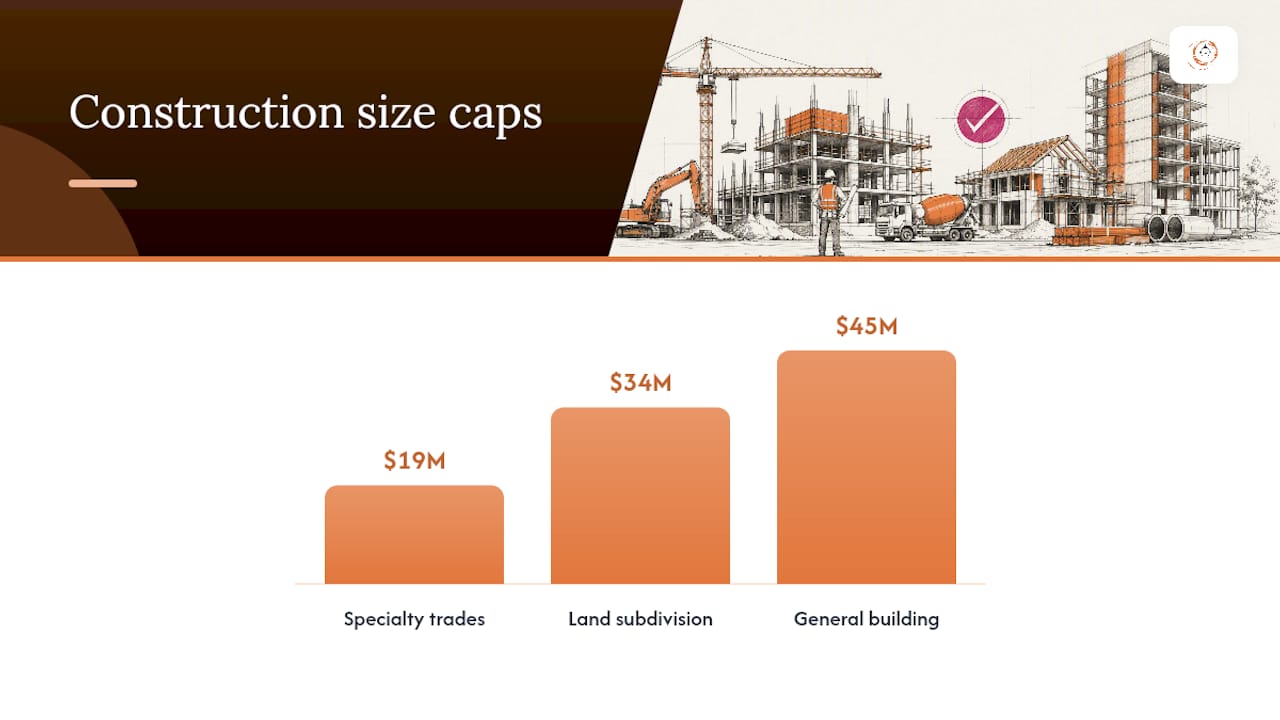
For most construction NAICS codes, the SBA measures your business by average annual receipts, not employee count. Specialty trade contractors typically qualify as small based on receipts thresholds around nineteen million dollars, general building construction firms near forty-five million dollars, and land subdivision near thirty-four million dollars. A proposed rule published in the Federal Register on August 20, 2026, could reshape those thresholds, with public comments due September 21, 2026.
TL;DR:
- Smaller construction firms with receipts under $19 million for specialty trades or $45 million for general building work remain eligible for small-business set-asides, but affiliate relationships can increase these thresholds.
- Accurately calculating eligibility requires reviewing five years of receipts, including affiliates, and updating ownership or joint venture structures before bidding to avoid disqualification.
- SBA measures size differently depending on industry, using receipts for most construction sectors, but affiliation can cause firms to surpass thresholds unexpectedly.
- Firms should verify their NAICS code, review current SBA thresholds, and conduct affiliate audits well before bid deadlines to ensure eligibility for federal construction contracts.
Table of Contents
- Current SBA Size Standards for Construction NAICS Codes
- How SBA Measures Size and Why Affiliation Can Change Your Status
- What the 2026 Proposed Rule Changes for Contractors
- How Do I Find My NAICS Code and Confirm SBA Eligibility?
- Protecting Your Eligibility: Bidding, Subcontracting, and Risk Management
- A Contractor’s Path to Verified Eligibility
- Why This Rulemaking Deserves Your Attention Now
- How R. Construction Solutions Helps You Verify and Protect Your Size Status
- Sources
- FAQ
Current SBA Size Standards for Construction NAICS Codes
The SBA’s official Table of Small Business Size Standards organizes construction firms into three broad NAICS groups, and where your firm lands determines whether you can compete for set-aside contracts reserved for small businesses.
Here’s how the current thresholds break down by sector:
- General building construction (NAICS 236xxx): Most subsectors, including residential and nonresidential building, use receipts standards near forty-five million dollars.
- Heavy and civil engineering construction (NAICS 237xxx): Thresholds vary by specific code, with land subdivision (NAICS 237210) near thirty-four million dollars.
- Specialty trade contractors (NAICS 238xxx): Electrical, plumbing, HVAC, roofing, and most other trade specialties fall under a receipts standard approximately nineteen million dollars, one of the most common thresholds in the entire construction table.
Those two approximate thresholds for specialty trades and general building work cover the majority of construction firms bidding on federal work today. If your firm’s five-year average receipts sit under the threshold tied to your primary NAICS code, you’re likely eligible for small-business set-asides.
Quick reference: Specialty trades = $19M cap. General building construction = $45M cap. Land subdivision = $34M cap. These are the three numbers every construction contractor bidding federal work should have memorized.
A handful of construction NAICS codes deviate from these patterns, so don’t assume your subsector matches the sector average. Dredging and certain marine construction codes, for instance, carry different thresholds than standard heavy construction work. The safest move is downloading the current table directly or querying the SBA’s size standards dataset on data.sba.gov, which lets you pull the exact figure for your six-digit code rather than relying on a sector generalization.
How SBA Measures Size and Why Affiliation Can Change Your Status
SBA applies two different measurement methods depending on the industry: average annual receipts for most construction codes, and average number of employees for a smaller set of industries. Receipts are averaged over the preceding five fiscal years; employees are averaged over the preceding 24 months, counting all full-time, part-time, and temporary workers.
The complication most contractors miss is affiliation. Under 13 CFR Part 121, SBA doesn’t just look at your firm’s standalone numbers. It aggregates receipts or employees from any business you control, or that controls you, through ownership, common management, or contractual relationships. A firm that looks small on its own tax returns can get bumped into “large” status the moment SBA counts a sister company or a majority-owned joint venture partner.
Here’s the sequence for calculating your size correctly:
- Pull five years of tax returns to establish your baseline average receipts.
- Identify every entity with common ownership, shared officers, or economic dependency ties to your firm.
- Add those affiliates’ receipts (or employees, if applicable) to your own before comparing against the threshold.
- Recheck the math whenever ownership structure or joint venture agreements change.
Pro Tip: Gather your tax returns, payroll summaries, and any affiliate or joint venture agreements before you bid, not after a competitor protests your size. A protest triggered after contract award is a much harder position to defend than a clean self-certification filed upfront.
What the 2026 Proposed Rule Changes for Contractors
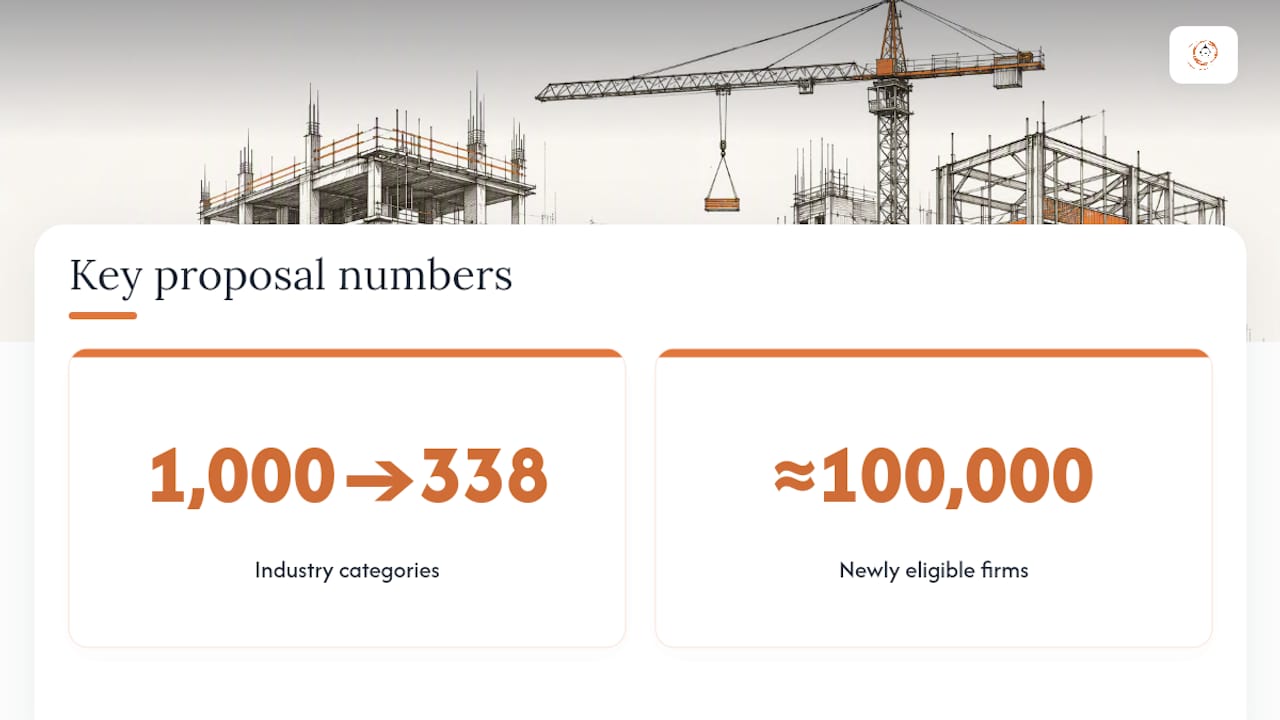
SBA’s proposed rule would consolidate nearly 1,000 existing size standards into just 338 industry categories, collapsing many of today’s six-digit NAICS-specific thresholds into broader four- and five-digit groupings. The stated goal, according to the Office of Advocacy, is a simpler, less volatile system that doesn’t force firms to track dozens of near-identical thresholds across similar trades.
The projected impact is substantial for construction. SBA estimates the proposal would make roughly one hundred thousand additional firms newly eligible for small-business status nationwide if finalized as written, a figure corroborated by Federal News Network’s coverage of the rulemaking. For industries where SBA judges employment to be a more stable measure than receipts, the methodology also proposes converting some construction-adjacent codes from receipts-based to employee-based standards.
None of this is final. The proposal is open for public comment through September 21, 2026, and contractors who want to weigh in can submit remarks through Regulations.gov or the Federal Register docket directly. Treat every number above as a proposal, not a rule you can rely on for a bid submitted today.
How Do I Find My NAICS Code and Confirm SBA Eligibility?
Confirming your size status is a short, mechanical process if you work through it in order.
- Identify your primary NAICS code using the Census Bureau’s NAICS lookup tool, matching the code to the principal purpose of your business, not just one contract type.
- Look up the current size standard for that code using the SBA Size Standards Tool or the official table, checking for six-digit exceptions within your sector.
- Calculate your average receipts or employees per the SBA’s method, then add in any affiliate figures before comparing against the threshold.
- Self-certify in SAM.gov if you fall under the cap, or request a formal size determination from your SBA Government Contracting Area Office if a contract award is imminent and you expect a challenge.
Protecting Your Eligibility: Bidding, Subcontracting, and Risk Management
Affiliation isn’t just a compliance detail. It’s the single most common reason contractors lose set-aside eligibility they thought they had, and it can surface unexpectedly through joint ventures, mentor-protégé arrangements, or even a family member’s ownership stake in a related firm.
A few moves protect you before a bid, not after a protest:
- Audit every affiliate relationship annually, not just when you’re about to submit a proposal.
- Assemble a rolling five-year receipts history so you’re never scrambling during a solicitation deadline.
- Request a formal SBA size determination when a large contract is imminent and your eligibility is close to the line.
- Review joint venture agreements for control provisions that could trigger affiliation you didn’t anticipate.
Pro Tip: If your receipts are within 10% of your NAICS threshold, or you’re forming a new joint venture, involve your local SBA Government Contracting Area Office or a procurement consultant before you submit, not after a competitor files a size protest.
A Contractor’s Path to Verified Eligibility
One general contractor we advised had grown through two affiliated entities without realizing SBA would aggregate their receipts. A NAICS review, five-year receipts calculation, and affiliate audit confirmed continued eligibility. The firm self-certified in SAM and went on to win a public water project set-aside, part of the 90% bid-compliance track record our clients maintain.
Why This Rulemaking Deserves Your Attention Now
Small contractors tend to treat size standards as background noise until a protest or a lost bid forces the issue. That’s backwards. The firms that come out ahead during this rulemaking will be the ones who built their receipts documentation and affiliate review into routine operations months before the comment period closes, not the ones scrambling to reconstruct five years of tax returns after a competitor challenges their status.
I’d also flag something publishers in this space rarely mention: the imagery surrounding federal contracting content should reflect who’s actually doing this work. Construction ownership and leadership in the U.S. is far more diverse than the stock photography suggests, and outlets covering this industry should represent that range of races and genders, not a single recycled figure.
— Rowena
How R. Construction Solutions Helps You Verify and Protect Your Size Status
Getting your NAICS code, receipts calculation, and affiliation review right the first time saves you from a protest that can unravel a contract award months after you thought you’d won it. Federal-rconstructionsolutions handles exactly that groundwork for construction firms, pairing RFP writing and FAR and Davis-Bacon compliance support with SAM.gov registration help, certified payroll setup, and opportunity identification tailored to your NAICS classification.
Where a general contractor might spend weeks untangling affiliate relationships or guessing at which SBA table applies, Federal-rconstructionsolutions builds that verification into the front end of every engagement, so your eligibility is documented before you submit, not defended after an award. If your firm is approaching a size threshold or preparing for a set-aside bid, visit the Federal Procurement Services page to schedule a consult and get your size status confirmed before your next submission deadline.
Sources
- SBA Issues Proposed Rules on Industry Size Standards and Revised Size Standards Methodology – Office of Advocacy
- Table of size standards | U.S. Small Business Administration
- Small Business Size Standards — Federal Register
- 13 CFR Part 121 — Small Business Size Regulations
FAQ
What is the SBA size standard for construction companies?
It’s the maximum average annual receipts (or, for a few codes, employee count) a firm can have and still qualify as “small” for a given NAICS code, with specialty trades typically capped at $19 million and general building construction at $45 million.
How do I calculate my SBA size standard?
Average your firm’s total receipts over the preceding five fiscal years, add in receipts from any affiliated entities under common ownership or control, and compare the total against the threshold listed for your primary NAICS code in the SBA’s table.
What are the SBA’s basic requirements for a small business?
A business generally must be organized for profit, have a place of business in the United States, operate primarily within U.S. markets, be independently owned and operated, and fall under the receipts or employee threshold assigned to its NAICS code.
What are the SBA guidelines for federal contracting eligibility?
Firms must confirm their NAICS code, verify they fall under the applicable size standard including affiliates, and self-certify as small in SAM.gov before pursuing set-aside contracts; a formal size determination request is available if eligibility is contested.
When does the proposed 2026 rule take effect?
It hasn’t taken effect. The rule is currently a proposal with public comments due September 21, 2026, and construction firms should continue applying current thresholds until SBA issues a final rule.
Recommended
- SBA Role in Federal Contracting for Construction Firms
- Government Bid Eligibility for Small Contractors: 2026 Guide
- Why Small Contractors Lose Their First Federal Bid
- SAM Registration for Small Construction Companies: 2026 Guide
Working in the public sector? One short email a week — prevailing wage, certified payroll, bid protests, agency procurement rules. Free, no pitch. Subscribe.
Free and unconditional. No call required, no obligation, unsubscribe anytime.