
SAM Registration for Small Construction Companies: 2026 Guide
SAM registration is the federal government’s mandatory system that qualifies small construction companies to receive contracts, grants, and subcontracts from any U.S. federal agency. Without an active registration in the System for Award Management (SAM.gov), your company cannot legally receive federal payments or be awarded a federal contract. The federal government awarded over $163 billion to small businesses in FY2023 alone. That number represents real opportunity for small construction firms willing to complete the process correctly.
What are the SAM registration requirements for small construction companies?
Before you log into SAM.gov, gather every required document. Missing even one item causes delays or outright rejection.
Here is exactly what you need:
- Legal business name: Must match your IRS records character for character. “LLC” and “L.L.C.” are treated as different names by the IRS validation system. Use your CP-575 letter (the IRS confirmation letter sent when you received your EIN) to confirm the exact spelling and punctuation.
- Employer Identification Number (EIN): Your nine-digit federal tax ID. The IRS validation system requires an exact match on both name and EIN. A single formatting difference triggers automatic rejection.
- Physical business address: A real, verifiable location. P.O. boxes are not accepted. Home offices qualify as long as the address is accurately reported.
- Bank account information: Routing number and account number for electronic funds transfer (EFT). The federal government pays contractors by direct deposit only.
- NAICS codes: Your primary North American Industry Classification System code defines which federal contracts you are eligible to bid on. Construction firms commonly use codes in the 236000–238990 range depending on specialty.
- Ownership disclosure: Any individual owning 25% or more of the business must be disclosed, including their Social Security Number or EIN.
- Points of Contact: You need an Electronic Business Point of Contact (EBiz POC) and a Government Business Point of Contact. These are the people federal agencies will contact about your registration and contracts.
Pro Tip: Pull your CP-575 letter before starting registration. Cross-reference every character of your business name against that document. One punctuation mismatch will send your application back to square one.
How to complete the SAM registration process step by step
The full registration takes most small construction firms two to four hours. Plan for it. Do not rush.
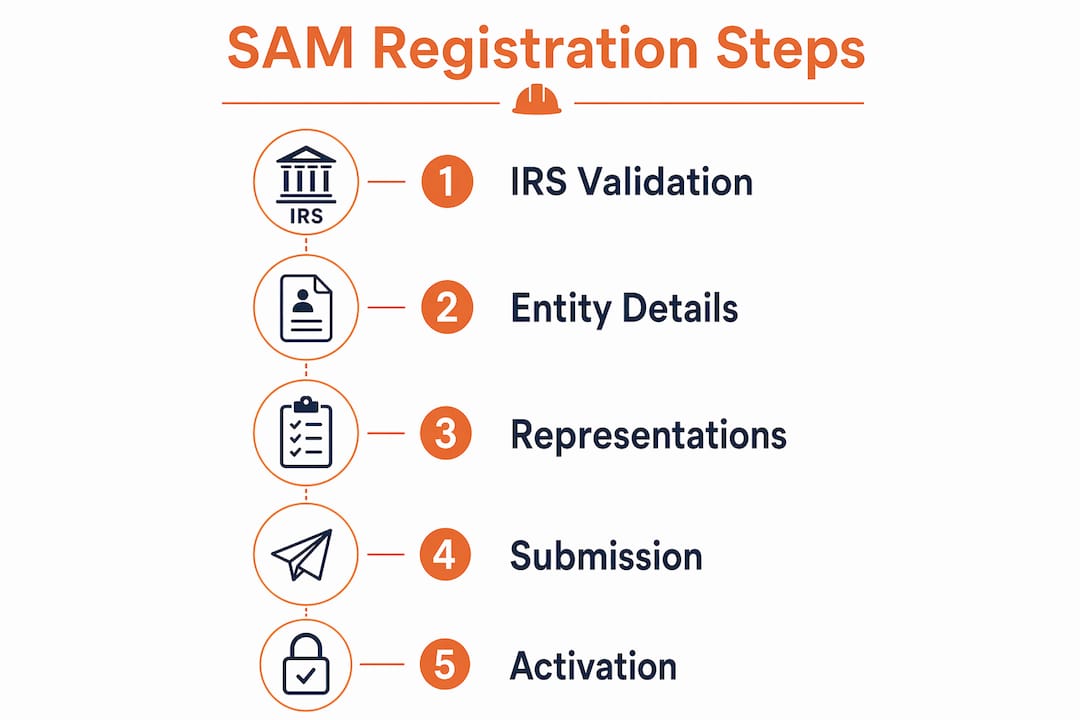
- Create a Login.gov account. SAM.gov requires Login.gov for access. Set up multi-factor authentication (MFA) during this step. Use an email address you check regularly.
- Start a new entity registration on SAM.gov. Select “Register Entity” and choose “Business or Organization.” The system will automatically assign your Unique Entity Identifier (UEI), which replaces the old DUNS number.
- Enter your core entity information. Input your legal business name, EIN, and physical address exactly as they appear on your IRS records. The system runs an IRS validation check at this stage.
- Select your NAICS codes and Product Service Codes (PSCs). Your primary NAICS code is the single most important factor for contracting officer searches. Choose the code that most accurately describes your primary business activity.
- Complete Representations and Certifications. This section covers your business’s legal status, size, ownership, and compliance with federal regulations including the Davis-Bacon Act and the Federal Acquisition Regulation (FAR). Budget 60–90 minutes for this section alone.
- Review and submit. Check every field before submitting. Errors caught before submission save days of back-and-forth.
- Track your registration status. Log back into SAM.gov to monitor progress.
| Stage | Action Required | Typical Timeline |
|---|---|---|
| IRS validation | Automatic name/EIN check | 1–3 business days |
| Full activation | Complete processing | 7–15 business days |
| Annual renewal | Manual re-registration | 1–3 business days |
Pro Tip: If the IRS validation step fails, do not resubmit immediately. Contact the IRS Business and Specialty Tax Line at 1-800-829-4933 to confirm your exact registered business name before trying again.

What common mistakes do small construction firms make during SAM registration?
Over 30% of first-time SAM registrations are rejected due to missing or mismatched documentation. Most of those rejections are preventable.
The most frequent errors include:
- IRS name or TIN mismatches. Even minor formatting differences between your SAM submission and IRS records cause automatic rejection. Always verify against your CP-575 letter.
- Wrong NAICS code selection. Choosing a code that does not match your actual work makes your business invisible to buyers searching for your specialty. A general contractor who selects a residential code will miss commercial federal solicitations entirely.
- Rushed Representations and Certifications. Inaccurate answers in this section can result in contract termination or legal liability. Read every question carefully.
- Using a P.O. box as your physical address. The government requires a verifiable operating location. A P.O. box will cause your registration to fail.
- Incomplete ownership disclosure. Missing SSNs or EINs for owners with 25% or more stake will stall your application.
- Failing to renew annually. SAM registration expires every 12 months. A lapsed registration means you cannot receive federal contracts until renewal is complete. Set a calendar reminder 30 days before your expiration date.
- Paying a third-party service for registration. SAM.gov registration is completely free. Some companies charge $500 to $2,000 for a service you can do yourself at no cost. Those fees are unnecessary.
Warning: Third-party companies advertising SAM registration services are not affiliated with the federal government. SAM.gov registration is 100% free. If a company asks you to pay for registration, decline.
Avoiding these mistakes is not complicated. It requires patience and attention to detail before you start, not after you submit.
How to use your SAM registration to find federal contracts and subcontracts
An active SAM registration opens the door. What you do next determines whether you walk through it.
- Search SAM.gov for open solicitations. Use the “Contract Opportunities” search on SAM.gov. Filter by your NAICS code, location, and contract value. Set up email alerts for new postings that match your criteria.
- Understand small business set-asides. The federal government reserves a portion of contracts exclusively for small businesses. Your NAICS code and business size determine which set-asides you qualify for. Contracting officers use SAM.gov data to identify eligible firms.
- Pursue subcontracting opportunities. Federal law requires large prime contractors to subcontract portions of their work to small businesses. Subcontracting is a lower-barrier entry point for firms that are not yet ready to bid directly on federal prime contracts. It also builds your past performance record, which is critical for future bids.
- Apply for relevant certifications. If your business qualifies, certifications like Woman-Owned Small Business (WOSB), HUBZone, or Service-Disabled Veteran-Owned Small Business (SDVOSB) increase your access to set-aside contracts. These certifications are managed through the SBA and SAM.gov.
- Build relationships with prime contractors. Attend federal procurement events, industry days, and SBA matchmaking sessions. Prime contractors actively look for reliable subcontractors with active SAM registrations and relevant NAICS codes.
Your SAM registration also increases your visibility to federal buyers who search the SAM.gov database directly. Keeping your profile complete and current is not optional. It is part of your marketing in the federal marketplace.
Key Takeaways
SAM registration is the mandatory first step for any small construction company that wants to compete for federal contracts, and accuracy in every field determines whether your registration activates or gets rejected.
| Point | Details |
|---|---|
| Registration is free | SAM.gov charges nothing; avoid third-party services charging $500–$2,000 for this process. |
| IRS match is critical | Your business name and EIN must match IRS records exactly, including punctuation and abbreviations. |
| NAICS code drives visibility | Your primary NAICS code determines which federal solicitations you appear in and qualify for. |
| Renewal is annual and manual | Set a calendar reminder 30 days before expiration to avoid losing contract eligibility. |
| Subcontracting builds your record | Federal law requires large primes to subcontract, giving small firms a direct entry path. |
Why data accuracy is the real work of SAM registration
By Rowena
Most small construction company owners I work with expect the hard part of SAM registration to be the paperwork volume. It is not. The hard part is the precision required before you type a single character into SAM.gov.
The IRS validation step stops more registrations than any other part of the process. I have seen firms with years of solid work history get rejected because “Co.” appeared as “Company” in their submission. That is not a technicality. That is the system working exactly as designed. The federal government needs to verify your identity with certainty, and the IRS is the source of truth.
My honest advice: treat the Representations and Certifications section like a legal document, because it is one. Rushing through 60–90 minutes of compliance questions to save time is a false economy. An error there does not just delay your registration. It can follow your business into contract performance and create liability you did not anticipate.
The subcontracting path is also underused by small firms. Many owners I speak with want to go straight to prime contracting. That is a valid goal. But subcontracting builds the past performance record that federal agencies look for in prime contractors. Starting there is not settling. It is building the foundation that makes your future prime bids credible.
Finally, pay nothing for SAM registration itself. Spend that money on professional help with your bid writing, compliance documentation, or NAICS code strategy. Those are the areas where expert guidance pays real dividends.
— Rowena
How Federal-rconstructionsolutions supports your SAM registration success
Federal-rconstructionsolutions works directly with small construction firms to cut through the complexity of federal procurement, from initial SAM registration to full bid submission. Their team helps clients avoid the IRS validation errors and NAICS code mistakes that reject over 30% of first-time registrations.
Federal-rconstructionsolutions’ federal procurement services include registration guidance, compliance support, and RFP writing tailored to construction businesses. Their track record includes securing contracts for public water projects and achieving 90% compliance rates on bid submissions. For firms ready to pursue ConstructConnect bid support or build a full federal contracting pipeline, Federal-rconstructionsolutions provides the expertise to move from registration to award.
FAQ
Is SAM registration required for all federal contracts?
Yes. Every company that wants to receive a federal contract, grant, or subcontract payment must have an active SAM registration. There are no exceptions for small businesses or first-time contractors.
How long does SAM registration take to activate?
Standard activation takes 7–15 business days for new registrations. Annual renewals typically process in 1–3 business days. Start the process well before any bid deadline.
Does SAM registration cost anything?
SAM registration is completely free on SAM.gov. Any company charging a fee for registration is a third-party reseller. Those fees are unnecessary and range from $500 to $2,000.
How do I verify my SAM registration is active?
Log into SAM.gov and check your entity’s registration status. Active registrations show an expiration date. Federal buyers can also search your company name or UEI on SAM.gov to confirm your status.
What happens if my SAM registration expires?
A lapsed registration disqualifies your company from receiving federal contract awards or payments until renewal is complete. Renewal is manual and must be done every 12 months. Missing the deadline can cost you an active contract opportunity.