
The General Contractor's Role in Private Market Construction
In private market construction, the general contractor (GC) is the single point of accountability for delivering a project from groundbreaking to closeout. Every subcontract, permit, safety plan, and payment application flows through this one party, which means the owner’s exposure to schedule risk, cost overruns, and legal liability depends directly on how well that GC performs. Understanding the role of a general contractor in private market projects is not just useful background knowledge. It shapes how you structure your contracts, select your team, and protect your budget.
Here is what a GC is responsible for at a high level:
- Central accountability: The GC is legally responsible for delivering the project per the contract, shielding the owner from direct site management.
- Subcontractor management: The GC hires, coordinates, and oversees all specialty trades, from electrical and plumbing to HVAC and structural work.
- Compliance and permitting: The GC secures permits, enforces building codes, and maintains OSHA safety standards on site.
- Risk absorption: Under a lump sum contract, the GC absorbs cost overruns, not the owner.
- Single point of contact: The owner communicates project needs through the GC, who translates those needs into field execution.
What does a general contractor actually do on a private project?
The GC’s scope in private market construction goes well beyond hiring workers and showing up on site. Legally, the GC is bound by contract to deliver the completed facility per the drawings, specifications, and schedule. That legal accountability is what separates the GC from every other party on the project team.
Operationally, the GC manages a web of relationships and documents that most owners never see directly:
- Subcontractor coordination: The GC selects, contracts, and directs all specialty trades, ensuring their work aligns with the master schedule.
- Owner and architect interface: The GC translates design intent into field execution, flagging conflicts between drawings and site conditions before they become change orders.
- Scheduling and sequencing: The GC builds and maintains the project schedule, managing trade handoffs so one crew’s delay does not cascade into the next.
- Budgeting and cost control: The GC tracks actual costs against the contract value, managing contingencies and flagging scope changes early.
- Contract administration: GCs manage the largest volume of project documents, from subcontracts to payment applications, requiring organized administrative systems to protect cash flow.
In private sector work specifically, the GC operates without the rigid procurement rules that govern public projects. That flexibility can accelerate decisions, but it also places more responsibility on the owner to select a GC with strong internal systems. The AIA Contract Documents framework is the most widely used standard for defining scope, payment terms, and risk allocation in private GC agreements, and most experienced GCs work within it.
Key responsibilities at every stage of a private construction project
A GC’s duties shift significantly as a project moves through its phases. Owners who understand this progression can ask better questions and catch problems earlier.
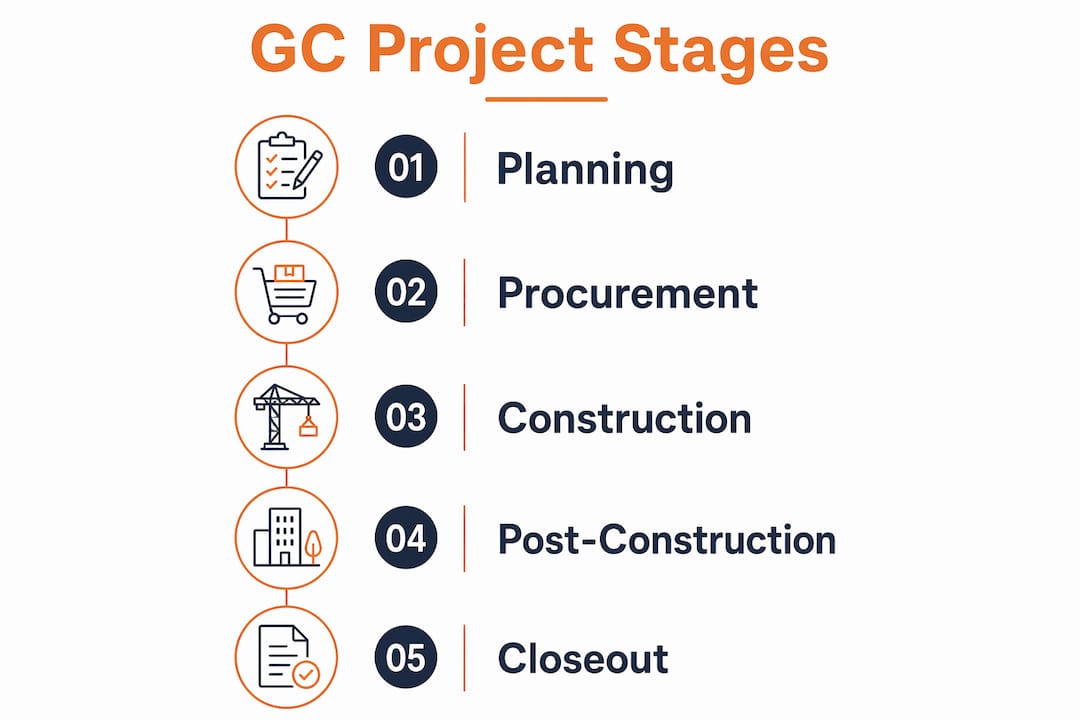
Preconstruction
- Develop the preliminary budget and identify value engineering opportunities before design is locked.
- Vet and prequalify subcontractors based on licensing, financial stability, and relevant project experience.
- Secure building permits and coordinate with local authorities having jurisdiction.
- Review construction documents for conflicts, ambiguities, or missing details that could generate change orders later.
- Build the master project schedule, establishing milestones and critical path activities.
Construction phase
- Manage daily site operations, including labor, equipment, and material deliveries.
- Enforce the site safety plan in compliance with OSHA regulations, including personal protective equipment requirements and hazard controls.
- Conduct quality control inspections at each phase of work before the next trade begins.
- Facilitate weekly owner-architect-contractor meetings to keep all parties aligned on progress and open issues.
- Process subcontractor pay applications, review them for accuracy, and submit owner payment requests on schedule.
- Manage change orders, documenting scope changes with cost and schedule impacts before authorizing additional work.
Post-construction
- Conduct the final walkthrough and generate the punch list, tracking all incomplete or deficient work to resolution.
- Collect and organize closeout documents: as-built drawings, warranties, operation and maintenance manuals, and lien waivers.
- Coordinate final inspections with the authority having jurisdiction and obtain the certificate of occupancy.
- Manage the warranty period, responding to defect claims and coordinating subcontractor corrections.
Financial management runs through every phase. The GC tracks invoices, manages retainage, and reconciles the final contract value against actual costs. On a lump sum contract, cost overruns impact the GC’s profit, not the owner’s budget, which gives owners a meaningful layer of financial protection when the contract is structured correctly.
How do general contractors, construction managers, and subcontractors differ?
These three roles are frequently confused, and the confusion costs owners money. Each party carries a different level of risk, a different scope of authority, and a different relationship to the owner.

General Contractor
The GC holds the prime contract with the owner and bears full financial and legal responsibility for project delivery. Under a fixed-price agreement, the GC absorbs cost overruns and is liable for construction defects. The GC’s primary job is hands-on execution: managing the site, the trades, and the daily workflow. According to Texas A&M University’s College of Architecture, general contractors focus on “immediate concerns in the physical construction environment” and hold accountability for work quality that construction managers do not.
Construction Manager (CM)
A construction manager typically works as an advisor to the owner, engaged earlier in the design phase to provide input on budget, schedule, and constructability. As the Construction Management Association of America (CMAA) clarifies, agency CMs “are not general contractors or constructors and typically do not perform the actual construction tasks themselves.” The CM does not hold the same financial risk as a GC. GCs provide a fixed-price build with full accountability, while CMs serve as strategic advisors without bearing that same financial exposure.
Subcontractor
Subcontractors hold contracts with the GC, not the owner. They perform specialized trade work within a defined scope, reporting to the GC for scheduling, quality, and safety compliance. The owner has no direct contractual relationship with subcontractors, which is precisely why the GC’s vetting and oversight of those trades matters so much.
The practical implication for owners:
- Hiring a GC transfers execution risk and day-to-day management responsibility away from you.
- Hiring a CM keeps you more involved in decisions but leaves execution risk distributed across trade contractors.
- Choosing between the two depends on your preference for budget certainty and risk transfer versus advisory involvement and shared control.
What skills and qualifications should you expect from a qualified GC?
Not every licensed contractor brings the same capabilities to a private market project. When you are evaluating a GC, these are the competencies that separate capable firms from exceptional ones.
- Project management and scheduling: Proficiency with scheduling tools and the ability to build a realistic critical path schedule, then actually manage to it.
- Contract administration: Understanding of AIA contract structures, change order processes, and lien law in the project’s state. Licensing requirements vary by state; California’s Contractors State License Board (CSLB), for example, sets specific financial and experience thresholds before a contractor can legally operate.
- Risk identification and insurance verification: The ability to spot scope gaps before they become disputes, and to verify that every subcontractor carries adequate general liability and workers’ compensation coverage.
- Subcontractor relationship management: A network of reliable, vetted trade partners, not just whoever is cheapest at bid time.
- Communication and leadership: Clear, consistent communication with owners, architects, and field crews. Owners should expect regular written updates, not just verbal check-ins.
- Financial acumen: The ability to read and manage a job cost report, process pay applications accurately, and flag budget variances before they compound.
A GC who excels at field execution but struggles with contract administration will create problems for you in the back half of a project, when change orders, retainage disputes, and closeout documentation become the critical path. Both sides of that skill set matter.
How the bidding process works and how to choose the right GC
Private market owners have more flexibility in GC selection than public agencies do. You are not required to award to the lowest bidder. That flexibility is an advantage, but only if you use it deliberately.
Bid types you will encounter:
- Lump sum (fixed price): The GC commits to a total price for a defined scope. Cost overruns are the GC’s problem. This structure gives owners budget certainty but requires complete, well-coordinated construction documents before bidding.
- Cost-plus with a guaranteed maximum price (GMP): The owner pays actual costs plus a fee, with a ceiling the GC cannot exceed without owner approval. This structure suits projects where design is still evolving at the time of GC engagement.
- Cost-plus without a cap: The owner bears all cost risk. This arrangement is rare in private market construction and generally not advisable unless the scope is genuinely undefined.
What to evaluate beyond the bid number:
- Licensing and insurance verification, confirmed directly with the issuing authority, not just from a certificate the GC provides.
- References from owners of comparable projects, specifically asking about schedule adherence, change order management, and communication quality.
- Subcontractor vetting practices: ask the GC how they prequalify their trade partners and what happens when a subcontractor underperforms.
- Financial stability: a GC who is financially overextended will slow-pay subcontractors, which creates lien exposure for your project.
- Effective GC selection hinges on vetting licensing, previous project success, financial stability, and subcontractor management capabilities.
Pro Tip: Ask each GC bidder to walk you through a specific change order situation from a recent project. How they describe that conversation with the owner tells you more about their communication style and integrity than any reference check will.
Why subcontractor vetting and risk management are the GC’s core value
The most common misconception owners have about GCs is that their primary value is construction knowledge. It is not. The GC’s core value is risk management, specifically the ability to identify, allocate, and contain the risks that would otherwise land on the owner.

Ambiguous work scopes are the greatest source of subcontractor risk. When a GC fails to align each subcontract scope with the prime contract requirements, gaps appear at trade handoffs, and those gaps produce delays, disputes, and cost overruns. A skilled GC closes those gaps before work begins, not after a problem surfaces on site.
Key risk management functions the GC performs on your behalf:
- Insurance verification: Confirming that each subcontractor carries the required coverage limits before they set foot on site.
- Indemnity clauses: Structuring subcontracts so that subcontractors are contractually required to cover costs even if their insurer denies a claim, protecting both the GC and the owner from uncovered losses.
- Safety protocol enforcement: Maintaining an OSHA-compliant safety program and holding subcontractors accountable to it, reducing the owner’s exposure to workplace injury liability.
- Coordination at trade handoffs: Managing the seams between subcontractors’ work is where high-value GCs separate themselves. Coordination failures at handoffs, not trade quality alone, are a frequent driver of expensive project delays.
- Document management: Centralizing submittals, shop drawings, and RFIs to prevent the cascading schedule impacts that poor document control creates.
The financial case for thorough GC risk management: When a GC properly structures insurance and indemnity provisions in subcontracts, the owner’s direct liability exposure on site-related incidents drops substantially. The alternative, an owner managing trade contractors directly without a GC, means absorbing every one of those risks personally.
Private market owners who treat GC selection as a price exercise routinely underestimate this risk transfer value. The difference between a GC who vets subcontractors rigorously and one who does not shows up in change orders, schedule delays, and, in the worst cases, litigation. For a deeper look at how subcontractor relationships affect project outcomes, Federal-rconstructionsolutions has covered subcontractor vetting strategies in detail.
Understanding building compliance requirements is another area where a qualified GC protects the owner. Code violations discovered during inspections can halt a project for weeks and trigger costly remediation. A GC who stays current on local code requirements and coordinates with inspectors proactively keeps that risk off your schedule.
How Federal-rconstructionsolutions supports private market project success

Federal-rconstructionsolutions brings the same compliance discipline and risk management rigor it applies to federal procurement directly to private sector construction projects. Whether you are managing a commercial build-out, a private infrastructure project, or a mixed-use development, the team at Federal-rconstructionsolutions understands how to structure GC relationships, evaluate bids, and protect your project from the risks that derail timelines and budgets.
Private sector opportunities can yield more consistent revenue and higher overall profitability than public contracts alone, and Federal-rconstructionsolutions helps construction businesses capture both. If you are ready to strengthen your position in the private market, explore the private sector construction services Federal-rconstructionsolutions offers, or review the bid support resources available for GC selection and project management.
Key Takeaways
In private market construction, the general contractor is the owner’s primary risk shield, responsible for every aspect of project delivery from preconstruction planning through final closeout.
| Point | Details |
|---|---|
| GC as single point of accountability | The GC holds legal and financial responsibility for delivering the project per contract, protecting the owner from direct site liability. |
| Lump sum contracts shift cost risk | Under a fixed-price agreement, cost overruns impact the GC’s profit, not the owner’s budget, giving owners financial certainty. |
| Subcontractor vetting is core value | Ambiguous work scopes are the greatest source of subcontractor risk; the GC’s contract alignment prevents delays and disputes. |
| CM vs. GC distinction affects risk | Construction managers advise without bearing execution liability; GCs hold full accountability for work quality and defects. |
| Indemnity clauses protect owners | Properly structured subcontracts require subs to cover costs even when insurers deny claims, reducing owner exposure. |
FAQ
What is the main role of a general contractor?
A general contractor is legally and operationally responsible for delivering a construction project per contract, managing subcontractors, compliance, and day-to-day risks so the owner does not have to manage the site directly.
What is a private general contractor?
A private general contractor operates in the private market rather than on government-funded projects, working under contracts negotiated directly with private owners rather than through public procurement rules. The core responsibilities, including subcontractor management, permitting, and risk absorption, remain the same.
How do general contractors charge for their work?
GCs typically charge through one of three structures: a lump sum fixed price, a cost-plus fee with a guaranteed maximum price, or a cost-plus arrangement without a cap. Lump sum contracts are the most common in private market construction because they give owners a defined budget commitment.
How does a GC differ from a construction manager?
A GC holds the prime contract and bears full financial risk for project delivery, while a construction manager typically serves as an advisor to the owner without assuming liability for construction defects or cost overruns. Owners who want budget certainty and risk transfer generally favor the GC structure.
What should you verify before hiring a general contractor?
Confirm the GC’s state license directly with the issuing authority, verify insurance certificates, check references from owners of comparable projects, and ask specifically about their subcontractor prequalification process and how they handle change orders.

