
Private vs Public Construction Contracts: 2026 Guide
Private and public construction contracts are defined by their funding source. Public contracts draw on taxpayer money and operate under strict procurement laws, including the Federal Acquisition Regulation (FAR) and the Davis-Bacon Act. Private contracts are funded by private capital and allow far more flexible negotiation. For contractors deciding where to focus their bidding efforts, understanding these differences in construction contracts is not optional. It shapes your compliance obligations, cash flow, profit margins, and how you win work in the first place.
How do private vs public construction contracts differ in procurement?
Public construction is taxpayer funded with rigid, transparent procurement rules. Private construction is funded by private capital with flexible, negotiated contract awards. That single distinction drives nearly every other difference you will encounter.
Public procurement follows a formal, documented process. Agencies must justify every decision in writing and open their records to public scrutiny. The three most common public bidding methods are:
- Invitation for Bid (IFB): The agency publishes full project specs. You submit a sealed price. The lowest responsive, responsible bidder wins. No negotiation.
- Request for Proposal (RFP): The agency evaluates both price and technical approach. Scoring criteria are published in advance. This method is common for design-build and complex federal projects.
- Qualifications-Based Selection (QBS): Used primarily for architect-engineer services. The agency selects based on qualifications first, then negotiates price.
Public bidding requires open records and audit transparency at every stage. That means your bid documents, pricing, and award justification become part of the public record. Private clients have no such obligation. They can invite three firms they trust, negotiate terms over a phone call, and award the job the same week.
Private sector bidding is relationship-driven. A developer who has worked with your firm before will call you first. Speed and personal rapport carry real weight. That does not mean private bids are informal. Scope documents, insurance requirements, and contract terms still matter. But the process is faster and far less bureaucratic.

Pro Tip: Review the full bid package before the pre-bid meeting on any public project. Submitting a Request for Information (RFI) early signals competence to the agency and gives you a chance to clarify ambiguous specs before they cost you money.
The construction bidding process for public work also demands strict formatting compliance. Agencies have rejected the lowest-priced bid because a required form was missing or a signature was in the wrong place. Responsiveness and procedural accuracy matter as much as your number.
What are the key contract terms and compliance requirements?
Public contracts are standardized and non-negotiable. Public contracts are “take it or leave it” documents mandated by government legal teams. Private contracts, by contrast, allow direct negotiation on payment terms, liability caps, indemnification clauses, and dispute resolution methods.
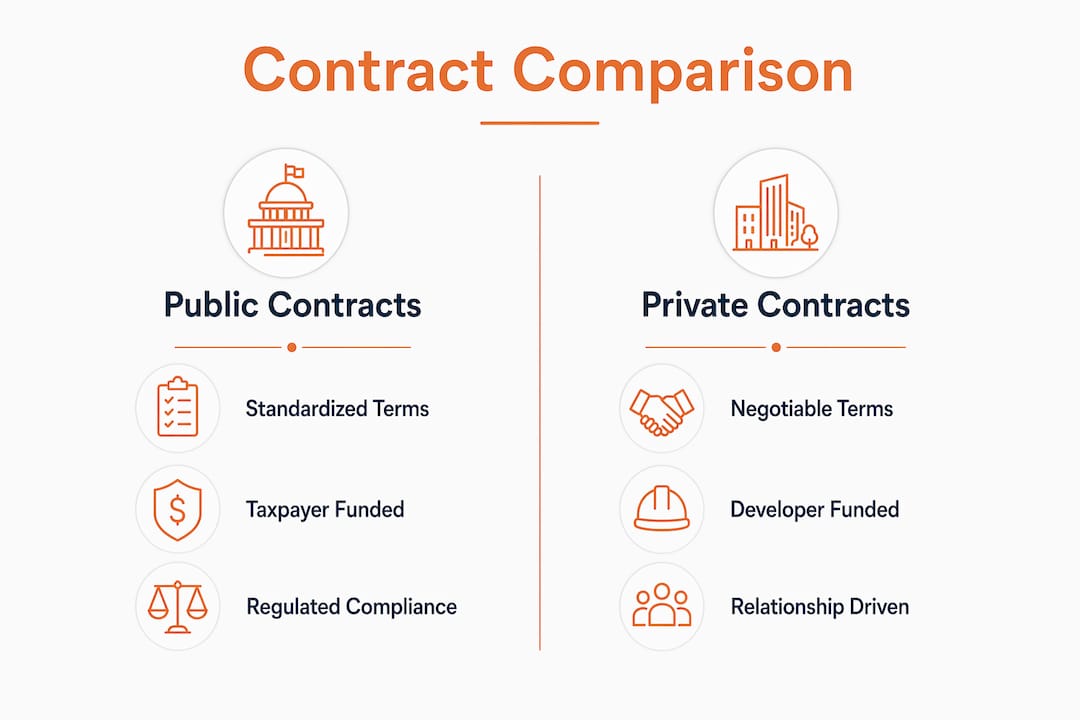
The table below compares the most critical contract features across both sectors.
| Feature | Public contracts | Private contracts |
|---|---|---|
| Wage requirements | Davis-Bacon Act prevailing wages on federal projects over $2,000 | State law varies; no federal equivalent unless state mandates it |
| Payment terms | Legally mandated 30–90 day cycles | Negotiable; milestone or net-30 terms common |
| Contract standardization | Fixed government forms; minimal modification | Fully negotiable; AIA or custom documents |
| Inspection and oversight | Mandatory milestones, third-party inspections, FOIA transparency | Owner-directed; less formal documentation required |
| Change orders | Formal written process with agency approval | Negotiated directly with owner; faster resolution |
Federal public construction contracts over $2,000 must comply with the Davis-Bacon Act, which requires payment of locally prevailing wages to all laborers and mechanics. That requirement adds a payroll documentation burden that private projects do not carry at the federal level. Thirty-two states have their own prevailing wage laws that may apply to state-funded private projects, so you need to check your state’s rules before assuming private work is wage-law-free.
Payment timing is one of the sharpest practical differences. Public agencies run invoices through bureaucratic approval chains. Payment cycles in public projects are legally mandated and can run 30–90 days from invoice submission. Private owners, especially experienced developers, often agree to milestone-based payments that align with your actual cash needs on the job.
Change orders tell a similar story. On a public project, every scope change requires a formal written modification approved by the contracting officer. On a private project, you can often resolve a change order in a single conversation and get a signed amendment the same day. That speed difference has real financial consequences on long projects.
Pro Tip: On public contracts, submit every change order request in writing the day the scope change is identified. Verbal approvals have no legal standing in public procurement, and delayed documentation is the most common reason contractors absorb costs they should have been paid for.
How do risks, profit margins, and cash flow compare?
Public projects generally carry thinner profit margins and slower payment cycles than private projects. Private projects offer higher margins but carry more market risk and payment uncertainty. Neither sector is objectively better. The right answer depends on your firm’s financial position and operational capacity.
Public work reduces credit risk because funding is secured before the project starts. A school district cannot run out of money mid-project the way a private developer can. That security has real value, especially for smaller firms that cannot absorb a payment default. The trade-off is that you will wait longer for every dollar you earn.
Private projects can deliver stronger margins because owners are not bound by the lowest-bid requirement. A private developer who values your track record and reliability will pay a premium for it. That premium disappears if the developer runs into financing trouble or disputes your invoice.
The cash flow gap in public work is the most underestimated operational challenge. Contractors must plan for 30–90 day invoice approvals in public work. On a $2 million project with monthly billing, you could carry $300,000 or more in receivables at any given time. Best practices for managing financial risk across both sectors include:
- Maintain a cash reserve equal to at least 60 days of project operating costs before starting a public project.
- Use schedule of values billing on all projects to tie payment requests to completed work, not calendar dates.
- Review retainage terms before signing. Public contracts often hold 10% retainage until final acceptance, which can take months after substantial completion.
- On private projects, negotiate a payment bond or personal guarantee from the owner if the project exceeds your firm’s standard credit threshold.
- Track receivables weekly. A 45-day invoice that slips to 75 days without follow-up is a cash flow problem you created.
Finding the right project mix between public and private work is critical. Specializing too narrowly reduces your bid opportunities. Spreading too broadly invites strong competition and thinner margins. Federal-rconstructionsolutions reports that contractors who expand into private sector opportunities can achieve 30% more consistent revenue and 20% higher overall profitability compared to firms that focus exclusively on public work.
What strategies should contractors use when bidding each contract type?
Winning in each sector requires a different approach. Public and private bidding reward different skills, and contractors who treat them the same way consistently underperform in one or both.
For public contracts, follow these steps:
- Verify your registrations first. SAM.gov registration is mandatory for federal work. Confirm your NAICS codes match the project’s requirements before investing time in a bid.
- Read the entire solicitation before pricing. Wage determinations, bonding requirements, and special contract clauses can add significant cost. Missing them at bid time means absorbing them at project time.
- Submit RFIs early. Pre-bid RFIs and legal vetting can sometimes open the door to modifications within standard public contract provisions. This requires legal expertise, but it is worth the investment on large contracts.
- Format your bid exactly as specified. Noncompliance with procurement formatting causes firms to lose bids despite submitting the lowest price. Responsiveness and responsibility outweigh raw bid amount.
- Build your compliance documentation system. Certified payrolls, daily reports, and inspection logs are not optional. They are your legal protection if a dispute arises.
For private contracts, the approach shifts toward relationship and negotiation:
- Invest in the pre-bid relationship. Private owners award work to firms they trust. Attend industry events, follow up after project completions, and stay visible in your target market.
- Negotiate contract terms before signing. Review indemnification, payment terms, and dispute resolution clauses. Push for milestone payments and a clear change order process.
- Vet the owner’s financing. Ask for proof of financing on projects above your standard threshold. A signed contract with an underfunded owner is a liability, not an asset.
- Price for the actual risk. Private projects carry market and payment risk that public projects do not. Your margin should reflect that.
Pro Tip: Use a bid-no bid decision framework before committing resources to any public solicitation. The cost of preparing a compliant federal bid is significant. Chasing every opportunity without a filter is one of the fastest ways to drain your estimating team.
The private sector bid solicitation process follows different rules than public procurement, and understanding those rules before you submit protects your time and your margins.
Key Takeaways
Public and private construction contracts require entirely different compliance systems, financial plans, and bidding strategies, and contractors who master both sectors consistently outperform those who specialize in only one.
| Point | Details |
|---|---|
| Funding source drives everything | Public contracts use taxpayer funds with rigid rules; private contracts use private capital with flexible terms. |
| Davis-Bacon Act applies to public work | Federal projects over $2,000 require prevailing wages; private projects follow state law only. |
| Cash flow gap is the top public risk | Plan for 30–90 day payment cycles and maintain adequate reserves before starting public projects. |
| Private work offers higher margins with more risk | Private projects allow negotiated pricing and faster payments but carry greater payment and market risk. |
| Compliance formatting wins public bids | A bid rejected for missing documentation costs you the same as a bid that was never submitted. |
What I have learned working across both contract types
By Rowena
The biggest mistake I see contractors make is assuming that winning a public contract works the same way as winning a private one. It does not. Public procurement is an adherence exercise. The agency is not evaluating your personality or your relationship history. They are checking boxes. If your bid package is missing a required form, you lose. That is not a judgment on your capabilities. It is just how the system works.
Private work is the opposite. Relationships, reputation, and responsiveness matter more than your price in many cases. I have watched firms with higher numbers win private projects because the owner trusted them. That trust takes years to build and seconds to lose.
The contractors I have seen thrive in both sectors share one habit: they treat each contract type as a separate business discipline. They do not carry private-sector negotiation instincts into a public bid room, and they do not apply public-sector rigidity to a private developer who just wants to get the job done. That mental separation is harder than it sounds, especially when you are busy.
My honest advice is to pick one sector to master first, build your systems for it, and then expand. Trying to operate in both without the right documentation standards and bidding workflows in place is how firms end up with compliance problems on public jobs and margin problems on private ones. The municipal procurement field guide is a good starting point if public work is your next move.
— Rowena
Federal-rconstructionsolutions helps contractors win in both markets
Federal-rconstructionsolutions specializes in federal procurement advisory and private sector construction consulting for firms that want to compete effectively across both contract types.
Their federal procurement services cover RFP writing, SAM.gov compliance, Davis-Bacon wage documentation, and bid submission support. For contractors expanding into private work, their private sector consulting covers contract negotiation, bid strategy, and project pipeline development. Federal-rconstructionsolutions reports a 90% compliance rate for clients on federal bid submissions. Contractors who have worked with them on both public and private projects report measurable improvements in bid win rates and project profitability. Contact Federal-rconstructionsolutions to build a bidding system that works for the contracts you want to win.
FAQ
What is the main difference between public and private construction contracts?
Public construction contracts are funded by taxpayer money and governed by strict procurement laws, including competitive bidding and the Davis-Bacon Act. Private contracts are funded by private capital and allow negotiated terms with fewer regulatory requirements.
Does the Davis-Bacon Act apply to private construction projects?
The Davis-Bacon Act applies to federal public construction contracts valued over $2,000. It does not apply to private projects at the federal level, though 32 states have their own prevailing wage laws that may cover state-funded private work.
Why do public construction contracts have slower payment cycles?
Public agencies process invoices through bureaucratic approval chains governed by legal mandates, resulting in payment cycles of 30–90 days. Contractors must maintain adequate cash reserves to cover operating costs during these delays.
Can contractors negotiate terms in a public construction contract?
Public contracts are largely standardized and non-negotiable. Experienced contractors can sometimes use pre-bid RFIs to identify conflicts between contract clauses and applicable statutes, but this requires legal expertise and is not guaranteed.
Which contract type offers better profit margins for contractors?
Private construction contracts generally offer higher profit margins because pricing is negotiated rather than awarded to the lowest bidder. Public contracts carry lower credit risk due to pre-secured funding but typically produce thinner margins.