
Municipal Procurement in Construction: A 2026 Field Guide
Municipal procurement in construction is the formal process through which local governments source, evaluate, and award public construction contracts to ensure projects meet quality, budget, and schedule requirements. The role of municipal procurement in construction extends well beyond selecting the lowest bidder. It governs risk allocation, contract design, supplier qualification, and lifecycle asset performance from the earliest planning stages through final delivery. Contractors and project managers who understand this process, including frameworks like Directive 2014/24/EU and the Most Economically Advantageous Tender (MEAT) model, position themselves to win more work and deliver better outcomes on public projects.
How does municipal procurement influence construction project outcomes?
Municipal procurement decisions shape every measurable dimension of a construction project, including cost, schedule, quality, and long-term risk. The procurement model a municipality selects determines how contractors price work, how risk is distributed, and how much flexibility exists for value engineering. Choosing the wrong model at the outset can lock in inefficiencies that no amount of on-site management can fix.
Strategic procurement impacts lifecycle risk and performance by aligning planning, model selection, contract design, construction delivery, and long-term asset management. This means the biggest risks on a public construction project often arise outside the tender stage entirely. Contract structure, risk allocation, and market engagement decisions made before a bid is ever published carry more weight than most contractors realize.
One of the most significant findings in recent procurement analysis is the value of early supplier involvement. Agile procurement, which embeds procurement expertise during the design phase, can drive 10 to 20% construction cost savings and accelerate time-to-market by 20 to 40%. Those numbers reflect the leverage recovered when procurement professionals collaborate with designers before specifications are locked in, allowing for value engineering and realistic subcontractor pricing.
Award criteria also directly shape contractor behavior. When municipalities evaluate bids on price alone, contractors are incentivized to cut scope, use lower-grade materials, or understaff projects. Evaluation-based procurement, which scores quality, lifespan, environmental impact, delivery timelines, and price together, attracts more capable suppliers and produces better long-term asset performance. The impact of procurement in construction is therefore not just administrative. It is a primary driver of whether a public asset performs as intended over its full service life.

Pro Tip: If you are preparing a bid for a municipal project, request the evaluation scoring matrix before submission. Knowing how points are weighted across price, quality, and schedule lets you allocate proposal effort where it counts most.
Key factors where procurement decisions directly affect project outcomes include:
- Procurement model selection: Design-bid-build, design-build, and construction manager at-risk each distribute risk and schedule pressure differently.
- Contract design: Poorly structured contracts create disputes, change order inflation, and schedule slippage.
- Market engagement timing: Early engagement with suppliers recovers value engineering opportunities that disappear once design is finalized.
- Award criteria: Price-only awards consistently produce higher lifecycle maintenance costs compared to value-based evaluation models.
What are the typical municipal procurement processes in construction?
Municipal procurement for construction follows a structured sequence designed to ensure transparency, legal compliance, and fair competition. Understanding each step is not optional for contractors who want to stay in the running. A single missed requirement can render a bid non-responsive before it is ever evaluated.
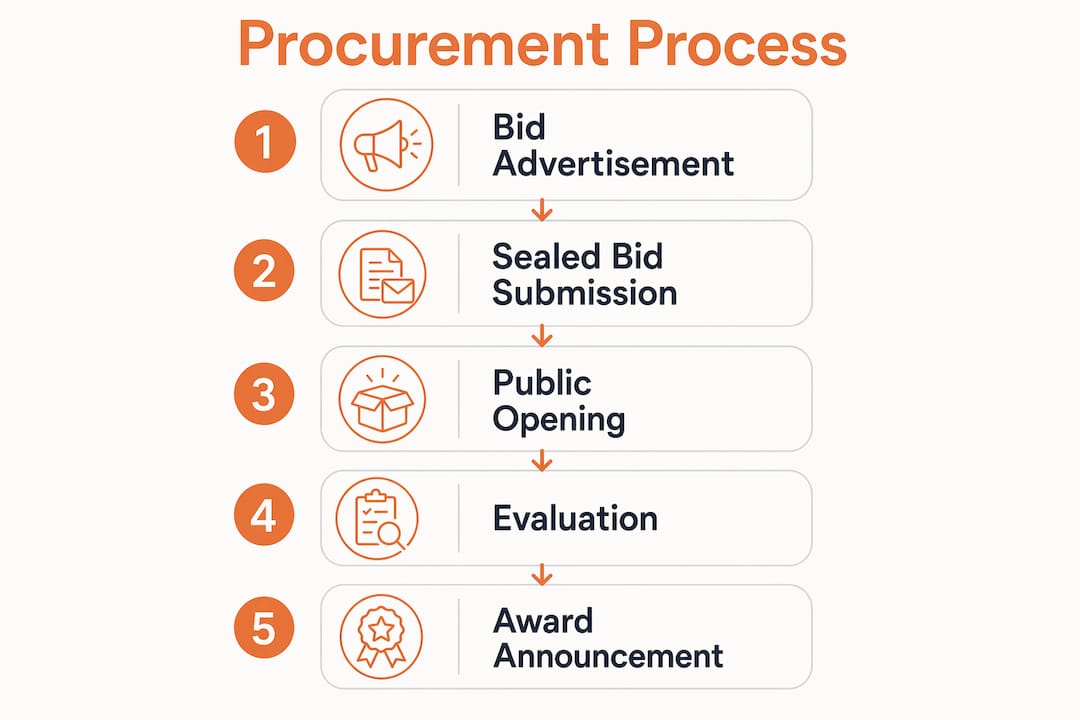
The most common method is the sealed bid, also called an Invitation to Bid (ITB). The City of Elyria’s 2026 ITB illustrates how this works in practice: sealed bids were required by May 21, 2026, with a public bid opening immediately following. All bids submitted after the deadline were rejected without review, regardless of price or qualifications. That is standard practice across most U.S. municipalities.
Here is the typical sequence for a municipal construction procurement:
- Procurement planning: The municipality defines project scope, budget, and delivery method before any public notice is issued.
- Bid advertisement: The ITB or Request for Proposals (RFP) is published through official channels, including government websites and legal notices.
- Pre-bid conference: Many municipalities hold a mandatory or optional pre-bid meeting to clarify scope and answer contractor questions.
- Bid submission: Contractors submit sealed bids by the stated deadline, including all required attachments.
- Public bid opening: Bids are opened publicly and read aloud, creating a transparent record of all submitted prices.
- Responsiveness review: Municipal staff verify that each bid includes all required documentation before scoring begins.
- Award recommendation: The lowest responsive and responsible bidder, or the highest-scoring bidder under MEAT criteria, is recommended for award.
- Contract execution: The selected contractor signs the contract and provides required bonds and insurance before work begins.
Documentation requirements are where many contractors lose bids they should have won. The City of Elyria requires prime contractors to submit ODOT certification with their sealed bids. That certification must be included at submission, not provided after award. Missing it means automatic disqualification, regardless of how competitive the price is.
| Procurement Stage | Key Requirement |
|---|---|
| Bid submission | Sealed bid with all certification attachments by stated deadline |
| Responsiveness review | Proof of contractor qualifications submitted at time of bid |
| Award scoring | Price, quality, schedule, and compliance evaluated together |
| Contract execution | Performance bond, payment bond, and insurance certificates required |
Affirmative action compliance, minority business enterprise (MBE) participation goals, and Davis-Bacon Act wage requirements are also standard elements of municipal construction contracts. Contractors who treat these as afterthoughts rather than bid requirements routinely lose work to competitors who plan for them from the start.
Lowest price vs. MEAT: which award method produces better results?
The choice between lowest-price award and the Most Economically Advantageous Tender model is one of the most consequential decisions a municipality makes in its public sector construction strategies. Each method produces measurably different contractor behavior, project quality, and long-term asset costs.
Under a lowest-price model, the contract goes to the bidder with the lowest total price, provided they meet minimum qualification thresholds. This approach is administratively simple and easy to defend publicly. The problem is that it creates a direct financial incentive for contractors to reduce quality, understaff projects, or submit unrealistically low prices with the intent to recover margin through change orders.
The MEAT model, introduced through 2014 EU public procurement reforms, requires municipalities to evaluate bids across quality, environmental and social criteria, lifecycle costs, and innovation rather than price alone. This shifts the competitive dynamic. Contractors who invest in better materials, more experienced crews, and realistic schedules are rewarded rather than penalized. The EU’s adoption of MEAT reflects a recognition that the lowest bid rarely produces the lowest total cost of ownership.
Pro Tip: When bidding on MEAT-evaluated contracts, quantify your lifecycle cost advantages explicitly. If your proposed materials require less maintenance over a 20-year period, calculate that savings and present it in your proposal. Evaluators are looking for that data.
The practical difference between the two models is visible in long-term maintenance budgets. Lowest-bid procurement can incentivize contractors to cut corners, increasing maintenance costs and shortening asset lifespans. Evaluation-based approaches aim for long-term value alignment between the municipality and the contractor. For construction professionals, this distinction matters because it changes what a winning proposal looks like.
| Award Criterion | Lowest Price | MEAT |
|---|---|---|
| Primary evaluation factor | Total bid price | Price, quality, lifecycle cost, innovation |
| Contractor incentive | Minimize cost at submission | Demonstrate long-term value |
| Risk to municipality | Higher maintenance costs, quality disputes | More complex evaluation process |
| Best suited for | Simple, well-defined commodity work | Complex infrastructure with long service life |
The U.S. federal procurement system uses a similar value-based framework through Best Value Source Selection under the Federal Acquisition Regulation (FAR). Many municipalities are now adopting comparable approaches for local infrastructure projects, particularly water systems, transportation, and public facilities where lifecycle performance matters.
How can construction professionals optimize bids for municipal contracts?
Winning municipal construction contracts consistently requires treating the bid process as a discipline, not a transaction. The contractors who win most often are not always the cheapest. They are the ones who submit complete, compliant, and well-documented proposals that give evaluators confidence.
Embedding procurement expertise early in design phases recovers lost leverage in value engineering and supplier collaboration. For contractors, the equivalent is engaging with the bid documents early, attending pre-bid conferences, and building relationships with municipal procurement offices before a specific project goes out to bid. Municipalities remember contractors who ask intelligent questions and show up prepared.
Practical steps to strengthen your municipal bid submissions:
- Read the entire bid package before pricing anything. Scope gaps, special conditions, and certification requirements buried in the technical specifications can make or break your margin.
- Verify all required attachments before submission. State certifications, MBE participation forms, affirmative action plans, and bonding documentation must be included at submission, not promised later.
- Build your internal submission timeline backward from the deadline. Subcontractor quotes, bonding approvals, and document assembly each take time. A sealed bid deadline of May 21 means your internal cutoff should be May 16 at the latest.
- Tailor your technical proposal to the evaluation criteria. If the municipality scores quality and schedule alongside price, your proposal narrative should address both with specifics, not generalities.
- Avoid underbidding to win. Municipalities track contractor performance. A project delivered over budget or behind schedule damages your standing for future bids more than losing a single contract.
Pro Tip: Register on SAM.gov and maintain your profile current even for municipal work. Many municipalities cross-reference federal databases when evaluating contractor responsibility, and an inactive or incomplete SAM.gov profile can raise compliance questions.
The private sector bid solicitation process shares structural similarities with municipal procurement, including sealed submissions and compliance attachments. Contractors who master one process transfer those skills directly to the other, which is why Federal-rconstructionsolutions consistently advises clients to build bid management systems that work across both public and private markets.
Understanding architectural intelligence for procurement is also becoming relevant for contractors in 2026, as municipalities increasingly use data-driven tools to evaluate supplier performance history and project delivery records during the award process.
Key takeaways
Municipal procurement in construction is a lifecycle discipline that begins before the first bid is published and extends through asset management, making early engagement and compliance the two most critical success factors for contractors.
| Point | Details |
|---|---|
| Procurement shapes outcomes | Model selection, contract design, and award criteria directly determine project cost, quality, and risk. |
| MEAT outperforms lowest price | Value-based evaluation produces better lifecycle asset performance and aligns contractor incentives with municipal goals. |
| Compliance is non-negotiable | Missing a certification attachment at submission disqualifies a bid regardless of price or qualifications. |
| Early engagement pays off | Agile procurement embedded in design phases can reduce construction costs by 10 to 20%. |
| Bid strategy must match criteria | Proposals tailored to evaluation scoring matrices consistently outperform generic price-focused submissions. |
Why procurement strategy is the most underrated skill in construction
I have reviewed hundreds of bid packages and post-award debriefs over the years, and the pattern is consistent: contractors who lose municipal work rarely lose on price. They lose on compliance gaps, thin technical proposals, or a fundamental misreading of what the municipality actually values.
The conventional wisdom in construction is that public contracts go to the lowest number. That was largely true 20 years ago. Today, municipalities using evaluation-based procurement are explicitly trying to move away from that model because they have lived through the consequences. A water treatment facility built by the lowest bidder that requires $2 million in repairs within five years is not a savings. It is a liability.
What I find most contractors miss is that procurement decisions made before the tender is even published, including risk allocation in the contract, the delivery model selected, and the evaluation criteria chosen, determine 80% of the project outcome. By the time a bid hits the street, the municipality has already made its most consequential choices. Your job as a contractor is to understand those choices and respond to them precisely.
The shift toward MEAT and evaluation-based scoring is not a bureaucratic trend. It is a structural change in how public money is being protected. Contractors who build the internal capability to respond to value-based criteria, through better documentation, lifecycle cost analysis, and proposal writing, will win a disproportionate share of public construction work over the next decade.
— Rowena
How Federal-rconstructionsolutions supports your municipal procurement success
Navigating municipal construction contracts requires more than competitive pricing. It requires compliance expertise, documentation discipline, and a bid strategy aligned with how municipalities actually evaluate proposals.
Federal-rconstructionsolutions brings deep experience in both federal and municipal procurement processes, helping construction businesses submit compliant, competitive bids that win. From procurement lifecycle support and RFP writing to MBE certification assistance that qualifies you for more public projects, the team at Federal-rconstructionsolutions builds the systems contractors need to compete consistently. If you are pursuing municipal infrastructure work and want a partner who understands the full procurement process from bid preparation through contract award, connect with Federal-rconstructionsolutions to discuss a strategy tailored to your business.
FAQ
What is the role of municipal procurement in construction?
Municipal procurement in construction is the process local governments use to source, evaluate, and award construction contracts through formal methods like sealed bids and MEAT scoring. It governs risk allocation, contractor qualification, and contract design to protect public investment and deliver quality infrastructure.
How does the municipal bidding process work?
The municipal bidding process typically follows a sequence from bid advertisement through sealed submission, public opening, responsiveness review, and contract award. Contractors must submit all required certifications and documentation at the time of bid submission to remain eligible for award.
What is MEAT and why does it matter for construction bids?
MEAT stands for Most Economically Advantageous Tender, a procurement award model that evaluates bids on quality, lifecycle cost, environmental criteria, and innovation rather than price alone. Contractors who understand MEAT criteria and tailor their proposals accordingly consistently outperform those competing on price only.
What are the most common reasons construction bids are disqualified?
The most common disqualification reasons are missing certification attachments, late submissions, and incomplete compliance documentation such as MBE participation forms or affirmative action plans. These issues are entirely preventable with a structured internal bid management process.
How can early supplier engagement improve construction project outcomes?
Embedding procurement expertise during the design phase allows for value engineering, realistic subcontractor pricing, and schedule alignment before specifications are locked in. Research shows this approach can reduce construction costs by 10 to 20% and accelerate delivery timelines by 20 to 40%.