
Preconstruction Kickoff Checklist: A Full Meeting Agenda
The preconstruction kickoff meeting happens after contract signing and before mobilization, and its job is simple: produce signed minutes and an action log that the whole team can execute against. Five items must get settled in that room before anyone moves equipment to the site. Confirm contract dates and Notice to Proceed, lock the baseline CPM schedule and its milestones, verify insurance and bond documents, publish a RACI matrix and communication plan, and agree on submittal and RFI review turnaround times. The project manager should lead the meeting, and minutes need to circulate within 24 to 72 hours of the meeting’s close.
- Contract dates and Notice to Proceed confirmed in writing
- Baseline CPM schedule reviewed with milestones recorded
- Insurance certificates and bonds verified against contract requirements
- RACI matrix and communication plan published to the team
- Submittal and RFI review SLAs agreed upon and logged
Key Takeaways
A successful preconstruction kickoff produces signed minutes, a published RACI matrix, and a confirmed CPM baseline within 72 hours of the meeting.
| Point | Details |
|---|---|
| Settle five items first | Confirm contract dates, CPM baseline, insurance/bonds, RACI, and submittal SLAs before mobilization. |
| Run a fixed agenda | Sequence introductions, scope, schedule, submittals, insurance, safety, logistics, and action items in order. |
| Assign decision authority | Use a RACI matrix for RFIs, submittals, change orders, and payment certifications to avoid bottlenecks. |
| Circulate minutes fast | Distribute meeting minutes and the action log within 24 to 72 hours, tied to Notice to Proceed. |
| Federal work needs extra checks | Federal-rconstructionsolutions offers a compliance checklist and consulting support for Davis-Bacon and Miller Act obligations. |
Table of Contents
- Kickoff Meeting Agenda Template You Can Use Today
- What Documents and Attendees You Need Before Kickoff
- Who Should Own Decisions in the RACI Matrix?
- How Do You Confirm the CPM Schedule at Kickoff?
- Confirming Contracts, Insurance, and Bonds
- Setting Submittal and RFI Turnaround Expectations
- Locking Down Site Logistics and Safety Requirements
- Turning Kickoff Decisions Into Minutes and Action Items
- Federal Procurement Resources for Public and Complex Projects
- Sources
- FAQ
Kickoff Meeting Agenda Template You Can Use Today
A preconstruction kickoff runs best on a fixed sequence, not a loose conversation. Procore’s preconstruction meeting guidance points to the same core building blocks: schedule, roles, documents, and outcomes. Here’s the order that keeps a two-hour meeting from running long.
- Introductions and roles (10 minutes) — every attendee states name, company, and function on the project.
- Project overview and scope review (15 minutes) — owner or architect walks through scope, exclusions, and any recent revisions.
- Contract terms and key dates (15 minutes) — confirm Notice to Proceed date, substantial completion, and liquidated damages triggers.
- Schedule and CPM review (20 minutes) — walk the critical path, flag long-lead items, confirm update frequency.
- Submittals and RFIs (15 minutes) — set the review platform, turnaround times, and escalation path.
- Insurance, bonds, and payment terms (15 minutes) — verify certificates, confirm retainage percentage and draw schedule.
- Quality assurance and safety plan overview (10 minutes) — review inspection points and site-specific safety requirements.
- Site logistics and walkthrough (15 minutes) — access, laydown, hours of work, utility locates.
- Communications and RACI matrix (10 minutes) — confirm decision authority and reporting lines.
- Open items and action log (15 minutes) — assign owners and due dates for everything unresolved.
Before the meeting, someone needs to distribute the attendance list, an editable agenda, and the key contract documents. Assign a facilitator to keep time, a note-taker to build the action log live, and a timekeeper if the group tends to run long on schedule debates.
What Documents and Attendees You Need Before Kickoff
A kickoff meeting only works when the right paperwork and the right people show up. LegalClarity’s checklist guidance puts insurance verification, permit confirmation, and clear ownership of action items at the center of a defensible meeting record.
Documents to bring:
- Signed contract and any executed amendments
- Approved construction drawings and specifications
- Baseline CPM schedule
- Submittal register and schedule of values (AIA G702/G703 format)
- Building permits, insurance certificates, and bonds
- SWPPP and geotechnical report
Attendees to invite:
- Owner representative and project manager
- Superintendent and lead subcontractors
- Architect or engineer of record
- QA/QC lead and safety officer
- Procurement contact for long-lead materials
Logistics to confirm:
- Meeting location or virtual link, with AV set up in advance
- Site access, escort requirements, and parking or laydown map
- Timing for a field walkthrough, if the site is accessible that day
Pro Tip: Send the drawing set and schedule of values 48 hours ahead. Reviewing documents cold in the room wastes the first 20 minutes on questions that a quick read would have already answered.
Who Should Own Decisions in the RACI Matrix?
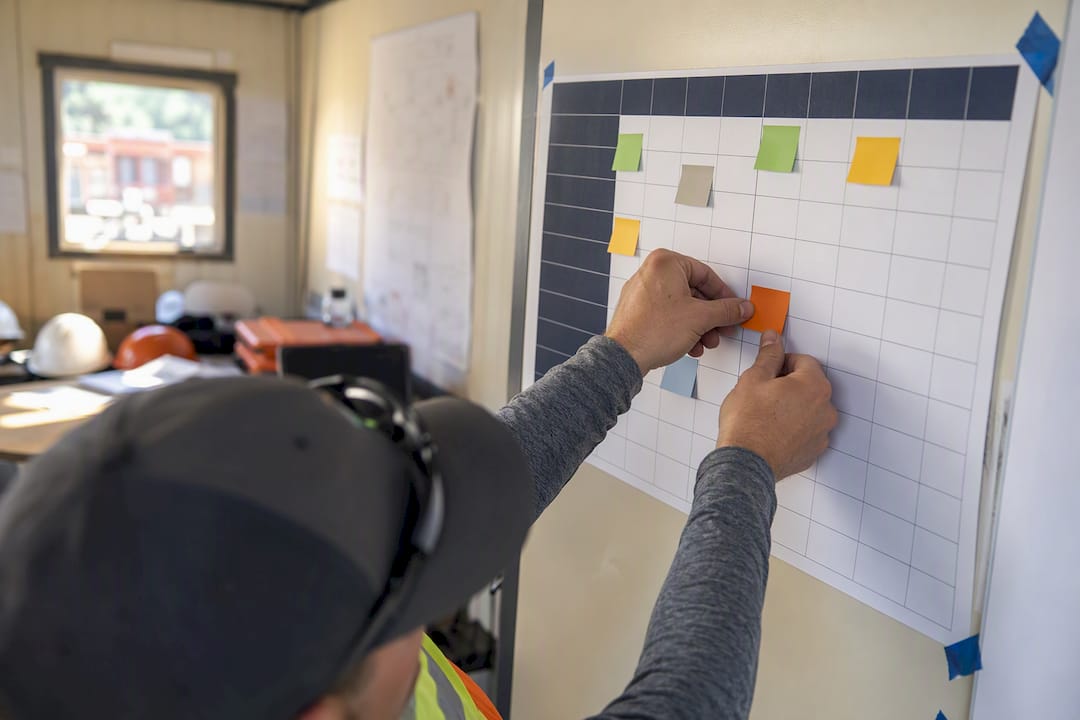
Every preconstruction kickoff needs a documented answer to one question: who decides what, and how fast? A RACI matrix, short for Responsible, Accountable, Consulted, and Informed, assigns that authority before disputes happen instead of during them. AllThingsConstructionPM’s guidance on precon attendees reinforces that unclear roles are one of the most common causes of early-project friction.
A workable RACI for a mid-size project usually looks like this:
- RFIs: Superintendent is Responsible, PM is Accountable, architect is Consulted, owner is Informed.
- Submittal approvals: Subcontractor submits, PM tracks, architect/engineer approves, owner is Informed.
- Change orders: PM drafts, owner is Accountable, architect Consulted on scope impact.
- Payment certifications: PM prepares the draw, owner or lender Accountable for release, accounting Informed.
Attach the finished RACI to your document control system and reference it in the meeting minutes, so it stays the single version everyone works from.
How Do You Confirm the CPM Schedule at Kickoff?
Treat the CPM schedule as a working tool at kickoff, not a document to rubber-stamp. Require the contractor to present the schedule with full logic ties, float values, and long-lead procurement items clearly flagged. That’s what surfaces conflicts while they’re still cheap to fix, rather than three months into the job when the float is gone.
Confirm and record these dates directly in the meeting minutes:
- Notice to Proceed date
- Site handover or mobilization date
- Interim milestones (foundation complete, structure topped out, rough-in complete)
- Substantial completion date
Projectmanager recommends recurring schedule reviews rather than a one-time check. Most teams settle on biweekly reviews for the first phase, then weekly once the project enters a critical path with tighter tolerances.
Schedule callout: A CPM baseline reviewed and accepted at kickoff, with long-lead items flagged early, gives the team room to solve procurement problems before they threaten the substantial completion date rather than after.

Confirming Contracts, Insurance, and Bonds
Insurance and bonding gaps rarely surface until a claim happens, which is exactly why kickoff is the moment to close them. Confirm every certificate lists the correct additional insured, coverage limits, and policy expiration dates. An ACORD certificate is a summary, not the policy itself. Request the actual policy language for any coverage tied to unusual project risk, including builder’s risk.
- Verify general liability, workers’ compensation, and builder’s risk certificates against contract-specified limits
- Confirm performance and payment bonds are on the correct forms and cover the full contract value
- Review the Federal Acquisition Regulation requirements if the project involves any federal funding or Miller Act bonding
- Align retainage percentage and monthly draw schedule with the schedule of values
Confirming this at kickoff, rather than assuming it’s handled, is exactly what LegalClarity’s pre-construction checklist recommends to reduce dispute risk later.
Setting Submittal and RFI Turnaround Expectations
Late submittals cause more schedule slippage than almost anything else on a job site, and most of that delay is preventable with clear rules set at kickoff. Autodesk’s guidance on preconstruction meetings points specifically to submittal schedule coordination and RFI turnaround as top precon priorities.
- Pick a single platform for RFIs and transmittals. Splitting review across email and a project management tool guarantees something gets missed.
- Set a review turnaround window, commonly 7 to 14 days, with a written escalation path if that window is missed.
- Agree on file naming conventions and version control rules before the first submittal, not after the third rejected resubmission.
- Coordinate submittal dates for long-lead materials against the CPM schedule so procurement isn’t the item that blows the critical path.
Pro Tip: Number every RFI sequentially from day one, even before the first one gets asked. It sounds trivial, but it prevents the duplicate-numbering mess that shows up on every project without a rule set at kickoff.
Locking Down Site Logistics and Safety Requirements
Mobilization delays often trace back to something that should have been settled at kickoff: site access, staging space, or missing safety documentation. Confirm site access hours, parking, laydown areas, hoisting plans, and any municipal restrictions on noise or work hours before the crew shows up.
- Verify the SWPPP and erosion control measures are approved and posted
- Confirm the site-specific safety plan and training documentation for all subcontractor crews
- Assign a single safety point of contact for the project
- Confirm who’s responsible for 811 utility locate requests and the timeline for getting them back
Skipping this step is how a fully staffed crew ends up standing around on day one waiting on a locate ticket that should have been submitted a week earlier.
Turning Kickoff Decisions Into Minutes and Action Items
The kickoff meeting only has teeth if someone converts it into a written record. Assign a note-taker before the meeting starts, not during it.
- Circulate draft minutes within 24 to 72 hours of the meeting.
- Capture every agreement, assigned action item with a due date, and open clarification that still needs an answer.
- Reference the specific documents discussed, by name and revision date.
- Tie the minutes to Notice to Proceed issuance, since that document usually starts the contract clock.
Federal Procurement Resources for Public and Complex Projects
Preconstruction kickoff on federal or public work carries extra weight, since Davis-Bacon labor compliance, Miller Act bonding, and certified payroll requirements all attach at this stage, not later. Federal-rconstructionsolutions built resources specifically for contractors navigating those obligations.
- The Federal Procurement Compliance Checklist for Contractors covers bonding, labor compliance, and recordkeeping items that commonly trip up first-time federal bidders.
- Federal Procurement Lifecycle for Construction Contractors explains where preconstruction obligations diverge from private work.
- Contractors bidding their first public contract can review Getting Your First Federal Construction Contract for context on what changes at award.
These apply directly whenever the project involves Miller Act bonds or Davis-Bacon wage requirements.
A field note on running better kickoffs
Keep the schedule discussion visual. Marked-up drawings and a whiteboard clarify logistics faster than fifteen minutes of verbal back-and-forth about where the crane sits. And a quick note on the photos you’ll see paired with checklists like this one: construction leadership doesn’t look like one demographic, and the imagery across this kind of content should reflect the actual diversity of the people running these projects.
— Rowena
Get Kickoff-Ready for Federal and Complex Projects
Running a clean preconstruction kickoff is only half the challenge on federal work. The other half is making sure your RFP language, compliance paperwork, and bonding structure hold up before you ever get to the meeting table. Federal-rconstructionsolutions works specifically with construction companies on FAR and Davis-Bacon compliance, SAM.gov registration, and the estimating and certified payroll systems that federal contracts demand.
If your next project involves federal funding, visit the Federal Procurement Services page to see how compliance support fits into your preconstruction timeline, and download the Federal Procurement Compliance Checklist to compare your current kickoff process against federal requirements before you sign the next contract.
Sources
- Acquisition
- Procore
- LegalClarity - Pre-construction meeting agenda
- AllThingsConstructionPM - Pre-construction meetings
- Autodesk - Preconstruction Meeting
FAQ
What Is a Preconstruction Kickoff Checklist?
It’s the list of documents, attendees, and decisions a project manager confirms before mobilization, covering contract dates, the CPM schedule, insurance and bonds, RACI roles, and submittal turnaround times.
Who Should Attend the Kickoff Meeting?
At minimum, invite the owner representative, project manager, superintendent, lead subcontractors, the architect or engineer of record, and the QA/QC and safety leads.
How Long Should a Preconstruction Kickoff Meeting Take?
Most kickoffs run two to two and a half hours, following a fixed agenda that covers roles, scope, schedule, contracts, insurance, safety, logistics, and open action items.
What Belongs in the Meeting Minutes After Kickoff?
Minutes should capture every agreement, assigned action item with a due date, open clarifications, and referenced document names, then circulate within 24 to 72 hours.
How Does Federal Work Change the Kickoff Checklist?
Federal and public projects add Davis-Bacon wage compliance, Miller Act bonding, and certified payroll requirements, which is why Federal-rconstructionsolutions built a dedicated compliance checklist for contractors managing those obligations.