
Federal Procurement Lifecycle for Construction Contractors
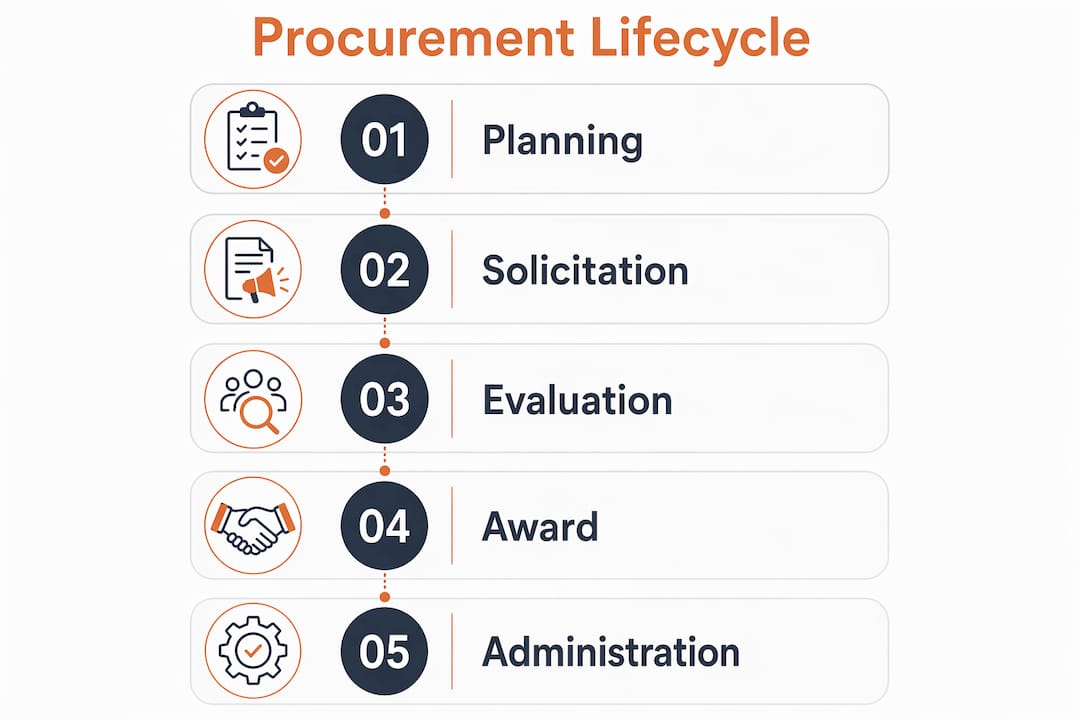
The federal procurement lifecycle is the government’s structured, five-phase process for acquiring goods and services, and every construction contractor competing for federal work must understand it. Formally governed by the Federal Acquisition Regulation (FAR), this process moves through Planning, Solicitation, Evaluation, Award, and Administration. Each phase carries distinct timelines, compliance requirements, and strategic windows. Contractors who treat this as a single bidding event consistently underperform against those who engage across the full cycle. This guide maps each phase with the specific actions construction professionals need to take to improve win rates and stay compliant.
What is the federal procurement lifecycle and its five phases?
The federal procurement lifecycle is a five-phase structured process that begins 6 to 24 months before contract award and extends through administration periods lasting a decade or more. That timeline surprises most contractors who only track active solicitations on SAM.gov. The real competitive work happens long before any RFP appears.
Here is how each phase operates and what it demands from you:
-
Planning (6 to 24 months before award). The agency identifies a need, conducts market research, develops requirements, and shapes the acquisition strategy. This is where scope, risk allocation, and evaluation criteria take form. Contractors who are not engaged here miss the most influential window in the entire cycle.
-
Solicitation (30 to 90 days). The agency publicly posts the opportunity, typically on SAM.gov, as a Request for Proposal (RFP), Invitation for Bid (IFB), or Request for Quote (RFQ). Your proposal preparation window is fixed and non-negotiable. Late submissions are disqualified without exception.
-
Evaluation (30 to 120 days). Government evaluators score proposals strictly against the stated criteria. Technical approach, past performance, price, and compliance with FAR requirements all factor in. A proposal that does not directly address each evaluation factor loses points regardless of the contractor’s actual qualifications.
-
Award (1 to 30 days). The agency selects the winning contractor, issues notifications, and executes the contract. Unsuccessful offerors have the right to request a debriefing, which is one of the most underused tools in federal contracting.
-
Administration (1 to 10+ years). Contract administration covers deliverable management, compliance monitoring, contract modifications, and final closeout. For construction projects, this phase includes Davis-Bacon Act wage compliance, certified payroll submissions, and progress reporting to the Contracting Officer’s Representative (COR).
Pro Tip: Request a debriefing after every unsuccessful bid. The government is required to provide one, and the feedback directly reveals scoring gaps you can correct in the next proposal cycle.
Treating these five phases as a pipeline rather than a sequence of isolated events is what separates contractors who win consistently from those who submit reactive bids.
How does early market research shape your position before solicitation?
Procurement decisions largely begin before RFPs through continuous dialogue, industry engagement, and internal government alignment. By the time a solicitation posts on SAM.gov, the agency has already defined its requirements, risk tolerance, and preferred acquisition approach. Contractors who show up at solicitation are responding to a document shaped by someone else.

FAR Part 10 mandates that agencies conduct market research before developing requirements and solicitations for acquisitions above the Simplified Acquisition Threshold. This obligation creates a formal channel for contractor input. Agencies must assess commercial availability, competition levels, and small business capacity. That process is your entry point.
Specific engagement methods available to construction contractors during the planning phase include:
- Requests for Information (RFIs). Agencies issue RFIs to gather technical input before writing requirements. Responding with detailed, constructability-focused answers positions your firm as a knowledgeable resource and can directly influence scope language.
- Industry Days. Agencies host these events to brief contractors on upcoming projects and gather feedback. Attendance signals capability and opens direct dialogue with program managers and contracting officers.
- Pre-solicitation contacts. Direct outreach to agency small business offices, program managers, or CORs before a solicitation releases is legal, ethical, and strategically valuable when done correctly.
- Sources Sought Notices. These are formal market research tools agencies use to identify qualified vendors. Responding with a strong capability statement helps agencies understand your NAICS code alignment and past performance.
Early engagement benefits contractors by shaping opportunities and reducing bid surprises, as government aligns requirements to marketplace realities. For construction firms specifically, influencing technical requirements and risk allocation during this phase can improve bid constructability and alignment with what the agency actually needs to build.
Pro Tip: Build a 12-month forward calendar of agency budget cycles and anticipated solicitations using USASpending.gov and agency procurement forecasts. This gives you a structured engagement schedule rather than reactive monitoring.
The most common mistake contractors make is waiting for the RFP. By then, the requirements are locked, the evaluation criteria are written, and the contractors who engaged early have already built relationships with the decision-makers.
What regulations and best practices govern solicitation, evaluation, and award?
The solicitation phase is governed by FAR-prescribed content requirements, evaluation criteria transparency, and formal contract execution steps. Non-compliance at this stage disqualifies proposals before evaluators read a single technical page. Understanding what the FAR requires and what agencies expect is the baseline for any competitive submission.
What your proposal must address
Every compliant federal construction proposal must directly respond to the Statement of Work (SOW) or Performance Work Statement (PWS), address each evaluation factor in the order listed, include accurate representations and certifications, and confirm active SAM.gov registration. Missing any of these elements is a common reason proposals are deemed non-responsive.
Common bidding mistakes that cost contractors contracts
Frequent contractor errors include late engagement, incomplete proposal responsiveness, and misunderstanding evaluation criteria. The table below compares what agencies expect against what contractors often submit:
| What agencies evaluate | Common contractor mistake |
|---|---|
| Technical approach aligned to SOW | Generic capability statements not tied to the specific project |
| Past performance on comparable projects | Listing unrelated work or omitting dollar values and outcomes |
| Price reasonableness and completeness | Missing line items or unsupported unit costs |
| Compliance with FAR certifications | Outdated SAM.gov registration or missing representations |
| Management plan and key personnel | Vague org charts without named individuals and qualifications |
The Award phase moves quickly once evaluation concludes. The agency issues a Notice of Award, and the unsuccessful offerors receive notifications. You have the right to request a formal debriefing within three days of receiving a pre-award or post-award notice. Use it. Agencies are required to explain the strengths and weaknesses of your proposal, and that information is worth more than any proposal-writing course.
Pro Tip: Review common bidding mistakes before every submission. A structured pre-submission checklist tied to the evaluation criteria catches the errors that cost points.
GSA advises contractors to invest early time in researching competition and federal market processes, treating planning and capture as integral lifecycle components rather than pre-bid overhead.
How should contractors manage contract administration through closeout?
Contract administration is the longest and most demanding phase of the federal contracting lifecycle. For construction projects, this phase can span one to ten or more years and involves daily compliance obligations that directly affect your firm’s reputation and future contract eligibility.
The table below outlines the core administration responsibilities and their compliance implications:
| Administration area | Contractor responsibility | Compliance risk if neglected |
|---|---|---|
| Certified payroll (Davis-Bacon Act) | Weekly submission to the contracting agency | Wage violations, contract termination |
| Progress reporting | Monthly or milestone-based reports to the COR | Payment delays, performance disputes |
| Contract modifications | Formal written approval before scope changes | Unauthorized work, cost disallowance |
| Safety and quality documentation | Maintain logs per contract requirements | Stop-work orders, liability exposure |
| Closeout package | Final invoices, releases, and as-built drawings | Delayed final payment, audit findings |
Effective administration safeguards contract value, supports performance transparency, and sets the stage for future contract eligibility. Your Contractor Performance Assessment Reporting System (CPARS) rating is written during and after this phase. A strong CPARS score is one of the most valuable assets a construction contractor can carry into the next bid cycle.
Documentation discipline is the single most important habit in contract administration. Every change request, verbal direction from a COR, schedule adjustment, and site condition deviation must be captured in writing and submitted through the proper contract modification process. Undocumented changes become uncompensated work. For construction firms pursuing federal contract growth, a clean administration record is the foundation of a repeatable win strategy.
Contractors who treat administration as a compliance burden rather than a strategic asset consistently leave money on the table and damage their CPARS ratings. The firms that win repeat federal work are the ones that perform as documented, communicate proactively with the COR, and close out contracts cleanly.
Key takeaways
Mastering the federal procurement lifecycle requires engaging across all five phases, from planning through administration, not just responding to solicitations.
| Point | Details |
|---|---|
| Five-phase structure | Planning, Solicitation, Evaluation, Award, and Administration each require distinct contractor actions. |
| Early engagement wins | Engaging during planning through RFIs and industry days shapes requirements before the RFP locks them. |
| FAR compliance is non-negotiable | Proposals must address every evaluation factor and maintain active SAM.gov registration to avoid disqualification. |
| Administration protects future work | Strong CPARS ratings and clean closeout records directly improve eligibility for future federal contracts. |
| Lifecycle mindset beats reactive bidding | Contractors who treat procurement as a pipeline from planning through closeout win more and waste fewer resources. |
Why the lifecycle mindset is the real competitive edge
I have worked with construction contractors at every stage of federal procurement, and the pattern is consistent. The firms that struggle are not struggling because they lack technical capability. They are struggling because they treat federal contracting as a series of one-off bids rather than a continuous business development process.
The contractors I have seen win consistently share one habit: they build their capture calendar around agency budget cycles, not solicitation release dates. They are attending industry days six months before an RFP posts. They are submitting RFI responses that demonstrate constructability knowledge. They are building relationships with program managers before a single requirement is written.
The procurement lifecycle as a pipeline approach encourages capture and business development activities aligned with each phase’s requirements and timelines. That is not theory. It is the operational difference between a 20% win rate and a 60% win rate on targeted opportunities.
I also want to be direct about contract administration. Most contractors underinvest here. They win the contract, mobilize the team, and then treat compliance as a back-office function. That is a mistake that shows up in CPARS scores and costs firms their next opportunity. The administration phase is where your reputation is built or damaged. Treat it with the same rigor you bring to proposal writing.
The FAR is not static. Staying current on FAR market research rule changes and acquisition policy updates is part of operating in this market. Contractors who build continuous learning into their business development process adapt faster and maintain compliance without scrambling.
The federal market rewards preparation. Start earlier than you think you need to, document everything, and treat every phase as an opportunity to differentiate your firm.
— Rowena
How Federal-rconstructionsolutions supports your procurement success
Federal-rconstructionsolutions built its 5551 Pillar specifically to support construction contractors across every phase of the federal procurement lifecycle. From requirements analysis and RFP writing to compliance support and contract administration guidance, the team brings the operational depth that construction firms need to compete effectively in the federal market. Clients achieve 90% compliance rates on bid submissions, and the firm’s track record includes securing contracts for public water infrastructure and other federally funded construction projects. If you are ready to move from reactive bidding to a structured lifecycle approach, explore the federal procurement services that Federal-rconstructionsolutions offers and connect with a specialist who understands your market.
FAQ
What is the federal procurement lifecycle?
The federal procurement lifecycle is the government’s five-phase process for acquiring goods and services, covering Planning, Solicitation, Evaluation, Award, and Administration. The full cycle runs from 6 to 24 months to award, with administration extending up to 10 or more years.
When should a construction contractor start engaging with a federal opportunity?
Contractors should engage during the Planning phase, 6 to 24 months before award, through RFIs, industry days, and sources sought responses. Waiting for the RFP means responding to requirements shaped entirely by competitors who engaged earlier.
What is FAR Part 10 and why does it matter for contractors?
FAR Part 10 requires federal agencies to conduct market research before developing requirements for acquisitions above the Simplified Acquisition Threshold. This creates a formal, legal channel for contractors to provide technical input and influence scope before solicitation.
How does CPARS affect future federal contracting opportunities?
CPARS is the Contractor Performance Assessment Reporting System, and agencies use these ratings as a past performance evaluation factor in future procurements. A strong CPARS record from disciplined contract administration directly improves your competitiveness on the next bid.
What are the most common mistakes contractors make during solicitation?
The most frequent errors include submitting generic proposals not tied to the specific SOW, listing unrelated past performance, and failing to address every evaluation factor in order. Maintaining an active SAM.gov registration and current FAR certifications is also a baseline requirement that contractors regularly overlook.