
Getting Your First Federal Construction Contract in 2026
Getting your first federal construction contract is a defined, repeatable process that small to mid-sized construction companies complete every year by registering correctly, targeting the right solicitations, and executing their first award with discipline. Federal procurement, the formal term for this process, is governed by the Federal Acquisition Regulation (FAR) and managed through systems like SAM.gov and beta.SAM.gov. The median time from SAM.gov registration to a first award runs 12 to 18 months, but firms that pursue active outreach and respond to Sources Sought notices compress that window to 6 to 9 months. Your first contract number is not just revenue. It is the foundation of a past performance record that unlocks every future bid.
What prerequisites are required before getting your first federal construction contract?
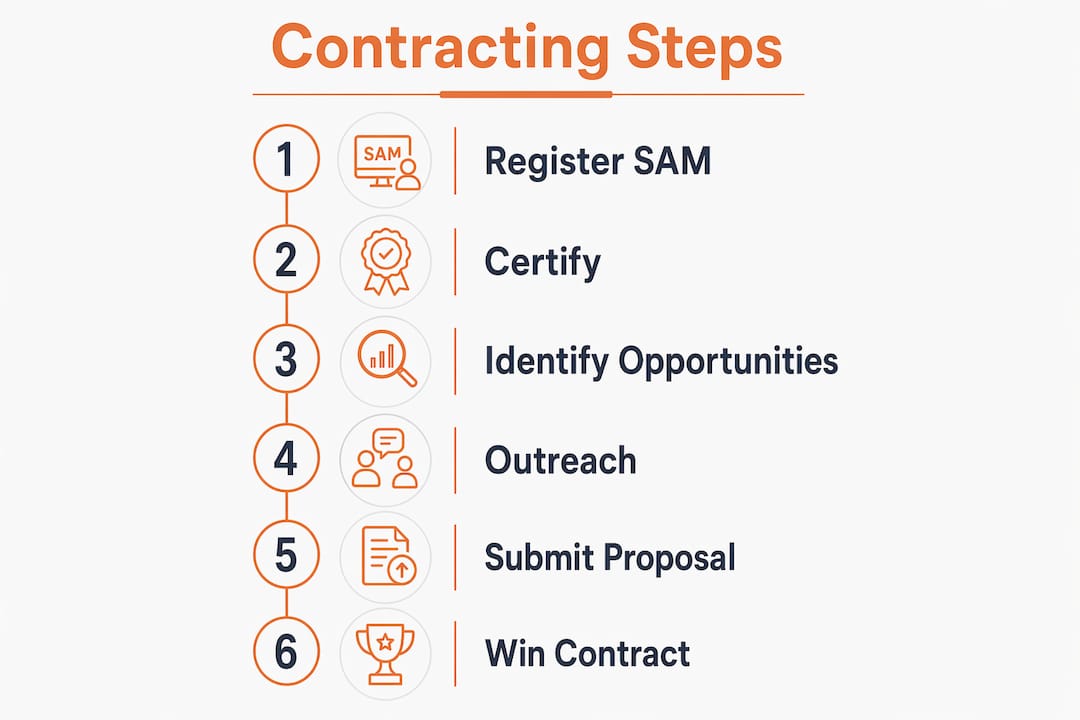
Active registration in SAM.gov is an eligibility gate, not a marketing step. Without it, you cannot receive a federal contract award, period. The registration process begins with obtaining a Unique Entity Identifier (UEI) through SAM.gov, which replaces the legacy DUNS number. Allow 10 to 14 business days for activation, and plan to renew annually or your eligibility lapses automatically.
Beyond SAM.gov, selecting the right NAICS codes determines which solicitations your firm appears eligible for. Construction firms should register under the most specific codes that match their core capabilities, such as NAICS 236220 for commercial and institutional building construction or NAICS 237110 for water and sewer line work. Registering under too many codes dilutes your profile; registering under too few limits your visibility to contracting officers searching for qualified vendors.
Small business certifications open access to set-aside contracts that larger firms cannot compete for. The most impactful certifications for construction companies include:
- 8(a) Business Development Program (SBA): For socially and economically disadvantaged business owners; provides access to sole-source awards up to $4 million for construction.
- HUBZone Certification (SBA): For firms located and employing workers in historically underutilized business zones; provides price evaluation preferences.
- WOSB (Women-Owned Small Business): Unlocks set-asides in industries where women-owned firms are underrepresented, including several construction NAICS codes.
- SDVOSB (Service-Disabled Veteran-Owned Small Business): Provides access to VA-specific and government-wide set-aside contracts.
Pro Tip: Apply for certifications before you start bidding. The 8(a) application alone can take 90 days or more. Running registration and certification in parallel, not sequentially, saves months.
A capability statement aligned to your NAICS codes is the one-page marketing document every contracting officer expects. It should list your core competencies, differentiators, past projects (even private sector ones), NAICS codes, UEI number, and contact information. Treat it as a living document you update every quarter.
How to identify and target the right federal construction opportunities
Finding the right solicitation is a skill, not a search. SAM.gov’s contract opportunities database lists active solicitations, but the volume is overwhelming without filters. Use the following sequence to locate realistic first targets:
- Filter by NAICS code and set-aside type. Search your primary NAICS code and filter for small business, 8(a), HUBZone, or WOSB set-asides depending on your certifications. This immediately removes competitions where you are not competitive.
- Set a contract size ceiling. Contracts below the Simplified Acquisition Threshold of $250,000 face fewer procedural requirements and are often awarded faster. For a first-time federal contractor, these are the highest-probability targets.
- Respond to Sources Sought notices and RFIs. These are pre-solicitation market research tools agencies use before issuing a formal solicitation. Responding costs little time and puts your firm’s name in front of the contracting officer before the competition opens.
- Explore GSA Schedule 36 (Facilities Maintenance and Management) and agency-specific vehicles like the Army Corps of Engineers’ MATOC or the Navy’s SeaPort-NxG. Getting on a contract vehicle is a separate process, but it creates a pipeline of task order opportunities without competing for each contract individually.
- Use USASpending.gov to map agency spending. Search for agencies that have awarded construction contracts in your NAICS code and dollar range in the past two years. These agencies have demonstrated demand and established procurement patterns you can plan around.
Direct outreach to contracting officers before a solicitation drops is one of the highest-leverage activities a first-time contractor can do. A short, focused capability briefing, delivered by email or at an industry day, builds name recognition that influences how evaluators read your proposal later.
Pro Tip: Request a capability briefing with the small business office at your target agency. These offices exist specifically to connect small contractors with contracting officers and are often underutilized by new entrants.
What are the key steps for writing winning federal construction proposals?
A winning federal construction proposal is built on compliance first, quality second. Section L and Section M of every solicitation are the two most important documents you will read. Section L contains the instructions for preparing your proposal. Section M defines exactly how evaluators will score it. Read both before writing a single word.

Build a compliance matrix before drafting. A compliance matrix is a simple spreadsheet that maps every requirement in Section L to a corresponding section of your proposal. This prevents the most common disqualification cause: missing a mandatory requirement that was buried in the instructions.
Understanding the source selection method in Section M determines your pricing and writing strategy:
| Source Selection Type | What It Means | Your Strategy |
|---|---|---|
| LPTA (Lowest Price Technically Acceptable) | Price wins after meeting minimum technical standards | Price aggressively; meet every technical requirement exactly |
| Best Value Tradeoff | Evaluators weigh technical quality, past performance, and price together | Invest in a strong technical narrative; justify a higher price |
For best value solicitations, your technical approach, management plan, and past performance sections carry significant weight. Generic narratives reduce scoring. Evaluators are trained to look for explicit alignment with the solicitation’s language and requirements. Mirror the government’s terminology. If the solicitation says “quality control plan,” your proposal must use that exact phrase, not “quality assurance process.”
Common proposal pitfalls to avoid:
- Submitting without a signed cover page or required certifications
- Providing past performance references who are unresponsive or unverified
- Writing a technical approach that describes what you will do without explaining how
- Ignoring page limits or font size requirements, which can result in automatic disqualification
- Failing to address every evaluation subfactor listed in Section M
Formatting matters more than most new bidders expect. A proposal that is hard to evaluate is a proposal that scores poorly, regardless of the underlying capability.
How can new firms build past performance and execute their first federal contract?
Past performance is the most valuable long-term asset a construction firm builds through federal contracting. CPARS records (Contractor Performance Assessment Reporting System) typically appear approximately 120 days after contract completion and follow your firm into every future source selection. A single strong CPARS record from a small contract can outweigh years of private sector experience in a federal evaluator’s scoring.
Follow this sequence to build your first verifiable past performance record:
- Pursue subcontracting opportunities under established prime contractors. Subcontracting is the fastest path to federal experience for firms with no prior government work. The SBA Mentor-Protégé Program pairs small businesses with experienced primes who provide technical and business development support.
- Target micro-purchase and simplified acquisition contracts first. A $50,000 repair contract at a federal facility is a legitimate federal contract number. It generates a CPARS record and satisfies past performance requirements for future bids within the same dollar range.
- Document every project detail from day one. Your past performance writeup must include the contract number, awarding agency, dollar value, performance dates, and your specific role. Evaluators verify these details against federal databases, so accuracy is non-negotiable.
- Execute conservatively on your first contract. Over-communicate with your contracting officer. Deliver on time or early. Flag any potential issues before they become problems. The first CPARS record is a long-term asset; a poor rating creates lasting damage that follows your firm for years.
Pro Tip: Coordinate your Past Performance Questionnaires (PPQs) with your references before you submit a proposal. PPQ management is one of the most underestimated parts of proposal preparation. An unresponsive reference is as damaging as no reference at all.
Construction solicitations typically use a 5 to 6 year lookback window for past performance relevance. This means private sector projects completed within that window can count, provided you document them with the same rigor as federal work.
What common mistakes should first-time federal construction contractors avoid?
The most costly mistakes in federal contracting are not strategic. They are procedural. Most disqualifications happen before an evaluator reads a single line of your technical proposal.
- Chasing solicitations before SAM.gov is active. A lapsed or pending registration means you cannot be awarded a contract, regardless of your proposal quality. Verify your registration status before every submission.
- Ignoring Section L and Section M. Proposals that do not follow the instructions or address every evaluation factor lose points automatically. Read these sections first, every time.
- Overestimating your competitive position. Bidding on $5 million construction contracts as a first-time federal contractor with no past performance is a low-probability strategy. Start smaller and build credibility.
- Skipping proactive outreach. Contracting officers who recognize your firm’s name before the solicitation opens are more likely to view your proposal favorably. Silence before the bid is a missed opportunity.
- Mismanaging subcontractor relationships. If your proposal commits to a specific subcontractor, that firm must be available and willing. Substituting subcontractors after award without approval is a compliance violation under the FAR.
Review the most common bidding mistakes before submitting any proposal. A pre-submission checklist reviewed by someone outside your proposal team catches errors that familiarity blinds you to.
Key takeaways
Winning your first federal construction contract requires active SAM.gov registration, targeted opportunity selection, compliant proposal writing, and disciplined contract execution to build a CPARS record that compounds over time.
| Point | Details |
|---|---|
| SAM.gov registration is non-negotiable | Register and activate your UEI before pursuing any solicitation or risk automatic disqualification. |
| Certifications unlock set-aside contracts | Pursue 8(a), HUBZone, WOSB, or SDVOSB status to access competitions with fewer competitors. |
| Section L and M drive proposal scores | Build a compliance matrix from these sections before writing a single word of your proposal. |
| Subcontracting accelerates past performance | Working under a prime contractor generates a federal contract number and CPARS record faster than prime bidding alone. |
| First CPARS record is a long-term asset | Execute your first contract conservatively; a strong rating compounds into future award advantages for years. |
What I’ve learned about winning that first federal contract
By Rowena
After working with dozens of small construction firms through their first federal procurement cycles, the pattern I see most often is this: firms spend six months preparing and then rush the most important step. They submit a proposal before their SAM.gov registration is fully active, or they respond to a solicitation that is three times their realistic capacity, and then they wonder why they did not win.
The firms that win their first contract within 9 months share one behavior. They treat outreach as a weekly discipline, not an occasional task. They send capability statements to small business offices every week. They respond to every Sources Sought notice in their NAICS code, even when they are not sure they will bid. They show up at agency industry days. By the time the solicitation drops, the contracting officer already knows their name.
I also think the construction industry underestimates how transferable private sector experience is in early federal bids. A $2 million commercial renovation project, documented with the same rigor as a federal contract, satisfies past performance requirements in many simplified acquisition solicitations. You do not start from zero. You start from wherever your best private sector work is.
The step-by-step federal contract guide at Federal-rconstructionsolutions lays out this sequencing clearly for firms that want a structured path rather than a trial-and-error approach. Use it as a checklist, not just a reference.
— Rowena
How Federal-rconstructionsolutions helps construction firms win their first federal contract
Federal-rconstructionsolutions, through its RCS 5551 Pillar program, provides construction firms with the end-to-end support that turns federal procurement from an intimidating process into a structured plan. The team assists with SAM.gov registration and certification guidance, capability statement development, and targeted opportunity identification so you pursue solicitations where you are genuinely competitive.
For firms ready to bid, Federal-rconstructionsolutions delivers expert proposal writing and compliance review services that achieve 90% compliance rates on bid submissions. The team also supports past performance documentation and CPARS preparation, and facilitates subcontracting matchmaking through the SBA Mentor-Protégé Program. If you are ready to move from preparation to pursuit, explore the full range of federal procurement services available through RCS and take the first concrete step toward your first federal award.
FAQ
How long does it take to get a first federal construction contract?
The median timeline from SAM.gov registration to first award is 12 to 18 months for new small businesses. Firms that respond weekly to Sources Sought notices and conduct proactive outreach compress this to 6 to 9 months.
What is SAM.gov and why is it required?
SAM.gov (System for Award Management) is the federal government’s primary vendor registration database. Active registration with a valid UEI is a legal prerequisite for receiving any federal contract award.
What is a CPARS record and why does it matter?
CPARS (Contractor Performance Assessment Reporting System) is the federal government’s official record of how a contractor performed on a completed contract. These records appear approximately 120 days after contract completion and are evaluated in future source selections.
Can private sector construction experience count as past performance?
Yes. Many federal solicitations, particularly those under the Simplified Acquisition Threshold, accept relevant private sector projects as past performance provided you document the contract value, dates, client contact, and your specific role with the same detail required for federal references.
What is the difference between LPTA and best value source selection?
LPTA (Lowest Price Technically Acceptable) awards to the lowest-priced proposal that meets minimum technical requirements. Best value tradeoff evaluates technical quality, past performance, and price together, allowing a higher-priced proposal to win if the technical approach is significantly stronger.