
Municipal Construction Bid Protest Process: 2026 Guide
The municipal construction bid protest process is a formal challenge filed by contractors to dispute contract awards or solicitation terms governed by local procurement rules. Unlike federal protests handled through the Government Accountability Office (GAO) or the Court of Federal Claims, municipal protests follow jurisdiction-specific procedures set by individual cities, counties, and public agencies. Deadlines vary widely, with some municipalities requiring filings within 5 to 10 business days of award notice. Knowing these rules before you bid is not optional. It is the difference between protecting your opportunity and losing it entirely.
What are the typical steps in the municipal bid protest process?
The municipal construction bid protest process follows a sequential structure, but the specific steps and timelines differ sharply by jurisdiction. Most processes share a common framework: file a written protest, receive an initial agency decision, and then pursue an appeal if the decision goes against you.
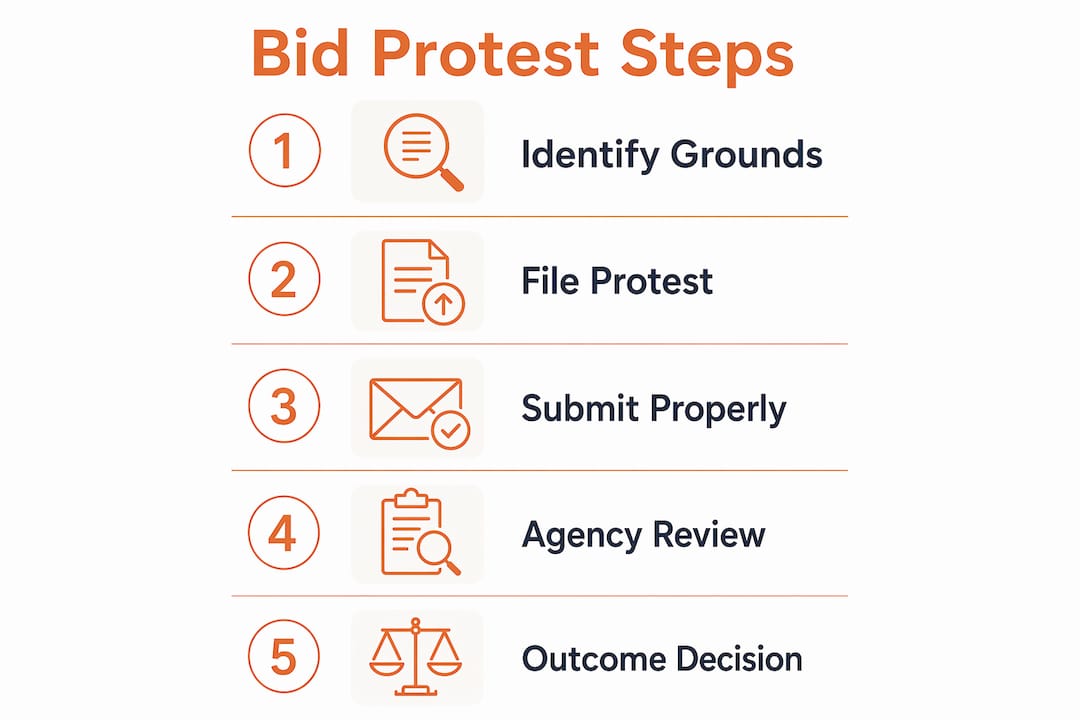
Step 1: Identify the grounds for protest. Valid grounds typically include procedural violations, improper bid evaluation, conflicts of interest, or solicitation terms that restrict competition. You must identify a specific legal or factual basis. A general disagreement with the outcome is not sufficient.
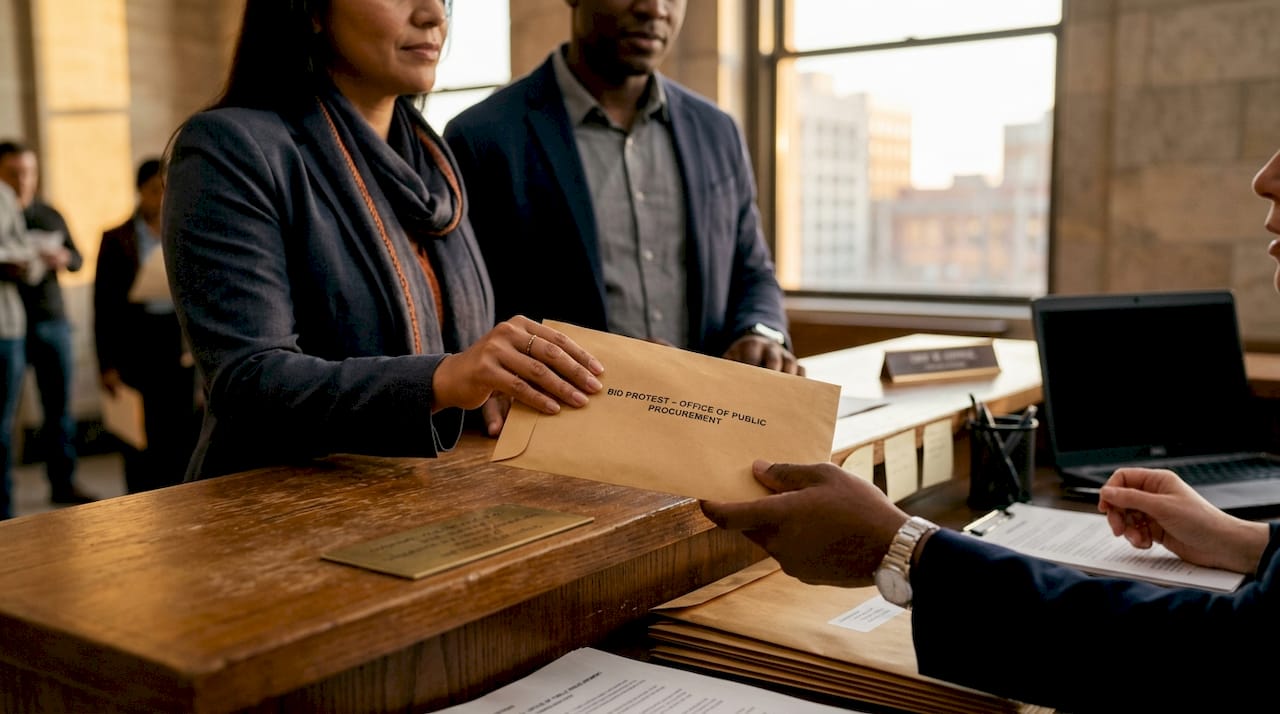
Step 2: File the protest within the required window. This is where most contractors lose before they start. Filing deadlines range from 5 to 10 business days in many jurisdictions, but some compress that window dramatically. Spokane, Washington requires protests filed within 2 days of bid opening, and the City Council hears those protests directly. Missing that window eliminates your right to challenge.
Step 3: Submit to the correct office. Protests are typically filed with the procurement officer, the city’s purchasing department, or a designated contract administrator. Some municipalities require simultaneous notice to the awarded contractor.
Step 4: Await the initial agency decision. The procuring agency reviews your protest and issues a written decision. This review period varies from a few days to several weeks depending on the municipality.
Step 5: File an appeal if denied. Many jurisdictions allow a secondary appeal to an administrative board, city council, or administrative law judge. The Sacramento Municipal Utility District (SMUD) requires internal appeals within 3 business days of the initial protest decision. That window is extremely tight.
- Always confirm whether the municipality suspends contract execution during the protest period.
- Obtain the specific protest policy document from the procurement office before you bid.
- Keep copies of every submission with timestamps and delivery confirmation.
Pro Tip: Request the municipality’s written protest policy at the pre-bid meeting. Many agencies will provide it on request, and reviewing it before bid submission gives you a procedural advantage most competitors skip.
How do municipal bid protests differ from federal and private sector processes?
Municipal bid protest procedures operate in a fundamentally different environment than federal or private sector procurement disputes. Understanding those differences prevents costly procedural errors.
| Factor | Municipal protests | Federal protests |
|---|---|---|
| Governing rules | Agency-specific local ordinances | Uniform FAR, GAO, and COFC rules |
| Filing venue | Procurement office, city council, or local board | GAO, agency level, or Court of Federal Claims |
| Timelines | 2–10 business days, varies by city | 10 days (GAO) post-award |
| Evidentiary standards | Informal, agency discretion | Formal, defined legal standards |
| Judicial review | Limited, requires exhaustion of admin remedies | Available through COFC |
| Conflict of interest risk | High. Same agency often decides initial protest | Separate review body at GAO |
The most significant difference is the conflict of interest built into local systems. Local protest decisions are frequently made by the same office that issued the original solicitation. That dynamic requires contractors to present an especially well-documented, evidence-based case rather than relying on procedural arguments alone.
Private sector bid challenges carry even fewer formal protections. There is no statutory right to protest a private contract award in most states. Contractors pursuing private sector bid solicitations must rely on contract terms, pre-bid agreements, or general commercial law. Municipal protests, despite their limitations, at least provide a defined administrative path.
What strategies improve success when filing a bid protest?
A well-prepared protest is built before the bid is submitted, not after the award is announced. The contractors who win protests are the ones who read the solicitation carefully, document everything, and act fast.
-
Review the solicitation for protestable issues before you bid. Pre-award protests filed before the proposal deadline are far more likely to be considered than post-award challenges. If you see ambiguous specifications, restrictive requirements, or apparent conflicts of interest in the solicitation, raise them early.
-
Use informal communications first. Before filing a formal protest, send a Request for Clarification to the procurement officer. Informal communications often resolve issues without adversarial conflict, preserve your relationship with the agency, and create a written record if you later need to escalate.
-
Build a factual, chronological narrative. Your protest document must tell a clear story. Identify the specific rule or procedure that was violated, cite the relevant section of the solicitation or procurement code, and attach supporting evidence. Vague allegations get dismissed quickly.
-
Document every communication in writing. Verbal agreements and undocumented conversations carry no weight in protest proceedings. Written records of disputes are the foundation of any successful claim or appeal. Log every phone call with a follow-up email confirming what was discussed.
-
Avoid common procedural mistakes. Late filings, missing required attachments, and filing with the wrong office are the three most common reasons protests are dismissed without review. Review common bidding mistakes that apply equally to municipal contests.
-
Maintain professionalism throughout. Protests that read as personal attacks on procurement staff rarely succeed. Frame every argument around facts, rules, and public interest. Agencies are more receptive to contractors who demonstrate they understand the process.
Pro Tip: Attach a table of contents to any protest longer than five pages. Decision-makers reviewing multiple protests appreciate organized submissions, and a clear structure signals that your arguments are equally well-organized.
How do you identify the right venue for your municipal bid protest?
Filing your protest with the wrong office is one of the fastest ways to lose your rights entirely. Venue authority varies by state and municipality, and there is no single national standard.
Common venues for municipal construction bid protests include:
- Procurement office or contract administrator. This is the most common first stop. The agency that issued the solicitation receives and initially decides most protests.
- Administrative law judges (ALJs). Some larger municipalities and public utilities route protests to ALJs for a more formal, quasi-judicial review.
- City council or county board. In cities like Spokane, the city council serves as the final administrative decision-maker for bid protests.
- State courts. Judicial review is available in some states but requires exhaustion of all administrative remedies first. Courts generally limit their review to whether the agency acted arbitrarily or violated law.
To confirm the correct venue, take these steps before you file:
- Download the municipality’s procurement code or purchasing policy from its official website.
- Call the procurement office and ask directly where protests must be filed and to whom.
- Confirm whether the municipality has a standing protest committee or routes appeals to elected officials.
- Check whether your state has a centralized procurement statute that governs local agencies, such as a state procurement code that municipalities must follow.
Municipal protest rules are highly fragmented with no uniform standard across jurisdictions. Jurisdiction-specific research is not optional. It is the first task before any protest filing.
What happens after you file a municipal construction bid protest?
Filing a protest triggers a defined sequence of events, but the outcomes and timelines vary by municipality. Knowing what to expect helps you manage project risk and plan your next move.
The most common outcomes after filing include:
Protest denied. The procuring agency upholds its original award decision. This is the most frequent outcome, particularly when the initial decision-maker is the same office that ran the procurement. If denied, you typically have the right to file an administrative appeal within a very short window.
Partial relief granted. The agency may acknowledge a procedural error but stop short of overturning the award. This could result in a re-evaluation of bids, a clarification of scoring criteria, or a revised solicitation.
Contract award suspended. Some municipalities automatically suspend contract execution while a protest is pending. Others do not. Confirm this policy upfront, because it affects whether the awarded contractor can begin mobilization before your protest is resolved.
Re-solicitation ordered. In cases where the agency finds significant procedural violations, it may cancel the award entirely and re-issue the solicitation. This is the best possible outcome for a protesting contractor.
If your protest is denied at the administrative level, your next options are an appeal to a higher administrative body or a judicial challenge in state court. Courts apply a deferential standard, meaning they will not substitute their judgment for the agency’s unless the decision was arbitrary, capricious, or contrary to law. Maintaining thorough documentation of all procurement communications and decisions is critical at this stage. Without a clear written record, cost recovery and legal challenges become significantly harder to pursue.
Key Takeaways
The municipal construction bid protest process requires jurisdiction-specific preparation, strict deadline compliance, and a well-documented factual case to succeed.
| Point | Details |
|---|---|
| Deadlines are compressed | Filing windows range from 2 to 10 business days. Missing them eliminates protest rights entirely. |
| Venue determines outcome | Filing with the wrong office can result in dismissal before your arguments are reviewed. |
| Pre-award review is critical | Identifying protestable issues before bid submission gives you the strongest grounds for challenge. |
| Documentation wins cases | Written records of all communications and decisions are the foundation of any successful protest or appeal. |
| Local systems favor agencies | The same office that issued the solicitation often decides the initial protest, requiring a strong evidence-based narrative. |
What I’ve learned from watching contractors lose winnable protests
After working with construction firms across federal and municipal procurement for years, the pattern I see most often is not contractors losing on the merits. It is contractors losing on procedure. They file one day late. They send the protest to the purchasing department when the ordinance requires it to go to the city clerk. They write three pages of frustration and call it a protest.
The contractors who succeed treat the protest process the way they treat a project schedule. They map the deadlines before they submit a bid. They read the procurement code the same week the solicitation drops. They send a Request for Clarification the moment they see something questionable, because that paper trail becomes the spine of any formal protest later.
The other thing I have seen consistently is that professionalism pays. Agencies remember contractors who file respectful, well-organized protests. They also remember contractors who file angry, unfounded ones. Your protest is not just a legal document. It is a signal about how you operate. Agencies award future contracts to firms they trust.
If you are serious about competing for municipal work, invest time in understanding each city’s specific rules. The bid invitation process and protest procedures are not the same from one municipality to the next. Treat each jurisdiction as its own environment, because it is.
— Rowena
How Federal-rconstructionsolutions supports contractors through bid protests
Navigating compressed deadlines, fragmented local rules, and agency-driven review processes is exactly where expert procurement support makes a measurable difference. Federal-rconstructionsolutions works directly with construction firms to prepare compliant, well-documented protest filings and manage the procedural requirements that vary across municipalities.
From pre-award solicitation review to post-award appeal support, the team at Federal-rconstructionsolutions brings the same compliance discipline that achieves 90% bid submission compliance to municipal contract disputes. Whether you need help identifying protest grounds, structuring your filing, or preparing for an administrative appeal, the federal procurement services at RCS 5551 Pillar are built for exactly this kind of work. Contractors pursuing USACE and other government projects can also access specialized procurement support tailored to complex bid environments.
FAQ
What is the municipal construction bid protest process?
The municipal construction bid protest process is a formal procedure allowing contractors to challenge contract awards or solicitation terms they believe violated local procurement rules. It typically involves a written filing with the procuring agency, followed by an administrative review and potential appeal.
How long do contractors have to file a bid protest?
Filing deadlines typically range from 5 to 10 business days after award notice, but some jurisdictions require filings as soon as 2 business days after bid opening. Always confirm the specific deadline in the municipality’s procurement code before submitting your bid.
What are valid grounds for a construction bid challenge?
Valid grounds include procedural violations, improper bid evaluation, undisclosed conflicts of interest, and solicitation terms that unfairly restrict competition. A general disagreement with the award outcome is not sufficient grounds for a protest.
Can contractors take a municipal bid protest to court?
Judicial review is available in some states but requires exhaustion of all administrative remedies first. Courts apply a deferential standard and will only overturn an agency decision if it was arbitrary, capricious, or contrary to law.
What happens if a bid protest is denied?
If the initial protest is denied, contractors can typically file an administrative appeal within a short window, often as few as 3 business days as required by agencies like SMUD. If the appeal is also denied, judicial challenge in state court is the remaining option.

