
Government Subcontracting: A Compliance Guide for Contractors
Government subcontracting means a business performs work under a contract held by a prime contractor, who remains directly and legally responsible to the federal agency for every deliverable, every dollar, and every labor standard. Three compliance obligations apply from day one: FAR Part 44 governs consent to subcontract and purchasing-system requirements; FAR Subpart 19.7 and SBA rules govern small business subcontracting plans; and the Davis-Bacon Act, enforced by the Department of Labor, requires wage determinations to flow down to every covered subcontract. Your first action: verify that all required flow-down clauses and current wage determinations appear in every subcontract or purchase order before work begins.
Start with these three sources:
- SBA prime and subcontracting guidance — roles, compliance reviews, and corrective-action expectations
- Acquisition.gov/FAR — full text of FAR clauses including 52.244-2 (consent to subcontract)
- SAM.gov — mandatory registration and subcontracting opportunity searches
Table of Contents
- How government subcontracting actually works: prime vs. subcontractor roles
- How flow-down clauses, consent rules, and tiers work day-to-day
- What rules govern federal subcontracting and where to read them
- When subcontracting plans are required and what they must contain
- Limitations on subcontracting: the percentages that matter
- Compliance, audits, and corrective actions: what to expect and how to prepare
- How to become a government subcontractor: a step-by-step path
- Shared responsibilities and best practices for primes and subcontractors
- Where to get help: SBA, PTACs, and free training resources
- Key Takeaways
- What most contractors get wrong about federal subcontracting
- Federal-rconstructionsolutions brings compliance expertise to your next bid
- FAQ
How government subcontracting actually works: prime vs. subcontractor roles
The prime contractor signs the contract with the federal agency and takes on full legal accountability. A subcontractor signs a separate agreement with the prime, not with the government. That distinction carries real consequences: the government has no privity of contract with the subcontractor, which means disputes, payment claims, and compliance failures all run through the prime.
Under FAR and SBA definitions, a first-tier subcontractor contracts directly with the prime. Lower-tier subcontractors contract with first-tier subs, and so on down the chain. In construction, a typical arrangement looks like this: a general contractor (prime) holds a federal building contract, then subcontracts structural steel to a fabricator (first-tier), who in turn contracts with a specialty welder (second-tier). Each tier inherits the compliance obligations the tier above flows down.
Because the prime retains ultimate liability, it must monitor subcontractor performance, verify wage compliance, and insert required clauses into every subcontract. Failing to do so does not transfer liability to the subcontractor. The SBA’s compliance review process targets primes directly when subcontracting plan deficiencies appear, and corrective action plans are a real enforcement tool, not a formality. For more on how contract tiers work in construction, the structure of first-tier and lower-tier relationships has its own set of documentation requirements worth reviewing before you sign anything.
How flow-down clauses, consent rules, and tiers work day-to-day
Understanding the mechanics of flow-down is where most compliance failures begin. A flow-down clause is a contract provision the prime must pass to its subcontractors because the government requires it to apply at every tier. Not every prime contract clause flows down, but many do, and the consequences of missing one range from back-wage liability to contract termination.
The consent-to-subcontract requirement
FAR clause 52.244-2 requires primes to obtain advance written consent from the contracting officer before awarding certain subcontracts. Consent is typically required when the subcontract is cost-reimbursement, time-and-materials, or labor-hour type; when the prime lacks an approved purchasing system; or when the subcontract is for a critical system or high-value component. Even primes with an approved purchasing system can face individual consent requirements on high-risk awards. Notification to the contracting officer must include the subcontractor’s name, type of subcontract, and the basis for price or cost.
Practical numbered checklist for flow-down tracking
- Insert Davis-Bacon wage determinations. Every covered construction subcontract must include the current wage determination for the applicable county and trade classification, per DOL’s Davis-Bacon guidance.
- Physically incorporate FHWA-1273. On federal-aid highway and transportation construction, FHWA-1273 must appear verbatim in every subcontract, not by reference.
Pro Tip: Build a clause matrix in a spreadsheet: list every prime contract clause in column A, mark “flows down: yes/no” in column B, and track the subcontract section where it appears in column C. Auditors from DCAA and agency inspectors general look for exactly this kind of documented evidence that you managed flow-downs deliberately, not accidentally.
What rules govern federal subcontracting and where to read them
The regulatory framework for federal subcontracting spans several authorities, and knowing which one applies to your contract type saves significant time.
- FAR Subpart 19.7 — and FAR 19.505 govern the small business subcontracting program, including when subcontracting plans are required, the 15 required plan elements, and limitations on subcontracting percentages. These apply to contracts above specific dollar thresholds with other-than-small businesses.
- SBA regulations — (13 CFR Part 125) implement the statutory small business subcontracting requirements and define compliance review procedures.
- Davis-Bacon Act and Related Acts (DBRA) — require prevailing wages on federally funded or assisted construction. The DOL Wage and Hour Division enforces these rules, and primes remain liable for subcontractor wage violations.
- FHWA-1273 — applies specifically to federal-aid highway and transportation construction projects funded under Title 23. It is not optional language; it must be physically incorporated into every subcontract on covered projects.
- DFARS (Defense Federal Acquisition Regulation Supplement) — adds DoD-specific requirements on top of the FAR baseline. The DoD Office of Small Business Programs (DoD OSBP) publishes guidance and resources specific to defense subcontracting.
To find current clause text, use Acquisition.gov, which maintains the official FAR and agency supplements. The eCFR at ecfr.gov carries SBA regulations. For wage determinations, use the DOL’s Wage Determinations Online (WDOL) system at sam.gov, where determinations are now integrated into contract solicitations.
When subcontracting plans are required and what they must contain
A subcontracting plan is a written commitment by an other-than-small business prime to award a specific percentage of subcontract dollars to small businesses and socioeconomic subcategories. The plan is not optional when the contract exceeds the applicable threshold and the prime is not a small business.
When a plan is required: Negotiated acquisitions expected to exceed certain thresholds require a subcontracting plan when the prime is other-than-small, with higher thresholds for construction contracts. Modifications that push a contract over the threshold can trigger the requirement mid-performance.
FAR Subpart 19.7 specifies three plan types:
| Plan Type | When Used | Key Reporting Form |
|---|---|---|
| Individual plan | Single contract; covers only that contract’s subcontracting | SF-294 / ISR (Individual Subcontract Report) |
| Commercial plan | Firm with multiple federal contracts; covers all commercial sales | SSR (Summary Subcontract Report) |
| Master plan | Pre-approved standard language reused across multiple contracts | Supplemented by contract-specific goals |
The 15 required elements of an acceptable subcontracting plan
FAR Subpart 19.7 lists these elements; every plan must address all of them:
- Separate percentage and dollar goals for small business, small disadvantaged business, women-owned small business, HUBZone small business, veteran-owned small business, and service-disabled veteran-owned small business
- A statement of total dollars planned to be subcontracted
- A description of the principal types of supplies and services to be subcontracted
- A description of the method used to develop subcontracting goals
- A description of the method used to identify potential small business sources
- A statement as to whether indirect costs were included in subcontracting goals and the basis for the determination
- The name of the individual responsible for administering the plan and their duties
- A description of the efforts the offeror will make to ensure small businesses have an equitable opportunity to compete
- Assurances that the prime will include the clause at FAR 52.219-8 in all subcontracts that offer further subcontracting opportunities
- Assurances that the prime will submit required reports and cooperate with reviews
- A description of the recordkeeping system for subcontracting activity
- Assurances that the prime will pay small business subcontractors on time per the Prompt Payment Act
- A description of the types of records the prime will maintain to demonstrate compliance
- Assurances that the prime will notify the contracting officer when a subcontract is awarded to a firm that is not the source originally proposed
- A description of the prime’s good faith efforts and corrective actions if goals are not met
Failure to make a good faith effort to comply can result in liquidated damages assessed against the prime. The contracting officer calculates damages based on the dollar amount of subcontracting not awarded to small businesses as required.
Limitations on subcontracting: the percentages that matter
FAR 19.505 sets the maximum percentage of contract value a small business prime can pay to non-similarly-situated subcontractors. These limits exist to prevent large businesses from using small business set-asides as pass-throughs.
| Contract Type | Maximum % to Non-Similarly-Situated Subs | Self-Performance Requirement |
|---|---|---|
| Services (except construction) | 50% of contract value | Self-performance requirement equal to half the work |
| Supplies (manufacturer) | 50% of contract value (excluding materials) | Manufacturing cost self-performance requirement |
| General construction | 85% of amount paid by government | At least 15% self-performed |
| Specialty trade construction | 75% of amount paid by government | At least 25% self-performed |
Scenario: A small business prime wins a $2 million general construction set-aside. The government pays $2 million. The prime may subcontract no more than $1.7 million (85%) to non-similarly-situated firms. It must self-perform at least $300,000 worth of work with its own employees. If the prime subcontracts $1.8 million, it violates the limitation and risks contract termination and debarment.
The nonmanufacturer rule applies to supply contracts. A small business that does not manufacture the end item must supply a product manufactured by a U.S. small business. Waivers are available when no small business manufacturer exists for the product, and the SBA administers the waiver process.
Compliance, audits, and corrective actions: what to expect and how to prepare
Audits in federal subcontracting are triggered by several common events: a subcontracting plan review during contract performance, a DCAA purchasing-system audit, a DOL wage compliance investigation, or an SBA compliance review initiated after a complaint or routine monitoring.
DCAA’s subcontract monitoring guidance.pdf?ver=JvPissFXrUWC9CRURZPLqA%3D%3D) identifies the most common deficiencies: missing price or cost analyses for subcontract awards, absent required clauses, failure to verify subcontractor accounting systems, and inadequate surveillance of subcontractor performance. These are not edge cases; they appear repeatedly across industries and contract types.
Typical audit timeline
Notification: The agency, SBA, or DCAA sends written notice identifying the scope of review and requesting documents within a specified period, typically 30 days.
Evidence request: Auditors ask for executed subcontracts, purchase orders, certified payrolls, SF-1413 (Statement and Acknowledgment), consent-to-subcontract documentation, make-or-buy records, and subcontracting plan progress reports.
Corrective action plan: If deficiencies are found, the prime receives a written finding and must submit a corrective action plan with specific remediation steps and a timeline. The SBA may require a follow-up review to confirm corrections were made.
Follow-up review: Depending on severity, a second review confirms whether the corrective actions resolved the findings. Repeated failures can escalate to liquidated damages or referral for debarment proceedings.
Audit-prep documentation checklist
- Executed prime contract and all amendments
- All subcontracts and purchase orders with flow-down clauses included
- Signed SF-1413 for each subcontractor
- Certified payroll records (weekly, for Davis-Bacon covered work)
- Wage determination incorporated into each subcontract
- Consent-to-subcontract requests and contracting officer approvals
- Make-or-buy program documentation
- Price or cost analysis for each subcontract award
- Subcontracting plan progress reports (ISR/SSR as applicable)
- Correspondence with the contracting officer regarding subcontracting activity
Pro Tip: Organize your audit package by subcontractor, not by document type. When an auditor asks about a specific sub, you can hand over a single folder containing that sub’s executed agreement, flow-down clauses, wage determination, certified payrolls, and consent documentation. That organization alone signals a well-managed purchasing system and typically shortens the review.
How to become a government subcontractor: a step-by-step path
Breaking into federal subcontracting as a construction firm requires preparation before you pitch a single prime. The registration and qualification steps below apply whether you are targeting a first-tier subcontract on a DoD project or a specialty trade role on a GSA building contract.
- Register on SAM.gov. Every business that wants to work on federal contracts, including subcontracts on some programs, must have an active SAM.gov registration. Maintain it annually; a lapsed registration can disqualify you from award.
- Select the right NAICS codes. Your NAICS codes signal to primes what work you perform. Choose codes that match your actual capabilities, not aspirational ones. The SBA uses NAICS codes to determine small business size standards.
- Obtain relevant certifications. If you qualify as a Women-Owned Small Business (WOSB), HUBZone firm, Service-Disabled Veteran-Owned Small Business (SDVOSB), or 8(a) participant, certify through SBA. Primes with subcontracting plans actively seek these firms to meet their goals. Learn more about WBE and MBE certification opportunities and how they factor into plan goals.
- Build a capability statement. A one-page capability statement is your primary marketing document with primes. Include your NAICS codes, past performance (project name, dollar value, scope, client), bonding capacity, key personnel, and contact information. Tailor it to each prime’s solicitation focus.
- Verify bonding and insurance readiness. Federal construction subcontracts routinely require performance and payment bonds. Confirm your bonding capacity before approaching primes. See the bonding requirements guide for specifics on what primes verify during onboarding.
- Search for opportunities. Use SAM.gov for prime contract awards (primes are listed and contactable), agency forecast sites, GSA schedules, and PTACs (Procurement Technical Assistance Centers) for local bid leads. PTACs provide free or low-cost counseling and often maintain lists of primes seeking subs in your trade.
- Contact PTACs for matchmaking. PTACs operate in every state and are funded by the DoD. They connect small businesses with prime contractors, review capability statements, and provide bid preparation support at no cost.
- Budget for administrative overhead. Federal subcontracting carries real administrative costs: certified payroll software, compliance tracking, proposal preparation time, and potential bonding premiums. Plan for these before pricing your first subcontract bid.
For a broader view of entering the federal construction marketplace, the entry requirements and opportunity landscape for small construction firms have specific nuances worth understanding before you commit resources.
Shared responsibilities and best practices for primes and subcontractors
Both sides of a subcontract carry obligations, and the clearest disputes arise when those obligations are not spelled out in writing at the start of the relationship.
Subcontractor onboarding checklist for primes
Before issuing a notice to proceed, primes should verify: the subcontractor’s SAM.gov registration is active; the sub holds required licenses for the work; insurance certificates name the prime and government as additional insureds; bonding is in place for the required amount; and the subcontractor has received, signed, and returned the subcontract with all flow-down clauses and wage determinations included.
Certified payroll and payment timing
On Davis-Bacon covered work, subcontractors must submit certified payrolls weekly using WH-347 or an equivalent form. Primes must collect these, review them for completeness, and retain them for at least three years. The prime remains liable for unpaid wages even when the subcontractor is the direct employer, per DOL’s Davis-Bacon guidance. Payment to subcontractors must comply with the Prompt Payment Act: primes must pay subs within seven days of receiving payment from the government for work the sub performed.
A common and costly mistake: primes assume that issuing a purchase order rather than a formal subcontract exempts them from flow-down requirements. It does not. Every purchase order for covered construction work must include the applicable labor clauses and current wage determination, or the prime faces back-wage liability for the subcontractor’s workers.
Risk mitigation practices
Require subcontractors to submit certified payrolls directly to you, not just to the agency. Conduct periodic performance reviews at defined milestones. Retain copies of all flow-down clauses in a project file separate from the prime contract file. For cost-reimbursement subcontracts, document your price or cost analysis before award; a defensible commercial item determination can reduce the documentation burden, but it must be written, dated, and retained before the purchase is made.
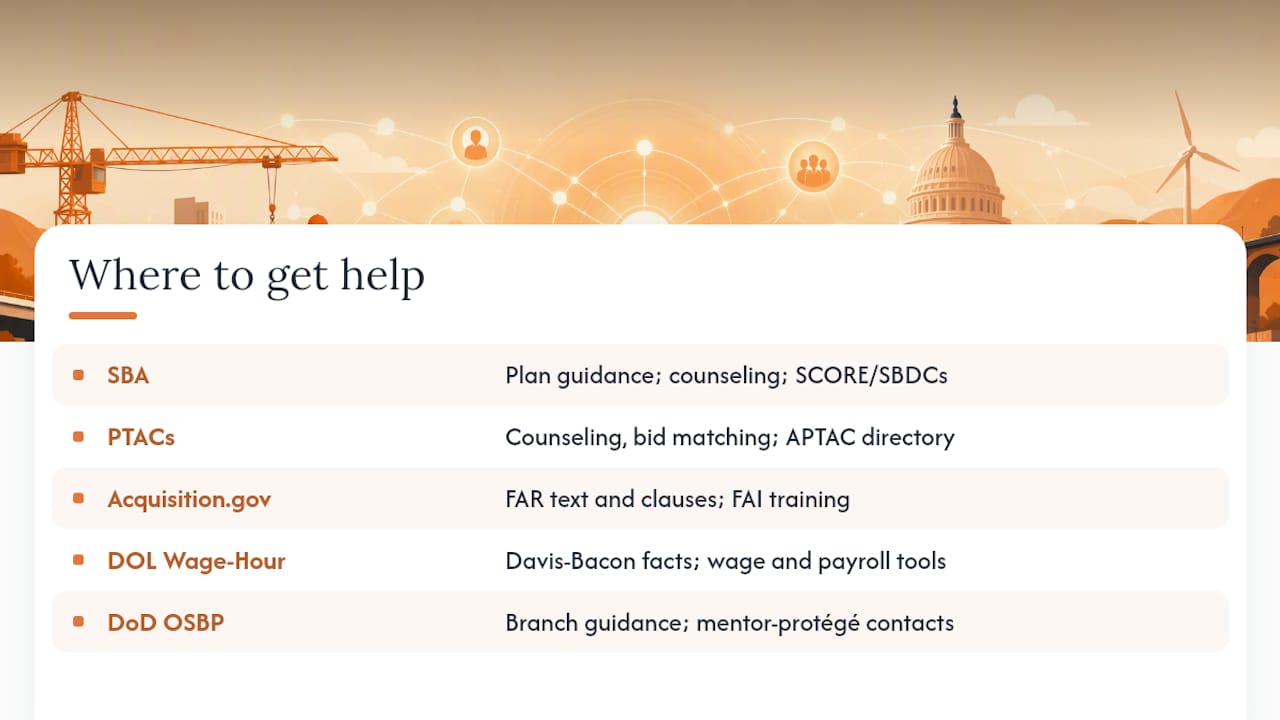
Where to get help: SBA, PTACs, and free training resources
The federal government funds several free resources specifically to reduce the compliance burden on small and mid-size contractors. Using them before you need them is the most cost-effective compliance strategy available.
SBA counseling and the SBA prime and subcontracting page provide guidance on plan requirements, compliance reviews, and how to respond to corrective action findings. SBA also operates SCORE and Small Business Development Centers (SBDCs) for broader business advisory support.
PTACs are the most underused resource in federal construction subcontracting. They offer one-on-one counseling, bid matching, capability statement reviews, and introductions to prime contractors. Find your local PTAC through the Association of Procurement Technical Assistance Centers (APTAC) directory.
Acquisition.gov hosts the full FAR text, agency supplements, and clause prescriptions. Bookmark the FAR table of contents and use the search function to locate specific clauses by number. The site also links to the Federal Acquisition Institute (FAI) training modules, which cover subcontracting plan preparation and compliance at no cost.
GSA’s learning resources include training on GSA Schedule contracting and subcontracting opportunities. The GSA also maintains a list of prime contractors with active subcontracting plans who are required to seek small business subcontractors.
DOL’s Wage and Hour Division publishes Davis-Bacon fact sheets, wage determination lookup tools, and certified payroll guidance. These are free downloads and should be in every construction firm’s compliance library.
DoD OSBP publishes agency-specific subcontracting guidance, mentor-protégé program information, and small business program contacts for each military branch. If your target market includes DoD construction, the OSBP pages for the Army Corps of Engineers, Navy NAVFAC, and Air Force Civil Engineer Center are worth bookmarking.
Downloadable templates for subcontracting plans, SF-1413, WH-347, and sample flow-down clause matrices are available through SBA, Acquisition.gov, and DOL. You do not need to build these from scratch.
Key Takeaways
Federal subcontracting compliance rests on three pillars: documented flow-down discipline, verified wage determinations in every subcontract, and a subcontracting plan that reflects genuine good faith effort toward small business goals.
| Point | Details |
|---|---|
| Prime liability is absolute | The prime contractor remains legally responsible for all subcontractor compliance, including wage violations and missing clauses. |
| Flow-downs require documentation | Every required clause and wage determination must appear in writing in each subcontract or purchase order before work begins. |
| Subcontracting plans have 15 elements | FAR Subpart 19.7 requires all 15 elements; missing any one can result in a rejected plan or liquidated damages. |
| Self-performance limits apply | General construction set-asides require at least 15% of the contract value to be self-performed by the prime or similarly-situated subcontractors; specialty trades require at least 25% self-performance. |
| Federal-rconstructionsolutions supports compliance | R. Construction Solutions provides FAR and Davis-Bacon compliance support, subcontracting plan preparation, and certified payroll assistance for construction firms. |
What most contractors get wrong about federal subcontracting
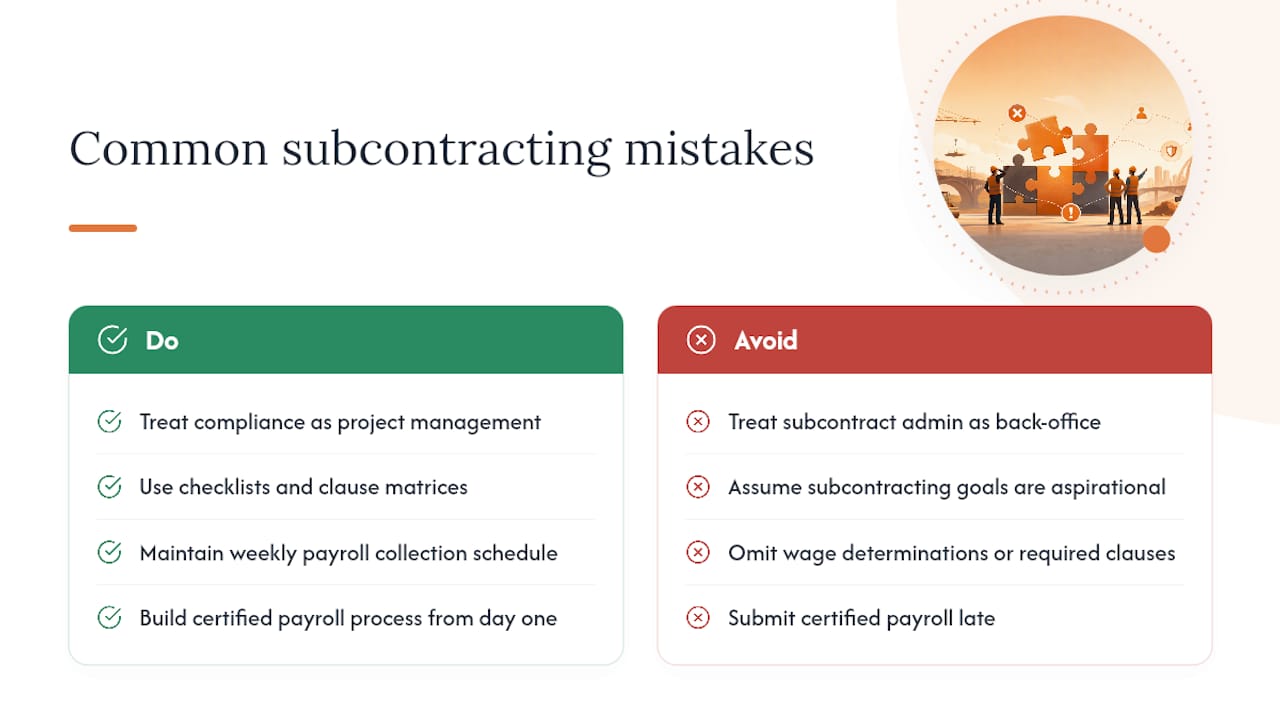
The conventional wisdom says the hardest part of federal subcontracting is finding the opportunity. After working with construction firms through SBA compliance reviews and DCAA purchasing-system audits, the harder part is consistently the documentation that should have been in place from day one.
Primes spend significant energy winning the contract and then treat subcontract administration as a back-office function. That is where the exposure accumulates. A missing wage determination in a purchase order, a flow-down clause that was referenced but not physically inserted, a certified payroll submission that arrived three weeks late: none of these feel like major failures during performance. Every one of them becomes a finding in an audit, and findings compound.
The other underestimated risk is the assumption that small business subcontracting plan goals are aspirational targets rather than enforceable commitments. They are enforceable. Liquidated damages for failure to make a good faith effort are calculated on actual subcontracting shortfalls, and the contracting officer has discretion to assess them even when the prime performed well on every other metric.
For construction firms specifically, the Davis-Bacon flow-down is the single highest-risk compliance gap. The prime’s liability for a subcontractor’s unpaid wages does not disappear because the sub was the direct employer. Build the certified payroll collection process before you need it, not after the DOL sends a notice.
The firms that manage federal subcontracting well treat compliance as a project management function, not a legal one. Checklists, clause matrices, and weekly payroll collection schedules are the tools that keep audits short and corrective action plans off the table.
Federal-rconstructionsolutions brings compliance expertise to your next bid
Construction firms that win federal subcontracts and keep them do one thing consistently: they treat compliance preparation as part of the bid, not an afterthought. Federal-rconstructionsolutions delivers exactly that kind of preparation through its federal procurement consulting services, purpose-built for construction businesses navigating FAR, Davis-Bacon, and SBA requirements.
The services cover the full compliance cycle: RFP writing, SAM.gov registration, FAR and Davis-Bacon compliance support, certified payroll setup, subcontracting plan preparation, and bid support through ConstructConnect project leads. Construction firms working with R. Construction Solutions have achieved 90% compliance rates on bid submissions, reducing the back-and-forth with contracting officers that delays award. Whether you are preparing your first subcontracting plan or responding to a corrective action finding, the team brings construction-specific experience to every engagement. Contact Federal-rconstructionsolutions to schedule a consultation and get your compliance documentation in order before the next solicitation closes.
FAQ
How does government subcontracting work?
A subcontractor performs work under a contract held by a prime contractor, who remains legally responsible to the federal agency. The prime must flow down required clauses, wage determinations, and compliance obligations to every subcontract tier.
How do you become a subcontractor for the government?
Register on SAM.gov, select accurate NAICS codes, obtain relevant small business certifications, build a capability statement, and contact prime contractors directly or through your local PTAC. Bonding and insurance readiness are required before most primes will consider you.
What happens to government contractors during a shutdown?
During a federal government shutdown, contractors working under funded contracts typically continue work if funding was already obligated. Contracts dependent on new appropriations may be paused; primes should review their contract’s funding status and notify subcontractors promptly if work must stop.
What are the self-performance requirements for construction set-asides?
Under FAR 19.505, small business primes on general construction set-asides must self-perform at least 15% of the contract value; specialty trade construction requires at least 25% self-performance by the prime or similarly-situated subcontractors.
When is a subcontracting plan required?
A subcontracting plan is required when an other-than-small business prime is awarded a negotiated contract exceeding applicable thresholds for the contract type and the contract offers subcontracting opportunities. FAR Subpart 19.7 governs the 15 required plan elements and enforcement.