
Federal Construction Contract Tiers Explained for Contractors
Federal construction contract tiers are classifications based on contract dollar value and subcontractor relationship level that determine approval authority, bonding requirements, and legal payment protections. Understanding federal contracting tiers is not optional for contractors who want to win and perform government work without costly compliance failures. The tier structure governs everything from who signs off on your contract to whether your suppliers can make a legal claim if they go unpaid. This article breaks down the federal construction contract levels, explains the Miller Act’s role at each tier, and gives you a practical framework for managing your obligations at every stage of a federal project.
What are the different federal construction contract tiers and approval authorities?
The federal contract tier structure is organized by contract dollar value, and each threshold triggers different procurement rules, competition requirements, and approval authorities. The Federal Acquisition Regulation (FAR) sets these thresholds, and they are updated periodically. As of October 1, 2025, the micro-purchase threshold rose to $15,000 and the Simplified Acquisition Threshold (SAT) rose to $350,000. These increases directly affect which procurement methods apply to your bids.
Here is how the tiers map to dollar values and approval authority:
| Contract Value | Tier Label | Approval Authority | Key Rules |
|---|---|---|---|
| Up to $15,000 | Micro-Purchase | Contracting Officer | No competition required; no bond required |
| $15,001 to $150,000 | Simplified Acquisition | Contracting Officer | Simplified procedures; bond discretionary below $150K |
| $150,001 to $750,000 | Standard Competitive | Contracting Officer | Full competition; Miller Act bonds required |
| $750,001 to $100 million | Mid-Tier Competitive | HCA or Competition Advocate | Sole-source requires senior sign-off |
| Above $100 million | Senior-Level | Senior Procurement Executive | Maximum oversight; full justification required |

Sole-source contract approval authority escalates with contract value. A Contracting Officer can approve sole-source awards up to $750,000, but contracts above $100 million require Senior Procurement Executive approval. That escalation exists to reduce risk by placing larger, less competitive awards under the most senior oversight available. For contractors, this means a sole-source strategy that works at $500,000 will face a completely different approval process at $5 million.
The Head of Contracting Activity (HCA) and Competition Advocate roles sit between the Contracting Officer and the Senior Procurement Executive. They review justifications for non-competitive awards and can challenge procurement decisions that do not meet FAR standards. Knowing who holds approval authority at your contract’s dollar level helps you anticipate review timelines and prepare stronger documentation.
Pro Tip: Before you submit a bid, confirm the contract’s dollar value against the current SAT. A contract just above $350,000 triggers full competition rules that a contract at $340,000 would not. Missing that line costs you time and compliance standing.
How do subcontractor tiers work in federal construction projects?
The subcontractor tier structure in federal construction defines the legal relationship between every party on a project and determines who holds payment protections under the Miller Act. This is where many contractors make expensive mistakes.
Tier 1: Prime Contractor. The prime contractor holds a direct contract with the federal government. This is the only party with privity of contract with the government agency. All legal obligations, performance requirements, and bonding responsibilities flow from this relationship. If you are the prime, you are accountable for every tier below you.
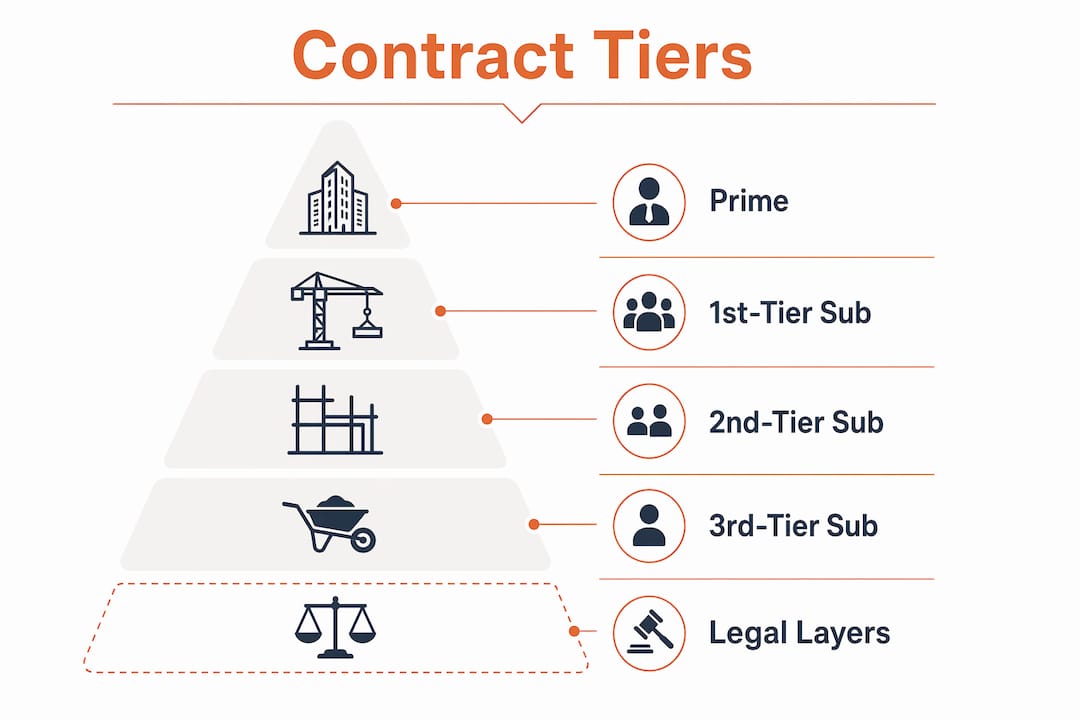
Tier 2: First-Tier Subcontractor. A Tier 2 subcontractor is contracted directly by the prime. This party holds privity with the prime, not with the government. Federal prime contractors hold privity with the government while subs hold privity with the prime, which means Tier 2 subs must direct all payment claims and disputes to the prime, not the agency.
Tier 3 and Beyond: Sub-Subcontractors. A Tier 3 subcontractor is contracted by a Tier 2 sub. This party has no direct legal relationship with the prime or the government. Their only contractual recourse is against the Tier 2 sub who hired them.
The table below shows how payment protections and notice requirements differ across tiers:
| Tier | Contracted By | Miller Act Bond Protection | Notice Requirement |
|---|---|---|---|
| Tier 1 (Prime) | Federal Agency | N/A (bond holder) | None |
| Tier 2 (Sub) | Prime Contractor | Yes, direct claim on bond | Written notice to prime within 90 days |
| Tier 3 (Sub-Sub) | Tier 2 Subcontractor | No protection | No valid Miller Act claim |
| Tier 4+ | Tier 3 and below | No protection | No valid Miller Act claim |
Miller Act payment bond protections extend only two tiers deep. Third-tier subcontractors and anyone below them have no legal claim on the prime’s bond. This is one of the most misunderstood facts in federal construction. A Tier 3 concrete supplier who goes unpaid cannot file a Miller Act claim, regardless of how much work they performed.
For Tier 2 claimants, the deadline is strict. Second-tier claimants must send written notice to the prime contractor within 90 days of last furnishing labor or materials. Missing that window eliminates the claim entirely. There are no extensions and no exceptions.
Pro Tip: If you are a Tier 2 sub and you have not been paid, calendar your 90-day notice deadline from the last day you provided work or materials. Do not wait for the prime to resolve the dispute first. Send the written notice and preserve your rights while negotiations continue.
What are the bonding requirements across federal contract tiers?
The Miller Act sets the bonding rules for federal construction, and the thresholds are firm. Here is what applies at each contract level:
- Below $35,000: Payment bonds are generally not required. The Contracting Officer has no obligation to demand them.
- $35,000 to $150,000: Bond requirements are discretionary by the Contracting Officer. The CO can require bonds but is not mandated to do so.
- Above $150,000: Both payment and performance bonds are mandatory at 100% coverage. No waivers are allowed under the Miller Act.
That 100% coverage requirement is significant. It means the bond must cover the full contract value, not a percentage of it. A $2 million contract requires a $2 million performance bond and a $2 million payment bond. Bonding capacity directly limits how large a contract you can pursue, which is why building your bonding line early is a strategic priority.
Common compliance pitfalls contractors face across tiers include:
- Failing to verify that Tier 2 subs have their own insurance and licensing before work begins
- Overlooking the 90-day written notice window for Tier 2 payment bond claims
- Misclassifying a Tier 3 supplier as a Tier 2 sub, creating false expectations about bond protections
- Ignoring subcontracting limitations that require accurate self-performance accounting
The limitations on subcontracting rules add another layer of complexity. Small business prime contractors must perform a set percentage of work themselves. The calculation excludes payments to similarly situated small business subcontractors, meaning you cannot count their work as your own self-performance. Getting this calculation wrong can trigger contract termination. Review your subcontract agreements against FAR Part 52.219 before you start work.
Pro Tip: Work with your bonding agent before you bid, not after you win. Knowing your bonding capacity ceiling prevents you from winning a contract you cannot legally execute. Review your federal procurement options to understand how bonding capacity affects your bid strategy.
How do contract tiers affect bidding strategy and acquisition methods?
The tier a contract falls into determines which acquisition method applies, and that directly shapes your bidding approach. Here is how to align your strategy with the tier structure:
-
Micro-Purchase tier (up to $15,000). No formal competition is required. Agencies can buy directly from a vendor. If you are registered in SAM.gov with the right NAICS codes, you can be selected without a competitive bid. Focus on visibility and past performance ratings at this level.
-
Simplified Acquisition tier ($15,001 to $350,000). Agencies use simplified procedures, which means faster awards and less documentation. This is an excellent entry point for contractors new to federal work. Review the step-by-step contract process to understand how to position for these awards.
-
Standard Competitive tier ($150,001 and above). Full competition applies. You need a complete bid package, Davis-Bacon Act wage compliance documentation, and Miller Act bonds in place. Your past performance record becomes a scored evaluation factor at this level.
-
Mid-Tier and Senior-Level contracts (above $750,000). These contracts require the most preparation. Subcontract management plans, small business subcontracting goals, and detailed compliance documentation are standard requirements. Understand competitive bidding rules tied to contract value before you invest in a proposal at this level.
-
Sole-source opportunities across tiers. Sole-source justification becomes harder to obtain as contract value rises. At the mid-tier level, the HCA must approve the justification. Above $100 million, the Senior Procurement Executive signs off. If you are pursuing a sole-source award, build your justification documentation early and align it with FAR Part 6 requirements.
The SAT increase to $350,000 as of October 1, 2025, is a real opportunity. Contracts that previously required full competition procedures now qualify for simplified acquisition. That means faster awards and less administrative burden for both agencies and contractors. Watch for common bidding mistakes that contractors make when thresholds shift, because agencies adjust their solicitation formats and many contractors miss the change.
What i’ve learned about tiers that most contractors find out too late
The most common mistake I see contractors make is treating the tier structure as a formality rather than a legal framework with real financial consequences. Contractors who win at the prime level often focus entirely on their own compliance and assume their Tier 2 subs will manage their own obligations. That assumption is wrong and expensive.
When a Tier 2 sub misses the 90-day written notice window for a Miller Act claim, the prime does not absorb that loss automatically. But the dispute still creates project delays, legal exposure, and relationship damage that falls on the prime’s record. Knowing your Tier 2 subs’ payment status is not just good management. It is risk control.
The bonding threshold misconception is equally costly. Many contractors believe the Miller Act’s $150,000 threshold is a ceiling, not a floor. It is the floor. Every dollar above that amount requires full bond coverage with no exceptions. I have seen contractors budget for a partial bond and discover mid-award that the requirement is 100% coverage. That discovery kills deals.
My strongest advice is to map your subcontract tier relationships before you sign anything. Know which of your subs are Tier 2 and which are Tier 3. Communicate clearly to Tier 3 parties that they have no Miller Act protections. That transparency protects everyone and prevents disputes that derail projects. Professional federal procurement support is not a luxury at this level. It is the difference between a profitable contract and a compliance failure.
— Rowena
How Federal-rconstructionsolutions helps you manage contract tiers
Federal-rconstructionsolutions brings specialized expertise to the exact compliance challenges this article covers. From Miller Act bond strategy to subcontractor tier documentation, the team at Federal-rconstructionsolutions has helped construction firms secure and perform federal contracts with a 90% compliance rate on bid submissions.
Whether you are bidding your first simplified acquisition contract or managing a multi-tier project above the $750,000 threshold, Federal-rconstructionsolutions provides the procurement guidance you need. Their federal procurement services cover RFP writing, bonding compliance, subcontract management, and tier-specific reporting requirements. Contact Federal-rconstructionsolutions to get a tailored plan for your next federal construction opportunity.
Key takeaways
Federal construction contract tiers determine approval authority, bonding obligations, and legal payment protections based on contract value and subcontractor relationship level.
| Point | Details |
|---|---|
| Tier structure follows dollar value | Contracts range from micro-purchase at $15,000 up to senior-level awards above $100 million. |
| Miller Act bonds are mandatory above $150,000 | Full 100% coverage is required with no waivers allowed under federal law. |
| Bond protections stop at Tier 2 | Third-tier subcontractors and below have no Miller Act claim rights on the prime’s bond. |
| Tier 2 subs have a 90-day notice deadline | Written notice to the prime must be sent within 90 days of last furnishing labor or materials. |
| SAT increase opens faster procurement | The Simplified Acquisition Threshold rose to $350,000 as of October 1, 2025, expanding simplified bidding opportunities. |
FAQ
What is the miller act bond threshold for federal construction?
The Miller Act requires payment and performance bonds on all federal construction contracts exceeding $150,000, with 100% coverage mandatory and no waivers permitted. Contracts between $35,000 and $150,000 may require bonds at the Contracting Officer’s discretion.
How many subcontractor tiers exist in federal construction?
Federal construction projects typically involve three or more subcontractor tiers. Tier 1 is the prime contractor, Tier 2 is contracted by the prime, and Tier 3 is contracted by Tier 2. Miller Act bond protections only cover Tier 1 and Tier 2 parties.
Who approves sole-source federal construction contracts?
Approval authority for sole-source contracts scales with contract value. A Contracting Officer approves awards up to $750,000, while contracts above $100 million require Senior Procurement Executive approval under FAR Part 6.
What is the simplified acquisition threshold in 2026?
The Simplified Acquisition Threshold is $350,000 as of October 1, 2025. Contracts at or below this amount qualify for simplified procurement procedures, which reduce competition requirements and speed up award timelines.
Can a tier 3 subcontractor file a miller act claim?
No. Miller Act payment bond protections extend only to Tier 1 and Tier 2 parties. Third-tier subcontractors and suppliers have no legal claim on the prime’s bond and must pursue payment through their direct contracting party.