
GCs: Find Construction Subcontractors You Trust, Verify License & COI
Start with peer referrals from other general contractors, then run parallel targeted invitations on two bidding platforms while your team verifies license status and insurance coverage before anyone mobilizes on site. Combine that with supply-house leads and, for public-funded work, a SUBNet search. Every candidate should clear license, COI, workers’ comp, and EMR checks before you sign anything.
TL;DR:
- Peer referrals are the most reliable source but require specific questions about past milestones, dispute handling, and rehire likelihood.
- Always verify licenses, insurance certificates, workers’ comp, and EMR directly with authorities or carriers before contracting.
- Use targeted invitations on bidding platforms and supply houses while reserving cold outreach for unfamiliar markets to save time.
- Maintain an ongoing prequalification system with performance data, rechecking annually and building a roster for quick access during project needs.
- For public-funded projects, utilize SUBNet and federal screening services like SAM.gov to ensure compliance and access larger subcontracting opportunities.
Table of Contents
- Where to Find Construction Subcontractors That Show Up and Deliver
- What Documents Should You Collect Before Hiring a Subcontractor?
- How Do You Invite Subcontractors to Bid and Compare Their Proposals Fairly?
- How to Build a Prequalified Subcontractor Roster You Can Rely On
- Red Flags, Payment Controls, and a Pre-Award Checklist
- Where Federal Procurement Data Fits Into Your Subcontractor Search
- How to Conduct Effective Background Checks and Reference Verification
- Strategies for Managing Subcontractor Disputes and Conflict Resolution
- Legal and Contractual Considerations Specific to Subcontractor Agreements
- What Actually Separates a Reliable Subcontractor Search From a Risky One
- An Alternative Path: Letting Federal-rconstructionsolutions Help You Source and Vet
- Sources
- FAQ
Where to Find Construction Subcontractors That Show Up and Deliver
Referrals from other general contractors remain the highest-yield channel because the recommendation already carries a track record attached to it. When you call a peer for a referral, ask specific questions: Did the sub hit milestone dates on the last three jobs? How did they handle a change order dispute? Would you rehire them for a project twice this size? Vague praise (“they’re great”) tells you nothing; specifics do.
Supply houses see more jobsites in a month than most GCs see in a year, and their counter staff often know exactly which electrical or plumbing crews are slammed versus which ones have capacity opening up next quarter. Ask your rep directly which subs pay their accounts on time. Payment discipline upstream often predicts payment discipline downstream.
Beyond referrals, a few other channels round out a reliable sourcing mix:
- Trade associations and local chapters. Your regional Home Builders Association or Associated General Contractors chapter maintains member directories, and union halls and apprenticeship programs can supply trained labor for specialty trades facing shortages.
- Bidding platforms and directories. Tools like BuildingConnected help you flag qualified and diverse subcontractors quickly, though they work best for targeted invitations rather than open postings, which tend to attract lower-quality responses.
- State licensing boards. These confirm active status and disciplinary history before you invest time vetting a company further.
- SAM.gov and SBA’s SUBNet. For projects tied to federal or public funds, SUBNet lists subcontracting opportunities that are filterable by state and NAICS code, giving primes a direct posting channel for subcontract notices.
Cold outreach still has a place, but reserve it for filling gaps in unfamiliar markets. Once you have three or four qualified names, switch to targeted invitations. It saves everyone’s time.
What Documents Should You Collect Before Hiring a Subcontractor?
Verification beats collection every time. A folder full of certificates means nothing if nobody confirmed they’re real, and a solid prequalification process checks licenses directly with the state board, pulls certificates of insurance from the carrier rather than the subcontractor, and calls references about how problems actually got handled.
Work through documents in this order:
- License verification, confirmed with the issuing state board, not a photocopy the sub hands you.
- Certificate of insurance (COI), requested directly from the insurance carrier to confirm coverage is active and matches your required limits.
- Workers’ compensation coverage, verified for current status, especially in states where lapses are common among smaller crews.
- Experience Modification Rate (EMR), a number below 1.0 generally signals better-than-average safety performance, while anything meaningfully above it deserves a conversation about their safety program, not just a rejection.
- Bonding capacity, checked against your contract size. A sub bonded for $200,000 jobs has no business bidding a $2 million scope.
- Financial statements and working capital, reviewed for anything that suggests the company is stretched thin across too many active jobs.
- References and OSHA logs, called and reviewed, not just requested.
Prequalification works best as an ongoing risk-management system rather than a one-time form you file away. Trades change owners, insurance lapses, and financial health shifts, so build rechecks into your calendar rather than treating the initial packet as permanent.
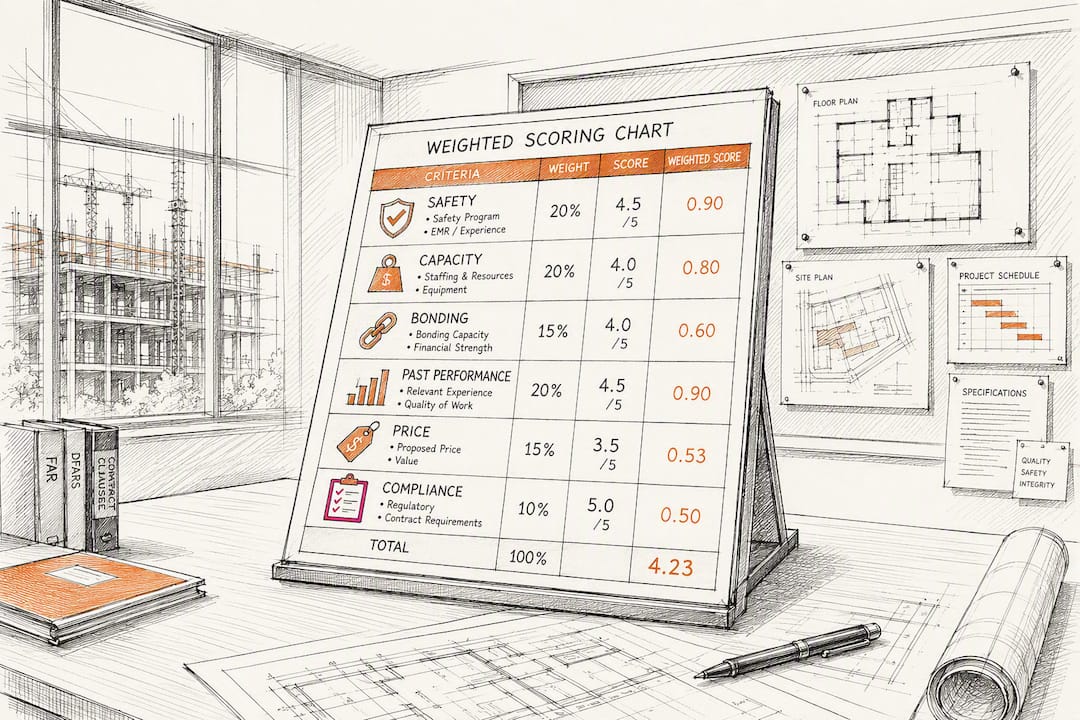
A weighted scoring system turns this pile of documents into an actual decision tool. One workable model weighs safety history, capacity and bonding, past performance, price, and compliance documentation. Awarding purely on lowest price tends to backfire through change orders and schedule slippage, which is exactly why price only carries a fifth of the weight here rather than driving the decision outright.
Pro Tip: A clean EMR is not the whole safety story. Ask to see the sub’s written safety program and training records, and ask who on their team owns safety accountability. A low EMR paired with no formal program is often a company that got lucky, not one that’s actually careful.
Whatever scoring model you use, record it somewhere permanent. Log prequalification status, document expiration dates, and scores directly in your project management or ERP platform, and set automated reminders for insurance renewals and updated financials. A subcontractor prequalification checklist built into your standard workflow keeps this from becoming a scramble every time a bid deadline approaches.
How Do You Invite Subcontractors to Bid and Compare Their Proposals Fairly?
Vague scope produces vague bids, and vague bids produce disputes later. Build your bid package to eliminate ambiguity from the start:
- Define scope precisely, including drawings, specifications, and explicit treatment of allowances so nobody assumes a line item is included when it isn’t.
- State payment terms and schedule up front, including retainage percentage and milestone structure, so bidders price the job with full information.
- Request itemized breakdowns, not just a lump-sum number. A breakdown lets you spot where a low bid is cutting corners versus genuinely more efficient.
- Set a firm bid deadline with a follow-up call two or three days before it, since a short reminder call meaningfully improves response rates compared to email alone.
- Hold a walkthrough or pre-bid meeting for anything with site conditions that photos and drawings can’t fully capture.
- Answer questions through written addenda distributed to every bidder simultaneously, never as a private clarification to one company.
Scope ambiguity is one of the most common sources of bid gaps, and a short scope-review call before award costs far less than untangling a change-order argument mid-project. If a bid comes in noticeably below the pack, ask for the breakdown before you assume you found a bargain.
How to Build a Prequalified Subcontractor Roster You Can Rely On
One-off hiring is expensive because you repeat the entire vetting process every time. A maintained roster changes that math. Track performance data the same way you’d track an employee’s file: on-time completion rate, change-order frequency, and quality callbacks all belong in a subcontractor performance record you can pull up before the next bid goes out.
Keep the roster current, not static:
- Recheck insurance and financials annually, since a subcontractor solvent last year isn’t guaranteed to be solvent this year.
- Feed small, low-risk scopes to newer subs before trusting them with a critical-path package.
- Set clear communication protocols for RFIs, submittals, and schedule updates so expectations don’t drift job to job.
- Keep at least two fully prequalified backups per critical trade, three for your highest-volume trades, so a schedule crisis doesn’t force you into rushed vetting.
- Use PM or prequalification software to automate renewal reminders and store documentation centrally instead of scattered across email threads.
A roster like this pays off exactly when you need it most: mid-project, when your framing sub disappears and you need a qualified replacement by Thursday.
Red Flags, Payment Controls, and a Pre-Award Checklist
Run this checklist before any subcontractor mobilizes: active license confirmed, certificate of insurance on file directly from the carrier, W-9 collected, bonding letter obtained for large scopes, and references actually called rather than just listed.
Watch for these warning signs, any of which should pause an award until resolved:
- SAM exclusion status. A subcontractor barred from federal work is a liability on any project with public funding tied to it.
- Active liens on prior jobs, which signal payment or performance disputes worth investigating further.
- A bid unusually far below the pack, which often means missing scope, not efficiency.
- Expired or mismatched insurance limits discovered after the fact rather than verified up front.
- Last-minute banking detail changes, a known fraud vector; always verify new account information through a phone call to a known contact, never through email alone.
The financial stakes justify the diligence: replacing a defaulted subcontractor typically costs multiple times the original subcontract value once you account for remobilization, schedule delay, and quality remediation. That single figure is the strongest argument for spending an extra afternoon on verification instead of racing to sign.
Once a sub is on board, payment controls should carry forward into your accounting system: joint checks for material-heavy trades, retainage held per contract terms, validated banking details, and staged mobilization payments tied to verified progress rather than a lump sum up front. For higher-risk scopes, consider a conditional award pending a performance bond.
Where Federal Procurement Data Fits Into Your Subcontractor Search
Public-funded projects open sourcing channels most GCs never touch on private work. SBA-registered small businesses browsing SUBNet find real posted opportunities with contact details and NAICS codes attached, and federal prime-subcontracting plans required under FAR 52.219-9 push large primes to actively seek out small-business subcontractors, which widens the pool if you’re positioned to compete for that work.
On projects carrying prevailing wage requirements, Davis-Bacon compliance, or formal subcontracting plans, the sourcing question and the compliance question are the same question. A subcontractor you can’t verify against SAM exclusion lists or who can’t handle certified payroll isn’t just a sourcing risk. They’re a compliance risk that can jeopardize the whole contract.
Federal-rconstructionsolutions works this territory daily through the 5551 Pillar practice: SAM.gov registration support, compliance screening, and network sourcing that connects general contractors to vetted subcontractors already positioned for federal-adjacent work. A public water project or a municipal infrastructure bid is exactly the scenario where prevailing wage rules, bonding requirements, and subcontracting plans intersect, and where getting the paperwork wrong costs more than the bid itself.
How to Conduct Effective Background Checks and Reference Verification
A reference call is only useful if you ask questions that can’t be answered with a reflexive “yes.” Skip “were they good to work with” and ask instead: What was the most significant issue that came up on the job, and how did they resolve it? Did they finish on schedule, and if not, why? Would you award them a larger scope next time?
Call at least three references, and prioritize ones from projects similar in size and complexity to what you’re bidding out. A sub who performed flawlessly on a $50,000 tenant improvement tells you little about how they’ll handle a $2 million structural package.
Background verification goes beyond references. Confirm the license is active and in good standing with the state board directly, not through documentation the subcontractor supplies. Check for pending litigation or liens through your county recorder’s office or a commercial background service. Cross-reference EMR data against industry averages for that trade, since a 1.2 might be normal for demolition work but alarming for a low-risk trade like painting.
Treat the site visit as part of the background check too. A quick visit to an active jobsite tells you more about how a crew actually operates, housekeeping, safety compliance, supervisor presence, than any document ever will. If a subcontractor resists a reference call or a jobsite visit, that reluctance is itself useful information.
Strategies for Managing Subcontractor Disputes and Conflict Resolution
Most subcontractor disputes trace back to one root cause: ambiguous scope that both sides interpreted differently once money got tight. Preventing disputes starts well before the conflict, in how precisely the original scope and change-order process were written.
When a dispute does surface, address it in this order. First, get the disagreement in writing quickly, even if it started as a phone call or a heated conversation on site. A dated email summarizing the disagreement protects both parties and creates a paper trail if it escalates. Second, go back to the contract language before anyone argues from memory or assumption. Most disputes over scope, payment timing, or change orders get resolved simply by rereading what both parties actually signed.
Third, escalate through a structured process rather than an emotional one: project manager to project manager first, then principal to principal if that fails. Many subcontract agreements include a mandatory negotiation or mediation period before either party can pursue arbitration or litigation, and skipping that step can complicate your legal position later.
Fourth, document everything as the dispute unfolds, including field conditions, photos, and correspondence. If the disagreement ends up in mediation or arbitration, the party with better contemporaneous documentation almost always has the stronger position, regardless of who was actually right on the underlying issue.
Legal and Contractual Considerations Specific to Subcontractor Agreements
Every subcontract should include a handful of protections that generic templates often skip. A flow-down clause binds the subcontractor to the same terms you agreed to with the owner, including schedule, insurance, and indemnification requirements, so obligations don’t get lost in translation between the prime contract and the sub-tier.
Payment terms need explicit pay-if-paid or pay-when-paid language, and you should know which one your subcontract actually uses, because they carry very different legal consequences in a dispute. Retainage percentage and release conditions belong in writing, not left to informal understanding. Include a clear change-order procedure that requires written authorization before extra work begins, since verbal approvals are the single most common source of billing disputes on a project.
Indemnification and insurance requirements should name your company as an additional insured on the subcontractor’s policy, not just require that a policy exists. Termination clauses need to spell out both convenience and default scenarios, along with the cure period the subcontractor gets before you can remove them from the job.
Lien waivers deserve particular attention: conditional waivers tied to each payment, with a final unconditional waiver at project closeout, protect you from a subcontractor filing a lien after they’ve already been paid. None of this replaces legal counsel reviewing your standard subcontract template, but knowing what belongs in it helps you spot a gap before it becomes a $40,000 problem.
What Actually Separates a Reliable Subcontractor Search From a Risky One
Most advice on finding subcontractors treats sourcing and vetting as separate problems solved with separate tools: a platform for finding names, a checklist for screening them. That split creates the exact gap where bad hires slip through. The GCs who build the strongest benches treat sourcing and verification as one continuous motion. A referral without a license check is just a warm lead. A perfect COI on a company you found cold off a directory is just paperwork until someone calls a reference.
The conventional wisdom also overweights price in early screening and underweights capacity. A subcontractor priced right but juggling four other jobs your size will miss your schedule regardless of how good their number looked. Ask about current workload before you ask about price. It’s a five-minute question that prevents a six-week delay.
If there’s one habit worth adopting immediately, it’s building the roster before you need it, not during a crisis. The GCs who never scramble aren’t the ones with better luck. They’re the ones who did the verification work in a calm month instead of a panicked one.
— Rowena
An Alternative Path: Letting Federal-rconstructionsolutions Help You Source and Vet
Running referral calls, managing two bidding platforms, and cross-checking SAM exclusion lists is a full workload on top of actually running your projects. Federal-rconstructionsolutions built the 5551 Pillar practice specifically to take that sourcing and compliance burden off a GC’s plate, particularly on projects where federal or public funding raises the stakes on getting it wrong.
The practice handles SAM.gov registration and upkeep, researches active federal opportunities matched to your NAICS codes, and taps an established sourcing network to connect you with subcontractors already screened for compliance readiness. Clients working with Federal-rconstructionsolutions report stronger compliance rates on bid submissions and faster access to federal-prime subcontracting opportunities than they managed sourcing alone, the kind of outcome that shows up directly on public works and municipal water projects where prevailing wage and bonding requirements can trip up an unprepared team.
Getting started is straightforward. Visit the federal procurement services page and request an initial consultation. Come to that first call with your current NAICS codes, a rough list of upcoming project types, and your SAM.gov registration status, and the conversation can move directly into where the sourcing gaps actually are. If your growth plans lean toward non-federal work instead, the private sector construction services team applies the same sourcing rigor to that side of the business.
Sources
A handful of primary sources belong in every GC’s bookmarks, not a third-party summary of them. Start with the SBA’s subcontracting opportunities page for live SUBNet listings searchable by state and NAICS code, and the SBA’s prime and subcontracting overview for how federal subcontracting plans work.
For hiring paperwork, the IRS page on Form W-9 covers vendor tax classification requirements before you issue any 1099. For federal registration support specifically, Federal-rconstructionsolutions maintains a walkthrough of SAM.gov registration, and its guide to federal marketplace entry for small construction businesses covers the platforms worth learning first. For heavy civil and municipal work specifically, ProZone Ltd.'s road construction services illustrate how subcontract sourcing plays out on public infrastructure jobs.
- Bidder selection (Procore Library)
- How to Find Qualified Subcontractors for Your Construction Projects (Autodesk)
- Subcontracting opportunities (SBA)
- Subcontractor prequalification checklist (SiteVetter)
- Subcontractor prequalification best practices (Autodesk)
FAQ
Is there a dedicated website for finding construction subcontractors?
Yes. Platforms like BuildingConnected let general contractors post targeted invitations and search qualified subcontractors, while SBA’s SUBNet lists federal-related subcontracting opportunities searchable by state and NAICS code.
How much should you pay a subcontractor?
Pricing depends on trade, region, and scope complexity, so compare itemized bid breakdowns from at least three qualified subcontractors rather than anchoring to a single number. A bid significantly below the others usually signals missing scope, not a bargain.
What should you avoid telling a contractor during bidding?
Avoid sharing your budget ceiling or another bidder’s number before bids are submitted, since it invites price anchoring instead of an honest, independent estimate. Keep scope questions and clarifications in writing so every bidder works from identical information.
What is the best way to find reliable contractors?
Combine peer referrals with two parallel digital channels, a bidding platform and a supply-house lead, then verify every candidate’s license, insurance, and EMR before inviting them to bid. For projects tied to public funds, adding a SUBNet search and working with a firm like Federal-rconstructionsolutions on compliance screening closes the gaps a general search alone would miss.
Recommended
- Why Subcontractor Relationships Win More Bids in 2026
- Subcontractor Prequalification Checklist: What to Verify Before Award
- The General Contractor’s Role in Private Market Construction
Working in the public sector? One short email a week — prevailing wage, certified payroll, bid protests, agency procurement rules. Free, no pitch. Subscribe.
Free and unconditional. No call required, no obligation, unsubscribe anytime.