
Subcontractor Prequalification Checklist: What to Verify Before Award
Use a standardized prequalification form that captures Capital, Capacity, and Character, score every submission with a weighted matrix, and assign a risk tier before you award work. This three-Cs framework, drawn from industry guidance like the NAMCE subcontractor prequalification guidebook, keeps your evaluation consistent across every bid instead of relying on gut feel or whoever answers the phone fastest. Thresholds need to flex with project size. A small tenant buildout and a large public works package should never clear the same bar.
Your immediate next step is simple: pull the sample checklist later in this guide, set a scoring threshold that matches your typical contract size, and start scoring the subcontractors already on your bid list.
- Collect standardized data on financials, bonding, insurance, safety, and experience
- Score each category with a weighted matrix, not a pass/fail checkbox
- Assign a tier (1, 2, or 3) that determines award limits and required controls
- Verify claims independently before you sign anything
Key Takeaways
A subcontractor prequalification checklist works best when it combines standardized data collection, a weighted scoring matrix, tiered approval limits, and independent verification before any award decision.
| Point | Details |
|---|---|
| Use the three-Cs framework | Score every subcontractor on Capital, Capacity, and Character rather than price alone. |
| Weight, don’t just check boxes | Apply category weights (financial, safety, technical, capacity) and calculate a total score out of 5.0. |
| Set project-specific tiers | Match Tier 1, 2, or 3 approval to contract size, with added controls for lower scores. |
| Verify before you trust | Call the surety, check state license boards, search OSHA and lien records, and call suppliers directly. |
| Renew and re-review | Requalify annually at minimum, and immediately after any safety incident, ownership change, or bonding shift. |
Table of Contents
- What Goes on a Subcontractor Prequalification Checklist?
- How Do You Score and Weight Subcontractor Risk?
- How Do You Verify What a Subcontractor Submits?
- What Should a Sample Prequalification Form Include?
- What Are the Warning Signs During Prequalification?
- How Prequalification Discipline Wins Federal and Public Work
- Why Most Prequalification Checklists Fail Before the First Score Is Ever Entered
- Sources
- FAQ
What Goes on a Subcontractor Prequalification Checklist?
A complete subcontractor evaluation form pulls seven categories of information, and skipping any one of them leaves a blind spot that shows up at the worst possible time, usually mid-project. The goal isn’t paperwork for its own sake. Every field you request should answer a specific risk question: can this company pay its people, finish the scope, and survive a bad month without dragging your schedule down with it.
Here’s the full field list, organized the way a review committee would actually work through a submission.
-
Company and licensing information. Legal business name, years in operation, state license numbers, and expiration dates. Confirm the license class actually matches the scope you’re buying. A subcontractor licensed for residential electrical work has no business bidding a commercial mechanical package.
-
Financial statements and ratios. Request the most recent fiscal year statement (reviewed or audited, depending on contract size), plus working capital, current ratio, and equity trend over the past two to three years. A shrinking equity position, even with healthy revenue, is often the first sign of trouble. Comparing submitted numbers against the Construction Financial Benchmarker referenced by CFMA turns raw figures into something meaningful. A current ratio near industry norms might look fine in isolation but weak against peers.
-
Bonding capacity letter. This should state both the single-job limit and the aggregate limit, along with current bonded backlog. NAMCE recommends recently dated letters, because a stale letter tells you nothing about a surety relationship that may have deteriorated since. Backlog concentration matters just as much as the limit itself. Bonding capacity read alone can hide the fact that a subcontractor already has a substantial portion of its aggregate tied up in a single job.
-
Certificate of insurance. General liability, workers’ compensation, auto, and umbrella coverage, with limits that match your contract requirements. Confirm your company is named as additional insured, not just referenced generically.
-
Safety record. Experience Modification Rate (EMR), three years of OSHA 300 logs, Total Recordable Incident Rate (TRIR), Days Away/Restricted/Transferred (DART) rate, and a copy of the written safety program. An EMR above 1.0 signals a claims history worse than the industry average for that trade classification, and it deserves a direct conversation, not a silent rejection.
-
Project experience and references. Similar-scope projects completed in the past three to five years, at least three owner or GC references, current backlog, and the percentage of that backlog tied to any single client. Ask for key personnel resumes too. The superintendent named on paper is often not the one who shows up.
-
Supporting documents. Completed W-9, disclosure of any liens or litigation in the past five years, diversity or small-business certifications if relevant to the project, and a bank reference contact.
Pro Tip: Build one master intake form and reuse it for every trade. Trade-specific supplements (a fire suppression license number, a crane operator certification) can attach as addenda, but a single core form makes side-by-side scoring dramatically faster when you’re comparing five bids on a tight schedule.
How Do You Score and Weight Subcontractor Risk?
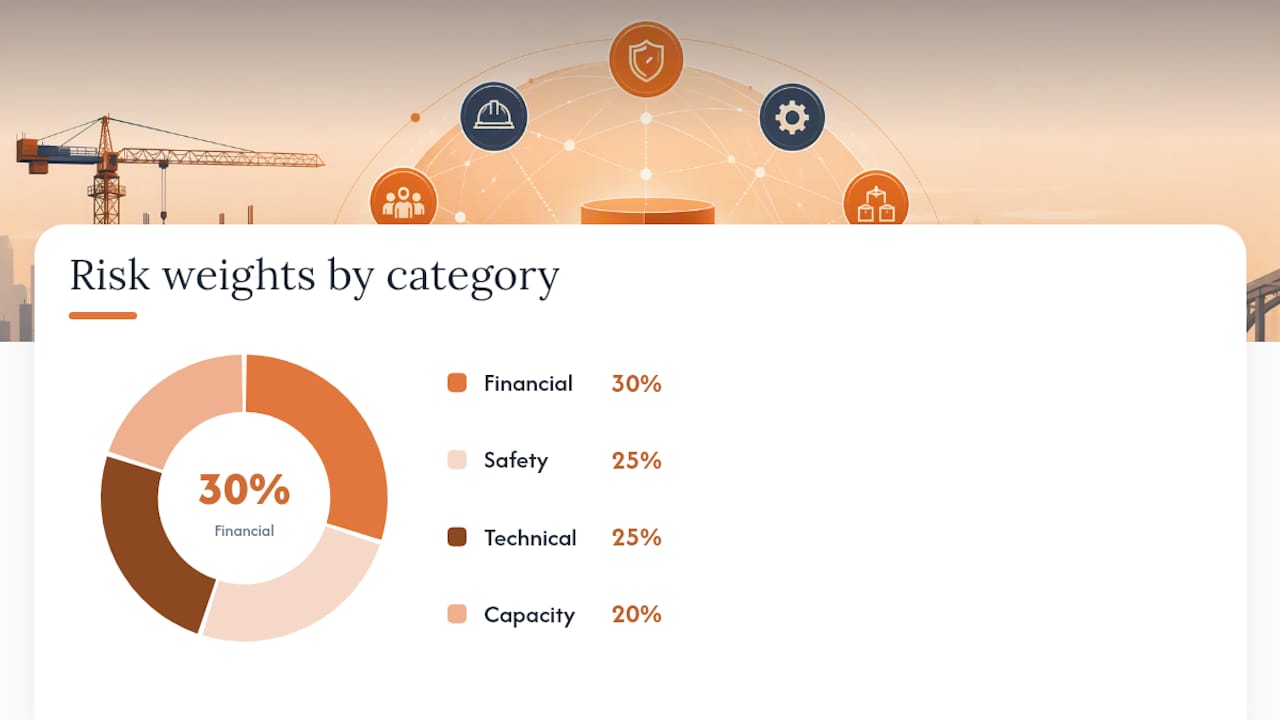
A weighted scoring matrix turns a stack of subjective judgments into a number you can defend later, and it’s the single biggest upgrade most procurement teams can make over an informal review. Research on subcontractor evaluation criteria consistently finds that time, reputation, and quality predict project success better than price, which is exactly why a matrix weighted toward financial stability and safety performance, not just the bid number, produces better outcomes than lowest-price selection.
A workable structure assigns each category a weight and scores every subcontractor from 1 to 5 within it:
- Financial stability (30%): current ratio, working capital trend, bonding capacity relative to backlog
- Safety performance (25%): EMR, TRIR/DART trend, OSHA citation history
- Technical capability (25%): relevant project experience, key personnel, reference quality
- Capacity and concentration (20%): available bonding, current backlog, percentage tied to one client
Multiply each category score by its weight and sum the results for a total out of 5.0. A subcontractor scoring 4.2 overall with strong financials but a thin safety record looks very different from one scoring 4.2 with the reverse profile, and the matrix format keeps that distinction visible instead of burying it in a single grade.
Translate the total score into three approval tiers:
- Tier 1 (score 4.0+): Approved for full award range, standard retainage, no added conditions.
- Tier 2 (score 3.0 to 3.9): Conditional approval. Cap award size, require monthly waivers, consider higher retainage or a performance bond on larger scopes.
- Tier 3 (score below 3.0): Approved only for small, low-risk packages, if at all, with mitigations like joint checks to suppliers or a required payment bond regardless of contract size.
Award size should also dictate documentation depth. A subcontract under $250,000 might clear on reviewed financials and standard insurance limits. Anything above $1 million on a public project typically warrants audited statements, higher umbrella coverage, and a fresh bonding letter no more than 90 days old. This is where subcontractor prequalification best practices from Autodesk get it right: thresholds tied to project size and a tiered “yes, but” approach beat a rigid pass/fail gate every time.
How Do You Verify What a Subcontractor Submits?
A prequalification form only tells you what a subcontractor wants you to know. Verification is what confirms it’s true, and it’s the step most procurement teams shortcut when the schedule gets tight. Building a defensible program means treating verification as a required step, not an optional courtesy.
-
Call the bonding agent directly. Confirm the letter is genuine, check how long the surety relationship has existed, and ask whether the subcontractor has had any bond claims. A relationship under two years old, or a surety that seems unfamiliar with the account, is worth a follow-up question.
-
Check license status with the state board. Look for active status, any disciplinary actions, and whether the license class matches your scope. Most state licensing boards post this online in minutes.
-
Search OSHA’s public enforcement records and county lien or judgment filings. A pattern of citations in the same hazard category, or recent liens from suppliers, tells you more than the subcontractor’s own safety statement ever will.
-
Call at least two suppliers, not just owner references. Ask specifically about payment timing, not just “would you work with them again.” Suppliers see payment behavior that owners never do.
-
Document every check. Record the date, who performed it, and the result, then file it with the subcontractor’s record. This turns your prequalification program into an audit trail, which matters enormously if a dispute or claim surfaces later. As CFMA’s prequalification primer notes, verification steps like these are what separate a real risk control from paperwork that just sits in a folder.
Pro Tip: Keep a simple verification log, even a shared spreadsheet, works, with columns for check type, date, verifier initials, and outcome. When a project runs into trouble eighteen months later, that log is what shows your team did its homework.
What Should a Sample Prequalification Form Include?
A ready-to-use form mirrors the components checklist above, but organizing it by document type versus data field makes it far easier for a subcontractor to complete quickly, and easier for your team to score consistently once it comes back.
| Section | Documents to Upload | Data Fields to Capture |
|---|---|---|
| Company & licensing | License copy, business registration | License number, expiration, years in business |
| Financials | Reviewed/audited statement | Working capital, current ratio, equity trend |
| Bonding | Surety letter (dated within 12 months) | Single-job limit, aggregate limit, current backlog |
| Insurance | COI, umbrella policy | Carrier names, limits, additional insured status |
| Safety | OSHA 300 logs, safety program | EMR, TRIR, DART, citation history |
| Experience | Reference list, resumes | Similar projects, backlog concentration, key personnel |
Set conditional thresholds up front so subcontractors know what to expect. Require audited (not just reviewed) financials above a set contract size, push umbrella insurance limits higher on projects with elevated liability exposure, and ask for a fresh bonding letter, not one held over from a prior job, whenever the award approaches a subcontractor’s aggregate limit.
Distribution doesn’t need to be complicated. A fillable PDF sent by email works for smaller GCs; a shared portal or subcontractor management platform scales better once you’re running more than a handful of bids per month. Either way, set a response window of 5 to 10 business days and hold to it. A subcontractor who can’t return a prequalification packet promptly often struggles with paperwork deadlines on the job too.
Once forms come back, index them so estimating teams can pull them fast. A simple system, tier, expiration date, last verification date, sorted by trade, means nobody’s re-verifying a subcontractor who was already cleared three months ago. It also gives you a clean audit file if a bonding company, owner, or auditor ever asks how you selected your subcontractor list.
What Are the Warning Signs During Prequalification?
Certain patterns should stop a review cold, or at minimum trigger conditional approval with added controls rather than a rubber stamp.
- Financial red flags: declining equity over consecutive years, more than 40% of backlog tied to a single client, or a banking relationship under one year old
- Bonding and insurance red flags: no surety relationship at all, a bonding letter older than 12 months, or insurance limits below your contract requirement
- Safety and performance red flags: EMR above 1.0, repeat OSHA citations in the same category within three years, or multiple supplier complaints about late payment
- Submission behavior red flags: missing documents after a follow-up request, numbers that don’t reconcile between the financial statement and the narrative answers, or vague responses to direct reference questions
None of these automatically disqualify a subcontractor. They should trigger a specific response: conditional approval with a reduced award cap, mandatory joint checks to suppliers, required performance bonding regardless of contract size, or in the worst cases, removal from the bid list entirely.
How Prequalification Discipline Wins Federal and Public Work
A rigorous three-Cs process doesn’t just reduce risk. It’s what makes bids defensible when a contracting officer or bonding company asks how you selected your team.
Public water projects and other federal awards live or die on documentation. A subcontractor list backed by verified bonding, safety history, and financial ratios isn’t paperwork overhead, it’s the evidence that lets a contracting officer say yes with confidence.
Federal work adds layers general contractors won’t see on private jobs: certified payroll compliance under the Davis-Bacon Act, active SAM.gov registration status for every subcontractor on the team, and bonding expectations that often exceed private-sector norms. Review why federal contracts require bonding before assuming your standard bonding threshold will clear a public works package.
Pro Tip: Add a SAM.gov and Davis-Bacon compliance line to your prequalification form for any subcontractor being considered for federal or federally funded work. A clean prequalification score means little if the subcontractor can’t legally perform on the contract.

If you’re preparing subcontractors for federal or public-sector work, Federal-rconstructionsolutions’ federal procurement services build compliance verification directly into your prequalification and bid workflow, from SAM.gov status checks to Davis-Bacon certified payroll readiness. Teams pursuing Army Corps of Engineers projects can also lean on USACE-specific procurement and quality control support to align subcontractor standards with agency requirements before a bid ever goes out.
Why Most Prequalification Checklists Fail Before the First Score Is Ever Entered
Most subcontractor prequalification programs collapse for one reason: they treat the checklist as the finish line instead of the starting point. Teams spend weeks building a beautiful intake form, then let the data sit unverified in a folder because nobody owns the follow-up calls. The checklist was never the hard part. Verification is.
The conventional advice on this topic overweights the form and underweights the tiering. A binary pass/fail gate feels rigorous, but it forces reviewers into an all-or-nothing decision on subcontractors who might be perfectly capable on a smaller scope with a few added controls. The tiered approach, treating a marginal score as “yes, with conditions” rather than a flat no, keeps qualified regional and small subcontractors in your pipeline instead of locking them out over one weak ratio.
If you do only one thing differently after reading this, make it verification. A polished form with unverified numbers is worse than no form at all. It creates false confidence.
— Rowena
Sources
- Identification of subcontractor prequalification evaluation criteria and their impact on project success — ScienceDirect
- Subcontractor qualification best practices — Autodesk
- Subcontractor review and prequalification: a primer — CFMA
- Subcontractor prequalification guidebook — NAMCE
FAQ
How Do You Prequalify Subcontractors?
Collect standardized data on financials, bonding, insurance, safety, and experience using a single intake form, score each category with a weighted matrix, assign a risk tier, and independently verify the top claims (bonding letter, license status, safety record) before awarding work.
What Is a Prequalification Questionnaire for Subcontractors?
It’s a standardized data-collection form that captures a subcontractor’s Capital (financial strength), Capacity (bonding, backlog, staffing), and Character (safety and performance history), used to score and compare subcontractors before bid award rather than during a project crisis.
How Much Does Subcontractor Prequalification Cost?
Cost depends mostly on staff time rather than a fixed fee. Reviewing financials, calling sureties and suppliers, and checking public records typically take a few hours per subcontractor, though many contractors treat this as a fixed part of preconstruction rather than a separate line item.
What Are Subcontractor Prelims?
“Prelims” typically refers to preliminary costs, items like site setup, supervision, and temporary facilities, listed separately in a subcontractor’s bid, and reviewing them carefully during prequalification helps confirm a bid is complete rather than artificially low.
How Often Should You Requalify a Subcontractor?
Requalify at least annually as a baseline, and immediately after any event trigger such as a safety incident, ownership change, bonding capacity shift, or a significant complaint from a supplier or reference.