
Working with Government Contracting Officers: Proven Tips
Government contracting officers (COs) are the single decision-makers who control whether your construction business wins or loses a federal contract. Working with government contracting officers tips that actually move the needle share one common thread: they treat COs as risk managers, not buyers. Small businesses that engage agencies 12 or more months before an RFP is issued achieve win rates of 28–35%, compared to the 18% average across all federal contractors. That gap is not luck. It is the direct result of early preparation, disciplined communication, and meticulous compliance. This guide gives you the exact framework to close that gap.
How to prepare before engaging government contracting officers
Preparation is the foundation of every successful CO interaction. Contractors who walk into a capability briefing without agency research waste the CO’s time and their own. Start by studying the agency’s published procurement forecasts, past award data on USASpending.gov, and any posted pre-solicitation notices on SAM.gov.
Your business registration must be current and complete before you contact any CO. SAM.gov registration is mandatory for federal contract eligibility. If you qualify for set-aside programs such as 8(a), Service-Disabled Veteran-Owned Small Business (SDVOSB), or HUBZone, certify before outreach. COs actively search these designations when filling set-aside requirements, and your certification makes you immediately relevant.

Capability briefings that highlight specific NAICS codes, relevant past performance, and your ability to reduce procurement risk resonate far more than generic company overviews. A CO evaluating a water infrastructure project wants to see that you have completed similar work on time and within budget. Lead with that evidence.
Use a compliance matrix before you submit anything. A compliance matrix is a spreadsheet that maps every solicitation requirement to a specific section of your proposal. Compliance checklists and matrices reduce disqualification risk by confirming that no requirement goes unanswered.
Documents to organize before CO outreach:
- Current SAM.gov registration and NAICS code list
- Set-aside certifications (8(a), SDVOSB, HUBZone, WOSB)
- Past performance summaries with contract numbers, dollar values, and agency names
- Capability statement (one page, tailored to the target agency)
- Compliance matrix template ready for each solicitation
| Document | Purpose | When to Use |
|---|---|---|
| SAM.gov registration | Confirms federal eligibility | Before any outreach |
| Capability statement | Shows relevance and past performance | Industry days, CO meetings |
| Compliance matrix | Maps proposal to solicitation requirements | Before proposal submission |
| Past performance record | Demonstrates low risk | Proposals and briefings |
| Set-aside certification | Qualifies for targeted opportunities | Registration and bidding |
Pro Tip: Tailor your capability statement to each agency’s mission. A statement built for the Army Corps of Engineers should reference water and civil infrastructure projects, not commercial builds.
What are the best practices for communicating with contracting officers?
COs evaluate every vendor interaction through two questions: Is this vendor relevant to our procurement? Will engaging them reduce our risk? Relevance and risk reduction are the primary criteria. Every email, phone call, and meeting you have with a CO must answer both questions fast.
The trust-first communication approach works because it respects the CO’s constraints. COs operate under the Federal Acquisition Regulation (FAR), which limits what they can discuss and with whom. Sending a long sales pitch email puts them in an uncomfortable position. A concise, structured message that states your NAICS code, one relevant past project, and a specific question about an upcoming procurement is far more likely to get a reply.
Follow these steps when reaching out to a CO:
- Identify the right CO. Use SAM.gov, FedBizOpps postings, or USASpending.gov award records to find the CO assigned to contracts in your target area.
- Send a brief, structured email. State your company name, relevant NAICS codes, one comparable past performance example, and one specific question tied to a posted solicitation or procurement forecast.
- Attend agency industry days. Agency-hosted industry days are official events where COs must engage vendors. These are your best structured opportunity to introduce your company without violating procurement rules.
- Bring a technical expert to meetings. COs respond to substance. A project manager who can speak to construction methods, Davis-Bacon Act compliance, or site safety protocols adds credibility that a salesperson cannot.
- Respond to Requests for Information (RFIs). Submitting a substantive RFI response puts your company name in front of the CO before the solicitation is finalized. It also signals that you read requirements carefully.
- Follow up once, then wait. One follow-up email after a week of silence is professional. Multiple follow-ups signal desperation and can damage your reputation with that office.
Pro Tip: When responding to an RFI, include a one-paragraph summary of how your firm’s past performance directly addresses the agency’s stated requirement. COs read these summaries when shortlisting vendors.
Avoid generic outreach at all costs. An email that says “We are a full-service construction company ready to serve your agency” tells a CO nothing useful. It does not answer the relevance question, and it does not reduce perceived risk.
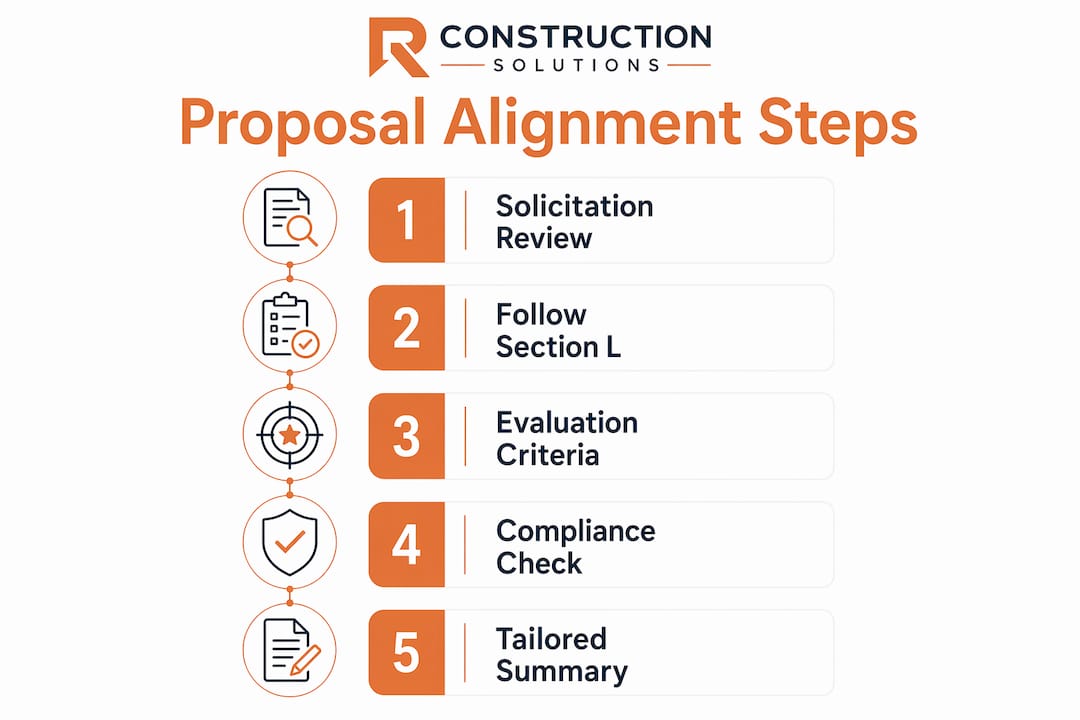
How to align your proposals with contracting officer expectations
A proposal that fails to follow solicitation instructions is disqualified automatically. COs lack legal discretion to overlook formatting errors or missing sections, regardless of how strong your technical approach is. This is the most preventable reason contractors lose federal bids.
Build every proposal around the solicitation’s evaluation criteria in the exact order they appear. If Section L says to address technical approach first and past performance second, your proposal must mirror that structure. COs score proposals against a predetermined evaluation matrix. Proposals that deviate from the required format create scoring problems that COs are not permitted to resolve in your favor.
Documentation is your defense. Every cost figure, schedule estimate, and technical claim needs supporting evidence. Cost reasonableness, a standard under the FAR, requires that your pricing align with market rates and be backed by supplier quotes, labor rate surveys, or historical contract data. Unsupported numbers invite scrutiny and can trigger a price realism review that delays award.
Common proposal pitfalls to avoid:
- Submitting a proposal without a completed compliance matrix
- Using fonts, margins, or page counts that violate solicitation instructions
- Leaving past performance references vague (always include contract numbers and dollar values)
- Failing to address every evaluation subfactor, even briefly
- Submitting cost data without supporting documentation
| Proposal quality factor | Compliance requirement |
|---|---|
| Technical approach | Must follow Section L structure exactly |
| Past performance | Requires contract numbers, agency names, and dollar values |
| Price/cost | Must include supporting documentation for cost reasonableness |
| Management plan | Must address key personnel and Davis-Bacon Act compliance |
| Formatting | Must meet page limits, font size, and margin specifications |
A federal procurement compliance checklist reviewed against each solicitation before submission catches the errors that cause disqualification. Build this review into your proposal process as a fixed step, not an afterthought.
How do agency resources improve your access to contracting officers?
The Office of Small and Disadvantaged Business Utilization (OSDBU) exists at most federal agencies specifically to connect small businesses with COs. OSDBU offices have direct CO access and a mandate to support small business engagement. If a CO is not responding to your outreach, the OSDBU is your most effective formal channel.
Prime contractor relationships offer another path. Many federal construction contracts require prime contractors to meet small business subcontracting goals. Positioning your firm as a qualified subcontractor to an established prime gets your work in front of agency COs through a trusted intermediary. Register your capabilities with prime contractor supplier diversity programs and respond to their subcontracting solicitations.
Strategies for building agency visibility:
- Register with the agency’s OSDBU and request a capability briefing introduction
- Attend every agency industry day and pre-solicitation conference in your target market
- Submit substantive responses to all relevant RFIs, even when you are uncertain about bidding
- Track contract award history on USASpending.gov to identify which COs manage contracts in your NAICS codes
- Build relationships with prime contractors who hold active agency contracts in your specialty
Defense Contract Shield provides detailed guidance on CO psychology and federal construction contracting norms that help contractors position themselves correctly before formal engagement. Understanding how COs think about risk and documentation gives you a significant advantage in every interaction.
Persistent but respectful follow-up is the standard. After an industry day, send a brief thank-you email that references a specific point from the event. This is professional, memorable, and keeps your name in front of the CO without crossing procurement boundaries.
What are the most common mistakes when working with contracting officers?
The most damaging mistake contractors make is attempting to persuade a CO with emotional or argumentative appeals. COs prioritize defensible decisions backed by contract documentation. A contractor who argues that their bid deserves consideration because of their relationship with the agency or their years of experience is making an argument the CO cannot legally act on.
Lack of compliance is the second most common failure. Contractors who skip the compliance matrix step, rush the proposal, or assume a CO will overlook a minor deviation lose bids they could have won. The bid/no-bid decision framework is a tool that prevents this by helping you focus resources on opportunities where you meet every requirement before you start writing.
When CO outreach goes unanswered, do not escalate immediately to legal counsel or agency leadership. Use formal channels first: the OSDBU, the agency’s small business advocate, or a posted industry day. Premature legal involvement signals conflict and can close doors permanently.
Key insight: Attorneys and legal counsel produce the best outcomes in federal construction when documentation is built first. Build your compliance record, cost documentation, and contract modification trail before bringing legal framing into the conversation. A CO responds to facts tied to contract requirements, not to persuasive arguments. Align your legal strategy with that reality.
Pro Tip: If your proposal is rejected, request a debriefing. Federal agencies are required to provide debriefings on competitive proposals. The feedback tells you exactly what the CO scored against your submission and where your next proposal must improve.
Key Takeaways
Winning federal construction contracts requires early CO engagement, meticulous compliance, and communication that answers the relevance and risk questions before a CO has to ask them.
| Point | Details |
|---|---|
| Engage agencies early | Contractors who engage 12+ months before RFP issuance achieve significantly higher win rates than the federal average. |
| Lead with relevance and risk | Every CO interaction must answer two questions: Is this vendor relevant? Do they reduce procurement risk? |
| Use compliance checklists | A compliance matrix reviewed before submission prevents the formatting and requirement errors that cause automatic disqualification. |
| Use OSDBU offices | When direct CO outreach fails, OSDBU offices provide mandated access and can facilitate formal introductions. |
| Build documentation first | Cost reasonableness, past performance records, and contract modification trails are the evidence COs need to make defensible decisions. |
What I have learned about CO relationships that most guides skip
Working in federal construction procurement long enough teaches you something that no checklist captures: COs are not looking for the best contractor. They are looking for the safest choice. That distinction changes everything about how you present your company.
The contractors I have seen succeed consistently are not always the most technically capable firms in the room. They are the ones who make a CO’s job easier. Their proposals are clean, their documentation is complete, and their past performance references answer the phone. They show up to industry days with specific questions, not sales decks. They submit RFI responses that demonstrate they actually read the requirement.
Patience is not optional in this market. A relationship with a CO that takes 18 months to develop can produce a contract worth years of revenue. Contractors who treat every interaction as a transaction lose. The ones who treat each touchpoint as a long-term investment in agency trust win more often and at higher contract values.
The bid/no-bid decision is where most contractors leave money on the table. Chasing every opportunity dilutes your proposal quality and burns out your team. A disciplined bid/no-bid process that filters for agency fit, past performance alignment, and compliance readiness is the single habit that separates contractors with 30%+ win rates from those stuck at the federal average.
— Rowena
Federal-rconstructionsolutions: support for your federal contracting goals
Federal-rconstructionsolutions, through the RCS 5551 Pillar, works directly with construction businesses to reduce the complexity of federal procurement. The team supports contractors with compliance checklist development, proposal writing, and agency engagement preparation, helping clients achieve 90% compliance on bid submissions.
Whether you are preparing your first federal bid or refining an existing approach, the federal procurement services offered through RCS 5551 Pillar give you structured support at every stage. From SAM.gov registration guidance to full RFP response development, the team brings practitioner-level knowledge to each engagement. Contractors looking to expand beyond government work can also explore private sector construction services that complement federal revenue with more consistent private project pipelines.
FAQ
What does a government contracting officer actually do?
A contracting officer is the only federal official with legal authority to award, administer, and terminate contracts on behalf of a government agency. They evaluate proposals against published criteria and make award decisions that must be fully defensible under the FAR.
How early should I contact a contracting officer before an RFP?
Contractors who engage agencies 12 or more months before an RFP is issued achieve win rates of 28–35%, well above the federal average. Early engagement through industry days and RFI responses builds the familiarity that improves your evaluation scores.
What is the fastest way to get a contracting officer to respond?
Send a concise email that states your NAICS code, one relevant past performance example, and one specific question tied to a posted solicitation. Relevance and risk reduction are the two criteria COs use to decide whether to respond.
What happens if a contracting officer ignores my outreach?
Contact the agency’s OSDBU office. OSDBU offices have direct CO access and a mandate to connect small businesses with procurement staff. Attending a posted agency industry day is the other formal channel that puts you in front of COs without violating procurement rules.
Why do proposals get disqualified even when the technical approach is strong?
COs cannot overlook solicitation errors regardless of proposal merit. Formatting violations, missing sections, and unsupported cost data cause automatic disqualification. A compliance matrix reviewed before submission is the most reliable way to prevent this outcome.