
Contracting Officer Role in Federal Projects: A Contractor's Guide
A contracting officer (CO) is the only government official legally authorized to enter into, modify, or terminate federal contracts on behalf of the U.S. government. Understanding the role of contracting officer in federal projects is not optional for construction firms. It directly affects whether you get paid, whether your modifications are valid, and whether your bid strategy targets the right decision-maker. Every construction contractor pursuing federal work needs to know who holds this authority, what limits it, and how to work within it.
What legal authority defines the role of contracting officer in federal projects?
The contracting officer’s authority comes from a written appointment called a warrant, issued on Standard Form 1402. That warrant specifies a dollar threshold. The CO cannot legally bind the government to contracts above that limit. This is not a technicality. It is the legal boundary that determines whether your contract is enforceable.
Only warranted officials can contractually bind the U.S. government. Exceeding the warrant’s dollar limit creates an unauthorized commitment, which requires formal ratification before any funds can be obligated. For construction contractors, that gap between doing the work and getting paid can be financially devastating.
Federal contracting officer duties under the Federal Acquisition Regulation (FAR) include:
- Entering into, administering, modifying, and terminating contracts
- Making determinations and findings required by law or regulation
- Approving progress inspections and milestones within their contract scope
- Safeguarding U.S. interests in all contractual relationships
- Exercising broad business judgment within FAR guidelines
The CO also holds implied authority for actions necessary to carry out their explicitly authorized duties. Approving a progress inspection or issuing a notice to proceed falls within this implied scope. That said, implied authority does not extend to authorizing additional scope or committing funds beyond the warrant limit.
Pro Tip: Ask to see the CO’s SF 1402 warrant before signing any contract modification. Confirm the dollar amount on the warrant covers the modification value. This one step protects you from performing work the government is not legally obligated to pay for.
How does a CO differ from a COR or program manager?
Construction contractors regularly receive instructions from multiple federal officials on a job site. Knowing who can legally bind the government prevents costly mistakes.

| Role | Legal authority | What they can do |
|---|---|---|
| Contracting Officer (CO) | Full warrant authority up to dollar limit | Enter, modify, terminate contracts; obligate funds |
| Contracting Officer’s Representative (COR) | No independent legal authority | Monitor performance, report issues, recommend actions |
| Program Manager | No contracting authority | Define requirements, manage project goals |
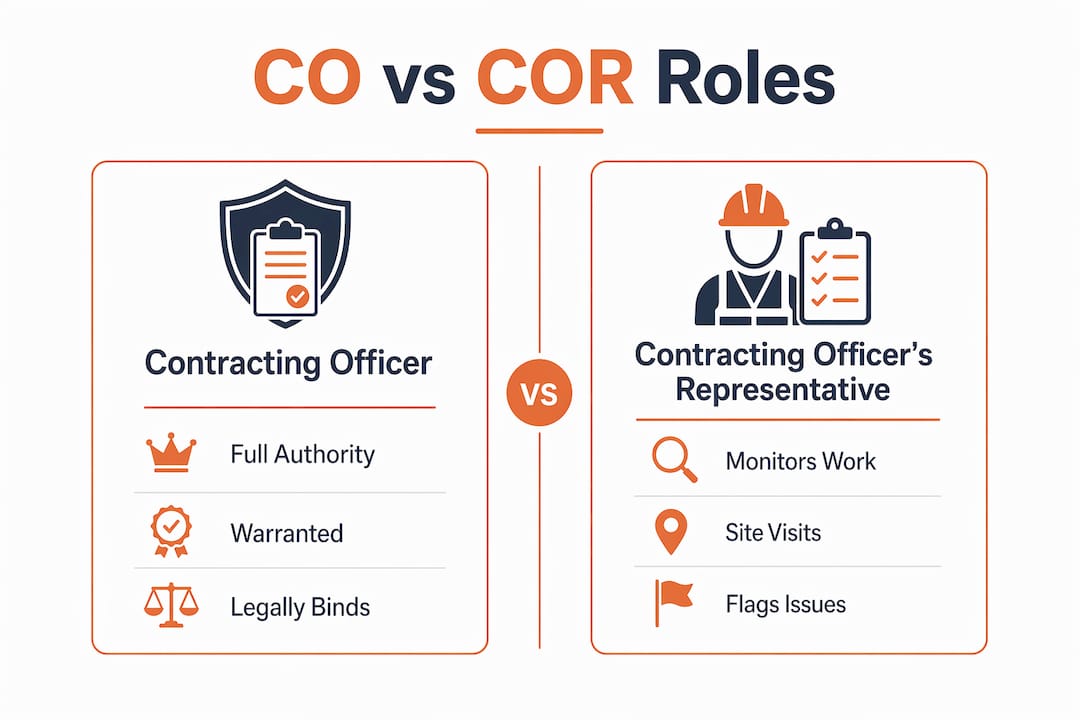
CORs act as the CO’s eyes and ears on a project. They conduct site visits, track deliverables, and flag performance issues. What they cannot do is authorize additional work, approve scope changes, or modify contract terms. That authority belongs exclusively to the CO.
Program managers define what the government needs and manage the project from a mission standpoint. They influence requirements and timelines but hold no contracting authority. A program manager telling your crew to add a feature or extend a scope item is not a legally binding instruction.
The practical implication is direct. If anyone other than the CO directs you to perform work outside your current contract scope, stop and get written CO approval first. Unauthorized instructions from non-CO officials can result in non-payment, even when you complete the work in good faith.
Pro Tip: When a COR or program manager requests changes verbally, respond in writing by asking them to confirm the request through the CO. This creates a paper trail and signals to the government that your firm understands the federal procurement process.
What are the key phases of federal contract management?
Federal procurement guidance defines five contract life cycle phases managed by the contracting officer: Planning, Solicitation, Evaluation, Award, and Administration. Each phase carries specific CO responsibilities and specific opportunities for contractor engagement.
-
Planning. The CO works with the program office to define requirements, set acquisition strategy, and determine contract type. Contractors can influence this phase by attending industry days and responding to Requests for Information (RFIs). Getting your firm’s capabilities in front of the CO early shapes how requirements are written.
-
Solicitation. The CO issues the Request for Proposals (RFP) or Invitation for Bids (IFB) and manages the question-and-answer period. All amendments to the solicitation come from the CO. Tracking bid invitations carefully during this phase prevents you from bidding on outdated requirements.
-
Evaluation. The CO leads the source selection process, coordinating with technical evaluators. Contractors are generally not in direct contact with the CO during this phase. Your proposal must speak for itself.
-
Award. The CO signs the contract. No other official can execute this action. The cycle from planning to award typically spans 6–24 months, depending on project complexity.
-
Administration. The CO oversees contract performance, approves invoices, issues modifications, and manages closeout. Administration can span 1 to 10+ years on large construction projects. Contractors should track scope carefully and avoid out-of-scope work without written CO approval.
| Phase | CO responsibility | Contractor action |
|---|---|---|
| Planning | Define requirements, set strategy | Attend industry days, submit capability statements |
| Solicitation | Issue RFP, manage Q&A | Submit questions, review amendments |
| Evaluation | Lead source selection | Wait; no direct CO contact |
| Award | Execute contract | Review and sign award documents |
| Administration | Approve invoices, issue modifications | Track scope, document all CO communications |
Understanding this cycle helps you time your outreach, prepare compliant proposals, and manage performance expectations. The full federal construction contract process requires knowing where each decision point sits and who controls it.
What steps should contractors take to verify CO authority?
Verifying a contracting officer’s authority is not bureaucratic caution. It is financial self-protection. Failing to confirm a CO’s warrant and dollar limits is one of the most common causes of costly contract disputes in federal construction.
Follow these steps before accepting any contract action:
- Request the SF 1402. Ask the CO directly for a copy of their warrant. A legitimate CO will provide it without hesitation.
- Confirm the dollar threshold. Check that the contract value or modification amount falls within the warrant limit. If it does not, the action requires a higher-level CO or a warrant increase.
- Review delegation letters. Some COs delegate specific authorities to other officials in writing. Confirm what is delegated and to whom before acting on those instructions.
- Get all instructions in writing. Verbal directions from any federal official carry no legal weight in a dispute. Require written confirmation for every scope change, schedule adjustment, or technical direction.
- Document every CO communication. Keep a dated log of all correspondence, meeting notes, and approvals. This record protects you if a dispute arises over scope or payment.
Only the contracting officer can ratify unauthorized commitments to legally obligate funds. If you perform work based on instructions from a COR or program manager without CO approval, you may have no legal recourse for payment. Understanding common subcontractor contract disputes reinforces why this verification step matters at every tier of the project.
Pro Tip: Build a simple CO authority checklist into your project startup process. Confirm the warrant, the dollar limit, and the delegation letters before your crew mobilizes. This takes less than a day and prevents disputes that can take months to resolve.
Key Takeaways
The contracting officer is the sole legal authority in federal contracting, and verifying their warrant before performing any work is the single most effective way to protect your firm’s payment rights.
| Point | Details |
|---|---|
| CO holds exclusive authority | Only a warranted CO can legally bind the government to a contract or modification. |
| Warrant limits are binding | The SF 1402 specifies a dollar threshold; work above that limit is not legally obligated without ratification. |
| CORs cannot authorize changes | COR instructions carry no legal weight for scope changes; always route through the CO. |
| Five phases define the cycle | Planning through Administration spans 6–24 months to award, with administration lasting years. |
| Verification prevents disputes | Requesting the SF 1402 and documenting CO communications protects payment rights on every project. |
What I’ve learned about CO relationships that most contractors get wrong
Working with construction firms on federal procurement reveals a consistent pattern. Contractors who struggle with federal projects almost always have the same blind spot. They treat the contracting officer as an obstacle rather than the one person who can actually solve their problems.
The CO is not the enemy of your project. They are the only official with the authority to fix a problem, approve a change, or release a payment. Building a professional, respectful relationship with your CO pays off in faster approvals and fewer disputes. That does not mean being informal or pushing boundaries. It means communicating clearly, documenting everything, and never putting a CO in a position where they have to say no publicly.
The other mistake I see constantly is contractors accepting verbal direction from CORs and program managers without escalating to the CO. I understand the impulse. The COR is on-site every day. The CO may be in a different city. But that convenience is exactly how unauthorized commitments happen. The CO is the only person whose “yes” means anything legally.
My honest advice: treat every federal project as if the CO’s warrant is the only document that matters. Because legally, it is. Firms that internalize this protect their margins and their reputation on every contract they win.
— Rowena
How Federal-rconstructionsolutions helps you work with contracting officers

Federal-rconstructionsolutions specializes in helping construction firms navigate the federal procurement process with confidence. The team at Federal-rconstructionsolutions understands the specific demands of contracting officer interactions, from verifying warrant authority to preparing compliant bid submissions. Their federal procurement support services cover RFP writing, compliance counseling, and bid strategy tailored to construction contractors. Federal-rconstructionsolutions also supports firms pursuing MBE certification and USACE procurement requirements. If your firm is ready to win federal contracts and manage them without costly missteps, Federal-rconstructionsolutions provides the expertise to get you there.
FAQ
What is a contracting officer in federal projects?
A contracting officer is the only government official legally authorized to enter into, modify, or terminate federal contracts on behalf of the U.S. government. Their authority is defined by a written warrant on Standard Form 1402.
What is the difference between a CO and a COR?
A contracting officer holds full legal authority to bind the government and obligate funds. A Contracting Officer’s Representative monitors performance but cannot authorize changes or modify contract terms.
What happens if a contractor follows instructions from a non-CO official?
Work performed based on instructions from a non-warranted official creates an unauthorized commitment. The government is not legally obligated to pay for that work unless the CO formally ratifies the commitment.
How do contractors verify a contracting officer’s authority?
Contractors should request a copy of the CO’s SF 1402 warrant and confirm the dollar threshold covers the contract or modification value. Delegation letters should also be reviewed before acting on any delegated authority.
How long does the federal contracting process take?
The cycle from planning to contract award typically spans 6–24 months. Contract administration can last 1 to 10 or more years, depending on project size and complexity.