
DBE Commercially Useful Function: Your Compliance Guide
A DBE performs a commercially useful function (CUF) when it is directly responsible for executing a distinct element of the contract — performing, managing, and supervising that work with its own forces — and, for material purchases, it negotiates price, determines quality and quantity, orders, and pays for those materials itself. Under 49 CFR 26.55. DBE expenditures count toward your contract goals only when this test is met.
Quick CUF screening checklist:
- Is the DBE performing the work with its own workforce and equipment?
- Is the DBE managing scheduling, ordering, and contract decisions?
- Is the DBE supervising the work on-site through its own personnel or owner?
- For materials: does the DBE negotiate price, determine quality/quantity, order, and pay for the material?
- Is the DBE’s payment commensurate with the work it actually performs?
“A DBE performs a commercially useful function when it is responsible for execution of the work of a contract and is carrying out its responsibilities by actually performing, managing, and supervising the work involved.” — 49 CFR 26.55
If you answer “no” to any of the first three items, or “no” to any of the four material functions when materials are involved, the agency will likely disallow that DBE credit.
Key Takeaways
A DBE performs a commercially useful function only when it performs, manages, and supervises its own distinct contract scope — and for materials, independently negotiates, orders, and pays for them.
| Point | Details |
|---|---|
| Core CUF test | The DBE must perform, manage, and supervise a distinct contract element with its own forces. |
| Materials four-function rule | DBE must negotiate price, determine quantity/quality, order, and pay for materials to claim material cost credit. |
| 30% self-performance threshold | Subcontracting more than 30% to non-DBE firms triggers a presumption of non-CUF under 49 CFR 26.55. |
| Documentation timing | Collect certified payrolls, invoices, and supervision logs at mobilization, not at closeout. |
| Federal-rconstructionsolutions | Provides pre-bid CUF readiness reviews, contract clause drafting, and audit-ready documentation support. |
Table of Contents
- What is a DBE commercially useful function under 49 CFR 26.55?
- The three-part CUF test: what performing, managing, and supervising actually mean
- How CUF is evaluated across common DBE categories
- Furnish-and-install and supplier rules: the four material functions
- Red flags and common CUF violations to watch for
- Records, timing, and what reviewers ask for during CUF reviews
- Step-by-step compliance checklist for primes and DBEs
- How CUF applies differently across construction, services, and supply contracts
- How to handle CUF in joint ventures involving DBEs
- Consequences and penalties for failing CUF requirements
- Why CUF documentation is the part most contractors get wrong
- Federal-rconstructionsolutions builds your CUF compliance process from the ground up
- Sources
- FAQ
What is a DBE commercially useful function under 49 CFR 26.55?
The regulatory foundation for CUF sits in 49 CFR 26.55, which governs how recipients count DBE participation toward federally assisted contract goals. The rule establishes two parallel tests: one for work performance and one for materials.
For work performance, the DBE must be responsible for execution and must carry out that responsibility by performing, managing, and supervising the contract work. For materials, the DBE must negotiate price, determine quality and quantity, order the material, and pay for it with its own funds.
“A DBE does not perform a commercially useful function if its role is limited to that of an extra participant in a transaction, contract, or project through which funds are passed in order to obtain the appearance of DBE participation.” — USDOT Q&A guidance, 49 CFR 26
The USDOT Q&A on 49 CFR 26 further clarifies that for furnish-and-install situations, the DBE must perform all four material functions to receive credit for material costs. Installation credit is available separately if the DBE installs with its own forces, even when the material functions are not fully met.
The DBE can rebut that presumption with evidence, but the burden shifts. Recipients also evaluate whether the arrangement is consistent with normal industry practice for similar non-DBE transactions.
Key CUF counting rules under 49 CFR 26.55:
- Count the full value of work the DBE performs with its own forces.
- Count material costs only when the DBE meets all four material functions.
- Do not count work the DBE subcontracts to non-DBE firms (beyond the 30% threshold without rebuttal).
- Do not count payments to a DBE that is acting as a pass-through.
The three-part CUF test: what performing, managing, and supervising actually mean
Regulatory language can feel abstract until you see what reviewers actually look for in the field. The FHWA CUF primer breaks the test into five evaluation areas for subcontractors: management, workforce, equipment, materials, and performance. Here is what each element of the three-part test means in practice.
Performing means the DBE’s own workforce is doing the physical work: labor, equipment operation, direct installation. Reviewers look at certified payrolls, timecards, and equipment logs. If the workers on-site are employed by the prime or a non-DBE sub rather than the DBE, the performance prong fails.
Managing means the DBE controls the business decisions that drive the work: scheduling, ordering materials, executing change orders, and making scope decisions within its NAICS classification. Purchase orders, change order signatures, and subcontract scope language are the primary evidence. A DBE that simply receives instructions from the prime and passes them along is not managing.
Supervising means the DBE has its own superintendent or owner on-site directing the work. Site visit logs, supervision wage records, and daily reports showing the DBE’s personnel as the responsible party all support this prong. Reviewers specifically check whether the prime’s foreman is directing the DBE’s crew — that arrangement fails supervision.
The commensurate pay test runs alongside all three prongs. Reviewers compare the dollar amount paid to the DBE against the scope and value of work actually performed. A DBE receiving $200,000 for work that cost $40,000 to perform, with the remainder flowing back to the prime, signals a pass-through arrangement rather than genuine CUF.
Pro Tip: Keep a weekly field log that records the DBE owner’s or superintendent’s on-site hours, the crew roster, and equipment used. That single document answers the supervision and performance questions in one place.
How CUF is evaluated across common DBE categories
CUF rules are not one-size-fits-all. The evaluation differs meaningfully depending on whether the DBE is acting as a subcontractor, a trucker, a regular dealer, or a manufacturer.
Subcontractor or prime contractor
The FHWA CUF primer identifies five evaluation areas: management, workforce, equipment, materials, and performance. For a DBE subcontractor, reviewers ask whether the DBE manages subcontractors effectively:
- Manages its own work schedule and coordinates directly with the owner or prime.
- Employs its own workforce (not workers supplied by the prime).
- Owns or independently leases its own equipment.
- Procures materials through its own purchasing process.
- Performs the scope defined in its subcontract, not a scope dictated by the prime.
A common violation: the prime hires the DBE’s workers directly and “loans” them to the DBE for billing purposes. No CUF.
Trucking
Under the DOT final rule on section 26.55, a DBE trucking firm must own and operate at least one truck and must control its trucking operations. When the DBE uses leased trucks from non-DBE lessees, only the fees or commissions the DBE retains count toward DBE goals — not the full value of the hauling. The DBE must be dispatching, scheduling, and directing the work, not simply lending its certification to a non-DBE hauler.

Regular dealer vs. manufacturer
| Category | What counts toward DBE goals | Key condition |
|---|---|---|
| Regular dealer | the full material cost | DBE must maintain inventory or regularly stock the product |
| Manufacturer | the full contract price | DBE must produce the product with its own workforce |
A regular dealer that simply drop-ships product from a non-DBE supplier without maintaining inventory does not meet the regular dealer standard.
Furnish-and-install and supplier rules: the four material functions
When a DBE furnishes materials on a contract, the counting rules are separate from the work-performance test. The USDOT Q&A guidance establishes four functions the DBE must perform to receive credit for material costs:
- Negotiate price — the DBE must independently negotiate the purchase price with the supplier, not simply accept a price the prime arranged.
- Determine quality and quantity — the DBE decides what product meets spec and how much to order, based on its own review of the plans and specifications.
- Order the material — the DBE places the purchase order in its own name.
- Pay for the material — the DBE pays the supplier with its own funds; two-party checks or payments routed through the prime disqualify the credit.
If the DBE installs the material with its own forces but does not meet all four material functions, it can still receive credit for the installation portion. The material cost credit is lost, but the labor and installation value counts.
Documentation requirements for material credit:
- Invoices showing the DBE as the named purchaser.
- Purchase orders in the DBE’s name.
- Shipping and receiving documents.
- Cancelled checks or bank records showing the DBE as payor.
- Correspondence showing the DBE negotiated price independently.
Red flags and common CUF violations to watch for
Agencies and primes that understand the anti-pass-through intent of 49 CFR 26.55 know exactly what a contrived arrangement looks like. These are the patterns that trigger CUF investigations:
- DBE subcontracts more than 30% of its contract value to non-DBE firms without a documented rebuttal.
- Prime supervises the DBE’s crew rather than the DBE’s own superintendent.
- Two-party checks or payments routed through the prime before reaching the DBE.
- DBE used as a pass-through with no independent management, workforce, or equipment.
- Equipment owned by the prime but “used” by the DBE without a legitimate lease.
- Prime provides the DBE’s workforce, either directly or through a staffing arrangement.
- DBE’s scope is undefined or duplicates the prime’s scope, making it impossible to identify a distinct contract element.
When CUF is not met, the consequences are concrete. The agency disallows the DBE credit, and the prime must make up the shortfall — either by substituting a qualifying DBE or by documenting good-faith efforts. Repeated violations can trigger enforcement action, contract termination clauses, or debarment proceedings. For the DBE, a finding of non-CUF can jeopardize its certification and its standing on future bids. Falsifying CUF claims — submitting documentation that misrepresents who performed the work or who paid for materials — carries False Claims Act exposure.
Pro Tip: If a reviewer raises a CUF concern, respond within the agency’s stated window with a rebuttal packet: certified payrolls, purchase orders, invoices, equipment lease or ownership documents, site supervision logs, and a signed owner affidavit. A timely, organized response often resolves a presumption before it becomes a formal finding.
Records, timing, and what reviewers ask for during CUF reviews
CUF compliance is not a one-time check at project closeout. Agencies typically schedule an initial CUF review shortly after DBE mobilization, periodic reviews during performance, and a final closeout review. Collecting evidence at mobilization rather than scrambling at the end is the single most effective practice a prime or DBE can adopt.
The DOT sample CUF form captures payment tallies, CUF findings, and supporting attachments. Recipients may adapt it, but the core fields are consistent across agencies.
| Document | Why it matters |
|---|---|
| Certified payrolls | Proves DBE’s own workforce performed the labor |
| Invoices (DBE as payor) | Establishes material credit eligibility |
| Purchase orders in DBE’s name | Confirms DBE ordered materials independently |
| Equipment ownership or lease docs | Shows DBE controls its own tools and vehicles |
| Site supervision logs | Demonstrates DBE’s superintendent directed the work |
| NAICS certification scope | Confirms the work falls within the DBE’s certified specialty |
TxDOT’s CUF guidance reinforces that state agencies request proof of payment, shipping and invoice documentation, and a running tally of DBE payments at each review interval. Waiting until closeout to assemble these records is the most common reason primes lose DBE credit they legitimately earned.
Step-by-step compliance checklist for primes and DBEs
A defensible CUF process starts before the contract is signed. Here is a repeatable playbook.
Pre-contract steps:
- Confirm the DBE’s NAICS code matches the scope of work assigned.
- Define the DBE’s distinct contract element in writing — scope, deliverables, and performance standards.
- Verify the DBE has its own workforce, equipment, and purchasing capacity for that scope.
Contract language to require:
- Include a clause requiring the DBE to manage, supervise, and perform the work with its own forces.
- Specify that the DBE will place all material purchase orders in its own name and pay suppliers directly.
- Prohibit the prime from directing the DBE’s workforce or supplying the DBE’s equipment without a documented independent lease.
Monitoring schedule:
- Conduct an initial CUF check within 30 days of DBE mobilization.
- Schedule periodic reviews at project milestones (typically monthly or at each pay application).
- Assign a designated compliance contact at the prime to collect and store evidence.
CUF response packet contents:
- Certified payrolls for the DBE’s workforce.
- Purchase orders and invoices showing the DBE as payor.
- Equipment ownership or lease agreements.
- Site supervision logs with DBE superintendent’s name and hours.
- Signed owner affidavit attesting to CUF performance.
- Running DBE payment tally matching the contract’s goal tracking.
For a broader view of how CUF fits into your overall federal bid compliance, the Federal Procurement Compliance Checklist for Contractors covers Davis-Bacon, certified payroll, and subcontractor monitoring in the same framework.
How CUF applies differently across construction, services, and supply contracts
The three-part performance test applies across all contract types, but the evidence and emphasis shift depending on the work category.
Construction contracts generate the most CUF scrutiny because the dollar values are high and the physical work is observable. Reviewers can visit the site, count workers, and check equipment serial numbers against ownership records. The five-area evaluation (management, workforce, equipment, materials, performance) maps directly to construction work.
Service contracts shift the focus from physical labor to professional management. A DBE providing engineering, inspection, or program management services must demonstrate that its own staff performs the billable work, that its principals make the technical decisions, and that it is not simply relabeling work performed by the prime’s staff. Payroll records and time-and-materials invoices are the primary evidence.
Supply contracts trigger the four material functions test most directly. A DBE supplier that does not maintain inventory, negotiate independently, or pay suppliers with its own funds will not receive material cost credit regardless of how the contract is structured. Connecting DBEs to subcontracting opportunities on public projects where their NAICS scope aligns with actual work is the most reliable way to set up defensible CUF from the start.
How to handle CUF in joint ventures involving DBEs
A joint venture (JV) between a DBE and a non-DBE firm can count toward DBE goals, but only the portion of work the DBE actually performs within the JV counts. The JV agreement must specify the DBE’s distinct scope, its share of management responsibilities, and its financial contribution. A JV where the non-DBE partner controls all decisions and the DBE’s name appears only on the letterhead fails the CUF test entirely.
Reviewers look at three things in a JV context: whether the DBE’s principals are making real management decisions, whether the DBE’s workforce and equipment are contributing to the defined scope, and whether the DBE’s financial exposure is genuine.
The MBE certification and federal procurement process resource explains how certification scope intersects with JV structuring — a useful reference when aligning a DBE partner’s NAICS codes with the JV’s work plan.
Consequences and penalties for failing CUF requirements
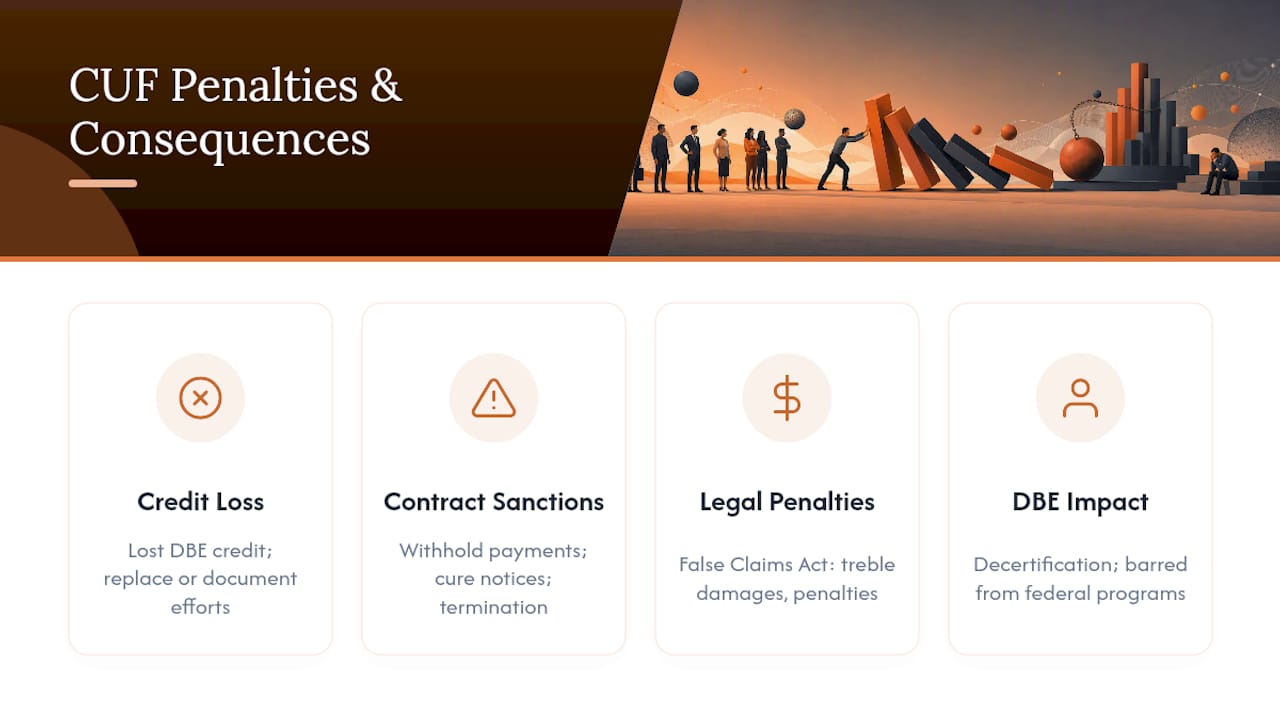
Lost DBE credit is the immediate consequence when a CUF determination goes against a prime. The prime must replace that credit through a substitute DBE or document good-faith efforts to do so. On contracts with tight DBE goals, a single failed CUF finding can put the prime out of compliance for the entire project.
Beyond credit loss, primes face contract sanctions including withholding of progress payments, cure notices, and termination for default in cases of repeated or willful non-compliance. Recipients who fail to enforce CUF requirements risk findings from FHWA or the relevant DOT modal agency, which can affect their program approval and future federal-aid eligibility.
Falsifying CUF documentation — submitting payrolls that misrepresent who performed the work, invoices that show the DBE as payor when the prime actually paid, or affidavits with false statements — triggers False Claims Act liability. Civil penalties under the False Claims Act can reach three times the amount of the false claim plus additional per-claim penalties. Criminal referrals are possible when the falsification is deliberate and systematic. For DBEs, a fraud finding results in decertification and typically bars the firm from federal programs for a defined period.
Avoiding these outcomes comes down to the same practices covered throughout this guide: clear scope definition, independent DBE management, and contemporaneous documentation collected from day one.
Why CUF documentation is the part most contractors get wrong
The CUF rule itself is not complicated. What trips up primes and DBEs alike is the gap between what actually happened on a project and what they can prove happened. A DBE superintendent who directed the work every day but never signed a site log, a DBE that paid its supplier but kept no cancelled checks, a trucking firm that owned three trucks but never documented which ones ran on which days — these are the situations where legitimate CUF performance gets disallowed simply because the paper trail is missing.
The deeper issue is that many primes treat CUF as a closeout task rather than a field practice. By the time the agency requests documentation, the DBE owner has moved on to the next project, the payroll records are scattered, and the purchase orders are buried in email. Agencies are not unsympathetic to honest mistakes, but they cannot count credit that cannot be verified.
The practical fix is not complicated either: assign one person at the prime to own DBE documentation from mobilization day, give the DBE a simple weekly reporting template, and store everything in a shared folder tied to the contract number. That discipline, applied consistently, is what separates contractors who pass CUF reviews from those who lose credit they earned.
Federal-rconstructionsolutions builds your CUF compliance process from the ground up
Knowing the rule is step one. Having the contract language, monitoring schedule, and documentation system in place before the first DBE invoice hits is what actually protects your goals.
Federal-rconstructionsolutions works directly with construction firms to build defensible CUF processes: drafting subcontract clauses that establish DBE control, setting up monitoring schedules tied to pay applications, reviewing certified payrolls for compliance gaps, and assembling CUF response packets before an agency ever asks for one. The focus is pre-bid readiness and audit-ready documentation, not reactive damage control.

Whether you are a prime managing multiple DBE subs or a DBE firm that needs to document its own performance, the federal procurement consulting services at Federal-rconstructionsolutions give you a structured, practical path to compliance. Contact Federal-rconstructionsolutions to schedule a CUF readiness review before your next project mobilizes.
Sources
- eCFR :: 49 CFR 26.55 – How is DBE participation counted toward goals?
- 49 CFR § 26.55 - How is DBE participation counted toward goals? | Electronic Code of Federal Regulations (e-CFR) | US Law | LII / Legal Information Institute
- Official Questions and Answers (Q&A’s) Disadvantaged Business Enterprise Program Regulation (49 CFR 26) | US Department of Transportation
- Commercially Useful Function
FAQ
What is a DBE commercially useful function in simple terms?
A DBE performs a commercially useful function when it actually does the work on a contract — with its own workers, equipment, and management — rather than serving as a paper participant. The legal standard comes from 49 CFR 26.55.
Is DBE certification the same as performing a commercially useful function?
No. Certification establishes eligibility; CUF determines whether the DBE’s work on a specific contract counts toward goals. A certified DBE that acts as a pass-through on a project does not perform a CUF and receives no credit, regardless of its certification status.
What are the new DBE requirements contractors should know?
The core CUF standard under 49 CFR 26.55 has been stable, but agencies have increased scrutiny of trucking arrangements, furnish-and-install material credits, and joint venture structures. Reviewing the USDOT Q&A guidance is the fastest way to stay current on agency interpretations.
What happens if a DBE fails the CUF test on a federal contract?
The agency disallows the DBE credit, and the prime must replace it or document good-faith efforts. Repeated failures or falsified documentation can lead to contract sanctions, False Claims Act liability, and DBE decertification.
How do you obtain DBE certification to participate in federal contracts?
DBE certification is administered by state Unified Certification Programs (UCPs). Applicants must meet the federal personal net worth threshold, demonstrate social and economic disadvantage, and show that the owner controls the firm. Federal-rconstructionsolutions offers certification assistance for construction businesses to help align your NAICS codes and documentation with program requirements.