
MBE Certification and the Federal Procurement Process
MBE certification in the federal procurement process refers primarily to SBA-administered programs like the 8(a) Business Development Program and Small Disadvantaged Business status, not a single federal MBE certificate. The federal government does not issue a standalone “MBE” credential. Instead, minority-owned construction firms qualify for federal set-aside contracts by obtaining SBA certifications and registering through SAM.gov. Private MBE certifications from organizations like the NMSDC serve corporate supplier diversity programs and do not unlock federal contract set-asides. Understanding this distinction is the first step toward building a certification strategy that actually wins federal work.
What federal certifications replace MBE certification in federal procurement?
The federal government does not issue a standalone MBE certificate. Federal agencies instead rely on SBA-managed programs to identify and support minority-owned and disadvantaged businesses. The two most relevant programs for construction contractors are the SBA 8(a) Business Development Program and Small Disadvantaged Business self-certification.
SBA 8(a) Business Development Program grants certified firms access to sole-source contracts and competitive set-aside opportunities. Firms accepted into the program receive nine years of support, split between a developmental stage and a transitional stage. The program also connects firms with SBA mentoring resources and business development assistance.
Small Disadvantaged Business (SDB) status is self-certified through SAM.gov. Federal agencies have a goal of awarding at least 12% of prime contract dollars to SDBs annually. That goal creates real procurement pressure on agencies to find and award qualified firms.
Other relevant federal programs include:
- HUBZone certification: For firms located in historically underutilized business zones
- SDVOSB: Service-Disabled Veteran-Owned Small Business certification
- WOSB: Women-Owned Small Business program
All federal certifications are free to obtain. They require substantial documentation, but the absence of fees removes a significant barrier compared to private programs.
Pro Tip: Register in SAM.gov before applying for any SBA certification. Your SAM.gov registration must be active and accurate, since SBA links directly to it during the 8(a) review process.
How does private MBE certification differ from federal programs?
Private MBE certification, most commonly issued by the National Minority Supplier Development Council (NMSDC), serves corporate supplier diversity programs. Fortune 500 companies and large private contractors use NMSDC certification to identify minority-owned vendors. This credential does not qualify your firm for federal set-aside contracts.

NMSDC certification is not recognized for federal contract set-asides. SBA 8(a) and SDB status are the credentials that matter for federal procurement. Confusing the two is one of the most common and costly strategic mistakes minority-owned construction firms make.
The table below compares the two certification types directly:
| Feature | Federal SBA certifications | Private MBE certification (NMSDC) |
|---|---|---|
| Issuing body | SBA / federal agencies | NMSDC or regional councils |
| Application fee | Free | $400–$1,500 |
| Processing time | ~90 days for 8(a) | 60–90 days |
| Federal set-aside access | Yes | No |
| Corporate supplier diversity | No | Yes |
| Annual renewal required | Yes (compliance review) | Yes (with fees) |
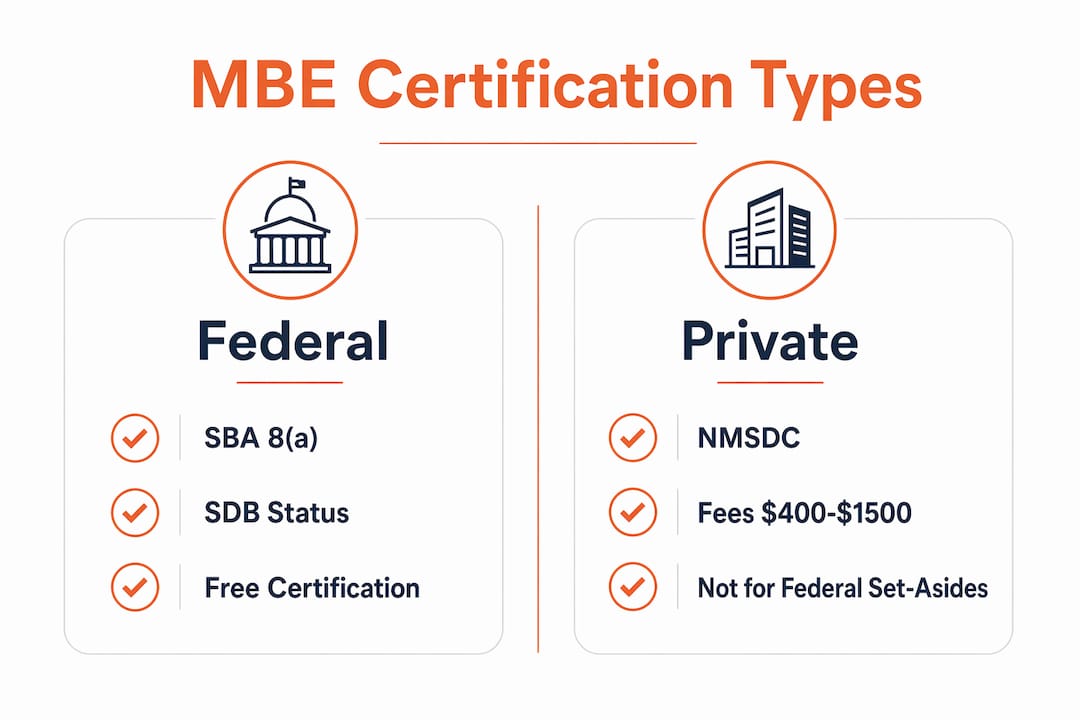
Private MBE certification fees range from $400 to $1,500, and annual renewals add ongoing cost. Federal certifications are free but demand far more paperwork and time.
The right sequence depends on your target customers. If you are pursuing federal agencies, start with SBA certifications. Add NMSDC certification later if corporate clients become a priority. Splitting your focus too early wastes resources and delays your entry into federal contracting.
What documentation do construction firms need for federal certification?
Eligibility for SBA 8(a) certification requires meeting specific ownership, control, and economic disadvantage thresholds. SBA 8(a) eligibility requires that the business be at least 51% owned and controlled by a socially and economically disadvantaged U.S. citizen. The owner’s personal net worth must be under $850,000, average income over the last three years must not exceed $400,000, and total assets must be under $6.5 million.
Gathering your documents before you start the application saves weeks. Auditors require an unbroken chain of evidence for capital investment and operational control. Missing a single document can delay approval by months.
Prepare the following before you apply:
- Proof of minority status: Birth certificate, tribal enrollment documents, or other official identification
- Ownership documents: Articles of incorporation, operating agreements, stock certificates, and buy-sell agreements
- Capital contribution evidence: Canceled checks, bank statements, or loan documents showing how the owner funded the business
- Tax returns: Personal and business returns for the last three years
- Financial statements: Balance sheets and profit-and-loss statements, current within 90 days
- Licenses and contracts: Current business licenses, existing contracts, and NAICS code documentation
If you are not a member of a group presumed socially disadvantaged under SBA rules, you must submit a social disadvantage narrative. Preparing this narrative can require 40–80 hours of work. It must describe specific experiences of social disadvantage and connect them to your business challenges. Vague or generic narratives are a leading cause of delays.
Pro Tip: Create a single shared folder with every required document before you open the application portal. Uploading documents piecemeal after starting your application increases the risk of errors and version mismatches.
Step-by-step process to apply for SBA 8(a) and SDB status
The federal certification process follows a clear sequence. Each step builds on the previous one, and skipping steps creates problems downstream.
-
Register on SAM.gov. Create your entity registration and select your NAICS codes carefully. Self-certify as a Small Disadvantaged Business during registration if you meet the criteria. Your SAM.gov registration must be active before any SBA application proceeds.
-
Gather your full documentation package. Use the document list from the previous section. Confirm that all financial statements are current and that ownership documents reflect the current structure of your business.
-
Create an account on Certify.SBA.gov. The SBA’s centralized portal handles 8(a) applications and renewals. Certify.SBA.gov links directly to your SAM.gov registration and allows you to upload firm and owner information, track application status, and respond to SBA requests.
-
Complete the 8(a) application sections. The application covers business profile, owner background, financial data, and the social disadvantage narrative if required. Answer every question completely. Partial answers trigger requests for additional information and extend your timeline.
-
Submit and monitor your application. SBA reviews typically take around 90 days, though complex applications take longer. Log into Certify.SBA.gov regularly to check for information requests. Respond to any SBA inquiries within the stated deadline to avoid delays.
-
Maintain your certification annually. Federal certifications require annual eligibility verification and compliance reporting. Missed annual reviews can result in program exit and loss of contract access. Set calendar reminders 60 days before each annual review date.
For SDB self-certification, the process is simpler. Log into SAM.gov, navigate to your entity registration, and select the SDB designation under the small business certifications section. No separate application is required, but you must meet the same economic disadvantage thresholds as 8(a).
Common mistakes in the MBE federal procurement certification process
The most frequent reason for denial is incomplete documentation. Applicants denied can appeal within 30 days or reapply after 12 months after addressing the deficiencies. A 12-month wait is a significant setback for a firm trying to enter federal contracting.
Avoid these five mistakes:
- Confusing NMSDC MBE with federal SDB/8(a) status. These are separate credentials for separate markets. Presenting an NMSDC certificate to a federal contracting officer accomplishes nothing.
- Submitting incomplete ownership documentation. Every transfer of ownership, capital contribution, and control decision needs documentary evidence. Gaps in this chain are the top cause of audit delays.
- Underestimating the social disadvantage narrative. A generic two-paragraph narrative will not pass SBA review. The narrative must be specific, personal, and tied directly to your business experience.
- Letting SAM.gov registration lapse. An expired SAM.gov registration disqualifies you from federal contracts and pauses your SBA certification. Review your registration expiration date every year.
- Ignoring annual compliance requirements. Failure to comply with annual reviews leads to decertification and loss of contract access. Treat annual reviews as a fixed business obligation, not an optional task.
Pro Tip: Review the common federal bidding mistakes that construction firms make before you submit your application. Many certification errors connect directly to broader procurement strategy gaps.
Key Takeaways
The MBE certification federal procurement process requires SBA-administered credentials like 8(a) and SDB status, not a private NMSDC certificate, to access federal set-aside contracts.
| Point | Details |
|---|---|
| No standalone federal MBE certificate | Federal agencies use SBA 8(a) and SDB status to identify minority-owned firms for set-aside contracts. |
| Federal certifications are free | SBA programs cost nothing to apply for, unlike private MBE certifications that charge $400–$1,500. |
| Documentation is the critical factor | Ownership proof, tax returns, and financial statements must be complete before you start the application. |
| Private MBE serves corporate clients | NMSDC certification does not qualify firms for federal set-asides; pursue SBA certifications first. |
| Annual compliance protects your status | Missing annual reviews causes decertification and loss of access to federal contract opportunities. |
Why I tell every construction firm to get the sequence right
The single biggest mistake I see minority-owned construction firms make is spending months and real money pursuing NMSDC MBE certification when their actual target is federal work. I understand the appeal. The NMSDC brand is well-known, the process feels familiar, and the certificate looks credible. But it does not open a single federal set-aside door.
Federal procurement runs on SBA credentials. The 8(a) program in particular gives certified firms access to sole-source awards that are simply not available to uncertified competitors. That is a structural advantage worth the 90-day application process and the documentation work.
I also push firms to start their SAM.gov registration and document gathering at the same time, not sequentially. Most firms wait until they have “everything ready” before touching SAM.gov. That costs them weeks. The federal opportunities available to certified MBE contractors in 2026 are real and growing. The firms that move early and prepare thoroughly are the ones that capture them.
One more thing: the social disadvantage narrative is not a formality. I have seen well-documented applications stall for months because the narrative was thin. Write it with specificity. Name the experiences. Connect them to your business. That narrative is often the difference between approval and a request for additional information.
— Rowena
How Federal-rconstructionsolutions supports your certification path
Federal-rconstructionsolutions works directly with minority-owned construction firms to prepare and file SBA certification applications, including 8(a) and SDB documentation packages. The team reviews ownership structures, financial statements, and social disadvantage narratives before submission to reduce the risk of delays or denials.
Beyond certification prep, Federal-rconstructionsolutions provides bid support and compliance guidance for firms ready to compete on federal contracts. The MBE certification services cover the full process from SAM.gov registration through annual compliance reviews. For firms ready to pursue federal procurement directly, the federal procurement services page outlines the full scope of support available, including RFP writing and quality control for contract submissions.
FAQ
Does the federal government issue an MBE certificate?
The federal government does not issue a standalone MBE certificate. Federal agencies use SBA programs like 8(a) and Small Disadvantaged Business self-certification to identify and award contracts to minority-owned firms.
Is NMSDC MBE certification valid for federal contracts?
NMSDC MBE certification is not recognized for federal contract set-asides. SBA 8(a) certification and SDB status are required to access federal procurement opportunities reserved for disadvantaged businesses.
How long does the SBA 8(a) application take?
The SBA 8(a) review process takes approximately 90 days, though complex applications can take longer. Applicants who submit complete documentation and respond promptly to SBA information requests experience the shortest timelines.
What happens if my SBA certification lapses?
Failure to complete annual compliance reviews results in decertification and loss of access to federal set-aside contracts. Firms that are decertified must reapply and meet all current eligibility requirements before regaining program benefits.
Can I hold both SBA 8(a) and NMSDC MBE certifications?
Yes, firms can hold both certifications simultaneously. The recommended approach is to obtain SBA certifications first if federal contracts are the primary target, then add NMSDC certification when pursuing corporate supplier diversity opportunities.

