
MBE Subcontracting Opportunities on Public Projects: 2026 Guide
Public agencies across the United States are legally required to set aside a percentage of construction contract value for minority-owned businesses, and that mandate creates real, accessible work for certified MBEs right now. The University of North Carolina system holds a 10% participation goal on projects valued between $100,000 and $4,000,000, while the City of Chicago directs that no less than 25% of annual contract value goes to MBEs. These are not aspirational targets. They are enforceable conditions that prime contractors must meet to win awards.
To access MBE subcontracting opportunities on public projects, you need to:
- Get certified through the correct government program. For federally funded projects, that means the Unified Certification Program (UCP) for Disadvantaged Business Enterprise (DBE) status. For state-funded work, your state’s MBE or Historically Underutilized Business (HUB) program applies.
- Register in official directories so prime contractors can find you when they search for certified firms to meet their participation goals.
- Search active opportunities using the SBA SUBNet database, which lets you filter by state, NAICS code, or keyword, and agency Office of Small and Disadvantaged Business Utilization (OSDBU) websites.
- Understand prime contractor obligations. Primes must submit subcontracting plans listing certified MBEs, their scopes of work, and dollar values. If they cannot meet the goal, they must document good faith efforts. Failure to submit an acceptable plan makes a prime ineligible for award.
- Know the compliance rules. Only firms certified for the specific NAICS codes covering the work being subcontracted count toward participation goals.
What MBE program requirements apply to public projects?
MBE programs in public construction exist to correct documented disparities in contracting access for minority-owned firms. Every federally assisted transportation project operates under the U.S. Department of Transportation’s DBE program, which sets contract-specific participation goals expressed as a percentage of the total bid amount. State-funded projects run parallel programs under state law, with their own certification bodies and goal structures.
Certification type matters more than most MBEs realize. Certification through the National Minority Supplier Development Council (NMSDC) is designed for corporate, private-sector procurement. It does not count toward public project participation goals. For public work, you need state or local government MBE certification, or DBE status through the UCP for federally funded contracts. These are separate programs with separate applications, and mixing them up costs you eligibility.
Participation goals vary by jurisdiction and contract size. The UNC system’s 10% goal applies to construction contracts from $100,000 to $4,000,000. Chicago’s 25% goal applies across city-funded contracts. Indiana’s Department of Administration requires prime contractors to submit a formal Subcontractor Participation Plan listing certified MBE, WBE, and IVOSB firms before award. Each jurisdiction publishes its goals in the bid documents, so reading the solicitation carefully is the first compliance step.
Prime contractors must document MBE participation on a schedule submitted with their bid. In Maryland, for example, the MBE Participation Schedule requires the prime to list each certified firm, the NAICS codes under which they are certified, the dollar value allocated, and the specific scope of work. If the prime cannot meet the goal, they must request a waiver and submit good faith effort documentation within a defined window, often 10 business days of being identified as the apparent awardee.
Keeping your certification current and your NAICS codes accurate in the state directory is not optional. A firm whose certification has lapsed, or whose listed codes do not match the work being solicited, cannot be counted toward the goal.
How does the subcontracting process work on public MBE projects?
The subcontracting process on public projects follows a structured sequence that begins before bids are even submitted. Understanding each step helps you position your firm to be selected.
Before bid opening, prime contractors are required to identify subcontracting opportunities within the contract scope and solicit certified MBEs. Under New York State DOT requirements, primes must use two methods of solicitation, conducted several days apart, and must solicit all certified firms within the appropriate geographic area whose certification matches the work being sought. Soliciting only a portion of available certified firms does not constitute adequate good faith effort.
The solicitation must cover more than just direct subcontracting. Primes are required to consider materials supply, manufacturing, fabrication, trucking, and professional services as additional avenues for MBE participation. If your firm is certified in trucking or materials supply under the relevant NAICS codes, you may qualify for opportunities that go beyond field labor.
At bid submission, the prime submits a subcontracting plan listing each MBE, the percentage of contract value allocated, and the scope of work. In Indiana, a Letter of Commitment from each listed MBE firm must accompany the plan. Subcontract agreements must be submitted to the state agency within 30 days of contract execution. These agreements must specify scope, dollar value, and demonstrate that the MBE is performing a commercially useful function, meaning the firm is actually doing the work with its own forces and equipment, not acting as a pass-through.
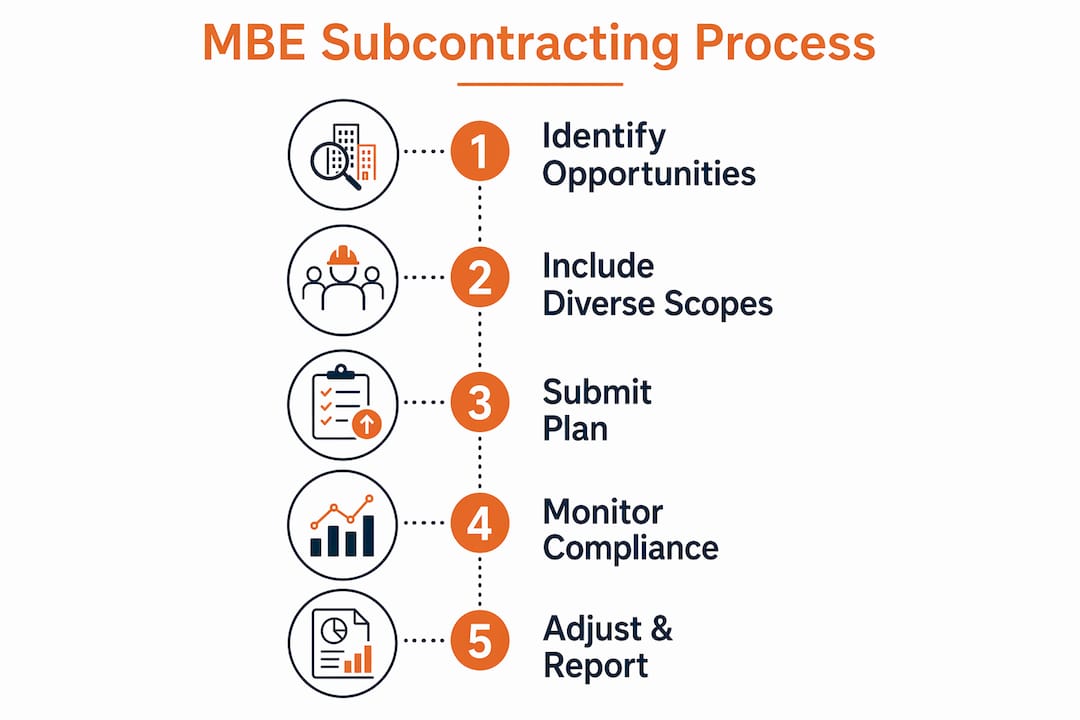
Post-award, compliance monitoring continues. If new subcontracting opportunities arise during construction, or if a listed MBE becomes unavailable, the prime must re-solicit certified firms to backfill participation. MBEs should document their own performance throughout the contract, since agencies audit participation records.
Pro Tip: Request a copy of the prime’s subcontracting plan after award. Knowing exactly what scope and dollar value are committed to your firm protects you if disputes arise during performance.
How to qualify and bid for public project subcontracts
Getting certified is the starting point, but it is not the finish line. Here is how to move from certification to winning work.
- Obtain the right certification first. Apply through your state’s MBE or HUB program for state-funded work, and through the UCP for federally funded projects. The correct government lane determines whether your participation counts toward the prime’s goal.
- Register in every relevant directory. Primes search state UCP directories to identify certified firms. If you are not listed, you are effectively invisible, regardless of your qualifications or track record.
- Search SBA SUBNet actively. The SUBNet platform lists active federal subcontracting opportunities filterable by state and NAICS code. Current listings include water infrastructure projects in California, sewer rehabilitation in Texas, and HVAC work in California, all open to certified subcontractors.
- Build a capability statement. This one-page document should cover your NAICS codes, bonding capacity, past project experience, key personnel, and contact information. Primes under time pressure to meet diversity goals need to verify your qualifications quickly. A clear, well-organized capability statement removes friction from that process.
- Attend pre-bid and matchmaking events. Many agencies hold pre-bid conferences specifically to connect certified MBEs with primes. Indiana’s Department of Administration explicitly lists attending pre-bid meetings as a recognized good faith effort method. Showing up puts your firm in front of decision-makers before the competitive pressure of bid day.
- Contact OSDBU offices directly. Every major federal agency has an Office of Small and Disadvantaged Business Utilization. These offices maintain lists of upcoming contracts and can connect you with prime contractors actively seeking certified subcontractors.
- Verify your NAICS codes match the work. Only the specific products and services for which you are certified in the state directory count toward participation goals. Review your certification listing before responding to any solicitation.
Pro Tip: The SBA recommends that minority-owned businesses start as subcontractors under established primes rather than pursuing prime contracts immediately. Subcontracting builds past performance records, bonding history, and relationships that make future prime bids far more competitive.
Strategic insights to maximize your success in public MBE subcontracting
The MBEs that consistently win subcontract work on public projects share a few practices that go beyond basic certification compliance.
Certify in the right lane, then stay current. Firms certified only through private-sector programs like NMSDC will not count toward public project goals. Once you have the correct state MBE or DBE certification, treat renewal as a business-critical deadline. Keeping certifications current and documents easily verifiable makes your firm more attractive to primes who are working against tight bid timelines.
Participation goals carry real enforcement weight. The City of Chicago mandates that no less than 25% of annual contract value goes to MBEs. Primes who cannot document good faith efforts to meet that goal face bid rejection.
Build relationships with prime contractors between bid cycles, not just during them. Primes maintain ongoing lists of reliable certified trade partners and actively scout certified MBEs for future work. Attending industry association events, reaching out directly to project managers, and following up after matchmaking events all contribute to being on a prime’s short list when the next solicitation drops.
Understand the commercially useful function standard before you pursue larger subcontracts. Agencies verify that MBEs are performing real work with their own workforce and equipment. Pass-through arrangements, where a certified firm takes a fee but does no actual work, are a compliance violation that can result in decertification. Bonding capacity also matters: larger subcontract values require performance and payment bonds, so building your bonding line early expands the opportunities you can pursue.
Check the public paving procurement process for public construction projects to understand how agencies structure MBE goals within bid packages, which helps you anticipate the documentation primes will need from you.
Best practices for proposal writing and competitive bidding
Your proposal to a prime contractor is a sales document and a compliance document at the same time. Both functions matter.
Lead with your certification status and NAICS codes at the top of any written submission. Primes need to confirm your eligibility before they can count your participation toward their goal. Burying that information slows down their review and reduces your chances of being selected under deadline pressure.

Quantify your past performance with specific project types, dollar values, and completion records. A prime evaluating two certified electrical subcontractors will choose the one whose submission shows three completed public school projects at $500,000 each over a generic list of services. Specificity builds confidence. Pair that with references from prior prime contractors who can speak to your reliability and quality.
Match your proposed scope precisely to your certified NAICS codes. If you propose work outside your certification scope, it will not count toward the prime’s participation goal, and the prime may need to find a replacement. Staying within your certified lane protects both parties.
Price competitively, but document your basis of estimate. Primes are not required to accept unreasonable quotes to satisfy participation goals, and agencies review this. A well-documented estimate shows professionalism and makes it easier for the prime to justify your selection in their good faith effort records. For guidance on how primes document MBE subcontractor commitments during the bid process, the construction project controls perspective offers useful context on what primes track internally.
Resources and support services for MBE subcontractors
The support infrastructure for minority-owned businesses pursuing public subcontracts is broader than most firms use.
SBA 8(a) Business Development Program. The 8(a) program limits competition for certain federal contracts to participating businesses and provides access to a Business Opportunity Specialist who helps navigate federal contracting. Eligible firms can also form joint ventures through the SBA Mentor-Protégé Program, pairing with experienced primes to pursue larger contracts while building capacity.
SBA Mentor-Protégé Program. This program connects small businesses with established mentors who provide business development support, technical assistance, and joint venture opportunities. For MBEs new to public construction subcontracting, a mentor relationship can compress years of learning into a single contract cycle.
Minority Business Development Agency (MBDA). The U.S. Department of Commerce operates the MBDA, which serves African American, Asian American, Hispanic American, Native American, and Pacific Islander-owned businesses. MBDA Business Centers provide technical assistance, access to capital connections, and help identifying contract opportunities.
State HUB and OSDBU offices. North Carolina’s Office for Historically Underutilized Businesses, for example, certifies firms and actively informs them of contracting and subcontracting opportunities through the UNC system and other public entities. Most states have equivalent offices with similar functions.
Financial assistance programs. Several states offer bonding assistance programs specifically for MBEs, recognizing that bonding capacity is often the barrier between certification and winning larger subcontracts. The SBA also offers surety bond guarantees through its Surety Bond Guarantee Program, which covers bid, performance, and payment bonds for small and emerging contractors.
Training and technical assistance. Many OSDBU offices and MBDA centers offer free workshops on proposal writing, contract management, and compliance documentation. Taking advantage of these programs before you pursue your first public subcontract reduces costly mistakes during performance.
For hands-on guidance navigating these programs and building a compliant bid package, Federal-rconstructionsolutions offers federal procurement support tailored specifically to minority-owned construction businesses.
Key Takeaways
MBE subcontracting opportunities on public projects are accessible to certified minority-owned businesses that register in official directories, understand participation goal requirements, and build relationships with prime contractors before bid cycles open.
| Point | Details |
|---|---|
| Certification lane determines eligibility | UCP/DBE certification is required for federally funded projects; state MBE programs cover state-funded work. |
| Participation goals are enforceable | Chicago mandates 25% MBE participation; UNC system projects require 10% on contracts from $100,000 to $4,000,000. |
| Directory registration is non-negotiable | Primes search state UCP directories to meet goals; firms not listed are effectively invisible to prime contractors. |
| SBA SUBNet opens federal opportunities | Filter active federal subcontracting listings by state and NAICS code to find current opportunities. |
| Relationships win work between bid cycles | Primes scout certified MBEs continuously, not just during active solicitations. |
FAQ
What is the difference between MBE and DBE certification for public projects?
MBE certification is issued by state or local government programs for state-funded contracts, while DBE (Disadvantaged Business Enterprise) certification is issued through the Unified Certification Program (UCP) for federally funded projects. You need the correct certification type for the funding source of each contract.
How do I find active MBE subcontracting opportunities on public projects?
Search the SBA SUBNet database by state or NAICS code for federal subcontracting opportunities, and check your state agency’s OSDBU website for state-funded project listings. Attending pre-bid conferences and matchmaking events also surfaces opportunities before they are widely advertised.
What happens if a prime contractor cannot meet the MBE participation goal?
The prime must document good faith efforts, including solicitation records, contact logs, and reasons why certified firms were not engaged. Without acceptable documentation, the bid is deemed non-responsive and the prime is ineligible for award.
Does NMSDC certification qualify my firm for public project MBE goals?
No. NMSDC certification is designed for private-sector corporate procurement and does not count toward public project participation goals. You must obtain state MBE or UCP/DBE certification to be counted on publicly funded contracts.
What is a commercially useful function, and why does it matter?
A commercially useful function means your firm is performing real work with its own workforce and equipment, not acting as a pass-through for another firm. Agencies audit this requirement, and pass-through arrangements can result in decertification and contract penalties for both the MBE and the prime.