
Solicitation Matching for Contractors: A 2026 Guide
What does solicitation matching mean for contractors?
Solicitation matching is the automated process of filtering government contract opportunities against your business profile to surface only the leads worth pursuing. Matching systems score opportunities against criteria like NAICS codes, set-aside status, and geographic preference, pulling from the thousands of notices posted on SAM.gov daily. The result is a targeted feed of relevant solicitations instead of an overwhelming list of everything the federal government is buying.
The core matching criteria most systems use include:
- NAICS codes: Your industry classification codes determine which solicitations are relevant to your trade or service.
- Set-aside status: Certifications like 8(a), HUBZone, SDVOSB, or WOSB filter opportunities reserved for specific business categories.
- Geography: Location preferences narrow results to contracts within your service area or state.
- Business size and bonding capacity: These filter out contracts your firm cannot realistically pursue.
SAM.gov is the authoritative source for federal solicitations, but it offers no fit scoring and no prioritization. Solicitation matching tools sit on top of SAM.gov to add that intelligence layer. For construction contractors specifically, this distinction matters because federal construction notices often carry tight response windows, mandatory site visits, and wage determination requirements that make wasted pursuit especially costly.
Common types of government solicitations you will encounter
Understanding solicitation types is not optional background knowledge. It directly shapes how you respond and how matching software scores each opportunity.
1. Request for Proposals (RFP)
An RFP is used when the agency wants a complete solution and will evaluate both technical approach and price. You submit a detailed proposal explaining how you will meet the requirements. Evaluation factors typically include technical capability, past performance, and management plan alongside price. Getting matched to an RFP without the technical depth to respond is a resource drain.
2. Invitation for Bids (IFB)
An IFB, also called an ITB at the state and local level, is a sealed-bid solicitation awarded to the lowest responsive, responsible bidder. Specs are complete, and price is the only evaluation factor once responsiveness is confirmed. Construction contracts above the simplified acquisition threshold frequently use this format. Submitting an RFP-style narrative to an IFB will get your bid ruled non-responsive.
3. Request for Quotes (RFQ)
RFQs are price-focused and typically used for well-defined, smaller purchases under the simplified acquisition threshold. You submit a quote, not a full proposal. Selection is usually based on price and basic qualifications. Solicitation matching tools that flag RFQs separately help you avoid over-investing proposal resources in what is essentially a price check.
4. Sources Sought / Request for Information (RFI)
A Sources Sought notice is market research, not a contract opportunity yet. Agencies use it to gauge small business interest and decide whether to set aside the eventual contract. Responding well here can shape the final solicitation before it is released. Many contractors skip these entirely and lose influence over procurement framing as a result.
How solicitation matching benefits your bid preparation and compliance
The practical payoff of solicitation matching goes well beyond saving time on searches.
- Bid relevance: Matching against your actual NAICS codes and certifications means you are reviewing opportunities your firm can realistically win, not just opportunities that mention your trade.
- Compliance support: Construction solicitations governed by FAR Part 36 require attention to presolicitation notices, mandatory site visits, and wage determinations. Matching tools that flag these requirements early give you time to prepare compliant bids.
- Proposal evaluation intelligence: Knowing whether an opportunity is an RFP or IFB before you commit resources determines your entire response strategy.
- Award probability: Contractors who match early and respond to Sources Sought notices build agency familiarity before the formal solicitation drops, which strengthens competitive positioning.
- Private sector alignment: The same profile-based matching logic applies when you expand into private sector bidding, where alignment with owner requirements and prequalification criteria mirrors the federal process.
Pro Tip: Integrate solicitation matching at the start of your business development cycle, not after you have already spotted an opportunity. Contractors who monitor Sources Sought notices and presolicitations consistently have more lead time to prepare compliant, competitive proposals.
Common solicitation matching mistakes and how to avoid them
Most contractors who struggle with solicitation matching are not making obvious errors. They are making subtle ones that compound over time.
- Relying solely on manual SAM.gov searches: Manual searches miss short-fuse RFPs and Sources Sought notices that post and close within days. Automated matching with daily alerts closes that gap.
- Ignoring Sources Sought responses: Skipping these notices means ceding influence over whether the final contract gets set aside for small businesses. A well-crafted Sources Sought response can shape the solicitation in your favor before it is even released.
- Misreading solicitation types: Submitting the wrong response format is an automatic disqualification. Check the evaluation section of every notice before committing resources.
- Missing wage determinations: Construction bids that ignore Davis-Bacon Act wage rates or fail to account for mandatory site visits can be ruled non-responsive despite competitive pricing.
- Skipping a bid-no-bid filter: Not every match is worth pursuing. Use a bid-no-bid decision framework to evaluate each match against your capacity, past performance, and win probability before investing proposal resources.
Contractors who apply proper solicitation matching and use federal procurement compliance checklists achieve a 90% compliance rate in bid submissions, according to Federal-rconstructionsolutions’ track record with federal construction clients.
Procurement experts consistently note that solicitation matching functions as competitive intelligence, not just a filter. Knowing evaluation criteria, incumbent contract history, and pricing trends from matched opportunities gives you a clearer picture of what it actually takes to win.
Step-by-step process for effective solicitation matching
Follow these steps to build a repeatable solicitation matching process.
Step 1: Build your contractor profile. Document your NAICS codes, set-aside certifications, bonding capacity, geographic service area, and past performance categories. This profile is the foundation every matching system uses to score opportunities.

Step 2: Register and maintain your SAM.gov record. SAM.gov registration is a prerequisite for federal contract eligibility. Keep your entity registration current, including NAICS codes and points of contact, so matching systems pull accurate data.
Step 3: Layer in an AI matching tool. SAM.gov alone provides no fit scoring. Add a matching platform that scores opportunities by NAICS, geography, and set-aside status, and configure daily alerts so short-fuse solicitations do not slip past you.
Step 4: Categorize each match by solicitation type. When a match arrives, identify immediately whether it is an RFP, IFB, RFQ, or Sources Sought. This single step determines your response format, resource commitment, and timeline. Refer to a trade contractor guide if the solicitation type is unfamiliar.
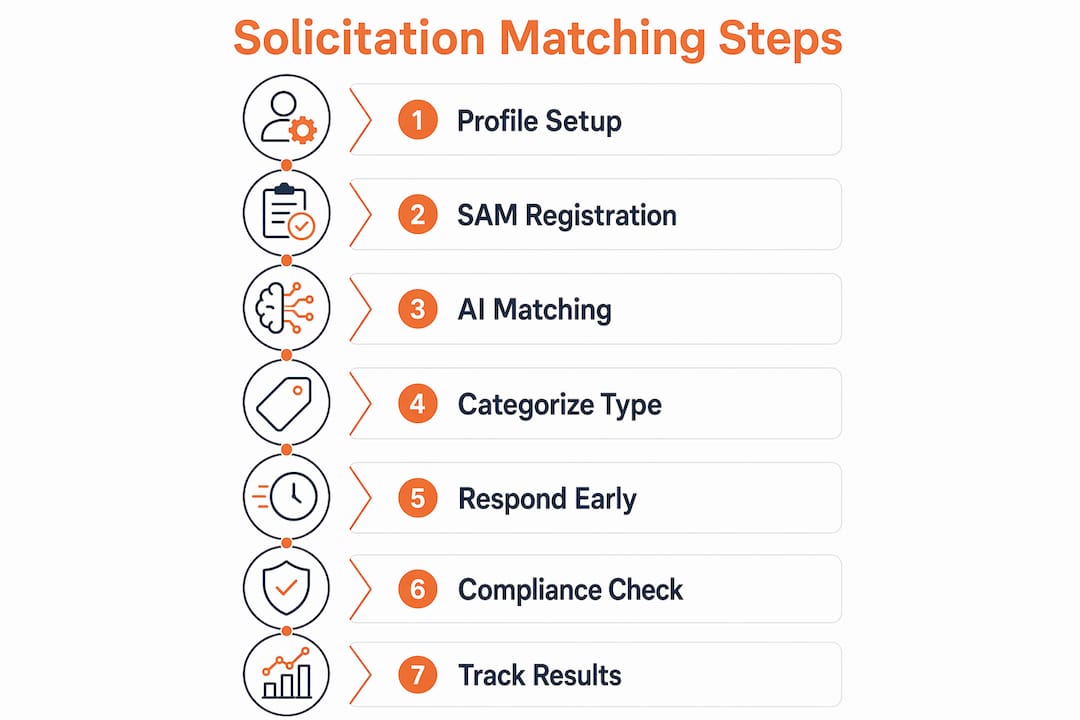
Step 5: Respond to Sources Sought notices. Before the formal solicitation posts, submit a capability statement that demonstrates your qualifications and supports a small business set-aside if applicable. This is your best opportunity to influence procurement framing.
Step 6: Apply a compliance checklist before submitting. Review wage determinations, site visit requirements, bonding documentation, and FAR clause compliance. Contractors who skip this step on construction bids risk non-responsiveness on otherwise competitive proposals. Review common bidding mistakes before finalizing any submission.
Step 7: Track outcomes and refine your profile. After each bid cycle, update your matching profile based on wins, losses, and feedback. Solicitation matching improves over time when your profile accurately reflects your current capabilities and certifications.
How Federal-rconstructionsolutions can support your solicitation strategy
Federal-rconstructionsolutions’ 5551 Pillar program is built specifically for construction contractors navigating federal procurement. From RFP writing and compliance support to federal procurement services that cover the full bid lifecycle, the team helps contractors apply solicitation matching in a way that produces compliant, competitive submissions. The track record includes securing contracts for public water projects and achieving a 90% compliance rate across federal bid submissions.
Key Takeaways
Solicitation matching is the most direct way for contractors to improve bid relevance, compliance, and award probability in federal construction markets.
| Point | Details |
|---|---|
| Matching criteria drive results | NAICS codes, set-aside status, and geography are the core filters that determine which solicitations reach you. |
| SAM.gov needs supplementing | SAM.gov is authoritative but offers no fit scoring; AI matching tools add the prioritization layer contractors need. |
| Solicitation type determines response | RFPs, IFBs, RFQs, and Sources Sought each require a different format; mismatching formats risks non-responsiveness. |
| 90% compliance is achievable | Proper solicitation matching combined with federal procurement compliance checklists supports a 90% compliance rate. |
| Sources Sought responses shape awards | Responding to Sources Sought notices before formal solicitations are posted can influence set-aside decisions in your favor. |
FAQ
What does solicitation mean in construction?
A solicitation is a formal government document requesting bids or proposals for a construction project, detailing requirements, evaluation criteria, and contract terms. Construction solicitations above the simplified acquisition threshold typically require presolicitation notices, site visits, and Davis-Bacon wage determinations.
What is a solicitation in contracting?
A solicitation is any request to submit offers or quotations to the government, including invitations for bids, requests for proposals, and requests for quotes. Each type uses a different evaluation method and requires a different contractor response format.
What are the three types of solicitation?
Federal procurement recognizes four primary types: RFP (negotiated, best-value evaluation), IFB (sealed bid, lowest price wins), RFQ (price quote for defined items), and Sources Sought or RFI (market research, no award). Construction contracts most commonly use IFBs and RFPs.
Does soliciting mean asking for money?
In government contracting, soliciting means formally requesting offers or proposals from contractors, not requesting money. The government is the buyer; the solicitation is its request for contractors to submit bids or proposals for work it intends to fund.