
WBE vs WOSB Designation Explained for Small Businesses
WOSB opens the door to federal set-aside contracts. WBE (WBENC) is the credential Fortune 500 supplier diversity programs recognize. If your primary buyers are federal agencies, pursue WOSB certification through the U.S. Small Business Administration. If your pipeline runs through corporate procurement, WBENC certification is the higher-impact first step.
The short decision rule:
- Federal contracting set-asides → WOSB or EDWOSB (SBA program)
- Corporate supplier diversity / Fortune 500 buyers → WBE via WBENC
Many firms eventually pursue both. The most efficient path is to complete your WBENC application first, then use that documentation to support your SBA WOSB application, since WBENC serves as an SBA-approved third-party certifier for the federal program.
Table of Contents
- What is WBE and WBENC certification?
- What are WOSB and EDWOSB, and how does the SBA program work?
- How do WBE and WOSB compare side by side?
- Which designation should your business pursue?
- How to apply for WBE (WBENC) and WOSB step by step
- Maintenance, compliance, and common pitfalls
- How to check whether your NAICS codes qualify for WOSB set-asides
- When does hiring a procurement consultant make sense?
- Key Takeaways
- Why the buyer-first framing changes everything for women-owned firms
- R. Construction Solutions supports your certification and bid readiness
- Authoritative sources and next steps
- FAQ
What is WBE and WBENC certification?
The Women’s Business Enterprise (WBE) designation is a private-sector credential issued by the Women’s Business Enterprise National Council (WBENC), a nonprofit organization, through a network of regional partner organizations across the country. It is not a government program. Corporate supplier diversity managers at major companies use WBENC certification to verify that a vendor is genuinely women-owned before awarding contracts or meeting supplier diversity spend goals.
Eligibility basics
WBENC requires that a woman or women own a majority share of the business and exercise day-to-day management and control. Critically, WBENC does not impose an SBA small-business size cap, so larger women-owned firms that have grown past federal size standards can still qualify. Citizenship is not a formal WBENC requirement, though individual regional partners may ask for documentation.
Benefits for private-sector contracting
A WBENC certification gives you access to corporate matchmaking events, supplier diversity databases used by procurement teams at major corporations, and the WBENC national conference network. Many Fortune 500 companies will not count a vendor toward their supplier diversity spend without a recognized third-party certification, and WBENC is the most widely accepted credential in that space.
The application process
You apply through a WBENC regional partner organization, not directly through WBENC national. The process includes a document review and an on-site visit to confirm that the woman owner genuinely controls the business. Fees vary by regional partner and business revenue, but typically range from a few hundred dollars for micro-businesses to over a thousand dollars for larger firms. Recertification is required annually, and a site visit may be triggered if your business structure changes.
Pro Tip: If your corporate sales pipeline is already active and you have Fortune 500 targets in mind, pursue WBENC first. Once certified, you can use your WBENC documentation to support your SBA WOSB application, since WBENC is an SBA-approved third-party certifier. This approach cuts total paperwork significantly.
What are WOSB and EDWOSB, and how does the SBA program work?
The Women-Owned Small Business (WOSB) Federal Contracting Program is administered by the U.S. Small Business Administration and gives eligible firms access to federal set-aside contracts in industries where women are underrepresented. A set-aside means the contracting officer restricts competition to a specific category of business, so you are not competing against large firms for that award. The program also includes a subset designation: Economically Disadvantaged Women-Owned Small Business (EDWOSB), which carries additional set-aside access in more restricted NAICS categories.
Eligibility checklist
To qualify as a WOSB, your business must meet all of the following under 13 CFR Part 127:
- Qualify as a small business under SBA size standards for your primary NAICS code (see 13 CFR Part 121)
- No active exclusions in the System for Award Management (SAM.gov)
For EDWOSB, the qualifying woman owner must also meet financial thresholds for personal net worth, adjusted gross income averaged over three years, and total personal assets, with retirement accounts excluded from net worth calculations.
Key regulatory note: The Federal Register rulemaking published May 11, 2020 updated WOSB certification procedures following congressional changes, requiring all firms to obtain SBA-issued or SBA-recognized certification before competing for set-asides. Self-certification is no longer accepted.
Program benefits
WOSB certification makes your firm eligible to compete for federal contracts set aside specifically for women-owned small businesses in eligible NAICS industries. EDWOSB status opens additional set-asides in industries where women are substantially underrepresented. These designations can also complement other socio-economic programs: a firm holding both WOSB and 8(a) certification, for example, can compete across multiple set-aside categories. Federal set-aside categories in construction explain how these programs interact for contractors specifically.
Certification routes and timeline
All WOSB applicants must apply through MySBA Certifications. You can apply directly through SBA or submit documentation from an SBA-approved third-party certifier (including WBENC). The review process typically takes 90 days, though complex ownership structures or incomplete documentation can extend that timeline. Annual attestations are required, and SBA conducts program examinations every three years.
Pro Tip: Before you start your WOSB application, confirm that your primary NAICS codes appear on the SBA’s eligible NAICS list. A WOSB certification does not give you set-aside access across all federal contracts — only in the NAICS codes the SBA has designated as eligible.
How do WBE and WOSB compare side by side?
The table below maps the key dimensions for a small women-owned business deciding between the two designations.
| Dimension | WBE (WBENC) | WOSB / EDWOSB (SBA) |
|---|---|---|
| Where it applies | Private sector: corporate supplier diversity, Fortune 500 procurement | Federal government: set-aside contracts in eligible NAICS industries |
| Ownership requirement | 51% woman-owned and controlled | 51% owned and controlled by U.S. citizen women |
| Citizenship requirement | Not formally required by WBENC | Required: U.S. citizen women only |
| Size standard | No SBA size cap | Must qualify as small under SBA size standards (NAICS-specific) |
| Primary benefit | Access to corporate supplier diversity programs and matchmaking events | Eligibility for federal WOSB/EDWOSB set-aside contracts |
| Certification path | Apply through WBENC regional partner; site visit required | Apply via MySBA Certifications; SBA direct or third-party certifier |
| Estimated cost | Varies by regional partner and revenue; typically a few hundred dollars | SBA direct certification: no fee; third-party certifier fees vary |
| NAICS restrictions | None | Set-asides limited to SBA-designated eligible NAICS industries |
| Renewal cadence | Annual recertification | Annual attestation; program examination every three years |
A few practical notes on what this table means for your decision. The citizenship requirement is a hard stop for WOSB: if the majority woman owner is not a U.S. citizen, WOSB is not available, though WBENC certification may still be accessible. The NAICS restriction for WOSB is the most commonly overlooked factor — your certification is valid, but your set-aside eligibility depends entirely on whether your primary NAICS code appears on the SBA’s eligible list. And while SBA direct certification carries no application fee, the time cost of document preparation is real regardless of which route you take.
Which designation should your business pursue?
Work through these questions in order before you apply for either credential.
- Are your primary NAICS codes on the SBA eligible list? Use the SBA’s WOSB eligibility checker for a preliminary confirmation. If your codes are not listed, WOSB set-asides will not apply to your work even after certification.
- Do you meet SBA size standards? — Check your primary NAICS code against SBA size standards. A firm that has grown past the size threshold for its NAICS code cannot hold WOSB certification, though it may still qualify for WBENC.
- Is your SAM.gov registration current? Federal contracting requires an active SAM registration with no exclusions. If you are not yet registered, that step comes before any WOSB application. See the government bid eligibility guide for small contractors for a SAM registration walkthrough.
Pursuing both certifications at once is rational when you have active leads in both channels. When resources are limited, sequence by near-term revenue: WBENC first if corporate sales are imminent, WOSB first if you have a federal opportunity in your pipeline. Firms that start with WBENC and use that documentation for their SBA application avoid duplicating the document-gathering effort.
How to apply for WBE (WBENC) and WOSB step by step
Applying for SBA WOSB certification
- Register or renew in SAM.gov — An active SAM registration with no exclusions is a prerequisite. SAM renewals can take 1–2 weeks; new registrations may take longer.
- Run the eligibility check. Use the SBA’s eligibility resource to confirm your NAICS codes and ownership structure meet program requirements before investing time in the full application.
- Create your account in MySBA Certifications. All WOSB applications are submitted through MySBA Certifications. If you are using a third-party certifier such as WBENC, you will still need to upload that certification documentation here.
- Submit and monitor your application — SBA reviewers may request additional documentation. Respond promptly to avoid delays. The standard review period is approximately 90 days.
Common delays: Incomplete ownership documentation for multi-member LLCs, SAM registration lapses, and missing citizenship proof are the three most frequent causes of application hold-ups. Gather all documents before you open the application portal.
Maintenance, compliance, and common pitfalls
Certification is not a one-time event. Both programs carry ongoing requirements that, if missed, can put your eligibility at risk.
WOSB annual and triennial requirements
- Annual attestation: — You must confirm each year that your firm still meets all WOSB eligibility criteria. Missing this attestation can result in decertification.
- Three-year program examination: — SBA conducts a more thorough review of your documentation every three years. Firms that have not kept their ownership records current often face delays or findings during these examinations.
WBENC recertification
WBENC requires annual recertification. A site visit may be triggered if your business address, ownership structure, or key personnel change. Notify your regional partner proactively when changes occur rather than waiting for the renewal cycle.
SAM.gov and exclusions
Under 13 CFR Part 127, active exclusions in SAM.gov disqualify a firm from WOSB certification and from competing for set-aside awards. SAM registrations expire annually. Set a calendar reminder 60 days before your SAM expiration date so the renewal processes before the deadline.
How to check whether your NAICS codes qualify for WOSB set-asides
WOSB set-asides apply only in NAICS industries the SBA has designated as eligible, based on research showing that women-owned firms are underrepresented or substantially underrepresented in those sectors. A WOSB certification is valid regardless of your NAICS code, but your ability to compete for set-aside contracts depends entirely on whether your primary NAICS codes appear on the SBA’s eligible list.
Step-by-step NAICS eligibility check
- Identify your primary NAICS code — Your primary NAICS code is the one that best describes your largest revenue-generating activity. It appears in your SAM.gov registration.
- Download the SBA’s eligible NAICS list — The SBA maintains a support document listing eligible NAICS codes for the WOSB Federal Contracting Program. Download the current version directly from SBA.gov.
- Cross-reference your codes — Check each of your active NAICS codes against the list. If your primary code is not listed, WOSB set-asides will not apply to your core work, though you may still hold certification and benefit from it in secondary NAICS categories that are listed.
Regulatory grounding: The WOSB Federal Contracting Program’s eligibility rules, including the NAICS-based set-aside structure, are governed by 13 CFR Part 127. The 2020 Federal Register rulemaking updated certification procedures following congressional changes to the program. Always verify current eligibility against the live eCFR text and the SBA’s current eligible NAICS document, not third-party summaries.
If your primary NAICS code is not on the eligible list, consider whether a secondary NAICS code that is listed represents a realistic service line for your business. Some construction firms, for example, hold multiple NAICS codes across trades and can compete for WOSB set-asides in the eligible categories even when their primary code falls outside the list.
When does hiring a procurement consultant make sense?
Certification paperwork is manageable for most owners. Where consultants add the most value is in the work that comes after certification: identifying the right opportunities, preparing competitive bids, and staying compliant through contract performance.

Situations where expert help accelerates results
Aligning your NAICS codes with the right set-aside categories, particularly when you hold multiple codes across construction trades, requires familiarity with how contracting officers structure solicitations. A consultant who works in federal construction procurement daily will spot misalignments that cost you bid eligibility before you invest time in a proposal.
For construction firms, FAR compliance, Davis-Bacon Act wage determinations, and certified payroll requirements add a layer of complexity that goes well beyond the certification itself. Firms that win their first federal set-aside contract and then struggle with certified payroll or prevailing wage compliance risk contract termination and debarment, which would end their federal contracting eligibility entirely.
Services to expect from a qualified consultant
- SAM.gov registration and renewal support
- WOSB and WBENC application document preparation
- WOSB Program Repository setup and maintenance
- Opportunity identification and NAICS alignment review
- RFP writing and bid preparation
- Post-award compliance: certified payroll, Davis-Bacon, FAR documentation
- Subcontractor network sourcing
Federal-rconstructionsolutions offers all of these services with a specific focus on construction firms. The federal procurement consulting services page outlines current engagement options, from project-based bid support to ongoing compliance retainers.
What to prepare before your first consultant call
Gather your current SAM.gov registration status, your primary and secondary NAICS codes, two to three years of federal tax returns, your ownership documents (operating agreement or articles of incorporation), and a short list of the federal or corporate buyers you are targeting. A consultant can give you an accurate scope and timeline estimate in a single call when you arrive with these documents ready.
Pro Tip: Ask any consultant you are evaluating to name the specific NAICS codes they have helped clients win set-aside awards under. A consultant with direct experience in your NAICS category will know the common pitfalls in that sector’s solicitations, not just the general certification process.
Key Takeaways
WOSB certification opens federal set-aside contracts in eligible NAICS industries; WBE (WBENC) is the credential corporate supplier diversity programs recognize, and many firms benefit from pursuing both using a single documentation package.
| Point | Details |
|---|---|
| WOSB = federal set-asides | WOSB certification gives access to SBA set-aside contracts, but only in eligible NAICS industries. |
| WBE (WBENC) = corporate access | WBENC certification is the credential Fortune 500 supplier diversity programs require; no SBA size cap applies. |
| EDWOSB financial thresholds | Personal net worth under $850,000, adjusted gross income under $400,000, and personal assets under $6.5 million qualify you for EDWOSB. |
| Sequence by buyer priority | Pursue WBENC first for corporate pipelines; WOSB first when a federal opportunity is active; use WBENC docs to support the SBA application. |
| Federal-rconstructionsolutions | Offers SAM registration, WOSB/WBENC application support, RFP writing, and Davis-Bacon compliance for construction firms pursuing both federal and corporate contracts. |
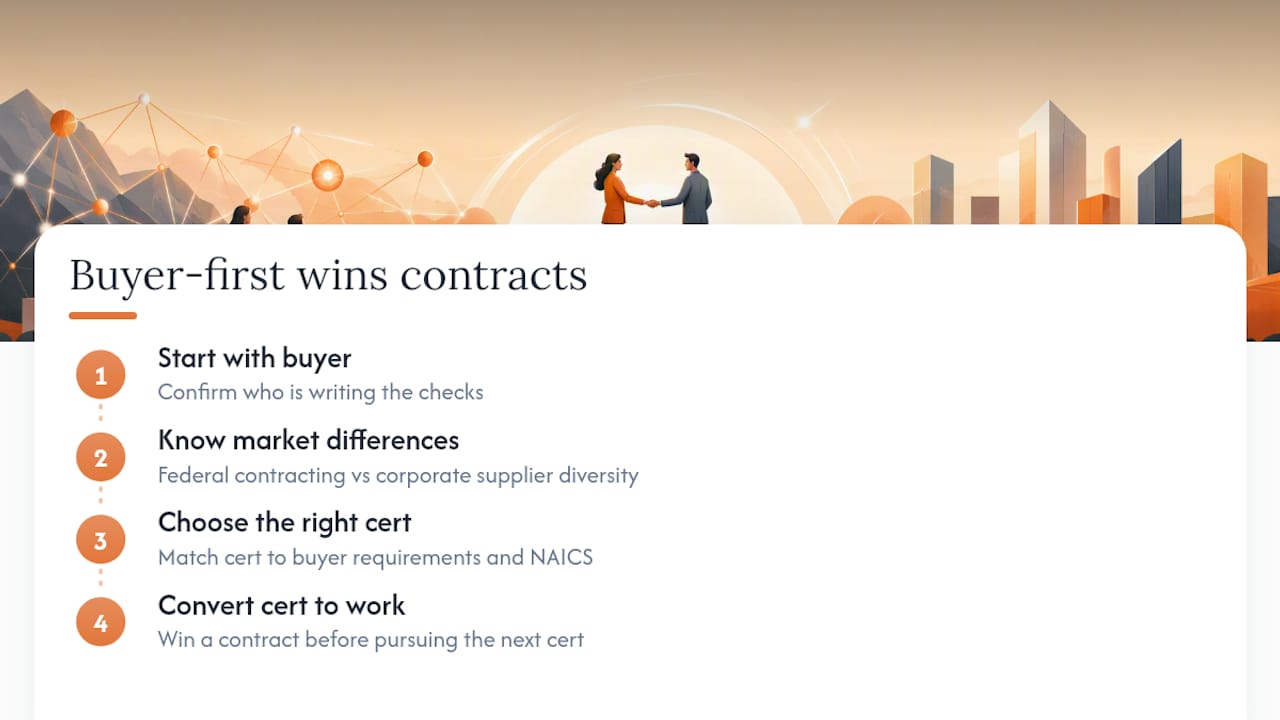
Why the buyer-first framing changes everything for women-owned firms
Most certification guides lead with eligibility checklists. That framing sends owners down a paperwork path before they have confirmed that the certification will actually open doors with the buyers they are already pursuing. The more useful question is always: who is writing the checks you want to cash?
Federal contracting and corporate supplier diversity are genuinely different markets with different procurement cycles, different compliance requirements, and different relationship dynamics. A small construction firm that earns WOSB certification and then discovers its primary NAICS code is not on the SBA eligible list has spent months on paperwork without gaining set-aside access. A firm that earns WBENC certification to satisfy a Fortune 500 supplier diversity requirement, then uses that same documentation to obtain SBA recognition, has covered both markets with roughly the same effort.
The firms that grow fastest in this space are not the ones with the most certifications. They are the ones that matched their first certification to their nearest revenue opportunity, executed the application cleanly, and used that credential to win a contract before pursuing the next one. That sequencing discipline, buyer first, then certification, then bid, is what separates firms that collect credentials from firms that build revenue with them.
R. Construction Solutions supports your certification and bid readiness
Certification paperwork is the starting line, not the finish. The real work is converting that credential into awarded contracts, and that requires knowing which opportunities to pursue, how to write a competitive proposal, and how to stay compliant through performance.
Federal-rconstructionsolutions helps small women-owned construction firms move from certification to contract award. The federal procurement consulting services cover SAM.gov registration, WOSB and WBENC application support, NAICS alignment review, RFP writing, and post-award compliance including certified payroll and Davis-Bacon documentation. For firms targeting corporate supplier diversity buyers, the private sector growth services address WBENC application support and corporate pipeline development. To get an accurate scope and timeline, gather your ownership documents, NAICS codes, and SAM registration status, then schedule an initial consultation through the federal procurement services page.
Authoritative sources and next steps
Use these official resources to verify eligibility, start your application, and read the governing regulations:
- Certifications - Small Business Administration
- MySBA Certifications
- eCFR — Title 13 Part 127
- Women-Owned Small Business and Economically Disadvantaged Women-Owned Small Business certification — Federal Register (May 11, 2020)
- WBENC WBE vs SBA WOSB: corporate credential vs federal set-aside | SupplierDiversity.com
- Code of Federal Regulations — 13 CFR Part 127 (govinfo PDF)
- Support document: eligible NAICS for WOSB federal contracting program — SBA
- WOSB: Am I eligible? — wosb.certify.sba.gov
Check your SAM.gov registration status and the SBA eligible NAICS list before any other step. Both are free, take under 30 minutes, and will tell you immediately whether your business is positioned to use WOSB set-asides.
FAQ
What is the difference between WBE and WOSB certification?
WBE (issued by WBENC) is a private-sector credential used by corporate supplier diversity programs, while WOSB is a federal government program administered by the SBA that gives eligible firms access to set-aside contracts in designated NAICS industries.
Is WOSB certification worth it for a small construction firm?
Yes, if your primary NAICS codes appear on the SBA’s eligible industries list and you are actively bidding on federal contracts. WOSB set-asides reduce competition significantly by restricting awards to qualifying women-owned small businesses in those industries.
What qualifies a business as a WOSB?
The business must be at least 51% owned and controlled by one or more U.S. citizen women, qualify as small under SBA size standards for its primary NAICS code, and have no active exclusions in SAM.gov, as defined under 13 CFR Part 127.
Are WBE and MBE the same certification?
No. WBE certifies women-owned businesses; MBE (Minority Business Enterprise) certifies minority-owned businesses. They are separate credentials issued by different organizations, though both are used by corporate supplier diversity programs and can be held simultaneously.
Can WBENC certification substitute for WOSB when bidding on federal contracts?
No. Federal WOSB set-aside contracts require SBA-issued or SBA-recognized certification submitted through MySBA Certifications. WBENC can serve as an SBA-approved third-party certifier, but you must still upload that documentation to the SBA portal before competing for federal set-asides.