
What Does PWS Mean in a Federal RFP? 2026 Guide
A Performance Work Statement (PWS) is a federal RFP document that specifies required outcomes and measurable performance standards for a contract without prescribing how contractors must achieve them. If you are bidding on federal construction contracts, understanding what does PWS mean in a federal RFP is not optional. It is the foundation of how the government evaluates your proposal and monitors your performance throughout the contract period.
The PWS operates under FAR Subpart 37.6, which directs agencies to prioritize performance-based acquisition documents over prescriptive methods. That regulatory mandate means PWS-based solicitations are common across federal service and construction contracts. Contractors who read the PWS correctly write stronger proposals and avoid costly performance surprises.
What does PWS mean in a federal RFP, and how does it differ from SOW and SOO?
A PWS focuses on what outcomes must be achieved, not how the work gets done. That single distinction separates it from two other common solicitation documents: the Statement of Work (SOW) and the Statement of Objectives (SOO).
The SOW prescribes specific tasks, methods, and procedures. The government tells you exactly how to perform the work. The PWS, by contrast, shifts responsibility for results to the contractor by defining performance metrics like response times, completion rates, and quality thresholds. You decide the method. The government measures the outcome.
The SOO sits at the other end of the spectrum. It provides top-level goals and allows contractors to develop their own PWS in response, giving maximum flexibility when the agency wants to evaluate diverse approaches. Agencies use the SOO when they want to see how different contractors would solve the same problem.
Here is how the three documents compare at a glance:
| Document | Government specifies | Contractor specifies | Best used when |
|---|---|---|---|
| SOW | Tasks and methods | Nothing | Work is well-defined and repetitive |
| PWS | Outcomes and metrics | Methods and approach | Performance can be measured objectively |
| SOO | High-level objectives | PWS and methods | Agency wants diverse contractor solutions |
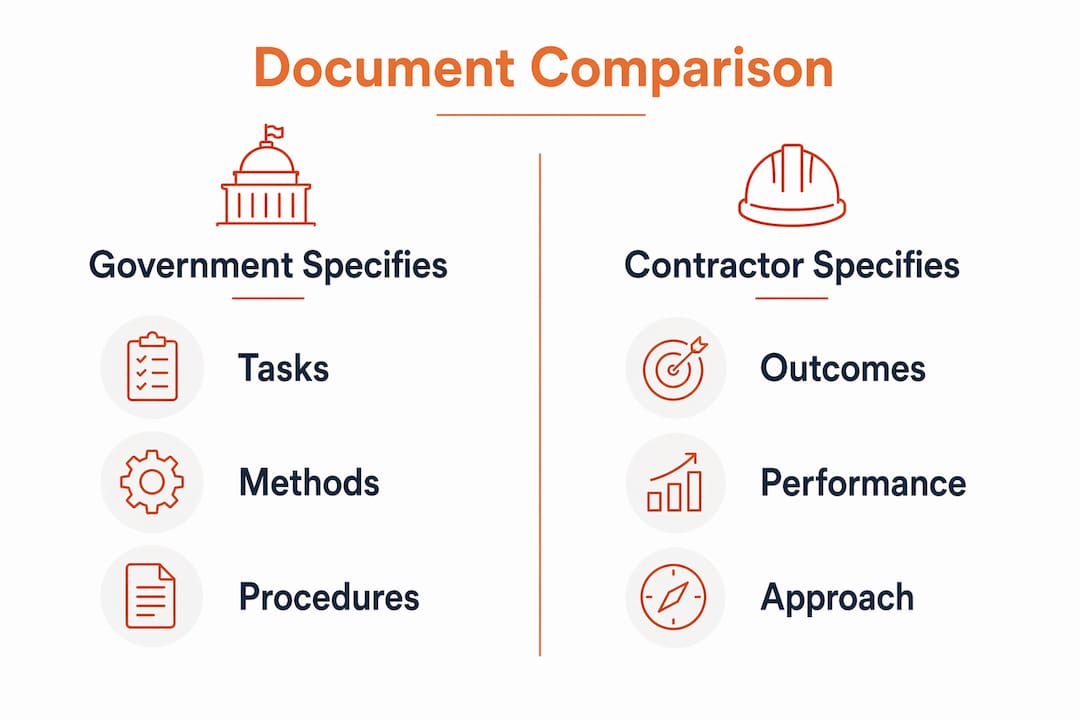
The FAR preference for PWS exists because outcome-focused contracts encourage contractor innovation and cost-efficiency. Agencies are not locked into one method, and contractors who find better ways to meet standards can do so without seeking contract modifications.
Key characteristics of a PWS include:
- Measurable performance standards (completion rates, defect rates, response times)
- Defined acceptable quality levels for each deliverable
- Clear periods of performance and reporting requirements
- Reference to a Quality Assurance Surveillance Plan (QASP) for monitoring
How does a PWS affect contractor responsibilities and proposal development?
A PWS gives you flexibility in method but holds you strictly accountable for outcomes. That is a meaningful distinction. You cannot blame the government for a poor result by saying “we followed the instructions.” Under a PWS, your method is your responsibility.

The Quality Assurance Surveillance Plan (QASP) is the enforcement mechanism. The QASP defines exactly how the agency will measure your performance, what thresholds trigger a deficiency notice, and what deductions apply to your payments if you fall short. Ignoring the QASP during proposal development is one of the most common and costly mistakes contractors make.
Your proposal must directly address the performance standards in the PWS. Evaluators look for evidence that you understand the metrics and have a credible plan to meet them. Vague promises of quality do not score well. Specific methods tied to specific outcomes do.
Strong proposals under a PWS typically include:
- A technical approach that maps your methods to each PWS performance standard
- A quality control plan that mirrors the QASP’s surveillance methods
- Past performance examples where you met or exceeded similar outcome-based requirements
- A risk mitigation section that explains how you will handle performance shortfalls before they become deductions
Pro Tip: Cross-reference every PWS performance standard with the corresponding QASP measure before you write a single word of your technical volume. If the QASP says the agency will inspect 10% of deliverables monthly, your quality control plan must address that exact inspection frequency.
Your past performance record carries significant weight in PWS-based evaluations. Agencies want evidence that you have delivered measurable outcomes before, not just that you completed tasks. Frame your past projects around results: on-time delivery rates, defect rates, and client satisfaction scores.
What evaluation criteria do federal agencies use for PWS-based RFPs?
Agencies evaluate PWS-based proposals on how well your proposed methods demonstrate the ability to meet performance standards, not just whether you agree to the terms. Agreeing to perform is the floor, not the ceiling.
Best-value procurements reward contractors who explain how their approach reduces risk or increases efficiency beyond the baseline PWS requirements. That means the winning proposal is rarely the one that simply promises compliance. It is the one that shows a credible, specific method for exceeding the minimum standards.
Federal agencies typically evaluate PWS-based proposals using these criteria:
- Technical approach. Does your methodology clearly explain how you will achieve each PWS outcome? Evaluators score specificity and credibility, not general statements.
- Quality control plan. Does your plan align with the QASP’s surveillance methods? Gaps between your plan and the QASP signal risk to evaluators.
- Past performance. Have you delivered comparable outcomes on similar contracts? Agencies check references and past performance databases.
- Price or cost. Is your price realistic given the performance standards? Unrealistically low bids raise red flags about your ability to sustain quality.
- Management approach. Who leads the work, and how will you manage performance issues before they escalate?
Pro Tip: Read the PWS as the evaluator’s scorecard. Every performance standard in the PWS is a potential evaluation criterion. If the PWS requires 95% on-time delivery, your proposal should explain exactly how your scheduling and tracking systems achieve that number.
The PWS is the RFP’s critical section because it sets the criteria evaluators focus on to award contracts. Treat every line of the PWS as a question the evaluator is asking: “How will this contractor achieve this outcome?”
Practical strategies for contractors to succeed with PWS in federal RFPs
Reading the PWS once is not enough. Successful contractors read it multiple times, annotate every performance standard, and build a compliance matrix before writing their proposal. A compliance matrix maps each PWS requirement to the section of your proposal that addresses it. That tool alone prevents the most common proposal failure: leaving a requirement unanswered.
Avoid treating a PWS like a traditional SOW. Contractors who respond to a PWS by listing tasks and activities miss the point entirely. The government does not care about your task list. It cares about your outcomes. Reframe every section of your technical volume around results, not activities.
Practical strategies that improve your win rate on PWS-based contracts:
- Build a compliance matrix. List every PWS performance standard in a spreadsheet and map it to your proposal section. No standard should go unaddressed.
- Mirror the QASP language. Use the same performance metrics and thresholds in your quality control plan that the QASP uses for surveillance. That alignment signals to evaluators that you understand how you will be monitored.
- Quantify your past performance. Replace “we completed the project on time” with “we achieved 98% on-time delivery across 14 task orders.” Numbers are credible. Adjectives are not.
- Propose a risk mitigation plan. Identify the two or three performance standards where failure is most likely and explain your contingency approach. Evaluators reward contractors who anticipate problems.
- Check your technical writing quality. Unclear writing in a technical volume signals unclear thinking. Evaluators cannot give credit for a plan they cannot understand.
Pro Tip: Many agencies embed prescriptive language inside a PWS document even though the format is supposed to be outcome-focused. When you spot a prescriptive requirement buried in a PWS, treat it as a hard compliance requirement. Failing to follow it can disqualify your proposal regardless of how strong your technical approach is.
Understanding RFP response sections helps you structure your proposal so evaluators can find your answers quickly. A well-organized proposal reduces the risk that a strong technical approach gets missed during evaluation. Contractors pursuing federal contracting opportunities in regulated trades should also verify that their licensing aligns with the performance standards the PWS requires before submitting a bid.
Key Takeaways
A PWS defines required outcomes and performance metrics, making it the single most important document in any federal RFP for service or construction contracts.
| Point | Details |
|---|---|
| PWS defines outcomes, not methods | Contractors choose their approach but are held strictly to measurable performance standards. |
| QASP is the enforcement tool | Cross-reference the QASP with the PWS before writing your proposal to avoid payment deductions. |
| Proposals must map to PWS standards | Use a compliance matrix to address every performance requirement in your technical volume. |
| Past performance must show results | Quantify outcomes from prior contracts rather than listing tasks or activities. |
| Best-value wins go beyond compliance | Proposals that explain how they reduce risk or exceed minimums score higher than those that simply agree to terms. |
What I have learned from watching contractors misread the PWS
By Rowena
The most persistent mistake I see contractors make is treating the PWS as a checklist to agree with rather than a performance contract to respond to. They write proposals that say “we will comply with all PWS requirements” and then wonder why they lost to a smaller firm with less experience.
The PWS is not asking for your agreement. It is asking for your plan. The government already knows you intend to comply. What evaluators want to know is how you will achieve a 95% completion rate when the project involves three subcontractors, two inspection phases, and a six-week weather window. That specificity is what wins contracts.
I have also seen contractors skip the QASP entirely during proposal development, only to discover during performance that a metric they thought was minor triggers a 5% payment deduction every month they miss it. Reading the QASP before you bid is not extra work. It is the work. The contractors who treat the QASP as a performance roadmap rather than a post-award surprise consistently outperform those who do not.
One more thing: the PWS is not total contractor freedom. It sets strict outcome expectations with real enforcement consequences. Contractors who interpret flexibility as looseness get caught short during surveillance reviews. Flexibility means you choose the method. It does not mean the standards are negotiable.
— Rowena
How Federal-rconstructionsolutions helps you respond to PWS-based bids
Federal-rconstructionsolutions works with construction contractors and small business owners who need to respond to PWS-based federal RFPs with confidence. The team behind the RCS 5551 Pillar understands how agencies evaluate performance-based proposals and helps clients build technical volumes that directly address PWS standards and QASP requirements.

Federal-rconstructionsolutions has supported clients in achieving 90% compliance rates on federal bid submissions, including public water infrastructure contracts where performance metrics are tightly monitored. Whether you are preparing your first PWS response or refining a proposal strategy for a recompete, the team provides the procurement expertise to strengthen your submission and reduce your compliance risk.
FAQ
What does PWS stand for in a federal RFP?
PWS stands for Performance Work Statement. It is a solicitation document that defines the required outcomes and measurable performance standards for a federal contract without specifying how the contractor must perform the work.
How is a PWS different from a SOW?
A Statement of Work (SOW) prescribes specific tasks and methods, while a PWS specifies outcomes and performance metrics. Under a PWS, the contractor decides the method; under a SOW, the government defines it.
What is a QASP and why does it matter?
A Quality Assurance Surveillance Plan (QASP) defines how the agency will monitor contractor performance against PWS standards. It specifies inspection methods, performance thresholds, and the deductions that apply when a contractor misses a metric.
Can a contractor propose its own methods under a PWS?
Yes. A PWS gives contractors full flexibility to determine how they will achieve the required outcomes. The government evaluates whether your proposed methods are credible and sufficient to meet the performance standards, not whether they match a prescribed approach.
What is the difference between a PWS and a SOO?
A Statement of Objectives (SOO) provides high-level agency goals and asks contractors to develop their own PWS in response. A PWS is the government-written document that already defines specific performance standards. The SOO offers more flexibility; the PWS sets the performance framework directly.