Pass GSAM/FAR Review: Schedule of Values for Federal Projects
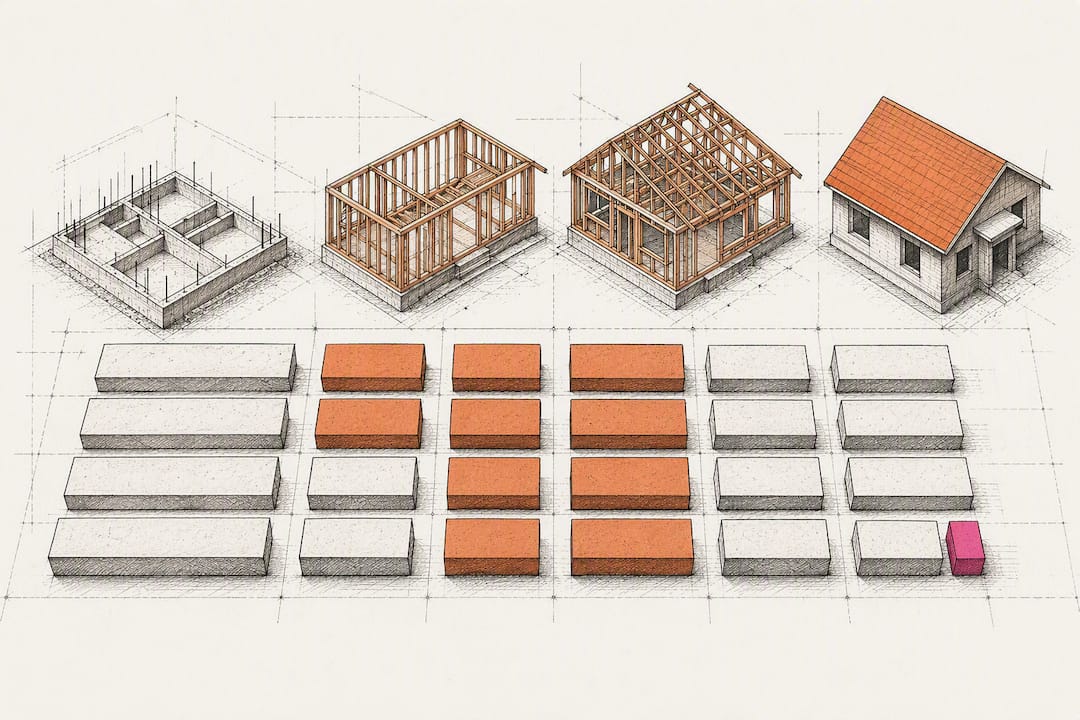
A Schedule of Values (SOV) is the cost breakdown that turns your contract sum into line items an agency can pay against, month by month. On public projects, its core job is reconciling progress payments against open-book accounting records. The single most important action: submit an SOV that matches your contract total exactly and ties directly to your construction schedule before your first pay application goes anywhere.
TL;DR:
- The SOV must match the contract sum exactly, with all line items tied to specific schedule activities and including direct, indirect, and bond costs.
- The SOV needs to be approved before the first pay application, typically within 14 days of Notice to Proceed, and regularly reconciled monthly against open-book records.
- Proper mapping of each line item to schedule activities is crucial for audit traceability and to avoid delays or rejections during submission.
- Front-loaded SOVs that inflate early activity values risk rejection, delays, and disputes, making conservative, well-documented valuations essential.
- Using the same cost accounting software for building the SOV improves accuracy, reduces reconciliation efforts, and ensures compliance.
Table of Contents
- What Is a Schedule of Values on Public Construction Projects?
- What Do GSAM and FAR Clause 552.236-15 Require?
- How Do You Build an SOV for a Public Project?
- What Does an SOV Template Look Like in Practice?
- How Do You Manage the SOV Through Monthly Reconciliation and Change Orders?
- Who Approves the SOV and How Long Does It Take?
- What Are the Biggest SOV Mistakes on Public Contracts?
- What Should Be on Your Practical SOV Checklist?
- Where to Find Primary SOV Guidance and Templates
- Get the SOV Right the First Time, Every Time
- Sources
- FAQ
What Is a Schedule of Values on Public Construction Projects?
An SOV breaks your contract price into line items covering labor, materials, equipment, and overhead for each major activity. On federal and state jobs, this document is not optional paperwork. It’s the mechanism the Contracting Officer uses to verify that what you’re billing matches what you’ve actually built.
The SOV differs from your Statement of Work (SOW) and construction schedule, though all three connect. The SOW describes what you’re contractually obligated to deliver. The schedule tells the agency when. The SOV puts a dollar figure against each piece so progress payments can be calculated as work happens. Miss that connection and you invite disputes at every pay application.
Every SOV line item needs a value, and the sum of every line must equal the total contract price, no exceptions. That total should include:
- Direct costs (labor, materials, equipment specific to each activity)
- Indirect costs (general conditions, supervision, insurance)
- Bond costs, which many agencies require you to list as a separate line rather than folding into overhead
Most SOV formats include five working columns: scheduled value, percent complete, cumulative billed to date, current period billing, and remaining balance. A sixth column, retainage withheld, tracks the percentage the agency holds back until substantial completion. If your SOV skips any of these, expect your pay application to bounce back with questions instead of a check.
What Do GSAM and FAR Clause 552.236-15 Require?
Federal construction contracts don’t leave SOV requirements to interpretation. Two regulatory sources govern how you prepare, submit, and maintain this document, and both carry real teeth if ignored.
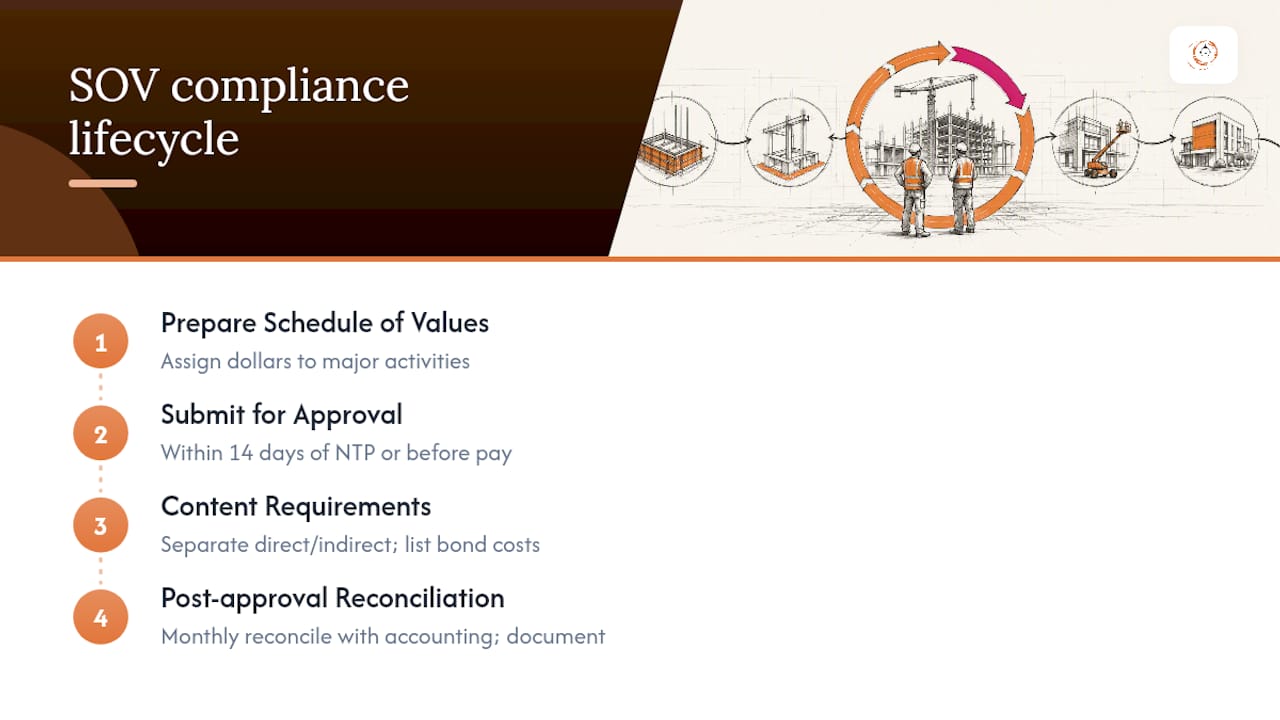
FAR/GSAM clause 552.236-15 is the foundational requirement. It directs the contractor to prepare and submit for approval a cost breakdown, referred to formally as the schedule of values, that assigns dollar figures to each major activity. The clause requires this breakdown to contain sufficient detail for the Contracting Officer to actually evaluate your payment applications, not just skim them. Values must separate direct and indirect costs, and bond costs can be broken out as their own line.
GSAM 536.515 governs what happens after approval. It requires monthly reconciliation of payments against open-book accounting records, meaning your SOV isn’t a one-time submission you file and forget. It gets adjusted, typically monthly, and that reconciliation must be coordinated with progress payments and documented in the contract file.
The schedule of values must contain sufficient detail to allow the Contracting Officer to evaluate applications for payment, with direct and indirect costs identified and bond costs separately stated where applicable.
Timing matters as much as content. Many public contracts require the SOV submitted alongside your construction schedule within a set window, commonly 14 days of Notice to Proceed unless the contract specifies otherwise. Submit and get approval before NTP or before your first pay application, whichever comes first in your contract’s language. Contractors who wait until the payment deadline is looming almost always end up negotiating under pressure, which rarely favors your side.
How Do You Build an SOV for a Public Project?
Building an approval-ready SOV isn’t complicated, but skipping steps is exactly how contractors end up in a rejection loop with the Contracting Officer. Work through this sequence in order.
- Start with the contract sum and SOW. Your total SOV value must equal the awarded contract price, and every line traces back to a scope item in the Statement of Work.
- Choose your breakdown structure. Break down by trade (electrical, concrete, mechanical), by location or building, or by Work Breakdown Structure (WBS) code, depending on what the agency’s template expects and what your accounting system already tracks.
- Map each line to a schedule activity. Assign activity IDs or WBS codes that connect SOV lines to your Level 1, 2, or 3 (L1/L2/L3) construction schedule, so a reviewer can trace a dollar figure to a specific task with a start and finish date.
- Build in all direct and indirect costs, define your retainage percentage clearly, and add the cumulative billing and remaining balance columns you’ll need for monthly pay applications.
- Run an internal reconciliation check. Confirm the line-item total equals the contract sum to the dollar, and make sure quantities and unit pricing have a defensible basis, meaning you could show your math to an auditor without flinching.
- Get sign-offs before submission. Route the draft past your project executive or estimator, then submit.
Pro Tip: Build your SOV in the same software you use for cost accounting, not a separate spreadsheet you reconcile later by hand. Every hour spent reconciling two systems is an hour you’re not spending on the next pay application.
Tying SOV lines to real schedule activities, using a cost-loaded scheduling approach, pays off every time an A/E or Contracting Officer walks the site and cross-checks your billing against visible progress.
What Does an SOV Template Look Like in Practice?
A workable SOV template needs specific columns, and skipping any of them is the fastest way to get your submission kicked back.
- Line item ID and description
- Activity ID or WBS code tying the line to your schedule
- Original contract value for that line
- Change order adjustments (additions or deductions)
- Billed to date (cumulative)
- Current period billing
- Balance to finish
- Retainage withheld
Picture a single line for “Site Concrete, Foundations” with an original value of $185,000. After a $12,000 approved change order for added footings, the adjusted value is $197,000. That’s the level of traceability a reviewer expects on every line, not just the big ones.
Agency portals add another layer. Ohio’s OAKS CI system, used by the Ohio Facilities Construction Commission, requires a CSV or Excel import formatted to its exact field structure. The portal flags two errors more than any other: SOV totals that don’t match the awarded contract amount, and missing required fields like activity codes or retainage percentages. Design your internal export to mirror the agency’s template columns before you ever attempt the upload, and you’ll skip most of the back-and-forth entirely.
How Do You Manage the SOV Through Monthly Reconciliation and Change Orders?
Your SOV isn’t a static document once it’s approved. GSAM 536.515 requires monthly reconciliation against open-book accounting records, and that requirement shapes how you operate for the life of the contract.
- Reconcile SOV figures against your accounting ledger every billing cycle, not just when a pay application is due.
- Document every reconciliation in the contract file, since auditors expect a paper trail showing when adjustments were made and why.
- Process change orders by adding new lines or adjusting existing values, always with backup documentation the Contracting Officer can review before approving the revised total.
- Keep a simple traceability matrix linking each SOV line to general ledger accounts and subcontractor invoices; this single habit does more to reduce audit friction at closeout than almost anything else.
Change orders that don’t get folded into the SOV promptly are a leading cause of payment disputes. Industry guidance consistently points to SOV maintenance as the difference between a smooth pay cycle and a stalled one, since unrecorded scope changes mean your billed amount no longer matches your approved baseline.
Who Approves the SOV and How Long Does It Take?
Three parties touch the SOV before it becomes the baseline for payment, and knowing each role prevents the finger pointing that stalls approvals.
- Contractor: Prepares the SOV, identifies subcontractor-supplied cost items, and submits it alongside the updated construction schedule.
- Architect/Engineer (A/E): Reviews the breakdown for reasonableness and recommends approval or revision to the owner’s representative.
- Project Manager or Contracting Officer: Reviews the submission, requests clarifications on any line lacking sufficient detail, and issues final approval.
Most agencies expect submission within 14 days of Notice to Proceed unless the contract states a different window. Build that timeline into your pre-construction planning rather than treating it as an afterthought once mobilization starts.
What Are the Biggest SOV Mistakes on Public Contracts?
Front-loading is the mistake that causes the most damage, and it’s tempting precisely because it seems to solve a real problem: improving early cash flow by inflating the value of early-stage activities relative to later ones. Contracting Officers scrutinize early SOV distributions closely, and an inflated early line can trigger rejection, added negotiation rounds, or a delayed Notice to Proceed while the agency sorts out whether your numbers hold up.
Other recurring errors include:
- SOV totals that don’t reconcile to the awarded contract sum, even by a small margin
- Line items too vague for the Contracting Officer to evaluate against actual progress
- Weak or missing ties between SOV lines and schedule activities
- Change orders left out of the SOV for one or more billing cycles
Pro Tip: If a line item’s early-month value looks generous compared to the work actually visible on site, assume the Contracting Officer will notice it before you submit, not after.
Mitigate all of this with conservative, defensible valuations backed by contemporaneous documentation, meaning records created at the time the work happened, not reconstructed later when someone asks questions.
What Should Be on Your Practical SOV Checklist?
Before submission, run through a short checklist covering the items agencies check first.
- Contract total match: SOV sum equals the awarded contract price to the dollar
- SOW alignment: every line traces to a defined scope item
- Schedule mapping: WBS or activity IDs connect SOV lines to L1/L2/L3 schedule tasks
- Retainage percentage clearly stated and applied consistently
- Bond costs separated as required
For agency portal submission, confirm your file format matches the required import structure, all required fields are populated, and your totals have been double-checked against the contract amount, since that mismatch is the single most common rejection reason on systems like OAKS CI.
| Checklist area | What to verify |
|---|---|
| Contract match | SOV total equals contract sum exactly |
| Schedule mapping | Each line tied to an activity ID or WBS code |
| Portal readiness | File format and required fields match agency template |
| Audit trail | Monthly reconciliation documented in contract file |
Federal-rconstructionsolutions has guided contractors through this exact process on public water infrastructure awards, where SOV precision determined how quickly first payments cleared.
Where to Find Primary SOV Guidance and Templates
For the regulatory language itself, go straight to FAR/GSAM clause 552.236-15 and GSAM Part 536 on Acquisition.gov. For a real-world agency template and import workflow, Ohio’s OFCC OAKS CI guidance shows exactly how a state system structures SOV data. For broader best practices on granularity and payment disputes, the AIA’s guidance on schedules of values is worth bookmarking alongside your firm’s own FAR compliance reference.
Get the SOV Right the First Time, Every Time
Most contractors treat the SOV as a formality to clear before the real work starts. That’s backward. The SOV is the real work, in the sense that it determines whether your cash flow matches your actual progress for the entire duration of the contract, not just at kickoff.
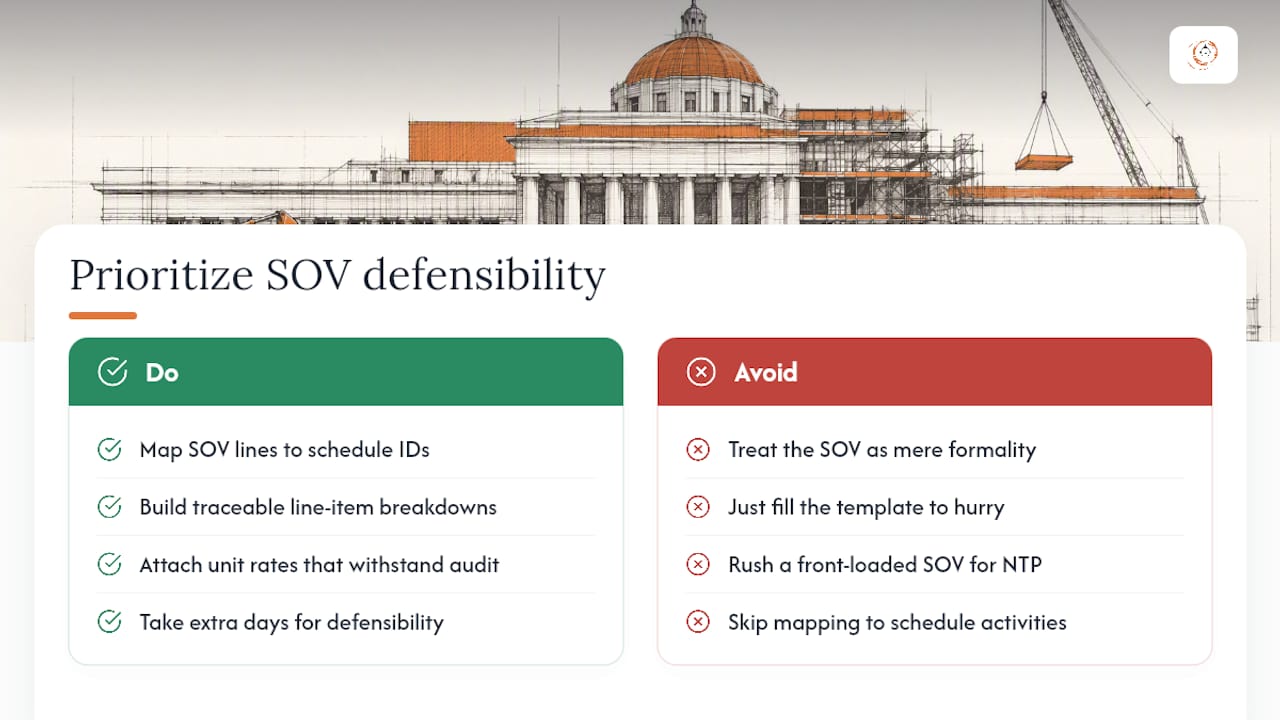
The conventional advice, “just fill out the template,” misses what actually trips contractors up: the SOV has to survive contact with an accounting audit months after you submitted it. That means the defensibility of your numbers matters more than the speed of your submission. A contractor who takes an extra three days to build a genuinely traceable line-item breakdown, tied cleanly to schedule activities and backed by unit rates that hold up under scrutiny, comes out ahead of one who rushed a front-loaded version to get NTP faster.
If there’s one place to prioritize effort, it’s the mapping between SOV lines and schedule activity IDs. Everything else, from monthly reconciliation to change order handling, gets dramatically easier once that connection exists. Skip it, and you’re rebuilding traceability from scratch every time an auditor or Contracting Officer asks a hard question. Contractors who want help building that connection correctly the first time, rather than fixing it after a payment gets held up, can review Federal-rconstructionsolutions’ federal procurement services for support on SOV preparation and broader FAR compliance.
— Rowena
Sources
- Acquisition
- Contract Schedule of Values (SOV) Create
- What is a schedule of values and why is it required on construction projects? | AIA Contracts Learn
FAQ
What Is a Schedule of Values in Construction?
A schedule of values is the contractor’s line-item breakdown of the total contract price, assigning a dollar value to each major activity so the owner or agency can measure progress and process payments accurately.
What Are L1, L2, and L3 Schedules in Project Management?
L1, L2, and L3 refer to schedule levels of detail: L1 is a summary milestone schedule for executives, L2 breaks work into major phases or systems, and L3 provides the detailed activity-level schedule that SOV lines typically map to for billing purposes.
Can You Give an Example of a Schedule of Values for Construction?
A typical SOV line might read “Site Concrete, Foundations” with an original value of $185,000, adjusted to $197,000 after an approved change order, with cumulative billing, current period billing, remaining balance, and retainage tracked in separate columns for each pay application.
Can You Give an Example of a CPM Schedule?
A Critical Path Method (CPM) schedule sequences construction activities like site prep, foundations, framing, and finishes, showing dependencies and durations so the project team can identify which tasks directly control the overall completion date.
Recommended
- FAR Regulations for Construction Explained: 2026 Guide
- Federal Contract Growth Plan for Construction Firms
- Common Federal Bidding Mistakes Contractors Must Avoid
- Federal Procurement Compliance Checklist for Contractors
Working in the public sector? One short email a week — prevailing wage, certified payroll, bid protests, agency procurement rules. Free, no pitch. Subscribe.
Free and unconditional. No call required, no obligation, unsubscribe anytime.