
FAR Regulations for Construction Explained: 2026 Guide
The Federal Acquisition Regulation, known as FAR, is the primary set of rules governing all federal government procurement, including construction, alteration, and repair of real property. For contractors pursuing federal work, far regulations construction explained means understanding a uniform legal framework that controls how agencies award contracts, how labor gets paid, and how disputes get resolved. FAR applies across every federal agency, from the Army Corps of Engineers to the General Services Administration, making it the single most important rulebook for any contractor entering the federal market.
What are FAR regulations for construction?
FAR construction regulations define the rules that apply specifically when a federal agency hires a contractor to build, renovate, or repair a government facility. The FAR framework controls Contracting Officer discretion, meaning agencies cannot simply pick whoever they want or negotiate terms freely. Every step, from solicitation to contract closeout, follows a prescribed process.
The FAR Council, which includes the Department of Defense, the General Services Administration, and NASA, issues and updates FAR rules. The Department of Labor enforces wage requirements that flow directly from FAR-referenced statutes. Individual contracting agencies then add agency-specific supplements on top of the base FAR, so a contract with the Army Corps of Engineers may carry additional requirements beyond what the base FAR requires.

Understanding FAR construction rules starts with recognizing that FAR Part 36 covers construction contracting specifically. It sets rules for sealed bidding, design-build procurement, and contract administration unique to construction work. Contractors who treat federal construction like a private project will miss obligations that can cost them money, time, and future opportunities.
Key compliance requirements under FAR for construction contractors
Federal construction compliance requirements are not optional additions to a bid. They are legally binding conditions that apply the moment a contractor signs a federal construction contract.
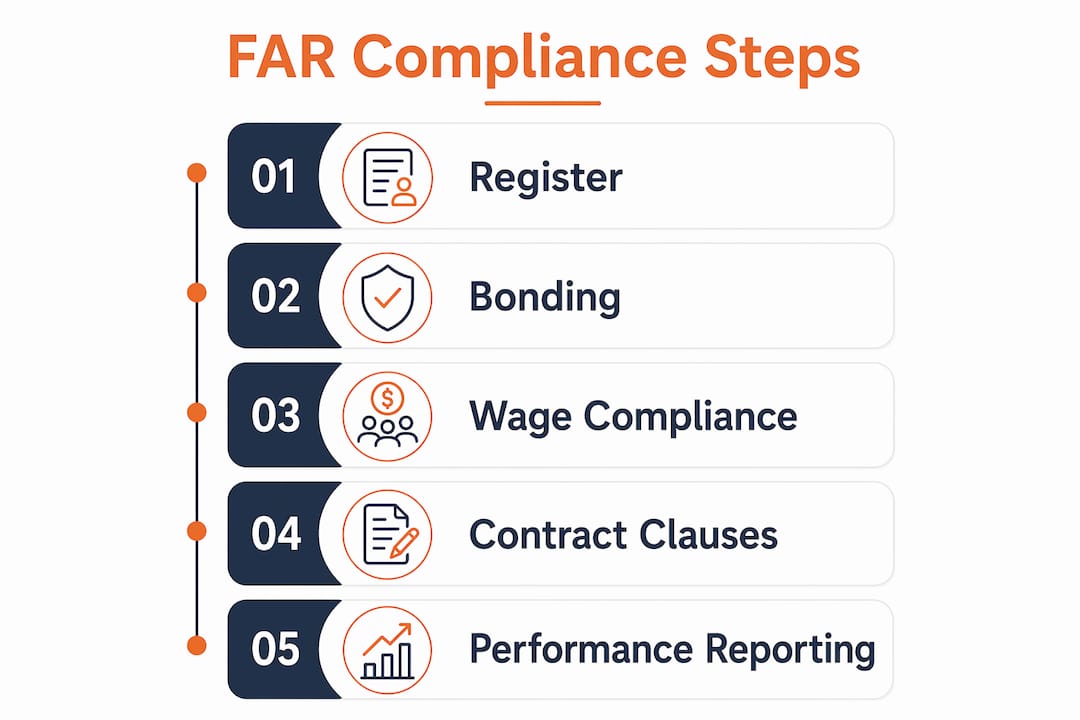
The core compliance elements every contractor must address include:
- Miller Act bonding: Federal contracts over $150,000 require both a performance bond and a payment bond. The performance bond protects the government if the contractor defaults. The payment bond protects subcontractors and suppliers who would otherwise have no lien rights on federal property.
- Davis-Bacon Act prevailing wages: Labor on federal construction must be paid at prevailing wage rates set by the Department of Labor for the specific trade and county where work occurs. These rates directly affect your bid pricing and must be calculated before you submit.
- SAM.gov registration: Every contractor must hold an active registration in the System for Award Management (SAM.gov) and obtain a Unique Entity ID before receiving a federal award. An expired SAM.gov registration can disqualify an otherwise winning bid.
- Small business set-aside goals: The federal government targets 23% of contract dollars for small businesses, with additional goals of 5% for women-owned small businesses, 3% for HUBZone firms, 5% for small disadvantaged businesses, and 3% for service-disabled veteran-owned businesses. Knowing your NAICS code and size standard determines whether you qualify for set-aside competitions.
- FAR Part 52 clauses: Every solicitation includes a list of FAR clauses incorporated by reference. These clauses define your specific obligations on that contract. Reading them before you bid is not optional.
Pro Tip: Review the compliance checklist for federal procurement before submitting any bid. Missing a single registration or certification can eliminate your offer from consideration before an agency even reads your price.
Strict FAR compliance creates a level playing field by preventing contractors from winning bids simply by undercutting labor costs. That fairness benefits contractors who invest in their workforce and price work honestly.
What are the critical FAR contract clauses for construction projects?
FAR Part 52 contains the specific clauses that define contractor rights and responsibilities on each project. Three clauses matter most for construction contractors.
-
FAR 52.236-2 Differing Site Conditions. This clause is one of the most valuable protections in federal construction. It entitles a contractor to an equitable adjustment when actual site conditions differ materially from what the contract documents indicated. Experienced federal contractors often bid with lower contingency of 2%–3% compared to private work, precisely because this clause reduces the financial risk of unknown underground conditions. On a private project, you absorb that risk entirely. On a federal project, you have a contractual path to recover costs.
-
FAR 52.243-4 Changes. The Changes clause gives the Contracting Officer authority to order changes within the general scope of the contract. When a change order is issued, the contractor has the right to request an equitable adjustment to the contract price and schedule. The process for a Request for Equitable Adjustment (REA) must be initiated promptly. REA costs are recoverable during informal negotiation, including fees for outside consultants and legal counsel, but that recovery right disappears once the matter escalates to a formal claim under the Contract Disputes Act.
-
FAR 52.233-1 Disputes. The Disputes clause requires contractors to continue work while disputes are resolved, even when the contractor believes the government is wrong. Stopping work without authorization constitutes a default. The clause also sets timelines: claims of $100,000 or less require a Contracting Officer decision within 60 days of a written request.
Pro Tip: Flag every FAR clause in a solicitation that relates to site conditions, changes, and disputes before you sign. Understanding construction compliance terminology for these clauses upfront prevents costly surprises during project execution.
The FAR framework requires contractors to focus on which clauses are active on each specific contract. Not every clause appears in every contract. Procurement professionals confirm that monitoring Part 52 clause lists is the single most effective compliance habit a contractor can build.
How does CPARS affect your federal construction reputation?
The Contractor Performance Assessment Reporting System, known as CPARS, is the federal government’s official record of how well contractors perform. It is not a suggestion box. It is a permanent record that follows your company into every future bid evaluation.
Federal agencies must complete CPARS evaluations for construction contracts valued at $900,000 or more. Evaluations are prepared at least annually and at contract completion. The records are retained for six years, meaning a poor evaluation from a project completed today will still appear in your record when you bid on contracts in 2031.
Key facts about CPARS that contractors must know:
- Evaluation categories cover quality of work, schedule adherence, cost control, business relations, and regulatory compliance.
- Agency discretion allows evaluations on contracts below $900,000 as well, so smaller contracts are not automatically exempt.
- Contractor response rights give you the opportunity to comment on evaluations before they are finalized. Use this right every time.
- Award impact is direct. CPARS evaluations influence contract awards by reflecting a contractor’s quality, timeliness, and compliance record. A pattern of “Satisfactory” ratings is not enough to win competitive awards against contractors with “Very Good” or “Exceptional” ratings.
The practical implication is clear. Every federal project is also an audition for your next federal project. Contractors who treat CPARS as an afterthought lose future work to those who manage it proactively. Review your evaluations, respond formally when you disagree, and document your performance throughout the project so you have evidence to support your comments.
How should contractors handle claims and disputes under FAR?
Claims and disputes are a normal part of federal construction. The Contract Disputes Act (CDA) governs how contractors formally assert rights against the government when negotiations fail.
The dispute process under FAR follows a specific sequence:
- Document everything in writing. Verbal agreements with a Contracting Officer carry no legal weight. Every direction, change, and site condition notice must be in writing and submitted promptly.
- Submit a certified claim for amounts over $100,000. The CDA requires contractor certification for claims above this threshold. A defective certification can invalidate the claim entirely.
- Continue work during disputes. FAR 52.233-1 requires contractors to keep working even while a dispute is pending. The only exception is a situation where continuing work would be physically impossible or illegal.
- Pursue an REA before filing a formal claim. An REA is an informal request for a price adjustment submitted directly to the Contracting Officer. It preserves your right to recover consultant and legal costs. Once you file a formal CDA claim, those costs are no longer recoverable.
- Know your deadlines. The CDA imposes a six-year statute of limitations on contractor claims. Missing this window forfeits your right to recover.
Contractors who maintain detailed daily logs, photograph site conditions, and send written notices to the Contracting Officer at every significant event build the strongest claims records. Documentation is not bureaucracy. It is your financial protection.
The Contracting Officer’s role in disputes is both gatekeeper and decision-maker at the first level. Building a professional, documented relationship with the Contracting Officer from day one reduces the likelihood that disputes escalate to formal claims at all.
Key Takeaways
FAR construction compliance requires bonding, prevailing wages, active SAM.gov registration, and a thorough understanding of Part 52 clauses before you submit a single bid.
| Point | Details |
|---|---|
| Miller Act bonding threshold | Contracts over $150,000 require performance and payment bonds by law. |
| Davis-Bacon wage compliance | Prevailing wage rates must be calculated per trade and county before pricing a bid. |
| CPARS retention period | Performance evaluations are kept for six years and directly affect future award decisions. |
| Differing Site Conditions clause | FAR 52.236-2 allows contractors to bid lower contingencies by shifting unknown site risk to the government. |
| REA vs. formal claim | Recover consultant costs through an REA during negotiation; that right ends once a formal CDA claim is filed. |
What I’ve learned from watching contractors win and lose on FAR compliance
Working alongside contractors who pursue federal construction work, I have seen the same pattern repeat. The contractors who struggle are not the ones who lack skill. They are the ones who underestimate the administrative weight of FAR compliance.
The most common and costly mistake is ignoring prevailing wage calculations until after the bid is submitted. Davis-Bacon rates vary by trade classification and county, and they can swing a labor budget by tens of thousands of dollars on a mid-size project. Getting this wrong at the bid stage means either losing money on the contract or submitting a non-competitive price.
The second mistake is treating CPARS as something that happens to you rather than something you manage. Contractors who review their draft evaluations, respond formally, and document their performance throughout the project consistently earn better ratings than those who wait for the final report and then complain.
Federal work offers real financial advantages that private work does not. Federal contracts provide prompt payment protections, standardized labor costs, and equitable adjustment clauses that make project finances more predictable. The contractors who recognize these advantages and price their bids accordingly win more work and run more profitable projects.
My honest advice: read every Part 52 clause in a solicitation before you price the job. Engage a bonding agent and a prevailing wage specialist early. Build a written communication habit with your Contracting Officer from the first day of the contract. These three practices will protect you from the disputes and compliance failures that derail otherwise capable contractors.
— Rowena
Federal-rconstructionsolutions supports contractors through FAR compliance
Federal-rconstructionsolutions helps construction businesses move from confusion to confidence in the federal market. Whether you are bidding your first government project or expanding an existing federal portfolio, the compliance requirements under FAR require expert guidance to get right the first time.
Federal-rconstructionsolutions provides bid support, RFP writing, and federal procurement consulting that targets 90% compliance for successful submissions. The team also helps contractors identify set-aside opportunities matched to their NAICS codes and size standards, reducing the time spent chasing contracts that were never a fit. For contractors ready to build a consistent pipeline of federal work, step-by-step bid guidance from Federal-rconstructionsolutions removes the guesswork from the process.
FAQ
What is FAR in federal construction contracting?
FAR stands for the Federal Acquisition Regulation, the uniform set of rules governing all federal government procurement, including construction contracts. It covers everything from how agencies solicit bids to how disputes are resolved after award.
When are performance and payment bonds required on federal construction contracts?
The Miller Act requires performance and payment bonds on federal construction contracts exceeding $150,000. These bonds protect both the government and subcontractors in the event of contractor default.
What is CPARS and why does it matter for contractors?
CPARS is the Contractor Performance Assessment Reporting System, where federal agencies record evaluations of contractor quality, schedule, and compliance. Evaluations for contracts of $900,000 or more are retained for six years and directly influence future contract award decisions.
What does the Differing Site Conditions clause do for contractors?
FAR 52.236-2 entitles contractors to an equitable adjustment when actual site conditions differ materially from contract documents. This clause reduces bid risk and allows experienced federal contractors to carry lower contingency percentages than they would on private work.
What is the difference between an REA and a CDA claim?
A Request for Equitable Adjustment is an informal negotiation with the Contracting Officer to adjust contract price or schedule. A Contract Disputes Act claim is a formal legal submission. Consultant and legal costs are recoverable during the REA phase but not after a formal CDA claim is filed.

