
Cost Loading Schedules: The EVM Guide for Project Managers
A cost-loaded schedule turns your CPM schedule into a time-phased budget, and it is the foundation that everything else in earned value management sits on. Instead of a bar chart that only tells you when work happens, you get a financial model that tells you how much money should have moved by any given date. That distinction is what separates project managers who spot a budget overrun in week six from those who discover it only at closeout.
The mechanics are simple to state, harder to execute well: you assign a dollar value to every scheduled activity, spread across its duration, so the sum of all activities equals your total budget. This creates planned value (PV) across the project timeline, the baseline against which you measure actual progress and actual spending.
Three practical outcomes make this worth the setup effort:
- Cashflow forecasting — you can predict monthly draw requirements months before they happen
- Payment application support — billing ties directly to verifiable progress rather than guesswork
- Early variance detection — cost and schedule drift show up while there’s still time to correct course
Key Takeaways
Cost-loaded schedules turn a project timeline into a financial control tool that enables earned value tracking, cashflow forecasting, and defensible payment applications.
| Point | Details |
|---|---|
| Cost-loading enables EVM | PV, EV, and AC calculations all depend on a cost-loaded baseline being in place first. |
| Match effort to project scale | Reserve full cost-loading for large, long, or contractually required projects, not small short jobs. |
| Avoid front-end loading | Distribute costs proportionally to work-in-place to meet federal and commercial contract requirements. |
| Update on a fixed cadence | Refresh schedules weekly and reconcile cost performance monthly to keep the baseline defensible. |
| Get expert support for complex CLINs | Federal-rconstructionsolutions helps contractors with CLIN balancing, SDEF uploads, and schedule acceptance reviews. |
Table of Contents
- What Is a Cost-Loaded Schedule, Exactly?
- What Fields Does a Cost-Loaded Schedule Need?
- Why Do Owners and Contractors Both Want Cost-Loading?
- How Do You Build a Cost-Loaded Schedule Step by Step?
- What Are the PV, EV, and AC Formulas in Construction?
- Which Software Handles Cost-Loading Best?
- How Often Should You Update a Cost-Loaded Schedule?
- How Do You Connect Cost-Loading to Risk and Procurement?
- When Is Cost-Loading Worth the Effort?
- How Federal-rconstructionsolutions Supports Cost-Loaded Schedules
- Sources
- FAQ
What Is a Cost-Loaded Schedule, Exactly?
A cost-loaded schedule is a CPM schedule where every activity carries an assigned monetary value, creating a time-phased budget that tracks planned expenditure across the calendar. It merges two documents contractors usually keep separate: the schedule of values and the project schedule itself.
That merger matters because it distinguishes cost-loading from value-loading. Cost-loaded schedules reflect the contractor’s actual estimate, internal costs, and margin. Value-loaded schedules reflect what the owner pays for each item, which may include markup or be adjusted for negotiation purposes. Confusing the two is one of the most common reconciliation headaches on a project.
- Cost-loaded = contractor/estimator lens (true cost)
- Value-loaded = owner/payment lens (billed value)
Roughly 90% of the effort in building a defensible cost-loaded schedule up front pays off later, according to early practitioner guidance on cost-loaded CPM scheduling, because it eliminates the manual reconciliation work that otherwise happens every billing cycle. Without this step, you cannot calculate PV, EV, or AC, the three inputs every earned value formula depends on.
What Fields Does a Cost-Loaded Schedule Need?
Building a defensible cost-loaded schedule starts with structure. You need a work breakdown structure (WBS) detailed enough that each activity maps to a distinct, measurable scope of work, not a vague bucket like “electrical” spanning four months.
Every activity should carry cost data broken into these categories:
- Direct labor (crew hours by trade, tied to actual wage rates)
- Materials and equipment (from quantity take-offs, not rough allowances)
- Subcontractor costs (bid-backed, not estimated)
- Overhead and general conditions
- Contingencies, mobilization, and closeout items
Once costs are assigned, you choose a distribution method across each activity’s duration. Linear distribution spreads cost evenly across days, which works for steady-progress activities like concrete pours. Weighted distribution front or back-loads cost to match how work actually happens, useful for activities like equipment procurement where most cost hits at delivery, not installation.
Finally, reconcile every activity back to your Schedule of Values or contract line items (CLINs). This is not optional on federal work. Standard coding structures like the USACE SDEF format exist specifically so schedule data uploads cleanly into government payment systems.
Pro Tip: Build your WBS and Schedule of Values at the same time, not sequentially. Retrofitting SOV line items onto an existing schedule almost always creates orphaned costs that don’t map to any activity.
Why Do Owners and Contractors Both Want Cost-Loading?
Owners increasingly require cost-loaded schedules because they solve a trust problem: how do you verify a payment application actually reflects work completed? A cost-loaded baseline gives owners a way to check billed amounts against planned expenditure at any point in the schedule, cutting down on disputes before they escalate into claims.
Contractors benefit too, even though it’s more work upfront. A cost-loaded schedule lets you track your own earned value internally, which means you catch cash-flow gaps before payroll is due, not after.
A cost-loaded schedule becomes a financial control instrument. It shows where money is supposed to flow and lets you detect budget drift early, before a manageable variance becomes a crisis that eats your margin.
The tradeoffs are real. Building and maintaining a cost-loaded schedule takes dedicated scheduler and estimator time, and some contractors resist it because it exposes internal cost structure to owners or construction managers. On a short residential remodel or a project under a few hundred thousand dollars, the administrative burden of full cost-loading often outweighs the control benefit. Save it for projects where the scale, duration, or contract terms justify the investment.
How Do You Build a Cost-Loaded Schedule Step by Step?
Follow this sequence, and don’t skip steps to save time. Each one catches errors the next step would otherwise bury.
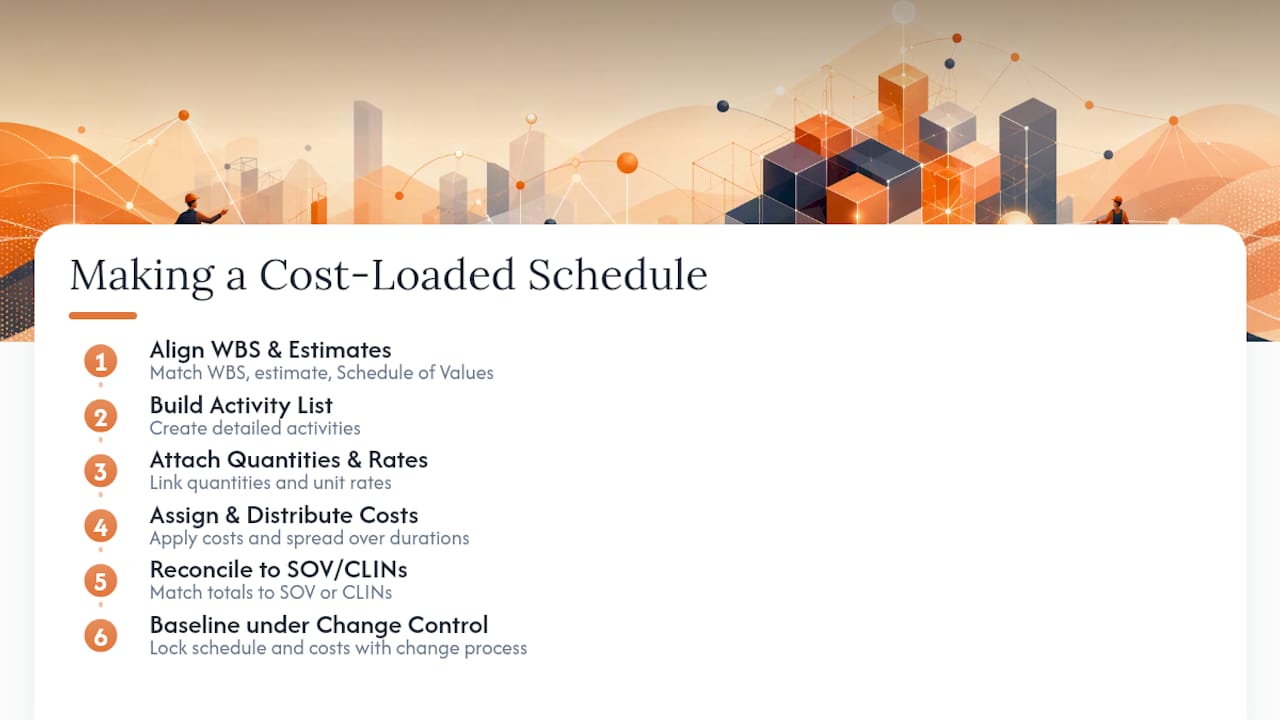
- Align your WBS, estimate, and Schedule of Values so every cost bucket has a home before you touch the schedule.
- Build the detailed activity list in your CPM schedule, matching the granularity of your WBS.
- Attach quantities and rates to each activity from your estimate, not rough percentages.
- Assign direct, indirect, and overhead costs, keeping each category tagged separately for later reporting.
- Distribute cost across activity duration, choosing linear or weighted methods based on how the work actually unfolds.
- Reconcile total cost-loaded value to your Schedule of Values or CLINs line by line, no gaps.
- Baseline the schedule and lock it under change control, so future revisions are tracked, not silently overwritten.
Here’s a small worked example. Say a foundation activity has 400 cubic yards of concrete at $180 per yard, plus 120 labor hours at $65 per hour. That’s $72,000 in material and $7,800 in labor, for a total activity cost of $79,800. If the activity runs 6 working days and progress is roughly linear, you’d load about $13,300 per day. That daily figure becomes your planned value contribution for that activity on any given date.
- Watch for front-end loading: inflating early activities to accelerate cash receipt is a common pitfall, and it’s explicitly disallowed on most federal and large commercial contracts.
- Request cost detail from subcontractors at bid time, not after award, so you’re not reverse-engineering their pricing to satisfy owner requirements. Structuring this into your bid strategy early avoids costly renegotiation later.
- If an owner hasn’t accepted your cost-loaded baseline yet, negotiate an interim schedule of values for early payment applications so cashflow doesn’t stall during review.
What Are the PV, EV, and AC Formulas in Construction?
Earned value management runs on three numbers, and a cost-loaded schedule is what makes all three calculable. Planned Value (PV), sometimes called BCWS, is the budgeted cost of work you scheduled to complete by a given date. Earned Value (EV), or BCWP, is the budgeted cost of work actually completed. Actual Cost (AC), or ACWP, is what you really spent.
From those three, you get two ratios that tell you whether the project is healthy: Cost Performance Index (CPI) = EV ÷ AC, and Schedule Performance Index (SPI) = EV ÷ PV. A CPI below 1.0 means you’re spending more than planned for the work completed; an SPI below 1.0 means you’re behind schedule.
- CPI below 0.9 usually warrants a formal cost investigation, not just a conversation, since it signals a recurring overrun pattern rather than a one-time blip.
- SPI below 0.95 often means resequencing or added crews, but confirm the delay is real progress slippage and not just a coding error before you escalate to a baseline change.
Which Software Handles Cost-Loading Best?
Tool choice depends heavily on project scale and how sophisticated your EVM reporting needs to be. Oracle Primavera P6 remains the standard for large infrastructure and federal programs, supporting multiple cost accounts and full EVM reporting out of the box. Procore offers cloud-based schedule and cost integration that works well for mid-sized commercial contractors who need collaboration across field and office teams. Microsoft Project is more accessible for smaller firms but has limited native EVM capability once a project needs multi-account cost tracking or CLIN balancing.
| Criteria | Oracle Primavera P6 | Procore | Microsoft Project |
|---|---|---|---|
| Best for scale/complexity | Large, complex, multi-phase programs | Mid-sized commercial projects | Small to mid projects |
| EVM/cost-loading features | Full EVM, multiple cost accounts | Schedule-cost integration | Limited native EVM |
| Ease of setup/maintenance | Steep learning curve | Moderate, field-friendly | Easiest to start |
| Finance/ERP integration | Strong, enterprise-grade | Growing integration ecosystem | Basic, often manual export |
| Licensing/cost | Higher, enterprise pricing | Subscription, tiered by module | Lower entry cost |
Match the tool to your contract requirements first. If you need CLIN balancing or SDEF file uploads for a federal agency, that narrows your options fast, regardless of what your team already knows how to use.
How Often Should You Update a Cost-Loaded Schedule?
Update your schedule weekly and review cost performance monthly, tied to your progress payment cycle. Assign clear ownership: the scheduler maintains logic and dates, the estimator supplies and revises rates, and finance reconciles actuals against the baseline.
Watch for these recurring pitfalls:
- Front-end loading — mitigate by requiring proportional distribution tied to work-in-place, not payment convenience.
- Incomplete WBS — mitigate by locking WBS structure before baseline, not mid-project.
- Missed updates after change orders — mitigate by making cost-loading revision a mandatory step in your change control checklist.
- Mismatched CLIN/SOV coding — mitigate with a coding crosswalk document reviewed before each submission.
On federal projects specifically, expect CLIN balancing requirements and mandatory cost assignments for closeout deliverables like O&M manuals and punch-list correction. Reviewing officers will reject schedules that skip these, so build them in from day one rather than adding them during a resubmission.
- Confirm CLIN totals match contract value exactly, with no rounding gaps.
- Verify closeout deliverables carry non-zero cost values.
- Cross-check that no single early activity exceeds a reasonable share of total contract value.
Practitioner Checklist for Audit-Ready Cost Loading
Keep this on hand before every schedule submission or payment application review:
- WBS fully mapped to Schedule of Values with no orphaned line items
- CLIN totals reconciled to contract value, verified by finance
- Update cadence documented and followed (weekly schedule, monthly cost review)
- EVM figures reconciled monthly against actual invoices and payroll
- Evidence package assembled for each payment application (quantities, rates, photos)
| Role | Responsibility |
|---|---|
| Estimator | Supplies unit rates and quantity take-offs |
| Scheduler | Updates activity logic, durations, and cost distribution |
| Finance | Reconciles actual costs against baseline monthly |
| Project manager | Signs off on cost reconciliation before submission |
This structure aligns with standard PMI earned value management guidance, which treats cost and schedule integration as the backbone of defensible project control, not an optional add-on for large programs only.
How Do You Connect Cost-Loading to Risk and Procurement?
A cost-loaded schedule works best when it’s not an isolated document sitting next to your risk register and procurement log. Link them, and each one gets sharper.

Start with risk management. Every identified risk with a cost impact, whether it’s a weather delay on site work or a long-lead equipment item, should have a corresponding contingency line in your cost-loaded schedule, tied to the specific activity it threatens. When that risk materializes, you adjust the affected activity’s cost and duration directly instead of scrambling to find where the money should come from. This also makes your contingency drawdown visible over time, which is exactly what owners want to see on monthly reports.
Procurement integration matters just as much. Long-lead items, subcontractor mobilization, and material deliveries all have cost and schedule implications that need to show up in your activity list before the purchase order is even issued. If your procurement log tracks a delivery date that isn’t reflected in the schedule’s cost distribution, you’ll see a false variance the month that item lands, one that looks like a cost overrun but is really just a timing mismatch.
The practical fix is a shared coding structure. Use the same activity IDs across your schedule, procurement tracker, and risk register so a change in one system triggers a review in the others. Teams that skip this step usually end up reconciling three disconnected spreadsheets by hand every month, which defeats the purpose of building a cost-loaded schedule in the first place.
When Is Cost-Loading Worth the Effort?
Cost-loading earns its keep on large, long-duration, or contractually required projects, especially anything using formal EVM reporting or federal CLIN structures. The setup cost is real, but so is the payoff: fewer disputes, cleaner payment applications, and early warning on budget drift.

Skip or simplify it on small, short, or low-risk jobs where the administrative burden outweighs the control benefit. Not every project needs this level of rigor, and forcing it onto a six-week job wastes hours better spent elsewhere.
Having supported contractors through federal procurement and compliance work, we’ve seen how often schedule acceptance reviews hinge on cost-loading discipline done right the first time.
How Federal-rconstructionsolutions Supports Cost-Loaded Schedules
Getting CLIN balancing right, aligning your Schedule of Values with a federal SDEF upload, or preparing a schedule for a formal acceptance review takes specialized knowledge most internal teams build only after a few painful rejections. Federal-rconstructionsolutions works directly with construction companies on exactly this kind of schedule and cost-readiness work, alongside broader federal procurement consulting, FAR and Davis-Bacon compliance support, and estimating services.

If your team is DIY-capable on straightforward commercial jobs, that’s often the right call. But when you’re facing complex CLIN balancing, a contract dispute tied to cost reconciliation, or your first SDEF upload for a federal agency, bringing in dedicated support prevents an expensive resubmission cycle. Federal-rconstructionsolutions has helped contractors navigate this exact readiness gap on public projects, including water infrastructure work where schedule acceptance was a contract milestone. Visit the federal procurement services page to talk through where your schedule stands before your next submission deadline.
Sources
- Cost Loaded Schedule – Project Management Formula
- PMI conference paper on cost-loaded CPM schedules (1993)
- Cost Loaded Construction Schedules for CPM and Cash Flow | Consult Leopard
FAQ
What Is a Cost-Loaded Schedule?
A cost-loaded schedule is a CPM schedule where every activity carries an assigned monetary value, creating a time-phased budget that maps planned expenditure across the project timeline and enables earned value tracking.
What Are the 5 Levels of Cost Estimation?
Cost estimates typically progress through five levels of increasing accuracy, from order-of-magnitude at the concept stage to definitive estimates near construction start, though exact naming conventions vary by organization and standard.
How Do You Make a Cost-Loaded Schedule?
Align your WBS, estimate, and Schedule of Values, build a detailed activity list, attach quantities and rates, assign costs, distribute them across activity durations, reconcile to your Schedule of Values or CLINs, and baseline under change control.
What Are L1, L2, and L3 Schedules in Project Management?
L1 through L3 refer to schedule detail levels, with L1 giving an executive summary timeline, L2 showing major milestones and phases, and L3 providing the detailed activity-level schedule most cost-loading work happens against.
Do Small Projects Need a Cost-Loaded Schedule?
Not usually. The setup and maintenance effort typically outweighs the benefit on small, short-duration, or low-risk projects, so simpler cost tracking methods often make more sense there.