$19M vs $45M NAICS Codes Decide Federal Bids for Construction Firms
Construction work falls under NAICS Sector 23, split into three subsectors: 236, 237, and 238. On a federal solicitation, the contracting officer assigns one NAICS code based on the work’s principal purpose, and that code sets the SBA size standard that determines who qualifies as a small business for that specific opportunity. Before you bid, confirm the solicitation’s assigned code, not just what sits in your SAM.gov profile, and check it against the SBA size standard table.
TL;DR:
- The assigned NAICS code on each federal solicitation, not your SAM profile, determines which SBA size standard applies for bid eligibility.
- Construction companies should verify the exact NAICS code listed in the solicitation and cross-check it with current SBA size standards before bidding.
- General construction codes typically have a $45 million receipts threshold, while specialty trade codes usually carry a $19 million standard; matching your revenue to the correct code is crucial.
- Choosing an overgeneralized or inaccurate primary NAICS code can weaken your bid’s credibility and risk disqualification from opportunities.
- Regularly re-verify your NAICS codes and size standards to prevent eligibility issues that could cost you federal contracts.
Table of Contents
- What Is NAICS Sector 23 for Construction?
- How Does NAICS Assignment Affect Federal Bid Eligibility?
- How Do You Select and Register NAICS Codes in SAM.gov?
- Which NAICS Codes Cover Common Construction Work?
- Pre-Bid Checklist: What to Verify Before You Submit
- Why Getting the Code Right Determines Whether You Even Get to Compete
- Reduce NAICS-Related Bid Risk With Federal Procurement Support
- Where to Verify NAICS Codes and Size Standards
- Sources
- FAQ
What Is NAICS Sector 23 for Construction?
NAICS organizes every industry in the U.S. economy into a nested numbering system, and construction sits entirely inside Sector 23. The two-digit prefix (23) identifies the broad sector. Add digits and you get more specificity: three digits name a subsector, four name an industry group, five name an industry, and the full six digits pin down the exact activity as defined in the 2022 NAICS manual.
Sector 23 breaks into three subsectors, and every construction firm operates somewhere inside one or more of them:
- 236, Construction of Buildings: residential and commercial building construction, including new builds and major renovations.
- 237, Heavy and Civil Engineering Construction: roads, bridges, utility systems, water and sewer lines, and similar infrastructure work.
- 238, Specialty Trade Contractors: electrical, plumbing, concrete, roofing, and other trade-specific work performed as a subcontractor or specialty prime; learn more about why electrical technician recruiting matters for skilled hiring.
A few six-digit examples show how granular this gets. Code 236220 covers commercial and institutional building construction. Code 237310 covers highway, street, and bridge construction. Code 238160 covers roofing contractors. The Bureau of Labor Statistics uses this same subsector breakdown when it reports construction employment data, so the structure isn’t unique to procurement. It’s the standard economic classification for the entire industry.
How Does NAICS Assignment Affect Federal Bid Eligibility?
Here’s the part that trips up a lot of otherwise well-run construction companies: your SAM.gov profile does not decide whether you qualify as small for a given contract. The solicitation does.
Under FAR 19.102, the contracting officer assigns the NAICS code to a solicitation based on the principal purpose of the work being procured. If the work has multiple components, the code follows whichever component represents the greatest share of contract value. That single assigned code then determines which SBA size standard applies, and size standards vary significantly by code.
The contracting officer’s assigned NAICS code, not the contractor’s own classification, governs which size standard applies to a given federal opportunity.
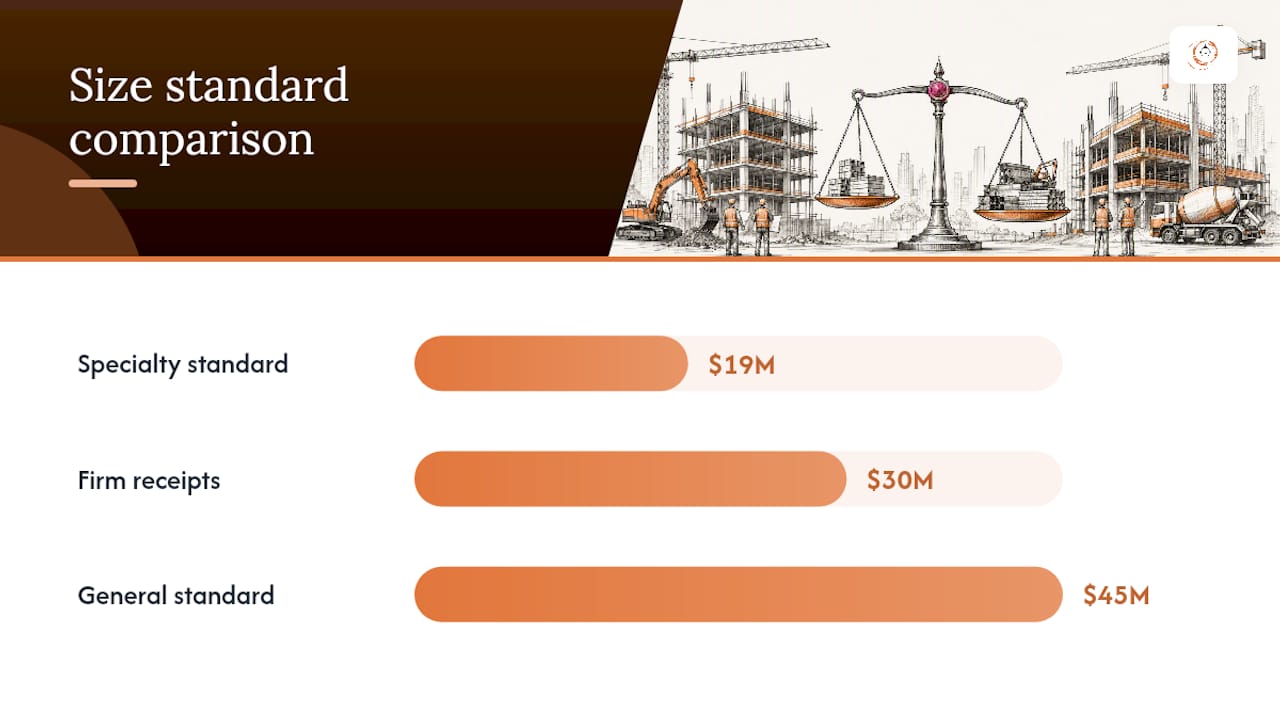
Size standards are published under 13 CFR 121.201 and are usually expressed as either average annual receipts or employee counts, depending on the industry. Many general construction codes carry a $45 million receipts standard, while many specialty trade codes carry a $19 million standard. That gap matters more than most contractors realize.
Picture two firms with identical annual receipts of $30 million. One bids on a solicitation coded 236220 (general building construction, $45M standard) and qualifies as small. The other bids on a solicitation coded under a specialty trade classification with a $19M standard and does not qualify, even though nothing about the company itself changed. The code on the solicitation, not the company’s self-image, is what decides the outcome.
How Do You Select and Register NAICS Codes in SAM.gov?
Getting your SAM.gov profile right starts with an honest look at where your revenue actually comes from, not where you’d like it to come from.
- Identify your primary revenue driver. Look at the last two to three years of gross receipts by activity, and find the single line of work that generates the most revenue.
- Select the corresponding NAICS code as your primary code. A firm doing mostly commercial building work should primary under 236220, while a heavy civil contractor typically primaries under 237310 or a related 237-series code.
- Add secondary codes only for work you actually perform. SAM.gov allows multiple additional codes, but each one should reflect real, demonstrable capability, not aspirational scope.
- Before submitting a proposal, pull the solicitation’s assigned NAICS code directly from the notice, then cross-check it against the current SBA size standard table for that code.
Your primary code in SAM.gov shapes how contracting officers and other buyers perceive your core capability when they search the system, so treat it as a first impression, not paperwork.
Pro Tip: Set a calendar reminder to re-verify your SAM.gov NAICS codes every time your revenue mix shifts meaningfully, not just at your annual renewal. A code list that’s two years stale can quietly exclude you from opportunities you’d otherwise win.
Which NAICS Codes Cover Common Construction Work?
The table below maps frequently used construction codes to typical federal applications and their general SBA receipts standard category.
| NAICS Code | Description | Typical Use | General Size Standard Category |
|---|---|---|---|
| 236220 | Commercial and Institutional Building Construction | Federal buildings, schools, offices | Higher receipts standard (general construction) |
| — | Industrial Building Construction | Plants, warehouses, industrial facilities | Higher receipts standard (general construction) |
| — | Water and Sewer Line and Related Structures | Utility infrastructure, public water projects | Higher receipts standard (general construction) |
| — | Oil and Gas Pipeline Construction | Pipeline and related infrastructure | Higher receipts standard (general construction) |
| 237310 | Highway, Street, and Bridge Construction | Road and bridge federal projects | Higher receipts standard (general construction) |
| 238160 | Roofing Contractors | Roofing on federal facilities | Lower receipts standard (specialty trade) |
| — | Plumbing, Heating, and Air-Conditioning Contractors | Mechanical subcontracting | Lower receipts standard (specialty trade) |
| — | Site Preparation Contractors | Excavation, grading, demolition prep | Lower receipts standard (specialty trade) |
| 238990 | All Other Specialty Trade Contractors | Catch-all for niche trade work | Lower receipts standard (specialty trade) |
As a rule, general construction codes tend to carry the $45 million receipts standard while specialty trade codes tend to carry the $19 million standard, though you should always confirm the current figure against the SBA table for the specific code in question. Reach for a catch-all code like 237990 or 238990 only when your work genuinely doesn’t fit a more specific listing. Overusing a catch-all code weakens how buyers read your capability, since it signals you couldn’t pin down your own specialty.
Pre-Bid Checklist: What to Verify Before You Submit
Run through this list before every proposal, not just the big ones:
- Confirm the exact NAICS code assigned to the solicitation, pulled from the notice itself.
- Verify the current SBA size standard tied to that specific code, since standards get revised periodically.
- Match your SAM.gov profile’s listed codes to your actual, demonstrable capabilities for the scope described.
- Document why you selected each NAICS code you carry, in case a size determination is ever challenged.
- Confirm whether Davis-Bacon certified payroll obligations apply to the scope, and prepare accordingly.
The most common mistake is assuming your SAM primary code determines eligibility for every opportunity you chase. It doesn’t. The solicitation’s assigned code does. A close second: missing the short window to formally challenge a solicitation’s NAICS code if you believe it’s wrong. Once that window closes, you’re stuck bidding under a code that may not reflect the work.
Pro Tip: Build an internal NAICS-to-capability matrix that your estimators and compliance staff reference on every opportunity. It turns a subjective judgment call into a documented, repeatable process, and it gives you a paper trail if a competitor ever protests your size status.
Why Getting the Code Right Determines Whether You Even Get to Compete
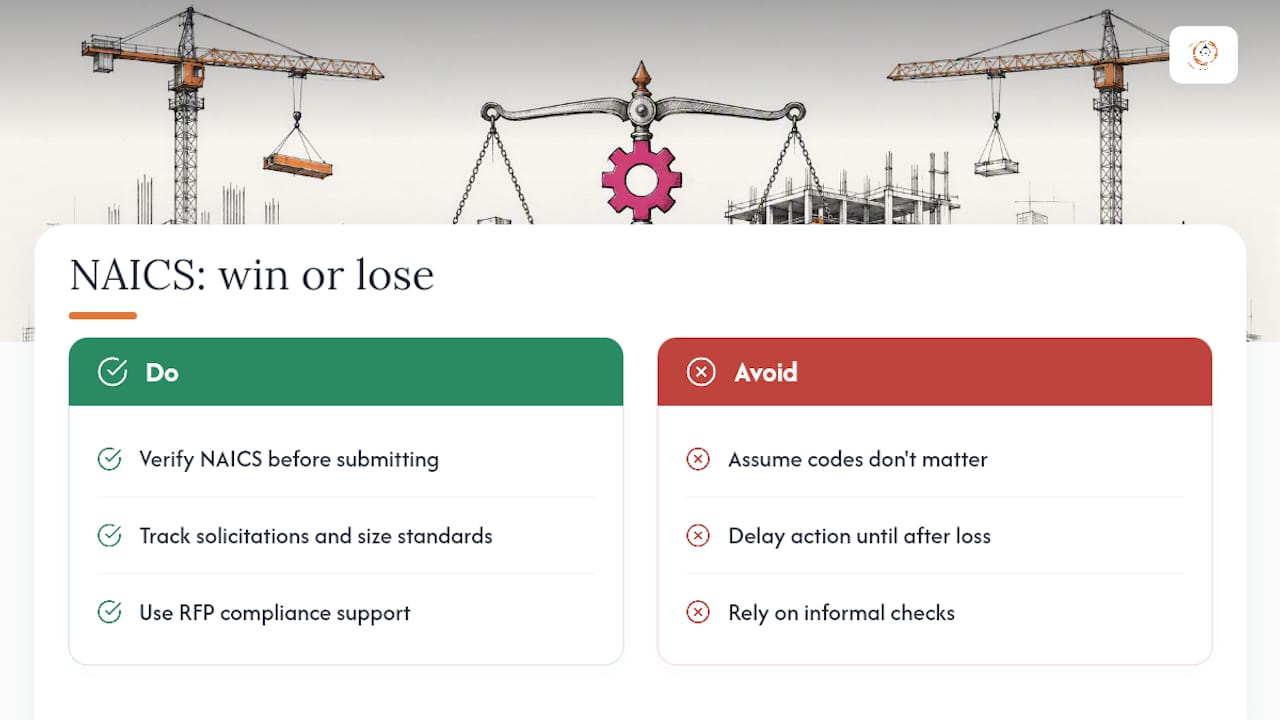
Getting the NAICS code right isn’t paperwork. It’s the gate that decides whether you’re even in the competition. Federal-rconstructionsolutions built its 5551 Pillar approach around this exact problem, because we’ve watched capable construction firms lose eligibility on technicalities they never saw coming, not on price or performance.
Our RFP writing and compliance support process is built to catch these issues early, and it’s part of why clients see 90% compliance on their bid submissions. If your team has the bandwidth to track solicitation codes and size standards internally, do it. If NAICS mistakes have already cost you an award, that’s the moment to bring in outside compliance support.
— Rowena
Reduce NAICS-Related Bid Risk With Federal Procurement Support
Federal-rconstructionsolutions gives small and mid-sized construction firms a faster path to bid eligibility than trying to interpret FAR clauses and SBA size standards on your own between estimating deadlines. Instead of guessing whether your SAM.gov codes line up with a solicitation’s principal purpose, you get direct support built specifically for construction procurement.
Our federal procurement services cover RFP writing, FAR and Davis-Bacon compliance support, SAM.gov registration and code selection, opportunity identification, and estimating support tailored to construction scopes. This work fits small and mid-sized construction firms pursuing federal contracts who need their NAICS classifications, size standards, and proposal language aligned before submission, not after a protest. Visit the Federal Procurement Services page to see how a compliance review can catch NAICS and eligibility issues before they cost you an award.
Where to Verify NAICS Codes and Size Standards
- NAICS Sector 23 (Census Bureau): official construction sector definitions.
- Acquisition: rules for how COs assign codes and size standards.
- SBA NAICS appeals guidance: how to challenge a solicitation’s code.
- 2022 NAICS manual (Census Bureau): full code listing and titles.
Sources
FAQ
What NAICS codes cover construction businesses?
Construction falls under NAICS Sector 23, divided into subsector 236 (building construction), 237 (heavy and civil engineering), and 238 (specialty trade contractors).
Does my SAM.gov primary NAICS code determine my bid eligibility?
No. The contracting officer assigns a specific NAICS code to each solicitation under FAR 19.102, and that assigned code, not your SAM primary, sets the applicable size standard.
What can I do if I think a solicitation’s NAICS code is wrong?
You can challenge it through the SBA’s size protest and appeals process, but the window to file is short, so act as soon as you review the solicitation.
What SBA size standard applies to construction NAICS codes?
Many general construction codes carry a $45 million receipts standard, while many specialty trade codes carry a $19 million standard. Always confirm the exact figure for your specific code.
How do I choose the right primary NAICS code for my construction company?
Identify the activity that generates most of your revenue, select the matching six-digit code as primary in SAM.gov, and add secondary codes only for work you can actually document performing.
Recommended
- Construction Bid Win Rate Explained for Contractors in 2026
- Federal Set-Aside Categories in Construction: 2026 Guide
- Bid Strategy Best Practices for Contractors: 2026 Guide
Working in the public sector? One short email a week — prevailing wage, certified payroll, bid protests, agency procurement rules. Free, no pitch. Subscribe.
Free and unconditional. No call required, no obligation, unsubscribe anytime.