
How MBE Utilization Plans Work for Contractors
An MBE utilization plan is your formal, written commitment to how you will meet a contract’s Minority Business Enterprise goals, and the single most important compliance action is submitting an accurate, signed plan tied to certified firms and then honoring every dollar commitment through the life of the contract. Agencies do not treat this as a one-time bid form. The USDOT’s DBE program, administered through state Unified Certification Programs (UCPs) under 49 CFR Part 26, requires recipients to monitor participation from award through closeout. New York State ESD, the Washington State Department of Transportation (WSDOT), and Rhode Island’s procurement office all use the same three-stage framework: goals set before award, commitments locked at award, and attainments measured in dollars actually paid to certified firms.
Understanding MBE plans also means knowing the terminology. The industry uses MBE (Minority Business Enterprise), MWBE (Minority and Women-owned Business Enterprise), and DBE (Disadvantaged Business Enterprise) as related but distinct designations. Federal-aid contracts follow DBE rules; state and local contracts often use MBE or MWBE. The differences between these certifications matter because certifications are not universally interchangeable unless a reciprocity agreement exists between programs.
Here is what you need to know before submitting your next bid:
- Submit the plan with the bid or within the agency’s post-award window (commonly 5–10 business days).
- List only firms verified as currently certified in the relevant state directory or UCP.
- Assign dollar amounts and NAICS codes to each subcontract line item.
- Keep signed subcontractor acknowledgements, solicitation logs, and payment records throughout the project.
- Report payments on the agency’s required schedule, typically monthly or quarterly; many agencies require quarterly workforce or EEO reports in addition to monthly payment reports.
Key Takeaways
An MBE utilization plan is a binding compliance document that agencies monitor from award through closeout, and the contractors who treat it as a project management function consistently avoid payment holds and deficiency notices.
| Point | Details |
|---|---|
| Submit accurately and on time | Attach certified firm names, FEINs, NAICS codes, dollar amounts, and signed acknowledgements before the agency deadline. |
| Integrate into estimating | Assign MBE subcontract line items during bid preparation so commitments are realistic and defensible at audit. |
| Track payments monthly | Reconcile dollars paid to each listed MBE every month; discrepancies caught early are correctable, at closeout they are not. |
| Build a GFE package contemporaneously | Log every MBE outreach contact in real time with dates, names, and responses; retroactive logs are a primary denial reason. |
| Federal-rconstructionsolutions | Provides pre-award participation packages, MBE outreach support, and payment-reporting controls to help contractors reach 90% compliance. |
Table of Contents
- How MBE utilization plans work: the field-by-field breakdown
- How agencies count MBE participation toward the goal
- When do you submit the plan, and what goes in the pre-award package?
- What happens when you cannot meet the goal: Good Faith Effort documentation
- How agencies monitor utilization and what auditors look for
- Best practices that keep your utilization plan on track
- A pre-submission checklist and sample template structure
- Why strong utilization plans are a competitive advantage, not just a compliance requirement
- Federal-rconstructionsolutions helps you submit compliant utilization plans
- Sources
- FAQ
How MBE utilization plans work: the field-by-field breakdown
Every agency form is slightly different, but the NYS ESD OCSD-4 Utilization Plan and comparable state templates share a consistent set of required fields. Knowing what each field actually demands prevents the most common responsiveness failures.
Core form fields
- Solicitation/contract number: Copy it exactly from the bid documents. A transposed digit can trigger a rejection.
- Contract value: Use the base bid amount. Some agencies want the total including alternates; read the instructions.
- MWBE goal percentage: State the agency-set goal, not your proposed participation. These are different numbers.
- Certified firm name, address, and FEIN: Pull directly from the state directory or UCP portal. Outdated addresses or a missing Federal Employer Identification Number (FEIN) are common deficiency triggers.
- NAICS or NIGP code: Match the code to the specific work the MBE will perform, not the prime’s primary code. A concrete subcontractor performing flatwork should carry NAICS 238110, not the general contractor’s code.
- Dollar amount and percentage of contract: State the estimated subcontract value in dollars and as a percentage of the total contract. Round to the nearest dollar; do not use ranges.
- Scope of work description: Write a specific, work-package-level description (“supply and install 4,200 linear feet of 8-inch ductile iron water main” rather than “plumbing work”). Vague descriptions invite auditor questions about whether the firm performed a commercially useful function.
Per 5 NYCRR §142.4, agencies must provide the utilization-plan form and specify minimum required data fields, including names, FEINs, scope descriptions, and estimated dollar amounts. Proceeds paid to firms not performing a commercially useful function are disregarded when calculating attainment.
Required supporting documents
- Signed subcontractor acknowledgement letters (one per listed firm, countersigned)
- Certification verification printout from the state UCP or MWBE directory
- Intent-to-perform or letter of intent forms where required by the agency
- Solicitation log showing outreach to certified firms (required even when the goal is met)
Pro Tip: Download the current certification status for every listed firm on the day you submit. Certification can lapse between the time you solicited the firm and your submission date, and an expired certification will make that firm’s dollars uncountable.
Jurisdictional variations at a glance
| Agency / Program | Form Name | Key Distinction |
|---|---|---|
| New York State ESD | OCSD-4 Utilization Plan | Requires FEIN, NAICS, and signed acknowledgements; submitted via NYSCS portal |
| Rhode Island procurement | MBE Utilization Plan | Five-business-day post-award submission window; aggregate utilization rate set by regulation |
| WSDOT (state-funded) | State Funded Contract Participation Plan | Separate from federal-aid DBE form; tracks MBE/WBE by contract line item |
| USDOT / State UCP | DBE Participation Schedule | Governed by 49 CFR Part 26; certification through state UCP required |
| Pennsylvania DCED | MBE/WBE Plan Template | Sets aggregate participation levels and requires quarterly reporting |
State certification directories are the primary resource agencies and prime contractors use to verify certifications and source subcontractors. Being listed in the MDOT MBE directory or your state’s equivalent increases a firm’s visibility to primes actively filling utilization commitments.
How agencies count MBE participation toward the goal
Credit calculation is where many contractors lose ground at audit. The basic rule is straightforward: agencies count the dollar value of work the certified firm actually performs with its own workforce and equipment. What complicates this is the range of exceptions and special counting rules that apply to manufacturers, suppliers, joint ventures, and trucking firms.
Standard counting rules
- Subcontracted work performed by the MBE’s own forces: 100% of the subcontract value counts toward the goal.
- Certified manufacturer: 60% of the purchase price counts (under federal DBE rules; state programs vary).
- Regular dealer / supplier: 60% of the purchase price counts for materials the firm supplies but does not manufacture.
- Trucking: Credit is based on the value of work performed by the certified firm’s own trucks and drivers; leased trucks from non-certified firms do not count unless the lease arrangement meets specific criteria.
- Joint venture: Only the portion of work the certified firm performs and controls counts. The JV agreement must specify each partner’s scope, and agencies require a copy of the agreement before award.
Per NYSDOT CAM Section 102-12, participation goals are set during project design, commitments are recorded at award, and attainments are measured after contract completion in dollars paid to certified firms. A commitment of $150,000 to an MBE subcontractor means $150,000 must appear in verified payment records at closeout.
What does not count
| Scenario | Why It Does Not Count |
|---|---|
| Work performed by the prime’s affiliate | Commercially useful function test fails; not an arm’s-length transaction |
| MBE acts as a pass-through (no real work performed) | Agency disregards proceeds per 5 NYCRR §142.4 and 49 CFR Part 26 |
| Certified firm’s certification has lapsed | Dollars paid after expiration date are not countable |
| Equipment rented from the prime to the MBE | May indicate the MBE is not performing a commercially useful function |
A practical counting example
Say your contract is $2,000,000 with a 15% MBE goal, meaning you need $300,000 in countable MBE participation. You plan the following:
- MBE electrical subcontractor performing work with its own crew: $200,000 subcontract = $200,000 credit (100%).
- MBE supplier providing rebar (regular dealer): $150,000 purchase = $90,000 credit (60%).
- MBE trucking firm using its own trucks: $25,000 = $25,000 credit (100%).
Total countable credit: $315,000, which exceeds the $300,000 goal. Document each arrangement separately and retain the subcontract agreements, purchase orders, and delivery receipts.
When do you submit the plan, and what goes in the pre-award package?
Timing rules differ by funding source and agency, and missing a deadline is treated the same as submitting an incomplete form: your bid becomes nonresponsive.
- Federal-aid DBE contracts (USDOT/FHWA/FTA): The DBE participation schedule is typically submitted with the bid or within a short window specified in the special provisions, often 3–5 business days after bid opening.
- State-funded MBE/MWBE contracts: Many states allow a post-award submission window. Rhode Island regulations set a five-business-day window after tentative award for the compliance plan. New York State agencies commonly allow 10 business days.
- WSDOT state-funded contracts: The State Funded Contract Participation Plan is submitted with the bid; WSDOT treats it as a bid responsiveness requirement.
What a typical pre-award package contains
- Completed utilization plan form (OCSD-4, WSDOT participation plan, or agency equivalent)
- Signed subcontractor acknowledgement letters for each listed firm
- Solicitation log documenting outreach to certified firms, including firms that declined
- Certification verification printouts from the state directory or UCP
- Intent-to-perform forms where required
- Any agency-specific worksheets (AAP forms, schedule of participation)
After you submit, the agency verifies certification status, locks your commitments into its system (NYSCS in New York, for example), and notifies each listed MBE of the award. If a listed MBE later declines or becomes unavailable, you must notify the agency immediately and request substitution approval before replacing the firm. Substituting without approval is a compliance violation.
Pro Tip: Build your pre-award package in parallel with your bid, not after. Waiting until award to contact MBE subcontractors almost always creates a scramble that produces weak acknowledgement letters or forces a Good Faith Effort filing.
What happens when you cannot meet the goal: Good Faith Effort documentation
A Good Faith Effort (GFE) is the documented record of the genuine steps you took to meet the MBE goal before concluding it was not achievable. Meeting the goal is always preferred. A GFE package is not a fallback strategy; it is a last resort that requires substantial, contemporaneous evidence.
TxDOT’s GFE guidance and comparable state frameworks list specific elements agencies evaluate. A GFE package typically must include:
- A solicitation log with dates, firm names, contact methods, and responses
- Copies of written solicitations sent to certified MBE firms (emails, faxes, letters)
- Documentation of follow-up attempts when firms did not respond
- Evidence of outreach to MBE trade associations and dissemination of bid documents to plan rooms or MBE directories
- Descriptions of efforts to break work into smaller packages that MBEs could perform
- Quotes or responses received, including rejections with stated reasons
- Evidence of any bonding or technical assistance offered to MBEs
GFE checklist agencies commonly use
- Did the prime solicit all certified MBEs in the relevant NAICS codes from the state directory?
- Were solicitations sent with enough lead time for MBEs to prepare a quote?
- Did the prime follow up on non-responses?
- Did the prime consider breaking larger work packages into smaller, MBE-accessible scopes?
- Did the prime document why each MBE that responded was not selected?
- Did the prime contact MBE trade associations and provide bid documents?
- Were price quotes received and compared?
Agencies route GFE packages through a review committee, sometimes called a Pre-Award Review Committee (PARC), which evaluates each element against the checklist. The most common denial reasons are late solicitation logs (created after the fact rather than contemporaneously), vague outreach notes with no dates or contact names, and absence of any price quotes.
Pro Tip: Log every MBE contact in real time, not at bid closing. A solicitation log dated the same day as bid submission is an immediate red flag for reviewers.
Waiver requests
When compliance is genuinely impossible, some agencies allow a formal waiver. Rhode Island’s regulations outline a waiver evaluation process for situations where meeting the aggregate utilization rate is not feasible. Waivers require the same documentation as a GFE package plus a written explanation of why the goal cannot be met, and they are approved at the agency’s discretion. Partial waivers, where the prime meets a reduced goal and documents why the full goal was unachievable, are more commonly approved than full waivers.
Common GFE pitfalls to avoid:
- Soliciting firms outside the relevant NAICS codes and counting those contacts
- Sending solicitations with a 24-hour response window
- Listing firms that are not currently certified
- Failing to document why a responsive MBE’s quote was rejected
How agencies monitor utilization and what auditors look for
The most common misconception about MBE utilization plans is that compliance ends at award. Agencies treat the plan as a living compliance document and monitor payments and workforce data throughout the contract term.
Reporting cadence varies by agency and contract type, but the standard pattern is:
- Monthly payment reports: Submitted in the agency’s portal (NYSCS, WSDOT’s system, or equivalent), documenting amounts paid to each listed MBE during the reporting period.
- Quarterly workforce/EEO reports: Required on many contracts in addition to monthly payment reporting; these document workforce composition by trade and demographic category.
- Final attainment report: Submitted at project closeout, reconciling total dollars paid to certified firms against the committed goal.
What auditors request
Common audit triggers include large discrepancies between committed and paid amounts, multiple consecutive months of zero payments to a listed MBE, and inconsistent addresses or contact information across documents. When an audit finds a discrepancy, the agency typically issues a deficiency notice requiring a written response and corrective action plan within a set number of days. Repeated or uncorrected deficiencies can result in withheld progress payments or, in serious cases, contract termination.
Pro Tip: Assign one person on your team as the MBE compliance point of contact. That person should reconcile payments to listed MBEs every month, not at the end of the project. Catching a missed payment in month two is a correctable error; catching it at closeout is a payment hold.
For a broader look at avoiding compliance violations on government contracts, the controls that prevent audit triggers are the same ones that protect your payment schedule.
Best practices that keep your utilization plan on track
Treating MBE utilization as a project management function, not an administrative form, is the single most effective way to prevent post-award noncompliance. Integrating compliance workflows into your project schedule from the estimating phase forward reduces the risk of scrambling at reporting deadlines.
Pro Tip: When you build your estimate, assign a line item for each MBE subcontract scope and attach the NAICS code. This creates a direct link between your bid and your utilization plan, making the form faster to complete and the commitments more defensible.
Outreach tactics that produce results
- Use the state UCP or MDOT-style directory to pull certified firms by NAICS code and geography before soliciting.
- Send written solicitations at least 10 business days before bid closing to give MBEs time to prepare competitive quotes.
- Provide complete bid documents, plans, and specifications with every solicitation, not just a scope summary.
- Offer bonding support, technical assistance, or extended payment terms to MBEs that express interest but cite capacity concerns. Agencies increasingly look for these capacity-building commitments in utilization plans, not just dollar figures.
- Follow up by phone or email within 48 hours of the written solicitation.
Internal controls worth building now
- Create a payment-tracking spreadsheet that maps each listed MBE to its committed dollar amount, with columns for each payment period.
- Assign a named compliance point of contact who owns the monthly payment report submission.
- Conduct a quarterly internal audit comparing committed amounts to paid amounts before the agency does.
- Retain all subcontract agreements, purchase orders, and payment records in a dedicated project folder organized by MBE firm name.
- Verify certification status for each listed firm at the start of every quarter.
For finding and qualifying MBE subcontractors on public projects, a structured outreach process tied to the state directory is the most reliable method.
Additional practices that reduce dropout risk:
- Use signed intent-to-perform letters at the time of solicitation, not just at award.
- Include a substitution clause in your subcontract that mirrors the agency’s substitution approval requirement.
- Brief MBE subcontractors on the reporting system so they know what payment confirmations the agency may request from them directly.
A pre-submission checklist and sample template structure
Before you submit any utilization plan, run through this checklist. A single missing item can make an otherwise strong bid nonresponsive.
Pre-submission checklist
- [ ] Solicitation/contract number matches bid documents exactly
- [ ] Contract value reflects the correct base bid amount
- [ ] MWBE goal percentage matches the agency-set goal
- [ ] Each listed firm’s name, address, and FEIN pulled from the current state directory
- [ ] NAICS or NIGP code assigned to each subcontract scope
- [ ] Dollar amount and percentage stated for each listed firm
- [ ] Scope of work description is specific and work-package-level
- [ ] Signed subcontractor acknowledgement letter attached for each firm
- [ ] Certification verification printout attached for each firm (dated within 30 days)
- [ ] Solicitation log attached, showing outreach to firms not listed
- [ ] All required agency-specific forms completed (AAP, intent-to-perform, etc.)
- [ ] Form signed by authorized representative of the prime contractor
Sample template structure
- Header block: Project name, solicitation number, contract value, agency name, prime contractor name and address, submission date.
- MWBE goal section: Agency-set goal percentage, total contract dollar value, total MBE dollar commitment, resulting participation percentage.
- Firm commitment table: One row per certified firm: firm name, FEIN, certification type (MBE/WBE/DBE), NAICS code, scope description, subcontract dollar amount, percentage of contract.
- Scope-of-work narrative: One paragraph per firm describing the specific work package, location, and estimated duration.
- Attachments list: Numbered list of all attached documents (acknowledgement letters, certification printouts, solicitation log, intent-to-perform forms).
- Signature block: Authorized representative signature, printed name, title, date.
Pro Tip: Save your utilization plan as a versioned file (e.g., “ProjectName_UtilizationPlan_v1_2026-03-15.pdf”) and keep every version. If the agency requests a revision, the version history shows you responded promptly and documents what changed.
For a federal procurement compliance checklist that maps these steps to payment-reporting controls, that resource covers the full pre-award through closeout cycle.
Why strong utilization plans are a competitive advantage, not just a compliance requirement
The contractors who treat MBE utilization plans as a compliance checkbox tend to be the same ones who receive deficiency notices six months into a project. The ones who build utilization into their estimating, scheduling, and payment workflows consistently outperform on contract performance evaluations, and agencies notice.
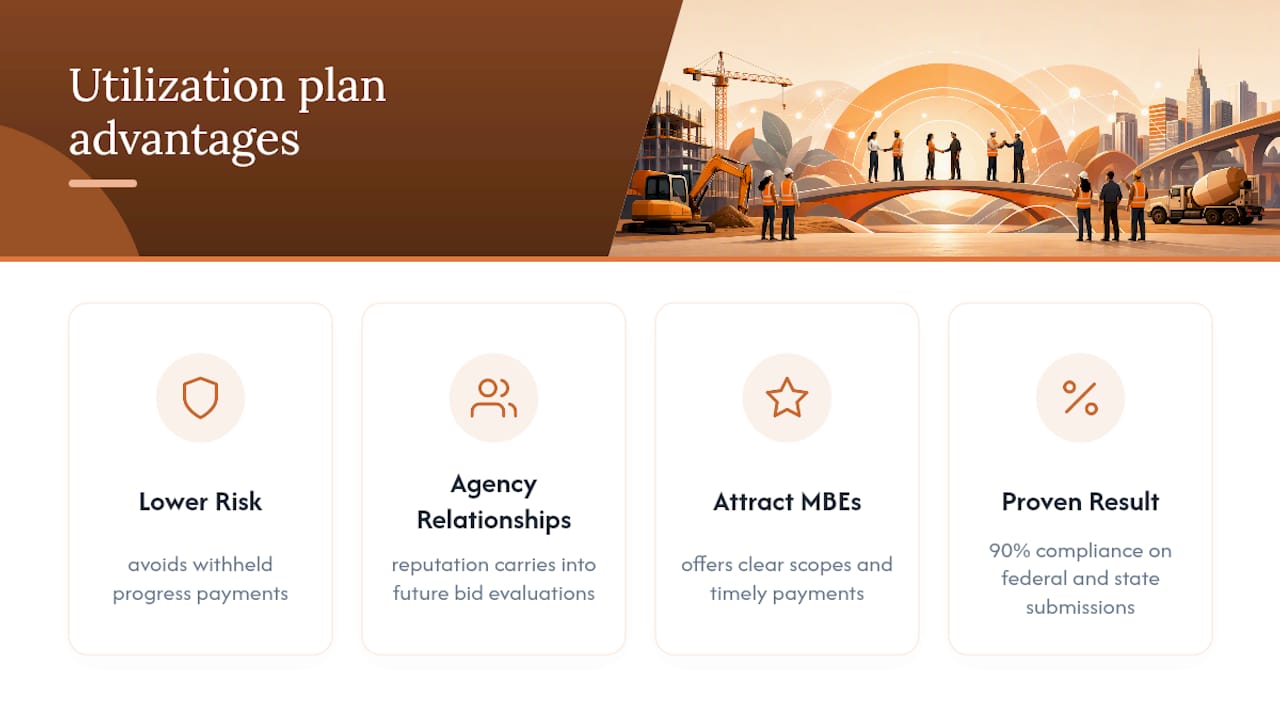
A well-executed utilization plan does three things beyond keeping you compliant. First, it reduces payment risk. Agencies withhold progress payments when MBE reporting is delinquent or when commitments and payments diverge. A contractor with clean monthly reports and a compliance point of contact rarely faces that disruption. Second, it builds agency relationships. Contracting officers remember which primes submit complete, accurate packages and which ones require repeated deficiency notices. That reputation carries into future bid evaluations. Third, it opens doors with MBE subcontractors who have choices about which primes they work with. Firms that offer clear scopes, timely payments, and genuine outreach attract better subcontractors than firms that treat MBEs as a last-minute compliance fill.
Federal-rconstructionsolutions works with construction businesses to achieve 90% compliance rates on federal and state contract submissions, including pre-award participation packages and MBE utilization plan drafting. The discipline required for a strong utilization plan is the same discipline that drives overall contract performance.
Federal-rconstructionsolutions helps you submit compliant utilization plans
Drafting an MBE utilization plan that passes agency review requires more than filling in a form. It requires knowing which certified firms are available in your NAICS codes, how to structure subcontract scopes so they survive a commercially useful function review, and how to build the payment-tracking controls that keep you clean through closeout.
Federal-rconstructionsolutions provides federal procurement and compliance support specifically for construction businesses, including pre-award participation package preparation, MBE outreach support, RFP writing, and payment-reporting controls. The firm’s 5551 Pillar approach integrates utilization planning directly into the bid and project management process, so compliance is built in from day one rather than patched in after award. For contractors who want a utilization-plan review or a compliance health-check before their next submission, contact Federal-rconstructionsolutions to schedule a consultation.
Sources
These primary agency forms and guidance documents are the canonical references for drafting and submitting MBE utilization plans across North American jurisdictions.
- Disadvantaged Business Enterprise (DBE) Program | US Department of Transportation
- OCSD-4 Utilization Plan (New York State ESD)
- §102-12 DBE/MBE/WBE/SDVOB participation (NYSDOT CAM Section 102-12)
- Minority & Women-Owned Business Enterprise (MWBE) - NYSDEC
- TxDOT contract letting and GFE guidance
- MBE certification is worth it for contractors bidding on public work — MDOT guidance
- MBE/WBE plan template and participation procedures (PA/DCED)
- 5 NYCRR §142.4 — Utilization plans (New York regulations)
This article is general information, not a substitute for advice from a qualified lawyer. Consult a qualified legal professional about your own circumstances before acting on anything here.
FAQ
What is an MWBE utilization plan?
An MWBE utilization plan is a contractor’s formal written commitment, submitted to the contracting agency, identifying the certified Minority and Women-owned Business Enterprise firms that will perform work on a contract, the dollar amounts committed to each, and the NAICS codes and scope descriptions for each subcontract. Agencies use it to verify that the contractor will meet the contract’s MWBE goal before award and to monitor payments against those commitments throughout the project.
What is the difference between DBE and MBE?
DBE (Disadvantaged Business Enterprise) is a federal designation governed by 49 CFR Part 26 and administered through state UCPs; it applies to USDOT-funded contracts. MBE (Minority Business Enterprise) is a state or local designation used on non-federal or state-funded contracts, with certification and counting rules set by each state program. The certifications are not automatically interchangeable unless a reciprocity agreement exists between the programs.
Is MWBE certification worth it for firms bidding on public work?
Yes. State certification directories are the primary resource agencies and prime contractors use to verify certifications and source subcontractors, so being listed directly increases a firm’s visibility to primes filling utilization commitments on public contracts.
What is MBE in procurement?
In public procurement, MBE refers to a business owned, operated, and controlled by one or more members of a minority group and has received certification from the relevant state or local certifying authority. Agencies set MBE participation goals on contracts and require prime contractors to document their efforts to meet those goals through a utilization plan.
What happens if a contractor does not meet the committed MBE goal?
If payments to listed MBEs fall short of committed amounts at closeout, the agency typically issues a deficiency notice requiring a written response and corrective action plan. Depending on the severity and the contractor’s compliance history, consequences can include withheld progress payments, required substitution of additional MBE work, or, in cases of willful noncompliance, contract termination.