Audit Ready for FAR 15.404-3: Estimating Subcontractor Quotes
Never treat a subcontractor’s bottom-line total as a comparable price. Require line-item breakdowns for labor, materials, equipment, and overhead, then run every quote through a bid-leveling matrix before you rank anyone. Add prequalification checks and a documented basis of estimate, and you protect your margin while building a paper trail that survives an audit or a losing bidder’s protest.
TL;DR:
- Always require detailed line-item breakdowns for labor, materials, equipment, and overhead to accurately compare subcontractor quotes and prevent hidden scope gaps.
- Use a scope matrix to normalize inconsistent bids by adding missing items and verifying scope alignment, reducing the risk of cost surprises during project execution.
- Conduct thorough prequalification checks, including verifying licenses, insurance, bonds, and safety records, to identify red flags beyond just the lowest bid.
- Cross-check loaded labor rates and material pricing against recent history and treat markups separately to ensure realistic and comparable cost estimates.
- Maintain detailed documentation of basis of estimate, clarification requests, and bid leveling processes to ensure compliance and improve chances of winning federal contracts.
Table of Contents
- What Is Estimating Subcontractor Quotes, and How Does It Differ From Bids?
- How to Read and Break Down a Subcontractor Quote
- Bid Leveling: How Do You Normalize Subcontractor Quotes for Comparison?
- Prequalification and Red Flags: What Should You Verify Before Award?
- How Do You Calculate and Sanity-Check Subcontractor Costs?
- Compliance and Documentation: What Records Does Federal Work Require?
- Tools, Templates, and Bid-Day Workflow Tips
- How Federal-Rconstructionsolutions Applies This in Practice
- Get Audit-Ready Subcontractor Bid Support From Federal-Rconstructionsolutions
- Sources
- FAQ
What Is Estimating Subcontractor Quotes, and How Does It Differ From Bids?
A subcontractor quote is a stated price for defined scope, and it should carry the exclusions, assumptions, and validity period that make it a real number you can act on. An estimate is looser: a preliminary figure a sub offers before drawings are complete, often padded with contingency because the scope isn’t locked. A bid or proposal is the formal, often binding response to your invitation, tied to specific plans and specifications.
Confusing these terms costs money. A framer who gives you a “ballpark” over the phone hasn’t quoted you anything binding, and treating that number as a firm price in your estimate invites a change order later. Expect firm quotes only after you’ve issued complete bid documents. Watch for where ambiguity hides: mobilization costs, permit fees, and site protection get buried in fine-print notes far more often than in the headline number.
How to Read and Break Down a Subcontractor Quote
Every quote hides its real cost structure inside qualifications and footnotes, not the total on page one. Work through each submission with the same checklist so nothing slips past you:
- Labor: confirm hours multiplied by rate, and check whether the rate is loaded or base.
- Materials: verify specs and quantities match your takeoff, not a generic allowance.
- Equipment: identify what’s owned versus rented, and for how many days.
- Overhead and profit: separate this from raw cost so you can compare markup strategies across bidders.
- Bonds and allowances: note whether bonding cost is included or billed separately.
- Exclusions: scan qualifications for mobilization, testing, dewatering, and site protection, the usual places subs carve out cost.
- Administrative details: check the quote’s validity date, payment terms, material lead times, and schedule assumptions before you rely on it.
A quote missing half of this detail isn’t incomplete by accident, and knowing lot clearing for construction cost items can help spot scope gaps subs often exclude. It’s often a sign the sub is leaving room to negotiate change orders after award.
Bid Leveling: How Do You Normalize Subcontractor Quotes for Comparison?
Bid leveling is the process that turns five wildly different-looking quotes into an apples-to-apples comparison, and it’s the step most estimators skip when they’re rushed. Best-practice guidance recommends building a scope matrix rather than eyeballing totals, because apparent low bidders frequently turn out to be the most expensive once missing scope gets priced in.
Here’s the sequence that works on real bid days:
- Build a scope baseline from your specs and drawings, including items subs commonly forget, like temporary protection, permits, and final cleanup.
- Populate a scope matrix, marking each line INC, EXC, or UNCLEAR for every bidder against your baseline.
- Plug in missing items using your own historical unit costs, and issue Bid Clarification Requests with a firm deadline for anything ambiguous.
- Calculate normalized totals once every bidder’s scope matches the baseline, so you’re comparing true cost, not creative omission.
- Rank the normalized totals and select the lowest qualified bidder, with your leveling sheet attached as documentation for the award decision.
A documented, step-by-step leveling process for a single trade package with four bidders and thirty line items typically runs two to four hours by hand. That’s real time, but it’s far cheaper than the change order you’ll eat when an “exclusion” surfaces mid-project.
Pro Tip: When two or more bidders exclude the same item, don’t just plug a number in and move on. That pattern usually means your spec itself is ambiguous, and the right fix is a clarification bulletin sent to every bidder, not a silent adjustment on one sheet.
Prequalification and Red Flags: What Should You Verify Before Award?
Price only tells half the story. A subcontractor can hand you the lowest normalized total on your matrix and still be the wrong choice if their insurance lapsed last month or their experience modification rate signals a safety problem waiting to happen.
Build prequalification into every bid package, not just the ones for large trades:
- Active license in your project’s jurisdiction, verified directly with the licensing board.
- Bond letter confirming bonding capacity for the size of your package.
- Certificate of insurance with the additional insured riders your contract requires.
- Experience modification rate (EMR), since anything above 1.0 warrants a closer look at their safety record.
- Two to three references from comparable recent projects, called directly rather than taken on faith.
Watch for red flags that show up before you ever check a reference: a quote with no breakdown at all, an insurance certificate close to its expiration date, evasive answers about scope, or pricing so far below the pack that nobody can explain the gap. Quick supplier calls and a basic trade credit check catch most of what a glossy proposal hides. A structured evaluation approach that checks schedule fit and past performance alongside price consistently outperforms price-only screening.
How Do You Calculate and Sanity-Check Subcontractor Costs?
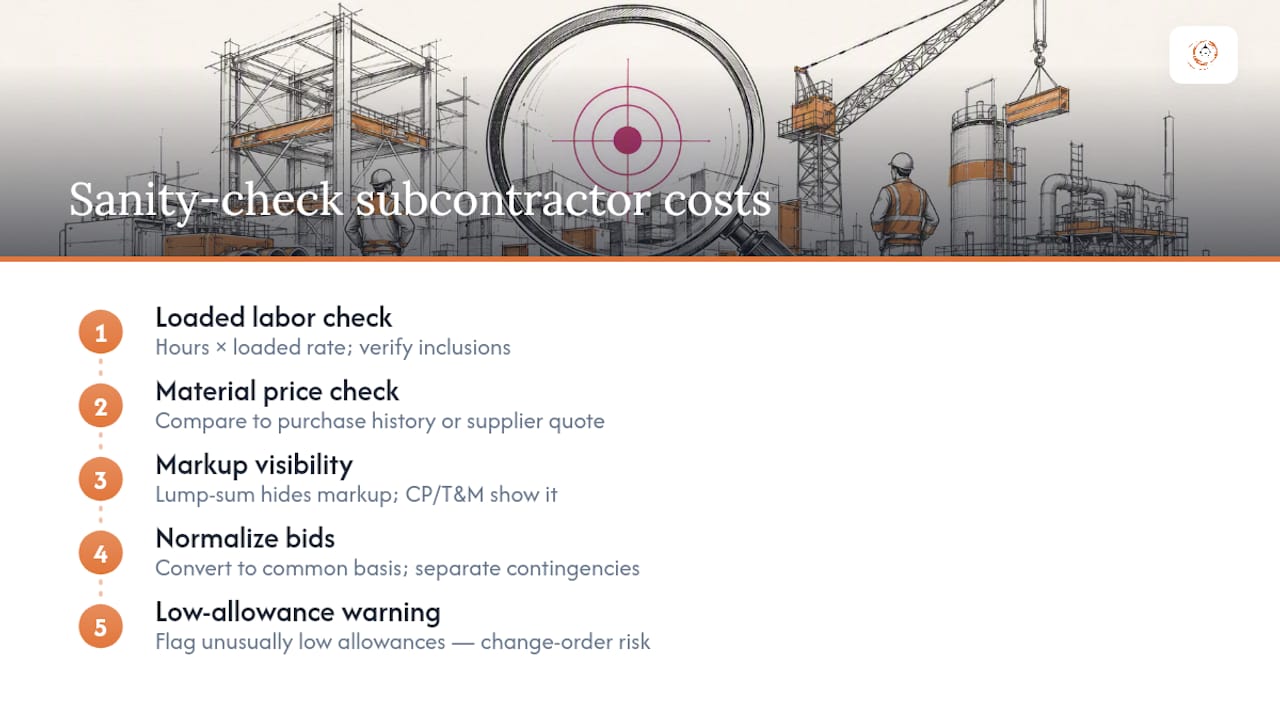
Start with the loaded labor check: multiply stated hours by the loaded rate, and confirm what “loaded” actually includes. A rate that only covers wages, without payroll taxes, workers’ comp, and burden, will look artificially cheap next to a competitor’s honest number.
Cross-check material pricing against your own recent purchase history or a supplier quote for the same specification.
Markups deserve the same scrutiny. Lump-sum bids fold overhead and profit into one number, so you can’t always see the markup percentage directly, while cost-plus and time-and-materials proposals show it explicitly. When normalizing bids that mix these pricing strategies, convert everything to a common basis, and treat contingency and allowances as separate line items rather than folding them into the base price. An allowance that’s unusually low often means the sub expects you to cover the difference through a change order later.
Compliance and Documentation: What Records Does Federal Work Require?
If you’re bidding federal work, FAR 15.404-3 requires you to perform and document a cost or price analysis on every subcontractor proposal above the applicable threshold. Passing through a subcontractor’s lump-sum total without that analysis isn’t a shortcut, it’s a compliance failure that can get proposals flagged or costs disallowed during audit.
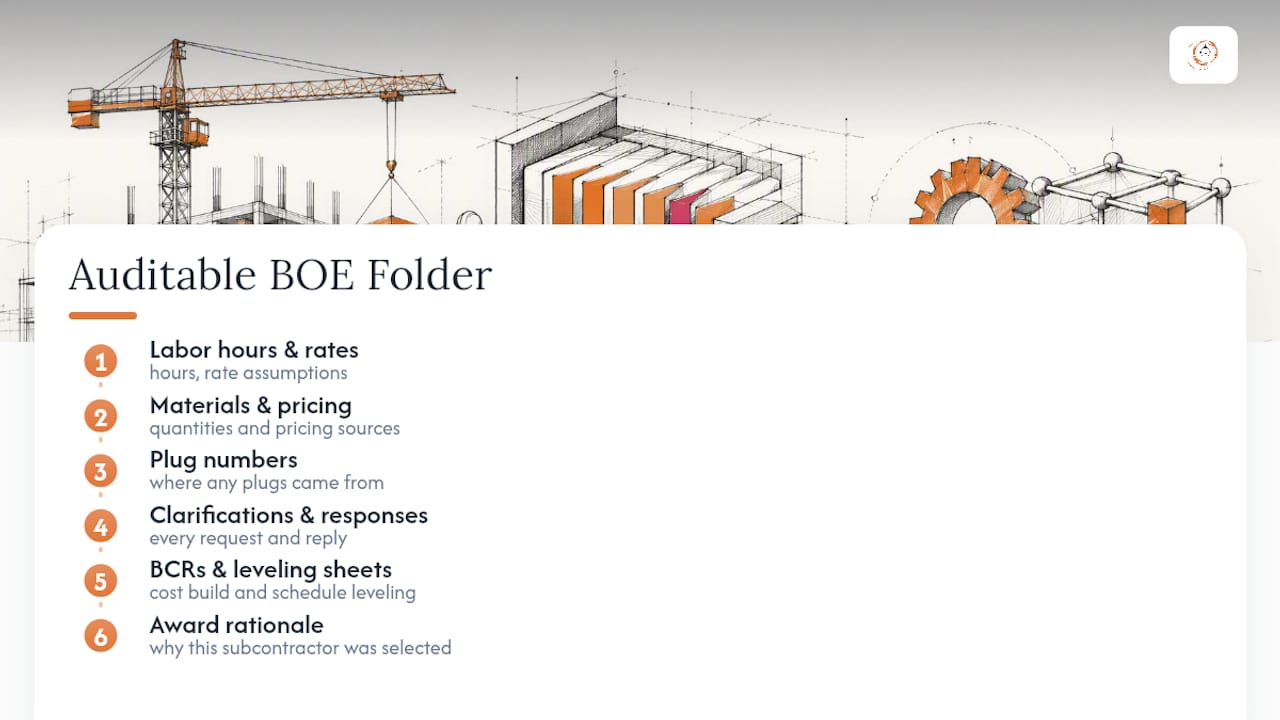
Your basis of estimate (BOE) for each subcontracted item should capture: labor hours and rate assumptions, material quantities and pricing sources, where any plug numbers came from, and every clarification request and its response. Store your BCRs, leveling sheets, and award rationale together in one auditable folder per project. When an auditor or contracting officer asks why you selected a particular sub, that folder should answer the question without a single phone call.
Tools, Templates, and Bid-Day Workflow Tips
A standardized bid form that mirrors your own estimate template eliminates most of the reformatting work that eats bid-day hours. When a bid form asks for exactly the categories your estimate needs, sub numbers plug in without translation.
- Use pre-leveled placeholders for trades where bids typically arrive late, so a straggler doesn’t stall the whole comparison.
- For last-minute bids, level only the top three to five scope items instead of the full matrix, and set a go/no-go threshold for anything that looks suspiciously low.
- Integrate sub bid import directly into your estimating software, which reduces bid-day transcription errors compared to manual entry.
How Federal-Rconstructionsolutions Applies This in Practice
Some firms build their approach around one reality: contracting officers reward documented reasoning, not just low numbers. Success in securing awards on public water projects reflects the same leveling and BOE discipline outlined here, applied under real federal deadlines. Clients engaging consulting services for bid support can expect the same scope-matrix and clarification-request rigor, adapted to their trade mix and submission timeline.
— Rowena
Get Audit-Ready Subcontractor Bid Support From Federal-Rconstructionsolutions
Some consulting services offer alternatives to building your compliance documentation from scratch under deadline pressure. Where most estimators scramble to reconstruct a basis of estimate after a contracting officer asks for one, building the leveling sheets, clarification logs, and BOE documentation into the bid process from day one ensures award rationale is ready before anyone asks for it.
That matters most on large federal packages, tight-timeline rebids, or any submission where a losing bidder might protest your selection. Federal-Rconstructionsolutions supports the full workflow, from RFP writing and compliance support to pre-bid qualification assistance, and helps contractors manage bid activity through platforms like BuildingConnected, ConstructConnect, and BidNet Direct. If you’re pursuing private-sector work alongside federal contracts, the firm’s estimating and budgeting guidance applies the same normalized-bid discipline to that side of your business. Reach out to Federal-Rconstructionsolutions to scope your next bid package before your next bid date locks in.
Sources
- Federal Acquisition Regulation (FAR) Part 15 — Contracting by Negotiation
- Subcontractor Bid Management Guide (2026)
- How to level subcontractor bids: a step-by-step process for GC estimators
FAQ
How Do You Calculate Subcontractor Cost?
Multiply verified labor hours by the loaded rate, which should include wages, payroll taxes, workers’ comp, and burden, then add material costs checked against your own recent pricing. Layer in equipment, overhead, and profit separately so you can see the actual markup rather than one blended total.
Can ChatGPT Do Construction Estimates?
General-purpose AI tools can help organize a scope matrix or draft clarification request language, but they can’t verify a sub’s actual material pricing, licensing status, or insurance coverage. Treat any AI output as a drafting aid, not a substitute for the prequalification checks and bid leveling described above.
What Is a Reasonable Markup for Subcontractors?
Markup varies widely by trade, project risk, and pricing strategy, so there’s no single universal percentage. What matters more during comparison is consistency: normalize lump-sum, cost-plus, and time-and-materials bids to a common basis before judging whether one sub’s markup looks out of line with the others.
Do Contractors Usually Charge for Estimates?
Most subcontractors provide bid-stage estimates for free as part of pursuing the work, though highly detailed preconstruction estimating on complex projects sometimes carries a fee. Always confirm this upfront in your invitation to bid so pricing expectations are clear before subs invest time in a quote.
What Does Federal-Rconstructionsolutions Charge for Bid Support?
Pricing for services like RFP writing, compliance support, and pre-bid qualification assistance is available directly on the Federal-Rconstructionsolutions site. Contact the firm for a scope-specific quote based on your project size and timeline.
Recommended
- Subcontractor Prequalification Checklist: What to Verify Before Award
- Bid Strategy Best Practices for Contractors: 2026 Guide
- FAR Regulations for Construction Explained: 2026 Guide
- Pass GSAM/FAR Review: Schedule of Values for Federal Projects
Working in the public sector? One short email a week — prevailing wage, certified payroll, bid protests, agency procurement rules. Free, no pitch. Subscribe.
Free and unconditional. No call required, no obligation, unsubscribe anytime.