
How Federal Contractors Match Equipment Rates to FEMA, USACE, and FHWA
Use FEMA’s Schedule of Equipment Rates for disaster-recovery work and the USACE Construction Equipment Ownership and Operating Expense Schedule (EP 1110-1-8) for Corps solicitations above the Simplified Acquisition Threshold. Actual cost records always take priority over either schedule, under FAR 31.105. If you can’t document actual costs, download the applicable schedule now, run the numbers through USACE’s CHECKRATE workbook, and keep that worksheet in your proposal backup file.
TL;DR:
- FEMA equipment rates apply only to disaster recovery work, exclude operator labor, and require actual operation for reimbursement.
- USACE EP 1110-1-8 offers a comprehensive methodology, including regional adjustments and a calculation workbook for projects above the Simplified Acquisition Threshold.
- Commercial rate guides like the Blue Book include unallowable costs such as contingency and escalation, which must be adjusted before federal use.
- Actual cost documentation is preferred under FAR 31.105, with schedules serving as a fallback when actual costs cannot be documented.
- Proper rate calculation involves separating ownership and operating costs, converting published rates correctly, and matching the schedule to the specific contract type to avoid disallowance.
Table of Contents
- Which Official Equipment Rate Schedules Apply to Federal Contracts
- How to Calculate Equipment Rates the Way Federal Reviewers Expect
- Allowable vs Unallowable Costs: Where Equipment Rates Get Disallowed
- Using Equipment Rate Schedules to Build Proposals and IGCEs
- What Experienced Federal Estimators Actually Do Differently
- Get Help Turning Equipment Rates Into a Winning Bid
- Where to Download the Official Rate Schedules
- Sources
- FAQ
Which Official Equipment Rate Schedules Apply to Federal Contracts
Federal construction contracts don’t leave equipment pricing to guesswork, and they don’t let you pick whichever schedule produces the highest number. Each authoritative source exists for a specific contracting situation, and picking the wrong one is one of the fastest ways to draw a contracting officer’s scrutiny or an after-the-fact audit finding.
FEMA’s Schedule of Equipment Rates applies almost exclusively to disaster recovery and emergency work funded under the Stafford Act. As of July 1, 2025, the Schedule of Equipment Rates sets predetermined hourly rates for applicant-owned equipment used in presidentially declared disasters. Those rates fold in depreciation, overhead, maintenance, fuel, lubricants, tires, and required OSHA safety equipment. What they don’t cover is operator labor, which gets billed as a separate line item entirely. FEMA also requires that equipment actually be operating and performing eligible work to qualify for reimbursement; standby time doesn’t count, a rule confirmed in FEMA’s public assistance guidance. If your firm does debris removal, road repair, or infrastructure restoration after a hurricane or flood declaration, this is your primary reference.
USACE EP 1110-1-8 governs a different world entirely: Army Corps of Engineers construction solicitations, particularly those expected to exceed the Simplified Acquisition Threshold. The EP 1110-1-8 methodology gives estimators a full framework, not just a rate table. It includes regional cost volumes that adjust for geographic variation, plus the CHECKRATE Excel workbook that automates the ownership and operating cost math so you’re not doing it by hand. If you’re bidding on a Corps of Engineers project, whether it’s levee work, dredging, or vertical construction on a military installation, this pamphlet is the document your estimate needs to trace back to.
FHWA guidance occupies a middle position. The Federal Highway Administration doesn’t publish its own equipment rate table the way FEMA and USACE do. Instead, FHWA guidance addresses how state highway agencies and their contractors should treat industry rate guides when pricing equipment for federally funded highway work. This matters because FHWA and its Office of Inspector General have flagged a recurring problem: commercial rate guides often bake in cost elements that federal cost principles don’t allow. According to FHWA’s contract administration guidance, contingency factors and replacement-cost escalation frequently show up in these guides and need to be stripped out or adjusted before the rates touch a federal invoice.
That brings up the fourth reference point contractors lean on constantly: The Rental Rate Blue Book, published by EquipmentWatch. It isn’t a government document, and no federal regulation requires its use. But FHWA guidance discusses it directly because so many state DOTs and contractors treat it as a starting benchmark for equipment pricing. The Blue Book publishes monthly ownership rates by make, model, and age, along with regional adjustment factors. Its value lies in the breadth of equipment it covers and how frequently it updates. Its limitation is exactly what FHWA warns about: the published figures include allowances built for commercial rental markets, not federal reimbursement rules, so you can’t drop a Blue Book number straight into a federal proposal without adjustment.
Here’s the quick-reference breakdown estimators use to sort these:
- FEMA Schedule of Equipment Rates — disaster and emergency work under Stafford Act declarations; excludes operator labor and standby time
- USACE EP 1110-1-8 — Corps of Engineers construction contracts above the SAT; includes CHECKRATE workbook and regional volumes
- FHWA guidance — governs how highway agencies treat commercial rate guides, requiring adjustment for unallowable cost elements
- The Blue Book — industry benchmark for commercial equipment rental rates, useful as a starting point but not federally compliant as published
- GSA CALC+ — labor rate benchmarking tool for MAS contracts, not an equipment rate source but essential for blended cost proposals
Get the wrong schedule attached to the wrong contract type, and you’ve built your entire equipment pricing line on a foundation the contracting officer can reject outright.
How to Calculate Equipment Rates the Way Federal Reviewers Expect
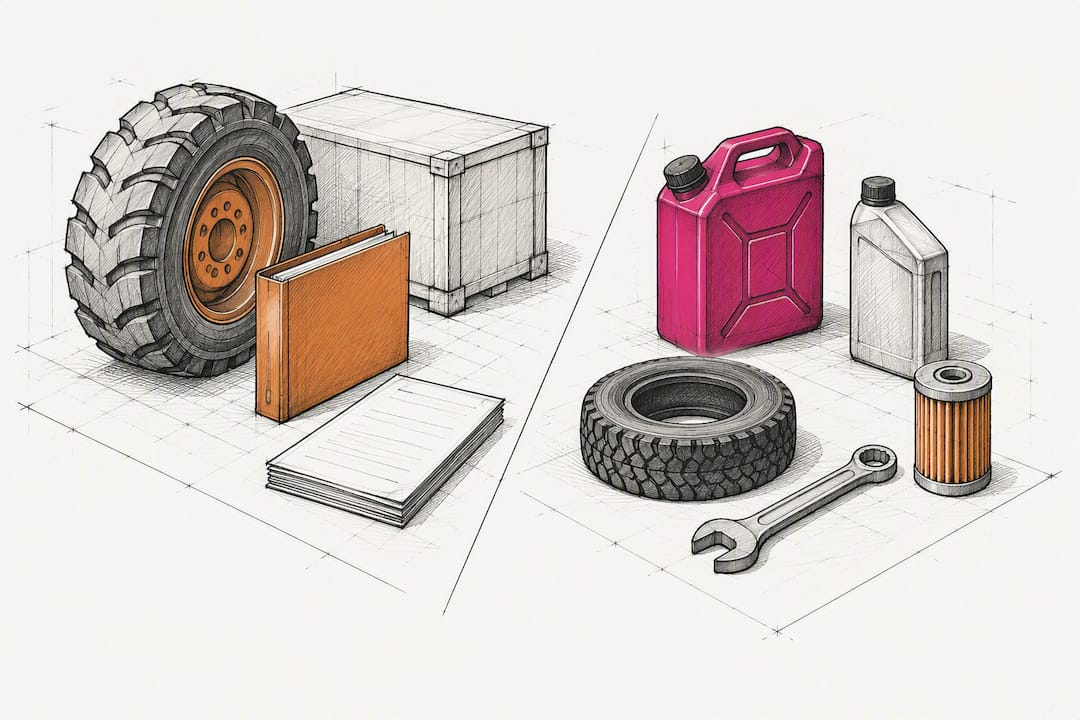
Every defensible equipment rate breaks into two buckets: ownership costs and operating costs. Ownership costs cover depreciation, cost of facilities capital (FCCM), insurance, taxes, and storage, essentially what it costs you to own the machine whether or not it’s running. Operating costs cover fuel, lubricants, tires, routine maintenance, and consumable parts, the costs tied directly to hours of actual use. Federal reviewers expect estimators to be able to separate these two categories cleanly, because they get treated differently depending on which schedule or accounting method you’re using.
Where this gets confusing for a lot of estimators is converting published rates into the hourly figures a proposal actually needs. Blue Book rates are published monthly, but federal line items are almost always priced hourly. The conventional FHWA approach divides the monthly rate by 176 hours to produce an hourly figure. That 176 number isn’t arbitrary. It reflects a standard assumption about available working hours in a month after accounting for weekends, weather delays, and routine downtime. Skip this conversion, or use a different hour count without documenting why, and your rate won’t reconcile with what a contracting officer sees on similar bids.
Standby time is where a lot of contractors lose money they thought they’d recover. FEMA’s rules are explicit: equipment has to be in operation performing eligible work to generate a billable hour. Idle time on a job site, even if the equipment is mobilized and ready, doesn’t qualify for FEMA reimbursement. FHWA guidance treats standby differently in some highway contexts, with separate conventions for calculating reduced standby rates when equipment is held on-site under contract terms. The takeaway: don’t assume standby rules from one federal program carry over to another. Check the specific schedule governing your contract before you build standby hours into your price.
For USACE work, the EP 1110-1-8 methodology asks for a specific set of inputs before you can generate a rate:
- TEV (Total Equipment Value) — the current replacement or acquisition value of the equipment
- AVF (Area Volume Factor) — a regional adjustment reflecting local market and operating conditions
- LIFE — the expected useful life of the equipment in operating hours or years
- WHPY (Working Hours Per Year) — the assumed annual operating schedule for the equipment class
Feed those into the CHECKRATE workbook and it generates the total hourly ownership and operating rate, along with a standby rate calculated on a separate formula. The workbook does the arithmetic, but it doesn’t validate your inputs, so an estimator who plugs in a wrong AVF for the wrong Corps district will get a clean-looking rate that’s wrong from the start.
Pro Tip: Save every CHECKRATE output file with a timestamp and a note on which inputs you used. If a contracting officer questions your rate six months into contract performance, you want to reproduce the exact calculation in five minutes, not reconstruct your logic from memory.
GSA’s CALC+ tool doesn’t calculate equipment rates at all, but it belongs in this conversation because most federal construction proposals blend equipment costs with labor costs on the same pricing schedule. CALC+ pulls awarded Multiple Award Schedule ceiling rates for labor categories, showing medians and percentile distributions estimators can use to sanity-check their own labor pricing alongside the equipment figures they’re building from FEMA or USACE sources.
Allowable vs Unallowable Costs: Where Equipment Rates Get Disallowed
Federal cost principles start from a simple preference that trips up a surprising number of estimators: actual cost data beats predetermined schedules every time it’s available. FAR 31.105 states plainly that contracting officers should require actual cost records when a contractor can produce them, and reserve predetermined schedules for situations where actual costs genuinely can’t be determined. Schedules aren’t a shortcut you get to choose for convenience. They’re a fallback, and treating them as your default approach when you have the accounting capacity to track real costs invites questions during review.
When you do rely on a schedule, FAR 31.105 requires the contracting officer, and by extension you, to review it for cost elements the government won’t reimburse. This is where FHWA’s OIG findings become directly relevant again. Commercial guides like the Blue Book are built for a rental market that expects to recover contingency margin and future replacement cost inflation baked into today’s rate. Federal cost principles generally don’t allow either of those elements in a reimbursable equipment rate.
Common adjustments contractors need to make before submitting a schedule-derived rate:
- Strip out contingency factors embedded in commercial guide pricing
- Recalculate depreciation using the equipment’s actual acquisition cost basis, not an inflated replacement value
- Remove any built-in profit margin that a commercial rental rate assumes but a cost-reimbursement rate shouldn’t include
- Separate operator labor out of any blended rate, since it’s billed independently under FEMA and most USACE contracts
- Confirm standby provisions match the specific program’s rules rather than defaulting to commercial rental conventions
Pro Tip: Before submitting any equipment rate derived from a commercial guide, run a three-step check: confirm the cost basis matches your actual acquisition records, confirm no contingency or escalation factor survived the conversion, and confirm the rate structure matches whether you’re billing under FEMA rules, USACE rules, or a highway program with its own standby conventions. Five minutes now saves a disallowance finding later.
Audit disallowances rarely come from dishonest pricing. They come from contractors who copied a Blue Book number, converted it to hourly, and submitted it without checking whether the commercial assumptions baked into that number belonged in a federal cost-reimbursement environment. Reviewing FAR regulations for construction before you finalize pricing gives you a clearer picture of exactly which cost principles apply to your contract type.
Using Equipment Rate Schedules to Build Proposals and IGCEs
Contracting officers use official schedules to build Independent Government Cost Estimates, and you should expect your proposal pricing to get measured against a similar baseline. That means your equipment rates need to function as a credible benchmark, not a number pulled to make your bid look aggressive. Overshoot what the schedule supports and you look uncompetitive. Undershoot it without a clear cost basis and you invite questions about whether your estimate is realistic enough to perform the work.
Here’s the practical sequence estimators follow when building the equipment portion of a federal proposal:
- Identify the controlling schedule for the contract type, whether that’s FEMA for disaster work, EP 1110-1-8 for USACE solicitations, or a state DOT’s FHWA-aligned guidance for highway work
- Pull actual cost records first if your accounting system supports it, since FAR 31.105 favors actual costs over any schedule
- Run schedule-derived rates through CHECKRATE or the equivalent methodology when actual costs aren’t available, documenting every input
- Cross-check labor components against GSA CALC+ ceiling rates to confirm your blended proposal price sits in a defensible range
- Adjust for geography, season, and project complexity, since a rate that works for a Gulf Coast disaster response won’t automatically transfer to a mountain-region USACE project
CALC+ ceiling rates deserve a specific caveat here: they represent an upper limit on awarded MAS pricing, not a target or a promise of what a task order will actually pay. Competitive task orders regularly come in below the ceiling, so treat CALC+ output as a boundary for your labor pricing sanity check, not a number to reach for.
Documentation matters as much as the calculation itself. Keep your accounting records, your CHECKRATE workbook outputs, and any derivation worksheets in a single proposal backup file before you submit. Reviewers who ask for backup during negotiation want to see the trail from raw input to final rate, and a contractor who can produce that trail in one email looks materially more credible than one who has to reconstruct it after the fact. For guidance on structuring that pricing narrative, see this breakdown on competitive pricing for federal bid submissions, and if your work involves large-scale material procurement alongside equipment costs, negotiating volume pricing with suppliers follows a similar documentation logic.
If you’re pricing equipment that isn’t listed on the FEMA schedule at all, FEMA maintains a process for requesting a rate entry for unlisted equipment types through the applicant’s assigned FEMA representative during the grant application process. Don’t guess at a comparable rate on your own; request the entry and document the response.
What Experienced Federal Estimators Actually Do Differently
The estimators who avoid disallowance findings share one habit above all others: they treat equipment cost documentation as a living file, not a one-time calculation. They maintain detailed ledgers tracking purchase price, depreciation schedule, maintenance logs, and fuel consumption for every major piece of owned equipment, well before a solicitation even appears. When a bid opportunity shows up, they’re not starting from a Blue Book number and hoping it survives review. They’re pulling from records that already substantiate actual costs, which FAR 31.105 treats as the preferred basis in the first place.
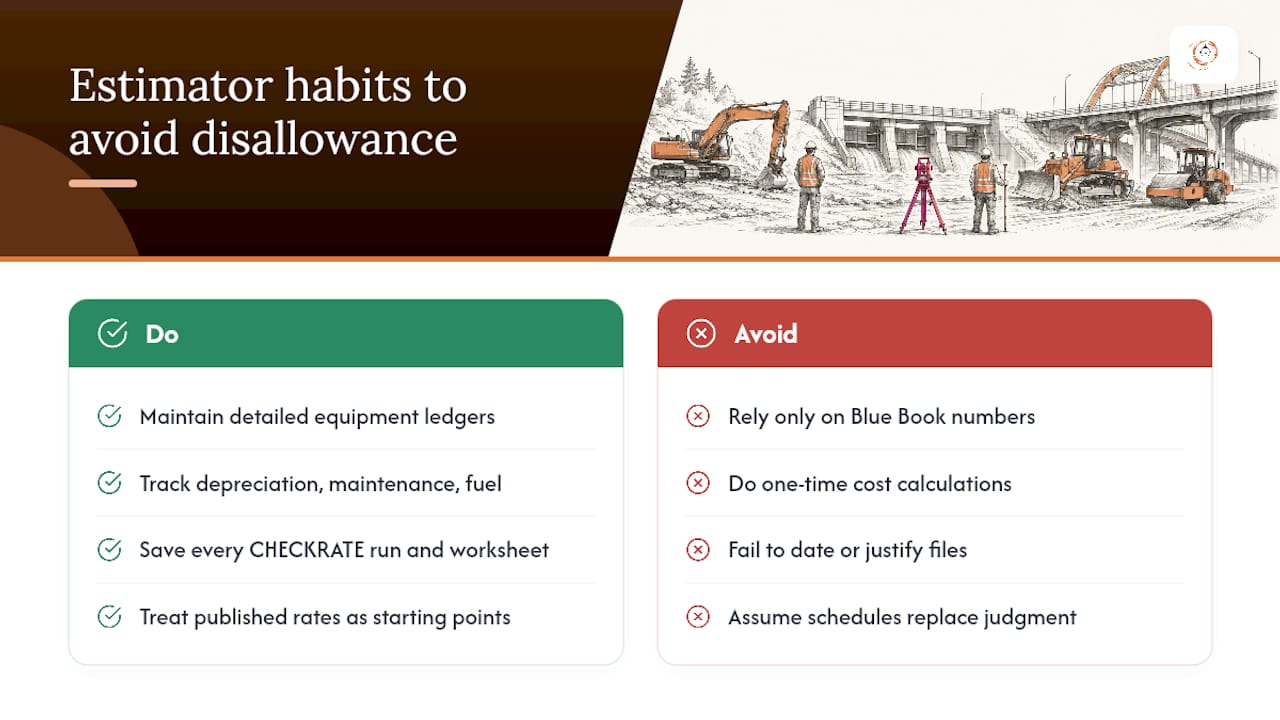
The second habit is less obvious but just as important: they save their work. Every CHECKRATE run, every derivation worksheet, every assumption about area volume factors or working hours per year gets filed with a date and a reason. When R. Construction Solutions supports clients through federal bid preparation, this documentation discipline is often the difference between a proposal that survives negotiation and one that gets picked apart line by line. First-time federal bidders, in particular, tend to underestimate how much a contracting officer will ask them to defend, right down to the hour conversion on a single dozer rate.
None of this replaces judgment. Schedules give you a defensible floor, not a finished answer. The estimators who get it right treat every published rate as a starting point that still needs to match their actual equipment, their actual region, and their actual contract terms.
— Rowena
Get Help Turning Equipment Rates Into a Winning Bid
Getting the schedule right is only half the battle. Converting FEMA or USACE rate data into a compliant, competitive proposal, especially your first one, is where most contractors lose time or lose the bid entirely. Specialized federal procurement consulting practices provide end-to-end RFP writing and submission support, FAR and Davis-Bacon compliance review, and estimating and budgeting help that accounts for exactly the kind of equipment cost documentation this article covers.
If you’re new to federal work, or you’re tackling your first USACE solicitation priced against EP 1110-1-8, hiring support makes sense before you submit, not after a contracting officer flags your equipment line for review. If your business isn’t yet registered on SAM.gov, that has to happen before you can bid on any federal opportunity, and Federal-rconstructionsolutions offers SAM.gov registration and renewal support built specifically for construction contractors navigating that process for the first time. For contractors ready to move on estimating, compliance, and full proposal development together, the RFP writing and compliance support services page outlines exactly what that engagement looks like. Reach out and get your equipment pricing reviewed before your next submission deadline.
Where to Download the Official Rate Schedules
Bookmark these directly rather than relying on a secondhand copy, since effective dates and rate tables update periodically. The FEMA Schedule of Equipment Rates lists current disaster-recovery equipment rates. The USACE EP 1110-1-8 pamphlet provides methodology and the CHECKRATE workbook. FHWA’s contract administration guidance covers equipment rental rate treatment for highway work. Always cite the effective date of whichever schedule you use in your submission.
Sources
- Schedule of Equipment Rates | FEMA
- EP 1110-1-8 (Vol. 2) Construction Equipment Ownership and Operating Expense Schedule | USACE
- Equipment Rental Rates - Contract Administration - Construction | FHWA
- CALC+ User Guide for Labor Ceiling Rates | GSA
FAQ
What are the current FEMA equipment rates?
FEMA publishes hourly rates for applicant-owned equipment on its Schedule of Equipment Rates page, with the current version effective for disasters declared on or after July 1, 2025. The rates cover ownership and operating costs but exclude operator labor, which must be billed separately.
What are Blue Book equipment rates?
The Rental Rate Blue Book, published by EquipmentWatch, lists monthly commercial rental rates for equipment by make, model, and age, adjusted regionally. FHWA guidance notes these rates often include contingency and escalation factors that must be adjusted before use on federally reimbursed work.
What are LCAT rates?
LCAT refers to labor categories, and in the federal contracting context, LCAT rates are the ceiling prices for those categories under GSA Multiple Award Schedule contracts. Contractors use GSA CALC+ to research these ceiling rates for benchmarking labor components alongside equipment pricing.
How do you calculate equipment rental rates for a federal proposal?
Start with actual cost records if available, since FAR 31.105 favors documented actual costs over predetermined schedules. When actual costs aren’t available, apply the applicable schedule, converting monthly Blue Book figures to hourly by dividing by 176, or running USACE inputs through the CHECKRATE workbook for EP 1110-1-8 compliant rates.
Can I use commercial rate guides directly on a federal contract?
Not without adjustment. FHWA guidance and OIG findings indicate commercial guides often include contingency factors and replacement-cost escalation that federal cost principles don’t allow, so you need to strip those elements out before submitting a guide-derived rate.
Does Federal-rconstructionsolutions help with equipment cost estimating?
Yes. Federal-rconstructionsolutions offers estimating and budgeting support as part of its federal procurement consulting services, helping contractors document and apply official rate schedules correctly in bid submissions. Current service details are available on the RFP writing and submission page.
Recommended
- Federal Construction Contract Tiers Explained for Contractors
- Competitive Pricing for Federal Bid Submissions in 2026
- Common Federal Bidding Mistakes Contractors Must Avoid
- Federal Contract Ceiling Limits Explained for Contractors
Working in the public sector? One short email a week — prevailing wage, certified payroll, bid protests, agency procurement rules. Free, no pitch. Subscribe.
Free and unconditional. No call required, no obligation, unsubscribe anytime.