
Federal Contract Ceiling Limits Explained for Contractors
A federal contract ceiling limit is the maximum dollar amount the government will pay under a contract, period. Understanding federal contract ceiling limits explained through the lens of the Federal Acquisition Regulation (FAR) is not optional for contractors. It is the foundation of every compliant bid and every profitable project. Miss this, and you risk absorbing costs the government will never reimburse.
What are federal contract ceiling limits?
A contract ceiling is a negotiated cap that defines the government’s maximum payment obligation. FAR Subpart 16.2 frames these ceilings as risk-sharing tools, not arbitrary numbers. That distinction matters. The ceiling reflects a negotiated balance between what the government is willing to risk and what the contractor is willing to absorb.
Ceiling limits apply across multiple contract types. Fixed-price contracts, time-and-materials (T&M) contracts, and fixed-ceiling-price contracts with retroactive price redetermination all carry ceiling provisions. Each type assigns risk differently, which is why the ceiling functions differently in each case.

The FAR governs all federal procurement guidelines on this topic. Contractors who treat ceilings as a formality rather than an operational constraint are the ones who end up working for free on government projects.
How do ceiling limits work in fixed-price and T&M contracts?
The ceiling functions very differently depending on your contract type. Knowing the difference protects your bottom line.
Fixed-price contracts
Fixed-price ceilings under FAR 16.2 are negotiated upfront and can only be adjusted through specific equitable adjustment clauses written into the contract. The government does not simply agree to pay more because your costs went up. You must trigger a formal adjustment mechanism, and that requires documented justification.
FAR 16.206 also recognizes fixed-ceiling-price contracts with retroactive price redetermination. These suit research and development projects where a firm fixed price cannot be set at award. The ceiling caps the government’s exposure while final pricing is settled after performance. This is a useful structure for contractors working on complex, scope-uncertain projects.
Key contractor obligations under fixed-price ceilings:
- Negotiate the ceiling carefully at award. Once set, adjustment is difficult.
- Identify which contract clauses trigger equitable adjustment rights.
- Document every scope change that could justify a ceiling modification.
- Track actual costs against the ceiling from day one, not day ninety.
Time-and-materials contracts
T&M ceilings work as hard caps. FAR 52.232-7(d) requires contractors to notify the contracting officer (CO) when costs reach 85% of the ceiling price. That notification triggers a conversation about whether a modification is needed. Without a formal modification, any costs above the ceiling are not reimbursable.
The ceiling in a T&M contract is also a scope-control tool. Weekly tracking of burn rates and proactive forecasting are not best practices. They are survival requirements.
Pro Tip: Set an internal alert at 75% of your T&M ceiling, not 85%. That extra buffer gives you time to prepare documentation and request a modification before you hit the FAR-mandated notification threshold.
What regulations govern federal contract ceiling limits?
The regulatory framework for ceiling limits in contracting sits primarily within FAR, with recent executive action adding new pressure on contract type selection.
- FAR Subpart 16.2 establishes the rules for fixed-price contract ceilings, including negotiation requirements and the equitable adjustment mechanisms that allow post-award price changes.
- FAR 52.232-7 governs payment rules for T&M and labor-hour contracts, including the 85% notification requirement and the contractor’s obligation to submit revised cost estimates when approaching the ceiling.
- FAR 16.206 covers fixed-ceiling-price contracts with retroactive price redetermination, a specialized structure used when upfront fixed pricing is not feasible.
- 2026 White House Executive Order directs federal agencies to default to fixed-price contracts and requires written justification for any non-fixed-price contract use. Agency heads must approve significant non-fixed-price awards.
The 2026 executive order signals a lasting shift in procurement policy. Contractors who have relied heavily on T&M or cost-reimbursement vehicles need to prepare for more fixed-price competition. That means pricing discipline and ceiling negotiation skills become more critical, not less. Contractors can review how these 2026 procurement trends are reshaping the construction market specifically.
How should contractors manage ceiling limit risks?
Ceiling risk is operational risk. The consequences of exceeding a ceiling without authorization are severe. Costs above the ceiling are not reimbursable, and contractors may be required to stop work entirely. That means you could complete a project and absorb significant unreimbursed labor and material costs.
Effective ceiling management requires three parallel disciplines:
- Burn rate tracking. Compare actual expenditures to the ceiling weekly, not monthly. Monthly reviews leave too little time to act when you approach the threshold.
- Incremental funding reconciliation. Incremental funding and ceiling price are two separate numbers. Failing to reconcile these causes overperformance that the government will not pay for without a formal modification. Many contractors confuse the two and absorb the difference.
- Proactive CO communication. FAR 52.232-7(d) requires timely notification before you breach the ceiling. Waiting until you hit 90% is too late. Contracting officers need lead time to process modifications.
The modification process itself takes time. A CO must review your revised estimate, get internal approvals, and issue a contract modification. That process can take weeks. If you notify late, you may be forced to stop work while the modification is pending.
Pro Tip: Maintain a dedicated ceiling tracker in your project management system that shows ceiling price, funded amount, actual costs to date, and projected costs at completion. Review it every Friday. Surprises at 95% of ceiling are avoidable.
Contractors who want to avoid the most common ceiling-related mistakes should also review federal bidding pitfalls that trip up even experienced firms.
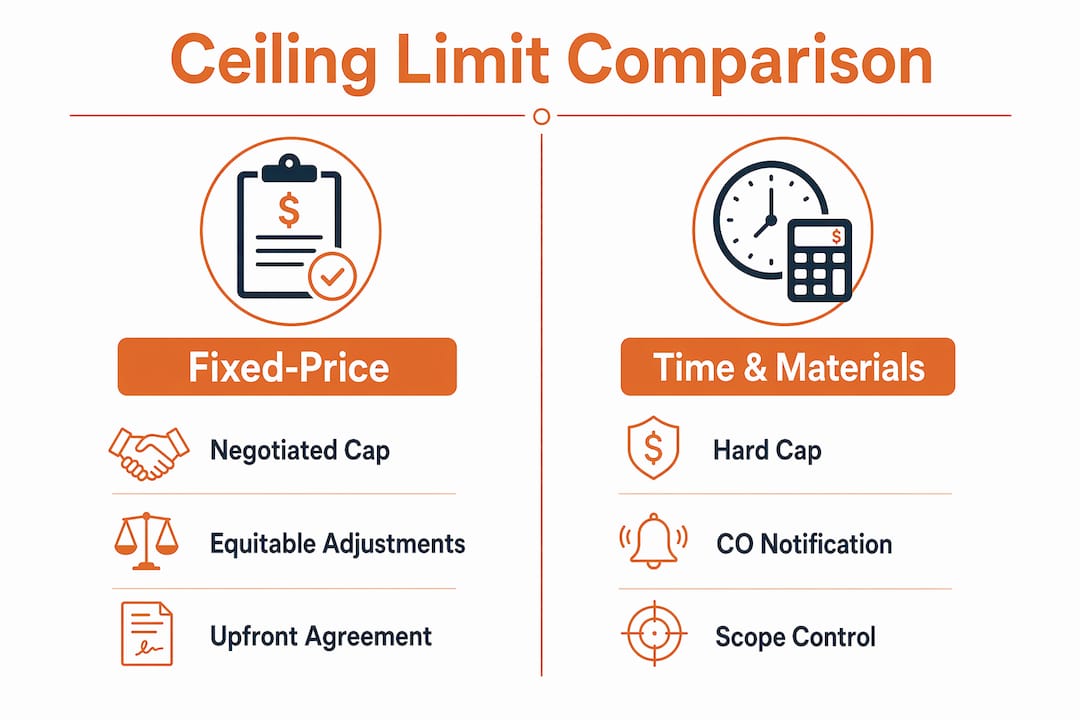
Fixed-price vs. T&M contracts: how do ceilings compare?
The table below clarifies the distinct ceiling characteristics across the two most common federal contract types.
| Feature | Fixed-price contracts | Time-and-materials contracts |
|---|---|---|
| Ceiling definition | Negotiated maximum; government pays no more | Hard cap on total government payment |
| Risk allocation | Contractor absorbs cost overruns above ceiling | Contractor bears costs above ceiling without modification |
| Adjustment mechanism | Equitable adjustment clauses in contract | Formal contract modification required |
| Notification requirement | No FAR-mandated threshold notification | Must notify CO at 85% of ceiling per FAR 52.232-7(d) |
| Retroactive adjustment | Available under FAR 16.206 for R&D contracts | Not applicable |
| 2026 policy preference | Strongly preferred by executive order | Requires written justification and agency approval |
The practical takeaway from this comparison is direct. Fixed-price ceilings demand front-end negotiation precision. T&M ceilings demand back-end monitoring discipline. Both require you to understand how equitable adjustment clauses operate, because those clauses are your primary tool for recovering costs within ceiling limits when scope changes.
For contractors new to federal contracting, the step-by-step process for winning a federal construction contract covers how ceiling negotiations fit into the broader bid and award process.
Key Takeaways
Federal contract ceiling limits are legally binding payment caps governed by FAR that require active monitoring, proactive CO communication, and precise negotiation to protect contractor profitability and compliance.
| Point | Details |
|---|---|
| Ceiling limits are risk-sharing tools | FAR frames ceilings as negotiated limits that allocate reasonable risk between government and contractor. |
| T&M ceilings require 85% notification | FAR 52.232-7(d) mandates contractor notification to the CO when costs reach 85% of the ceiling price. |
| Exceeding ceilings without modification | Costs above an unauthorized ceiling are not reimbursable; contractors may be required to stop work. |
| Fixed-price ceilings need upfront precision | Adjustments require equitable adjustment clauses; negotiate ceiling terms carefully before award. |
| 2026 policy favors fixed-price contracts | The White House executive order requires written justification for non-fixed-price contracts, increasing fixed-price competition. |
What I have learned about ceiling limits after years in federal procurement
Working with construction contractors on federal bids, I have seen one pattern repeat itself more than any other. Contractors treat the ceiling as the finish line. They price to the ceiling, win the contract, and then manage the project as if the ceiling is just a number on a page.
The ceiling is not the finish line. It is the boundary of your financial exposure. The moment you treat it as a target instead of a limit, you start making decisions that erode your margin. I have watched firms absorb five-figure losses on T&M contracts simply because they did not set up a weekly burn rate review. The FAR notification requirement at 85% exists precisely because the government knows contractors lose track.
The 2026 executive order pushing agencies toward fixed-price contracts is not a bureaucratic preference. It reflects a real frustration with cost overruns on non-fixed contracts. For contractors, this means the era of flexible T&M vehicles as a fallback is narrowing. You need to price fixed-price work with enough ceiling negotiation skill to protect yourself when scope creeps, because scope always creeps.
My strongest advice is this: treat ceiling management as a finance function, not a project management afterthought. Assign someone specific ownership of the ceiling tracker. Make it a standing agenda item in every project review. The contractors who win consistently in federal markets are the ones who never surprise their contracting officer. Early notification, clean documentation, and a well-negotiated ceiling clause are worth more than any low-ball bid price.
Architectural and engineering compliance checks, such as those outlined in federal A/E project requirements, also intersect with ceiling management when design scope changes trigger cost adjustments.
— Rowena
Federal-rconstructionsolutions can help you manage ceiling limits with confidence
Ceiling limits are one of the most misunderstood elements in federal contracting, and misreading them costs contractors real money. Federal-rconstructionsolutions works directly with construction businesses to build proposals that reflect accurate ceiling negotiations, FAR compliance, and risk-aware pricing strategies.

The team at Federal-rconstructionsolutions brings deep experience in federal procurement guidelines, RFP writing, and contract compliance support. Their federal procurement services are built specifically for contractors who want to bid with precision and win with confidence. Whether you are entering federal contracting for the first time or refining your approach to ceiling-heavy T&M vehicles, expert guidance makes the difference between a profitable contract and an expensive lesson.
FAQ
What is a contract ceiling in federal contracting?
A contract ceiling is the maximum dollar amount the government will pay under a federal contract. It is governed by FAR and functions as a risk-sharing cap negotiated between the government and the contractor.
What happens if a contractor exceeds the ceiling price?
Costs above the ceiling are not reimbursable without an authorized contract modification. Contractors may also be required to stop work until a modification is issued.
When must a contractor notify the CO about ceiling limits?
FAR 52.232-7(d) requires contractors on T&M contracts to notify the contracting officer when costs reach 85% of the ceiling price and to submit revised cost estimates if needed.
How are fixed-price contract ceilings adjusted?
Fixed-price ceilings can only be adjusted through equitable adjustment clauses written into the contract. These clauses must be triggered by documented events such as government-directed scope changes.
How does the 2026 executive order affect ceiling limits?
The 2026 White House executive order directs agencies to prefer fixed-price contracts and requires written justification for non-fixed-price awards. This reduces the frequency of T&M ceiling disputes but makes fixed-price ceiling negotiation more critical than ever.