Field Playbook for Fed Contractors: Differing Site Conditions Clause
The differing site conditions clause, found at FAR 52.236-2, shifts the risk of certain unknown physical conditions from the contractor to the government on covered fixed-price construction contracts. If field conditions materially differ from what the contract indicated, or turn out to be unusual and unforeseeable, you may be entitled to more time and money. But that entitlement depends entirely on one action: giving the Contracting Officer prompt written notice before you disturb the condition. Stop work first. Document second. Notify third.
TL;DR:
- Contractors must promptly notify the Contracting Officer in writing before disturbing any site condition to preserve the right to claim additional time and costs.
- Most disputed claims depend on whether the site condition was either specifically indicated in the contract or genuinely unexpected and unforeseeable, with failure to identify the correct type weakening the case.
- Evidence such as real-time photos, samples, daily reports, and expert reports are critical to proving the condition and supporting the claim for adjustments.
- The presence and application of FAR 52.236-2 vary depending on the contract size and details, so verifying clause inclusion in the solicitation is essential.
- Proper documentation, timely notice, and clear technical evidence form the foundation of a strong claim that the government cannot dismiss easily.
Table of Contents
- Understanding the Differing Site Conditions Clause and When It Applies
- Type I vs. Type II Differing Site Conditions: What Separates Them
- Giving Prompt Written Notice Without Losing Your Rights
- The Contracting Officer’s Duty and How Equitable Adjustments Get Calculated
- Building a Claim the Government Can’t Easily Dismiss
- Why the Government Denies Differing Site Conditions Claims
- Your Step-by-Step Response When You Hit a Differing Site Condition
- How Federal-rconstructionsolutions Helps Contractors Navigate DSC Situations
- What Subcontractors Need to Know About the DSC Clause
- Legal Precedent Shaping How Courts Read the DSC Clause
- Drafting Contract Language That Addresses Site Risk Up Front
- Pricing Unknown-Site Risk When the Clause Is Weak or Absent
- Get Help Documenting and Pursuing Your DSC Equitable Adjustment
- Where to Verify the Rules Yourself
- Sources
- FAQ
Understanding the Differing Site Conditions Clause and When It Applies
FAR 52.236-2 exists because the government would rather absorb the cost of a few surprise conditions than pay every contractor to price in worst-case subsurface risk on every bid. That is the entire policy logic behind the clause, and it is worth holding onto as you read the legal language, because it explains why the government fights hard on notice and foreseeability but rarely disputes the underlying premise that some conditions genuinely could not have been known in advance.
The clause itself runs four paragraphs, and each one does a specific job. Paragraph (a) sets the two triggers, known in practice as Type I and Type II conditions, covered in depth below. Paragraph (b) is the operative compliance requirement: the contractor must give the Contracting Officer prompt written notice of the condition before it is disturbed. Paragraph © obligates the Contracting Officer to investigate the site promptly after notice and, if the conditions warrant, adjust the contract price or schedule, or both, under the changes clause procedures. Paragraph (d) caps the remedy, denying any adjustment for a claim asserted after final payment under the contract.
Not every federal construction contract carries this clause automatically. FAR 36.502 directs contracting officers to insert the differing site conditions clause into solicitations and contracts for construction or dismantling, demolition, or removal of improvements, when the contract is fixed-price and exceeds the simplified acquisition threshold. Below that threshold, insertion is discretionary rather than mandatory, so a small task order might not carry the same protection a larger project does. That distinction matters when you are reviewing a solicitation package: check the contract clause list, not just the specification section, before you assume this protection exists.
A few practical takeaways for estimators and contracts managers reviewing a new solicitation:
- Confirm the clause is actually incorporated by reference or in full text in Section I of the contract.
- Check whether the contract is fixed-price; cost-reimbursement and some other contract types handle unforeseen conditions differently.
- Review the geotechnical or subsurface data furnished in the solicitation, since that data becomes the baseline against which “differing” conditions get measured.
- If the clause is missing or modified with disclaimer language, flag it during the pre-bid question period rather than after award.
Contractors researching FAR regulations for construction often assume every federal job carries identical risk-shifting language. It does not, and the gap between what a contract says and what a contractor assumes it says is where a lot of expensive disputes begin.
Type I vs. Type II Differing Site Conditions: What Separates Them
The clause recognizes two distinct categories, and mixing them up in a claim narrative is one of the fastest ways to weaken your case. Type I conditions are the ones the contract documents actually spoke to, incorrectly. Type II conditions are the ones nobody spoke to at all, because nobody expected them.
Type I requires a contractor to show that subsurface or latent physical conditions at the site materially differ from what the contract indicated, whether through boring logs, geotechnical reports, plans, or specifications. Smith Currie’s analysis of FAR 52.236-2 frames the practical test around four elements a contractor generally has to establish:
- The contract documents affirmatively indicated a specific subsurface or physical condition.
- The actual condition encountered materially differed from that indication.
- The contractor reasonably relied on the indicated condition when pricing or planning the work.
- That reliance caused increased costs or time, meaning damages actually flow from the discrepancy.
Type II covers conditions the contract never described one way or the other, unusual physical conditions that differ materially from what a contractor would reasonably expect on that type of work in that general area. There is no misleading boring log to point to. Instead, the test turns on unusualness and foreseeability: was this condition so far outside normal expectations for similar work that a reasonably prudent contractor could not have anticipated it during a normal site visit?
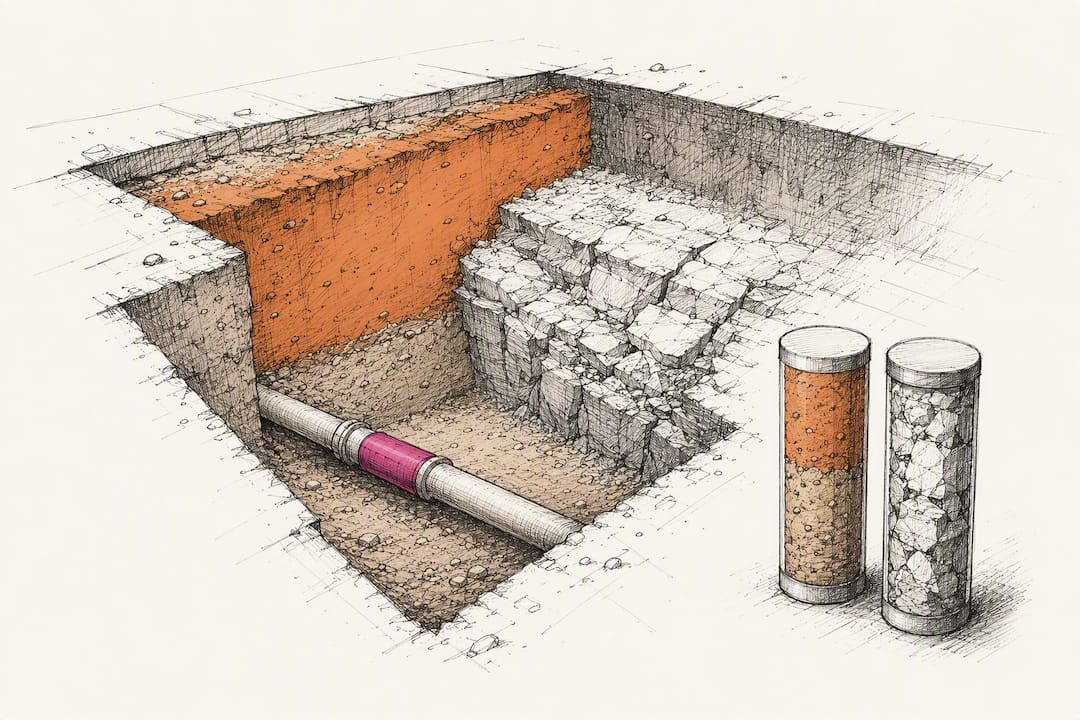
Consider three scenarios that show up repeatedly in federal construction disputes. An underground utility line appears in the excavation path with no record on any as-built drawing furnished with the bid package. That is a textbook Type I situation if the drawings indicated no utility there, or a Type II situation if the drawings simply said nothing at all. A crew hits unweathered rock strata at a shallower depth than every boring log in the geotechnical report suggested. That is Type I, assuming the borings were reasonably representative and the contractor priced excavation based on them. A site described in the solicitation as compacted native soil turns out to be uncontrolled fill material full of construction debris, three feet down. That is often argued as both types simultaneously, since it contradicts the description and is also unusual for the area.
Roughly nine out of ten disputed subsurface claims turn on whether the government’s own furnished data created a reasonable basis for reliance — which is why FHWA’s geotechnical guidance under GT-15 stresses that boring logs are only accurate at the specific bore location, not the space between borings. Extrapolating soil conditions between two boring points is common practice in estimating, and it is also exactly where government counsel will attack a Type I claim, arguing the contractor assumed uniformity the contract never promised.
Why do the examples matter beyond illustration? Because your notice letter and your eventual claim narrative need to identify which type you are asserting, and the evidence you gather in the field should map directly onto whichever test applies. A crew documenting a Type II claim needs regional comparison data and expert opinion on unusualness. A crew documenting a Type I claim needs the specific contract indication, side by side with the as-found condition.
Giving Prompt Written Notice Without Losing Your Rights
“Prompt” is not defined by a specific number of days in the clause text, and that ambiguity trips up more contractors than any other part of FAR 52.236-2. The safer reading, and the one supported by the clause’s plain language, is that notice must go to the Contracting Officer in writing before the condition is disturbed. Not after you have already excavated around it. Not after the crew has moved on to the next phase. Before.
That single requirement, “before disturbing,” is the reason field superintendents need standing instructions on this topic, not a memo they read once during onboarding. A superintendent who keeps digging for two more days because the schedule is tight, intending to “notify the office later,” may have already undermined the claim regardless of how clearly different the condition turns out to be.
A written notice that actually protects your position should include:
- The contract number and project site identification.
- The date, time, and specific location the condition was encountered.
- A factual description of the condition and how it differs from the contract’s indications or reasonable expectations.
- The immediate operational impact, meaning what work has stopped and why.
- A request for prompt Contracting Officer inspection and direction on how to proceed.
- A statement reserving the contractor’s rights to an equitable adjustment under FAR 52.236-2.
If the field crew calls the Contracting Officer’s representative by phone the moment the condition is found, that is a reasonable first move, but it is not a substitute for the written notice. Follow the call immediately with an email or formal letter, and log the phone call itself, who took it, what time, and what was said, in your daily report.
Pro Tip: Keep a one-page “DSC notice template” preloaded on every superintendent’s phone or tablet before mobilization. The five minutes it takes to fill in blanks on a ready-made form beats the twenty minutes it takes to compose a notice from scratch while a crew stands idle waiting for direction.
If circumstances genuinely prevent same-day written notice, ask the Contracting Officer in writing for a short, documented extension rather than simply staying quiet. Late notice is not automatically fatal. Smith Currie’s practice guidance notes that courts and boards have excused late notice where the government suffered no prejudice from the delay, but that exception is a fallback, not a plan. Betting your claim on “no prejudice” arguments means betting on litigation, not negotiation.
The Contracting Officer’s Duty and How Equitable Adjustments Get Calculated
Once you submit notice, the ball is legally in the government’s court, and the clause says so directly. FAR 52.236-2© obligates the Contracting Officer to investigate the site conditions promptly after receiving notice. That investigation typically involves a site visit, a request for supporting documentation, and often a request that the contractor stand by for direction before proceeding with disturbed work.
If the Contracting Officer determines the conditions do warrant an adjustment, the mechanics run through the standard changes clause, meaning the adjustment can cover both price and time, or either alone, depending on the actual impact:
- Direct costs cover labor, material, and equipment attributable specifically to the differing condition, often tracked through force account records if the work proceeds under a time-and-materials arrangement while the claim is pending.
- Indirect costs cover extended overhead, standby equipment, and schedule-related impacts that ripple beyond the immediate excavation or work area.
- Time extensions address critical path delay, which needs to be demonstrated through schedule analysis rather than asserted in general terms.
- Profit on the adjusted work is typically recoverable on the added scope, though anticipated profit on work the contractor never actually performed is generally not recoverable the way it would be on other change orders.
There is no fixed statutory clock forcing the Contracting Officer to resolve a DSC issue within a set number of days, but unreasonable delay in investigation or determination is itself grounds for a separate claim if it drives up your costs. Keep a running log of every request for CO action and every response date, because that log becomes evidence of government-caused delay if the investigation drags.
The clause’s real deadline is paragraph (d): no adjustment will be allowed for any claim asserted after final payment under the contract. That is an absolute cutoff, not a guideline. If you suspect a DSC claim is developing, resolve it, or at minimum preserve it formally, well before you sign off on final payment documentation.
Building a Claim the Government Can’t Easily Dismiss
Notice gets you in the door. Evidence is what actually moves the needle on price and time. Contracting officers and boards of contract appeals do not take a contractor’s word for what the ground looked like on a Tuesday morning six months ago, which means your documentation has to recreate that moment convincingly.
Field evidence, gathered immediately:
- Date-stamped photographs and video, ideally with verbal narration describing what the crew is seeing in real time.
- Physical samples labeled with location, depth, and date, kept under a documented chain of custody.
- Written statements from crew members and any third-party witnesses present when the condition was discovered.
Administrative records, maintained continuously:
- Daily reports noting the condition, work stoppage, and any direction received from the government.
- Timesheets and equipment logs isolating hours and machine time tied specifically to the DSC response.
- RFIs, government directives, and correspondence, especially anything showing the government was aware of and responded to the notice.
- As-built drawings showing discrepancies from the original design, a documentation practice covered in more depth in guides on plumbing as-built drawings for underground utility conflicts specifically.
Technical exhibits, assembled for the claim package:
- Geotechnical or laboratory reports confirming the actual soil, rock, or material composition encountered.
- Expert affidavits addressing foreseeability for Type II claims or reasonable reliance for Type I claims.
- Productivity loss analyses tying the condition to measurable schedule or crew-efficiency impacts.
- Cost breakdowns cross-referenced to your standard job-cost accounting records, not built as a standalone spreadsheet after the fact.
| Evidence category | Primary purpose | Collected by |
|---|---|---|
| Photo, video, and physical samples | Prove the condition existed and its physical characteristics | Field superintendent |
| Daily reports and logs | Establish timeline, notice, and continuous documentation | Project management staff |
| Correspondence and directives | Show government awareness and response | Contracts manager |
| Lab and expert reports | Establish technical basis for Type I or Type II classification | Third-party geotechnical or claims expert |
Organize this material chronologically and cross-reference it, so a reviewer can move from the notice letter to the photo taken that same day to the lab report confirming the material, without hunting through separate folders. Contractors managing multiple federal contract tiers often find that a standardized claim-file structure, used the same way on every project regardless of contract size, saves weeks of reconstruction time if a dispute escalates.
Why the Government Denies Differing Site Conditions Claims
Most DSC denials trace back to one of three recurring problems, and none of them involve the actual physical condition being disputed.
Notice and preservation failures top the list. A crew disturbs the condition before sending written notice, or sends notice so vague it fails to identify what actually differed, or waits until a monthly progress meeting to mention something the site found three weeks earlier. Fix this with standing field procedures, not after-the-fact training. Every superintendent should know the notice template exists before mobilization begins on any project.
Foreseeability and constructive knowledge come up constantly in Type II defenses. If the government can show that a pre-bid site visit, publicly available geological survey data, or industry-standard due diligence should have revealed the condition, your claim weakens fast. This is why thorough pre-bid site investigation is not a courtesy step. It is part of building the record that later supports “this genuinely could not have been anticipated.”
Contract disclaimers and “no relief” language occasionally appear in specifications attempting to narrow or waive the standard DSC protections. Spot these during the solicitation review, not after award, and raise a formal pre-bid question if disclaimer language appears to conflict with the standard clause. Silence at the pre-bid stage can later be read as acceptance of the disclaimer’s terms.
Pro Tip: Build a two-line habit into every field superintendent’s onboarding: “If it looks different from the plans, stop and call before you touch it again.” That single sentence prevents more notice failures than any policy manual.
The rebuttal to all three defenses is the same contemporaneous evidence trail described above. A dated photo taken the moment the crew stopped work, cross-referenced with a same-day written notice, and backed by an expert opinion on unusualness or reliance, is difficult for a Contracting Officer or board to dismiss on foreseeability grounds alone.
Your Step-by-Step Response When You Hit a Differing Site Condition
- Stop the work that would disturb the condition. Do not excavate further, do not backfill, do not proceed past the point of discovery.
- Secure the area and identify witnesses. Note names and roles of every crew member present.
- Photograph and sample immediately. Capture wide shots, close-up detail shots, and a labeled sample if the condition involves soil, rock, or material composition.
- Draft and send written notice promptly, as soon as possible after discovery. Use your standing template, address it to the Contracting Officer, and include a request for prompt inspection.
- Log costs and delays separately from your regular job costing. Create a distinct cost code for the DSC event from day one, so force account records are clean if the claim proceeds.
- Request a formal Contracting Officer site inspection. Do this in writing, even if you already discussed it by phone.
- Order lab or geotechnical testing where relevant. Independent test results carry more weight than field observation alone.
- Preserve chain-of-custody documentation for every sample taken. A sample with no documented handling history invites challenge.
- Assemble expert reports as the claim develops. Engage a geotechnical or claims expert early rather than after negotiations stall.
- Maintain an organized, chronological claim file. Track every schedule and critical-path impact as it happens, not reconstructed months later from memory.
Each of these steps takes minutes in the moment and prevents days of dispute later. The contractors who handle DSC events smoothly are almost never the ones with the best legal team after the fact. They are the ones whose field crews already knew the sequence before the shovel hit anything unexpected.
How Federal-rconstructionsolutions Helps Contractors Navigate DSC Situations
We work with construction companies navigating the compliance side of federal contracting, including differing site conditions. Getting FAR clause interpretation right, and getting the paperwork right when a claim is developing, can help differentiate a clean equitable adjustment from a denied claim.
In a DSC scenario specifically, that support can include:
- Reviewing your contract’s clause language before bid submission to flag missing or modified DSC protections.
- Helping structure field documentation protocols so notice and evidence-gathering happen consistently across projects.
- Supporting FAR compliance reviews when a claim is developing, to confirm notice timing and content meet the standard the Contracting Officer will apply.
If your team has an active or developing DSC situation, or wants field protocols in place before the next mobilization, a document review is the natural starting point, and the details on requesting one appear in the section further down this page.
What Subcontractors Need to Know About the DSC Clause
The differing site conditions clause flows down through the prime contract, but subcontractors do not automatically inherit the prime’s direct notice relationship with the Contracting Officer. That gap causes real problems on federal jobs, particularly for excavation, utility, and foundation subcontractors who are usually the trades that physically discover a DSC first.
Most subcontract agreements include a flow-down clause requiring the subcontractor to notify the prime contractor promptly, often within a shorter internal window than the government notice deadline, so the prime has time to prepare and submit its own written notice to the Contracting Officer before the condition is disturbed. If a subcontractor’s internal notice is late or informal, the entire chain can break down before the government ever hears about it.
Subcontractors should treat their subcontract’s notice provisions with the same seriousness as the prime treats FAR 52.236-2 itself. That means:
- Confirming the subcontract states a specific notice deadline and method, not a vague “promptly” standard with no anchor.
- Sending internal notice in writing even when the prime’s superintendent is on site and already aware, since verbal awareness does not create a paper trail.
- Keeping independent copies of photos, samples, and daily reports, rather than relying entirely on the prime’s documentation.
Subcontractors working on plumbing, utility, or underground trades in particular benefit from disciplined scheduling and documentation practices that flag discrepancies between drawings and field conditions early, since those trades are often the first to encounter buried utilities or fill material that differs from what the contract indicated.
Legal Precedent Shaping How Courts Read the DSC Clause
Boards of contract appeals and federal courts have spent decades refining how the four-part Type I test and three-part Type II test actually get applied, and the pattern in these decisions is consistent: tribunals scrutinize the government’s furnished data closely, but they scrutinize the contractor’s notice compliance just as closely.
The recurring theme across DSC decisions is that reasonable reliance on furnished indications, boring logs, geological reports, or subsurface descriptions, tends to favor the contractor when the government’s own data created a specific expectation that turned out to be wrong. Boards have consistently held that a contractor is entitled to rely on affirmative representations in bid documents rather than independently verifying every foot of subsurface material through its own investigation, since duplicating the government’s geotechnical work would defeat the purpose of furnishing that data in the first place.
At the same time, decisions denying claims consistently point to the same failure points covered earlier in this article: notice sent after the condition was disturbed, notice too vague to identify what actually differed, or a contractor’s own pre-bid site visit that should have revealed the condition. The Virginia Tech Construction Contracting resource on differing site conditions walks through the reasoning behind several of these outcomes in more detail, and it is a useful reference for contracts managers who want the legal logic behind the practical rules rather than just the rules themselves.
The practical lesson for contractors is not to memorize case names. It is to recognize that every decision, whichever way it comes out, turns on the same handful of facts: what the contract said, what the contractor found, when notice went out, and what evidence backs the gap between the two.
Drafting Contract Language That Addresses Site Risk Up Front
The strongest position on a differing site condition is never having to fight about it, and that starts at the drafting and pre-bid stage, not after mobilization.
For contractors reviewing a solicitation before bidding, confirm the standard FAR 52.236-2 language is present in full, unmodified form. If a solicitation includes supplemental disclaimer language attempting to narrow the clause, such as language stating the government provides subsurface data “for informational purposes only, without warranty,” treat that as a signal to submit a formal pre-bid question rather than assuming the standard clause protections still apply in full.
Where you have any influence over subcontract language, mirror the FAR notice timing as closely as possible, and specify exactly what form subcontractor-to-prime notice must take. Vague internal notice provisions are where flow-down protection quietly breaks down.
Beyond the clause itself, well-drafted contracts benefit from clearly identifying the specific geotechnical reports, boring logs, or survey data being incorporated by reference, with explicit language on the reliability and limitations of that data. Ambiguity about which document controls, an early boring log versus a later addendum, has derailed more than one DSC claim on a technicality unrelated to the actual site condition.
Finally, internal contract review checklists should flag DSC clause presence as a standard item, the same way they flag bonding and insurance requirements, rather than treating it as a specialty legal issue only worth checking on unusually large projects.
Pricing Unknown-Site Risk When the Clause Is Weak or Absent
Here is where I differ from a lot of standard bidding advice: padding your bid with a generic contingency for unknown site risk is a weaker move than most estimators think, and it often loses work you should have won. If the DSC clause is present and unmodified, the government has already agreed to absorb the risk of a materially different or unusual condition. Bidding a fat contingency on top of that protection is redundant cost that makes you less competitive for no real benefit.
The smarter move is targeted: read the geotechnical data critically before bid day, and if the borings are sparse, old, or geographically clustered away from your actual work area, raise a formal pre-bid question asking the government to confirm reliability or supplement the data. That question, on the record, strengthens a future Type I claim if the data turns out wrong, and costs you nothing at bid time.
Where the clause is modified or disclaimed, that changes the calculus entirely, and a real contingency, not a token line item, becomes appropriate. Either way, the highest-value investment isn’t in the number you write on the bid form. It’s in training field superintendents on notice procedures before mobilization, so the protection you already have in the contract actually gets used when you need it.
— Rowena
Get Help Documenting and Pursuing Your DSC Equitable Adjustment
A differing site condition is stressful enough in the field without also second-guessing whether your notice letter or your evidence file will hold up if the Contracting Officer pushes back. Federal-rconstructionsolutions works directly with contractors on the federal procurement side of this problem, from FAR compliance reviews before you bid to claim documentation support once a condition has already been found.
Where this typically helps most:
- A document checklist review of your existing DSC notice templates and field procedures before your next mobilization.
- Draft notice templates customized to your typical project type and contract vehicle.
- Claim-cost compilation support, organizing force account records and daily reports into a package a Contracting Officer can actually evaluate quickly.
Contractors handling both federal and non-federal work can also review private-sector construction services built around the same documentation discipline. To start, request a review of your current DSC procedures through the federal procurement services page, and bring your last few project’s notice templates, that single step usually surfaces the gaps worth fixing before your next site surprise turns into a denied claim.
Where to Verify the Rules Yourself
- Acquisition
- Acquisition
- 48 CFR § 52.236-2 reproduction | LII / e-CFR
- FHWA geotechnical guidance on DSC handling (GT-15)
- Smith Currie: What to Know About FAR 52.236-2
- Virginia Tech Construction Contracting: Differing Site Conditions chapter
Sources
- Acquisition
- Acquisition
- 15. Differing Site Conditions – Construction Contracting (Virginia Tech/Pressbooks)
- It’s What You Don’t Know! What to Know About FAR 52.236-2 - Smith Currie
FAQ
What is the difference between Type I and Type II differing site conditions?
Type I conditions materially differ from what the contract documents specifically indicated, such as boring logs or plans. Type II conditions are unusual physical conditions that differ from what a contractor would normally expect for that type of work in that area, regardless of what the contract said.
What are some examples of differing site conditions?
Common examples include unmarked underground utility lines, rock strata encountered at a shallower depth than the boring logs indicated, and uncontrolled fill material found where the contract described compacted native soil.
What does “differing site condition” mean?
A differing site condition is a subsurface or physical condition at a construction site that either contradicts what the contract documents indicated or is unusually different from normal conditions for similar work in the area, entitling the contractor to a possible equitable adjustment under FAR 52.236-2.
What are the three types of contractual conditions people usually ask about?
Most references to “three types” actually describe the two DSC categories, Type I and Type II, plus the general changes clause adjustment process that governs how the resulting price and time modifications get calculated once a claim is approved.
Can I still recover if my written notice was late?
Late notice is not automatically fatal if the government suffered no prejudice from the delay, but relying on that exception is risky, and prompt written notice before disturbing the condition remains the safest path to a full equitable adjustment.
Recommended
- Federal Procurement Compliance Checklist for Contractors
- Subcontractor Prequalification Checklist: What to Verify Before Award
- Bid Strategy Best Practices for Contractors: 2026 Guide
- FAR Regulations for Construction Explained: 2026 Guide
Working in the public sector? One short email a week — prevailing wage, certified payroll, bid protests, agency procurement rules. Free, no pitch. Subscribe.
Free and unconditional. No call required, no obligation, unsubscribe anytime.