Federal Contractors Need These 4 Items to Get QC Plans Accepted
A construction quality control plan is the contractor’s written system for inspecting, testing, and documenting work so it meets contract specifications before the government or owner ever has to ask. Acceptance depends on four deliverables: an organizational chart with clear authority, a definable feature of work list, the three-phase control system, and a testing and submittal register. The first move is simple: get your QC Manager appointment letter signed and, if the contract allows it, submit an interim plan so critical early work can start while the full plan finishes its review.
TL;DR:
- Federal contracts require the construction quality control plan to be submitted and approved before work begins, with an interim plan acceptable for early phases.
- The plan must include an organizational chart, QC Manager appointment letter, detailed DFOW list, testing procedures, and a three-phase control system for each work element.
- Reviewers prioritize the daily QC report, testing log, and submittal register, which should be complete, accurate, and consistently maintained throughout the project.
- Subcontractor and supplier QC plans or summaries should be integrated into the plan, with clear responsibilities and documentation for off-site fabrication and specialized work.
- Compliance with USACE ER 1180-1-6, UFGS 01 45 00, and FAR guidelines is essential, and plans should be concise, with heavy supporting documentation in appendices to ensure acceptance.
Table of Contents
- What Does a Construction Quality Control Plan Cover?
- What Should Be in a Quality Control Plan? A Reviewer’s Checklist
- How Do You Write the Three-Phase Control System?
- How Do You Build the Testing and Inspection Plan?
- What Documentation Do Reviewers Look At First?
- Who Needs to Be Named, and What Authority Do They Need?
- How Do Subcontractors and Suppliers Fit Into the Plan?
- What Appendices and Sample Forms Should You Include?
- What Mistakes Get QC Plans Rejected?
- Where the Federal Rules Actually Live
- A Practitioner’s View on What Actually Gets Plans Accepted
- How Federal-rconstructionsolutions Helps You Get a QC Plan Accepted
- Sources
- FAQ
What Does a Construction Quality Control Plan Cover?
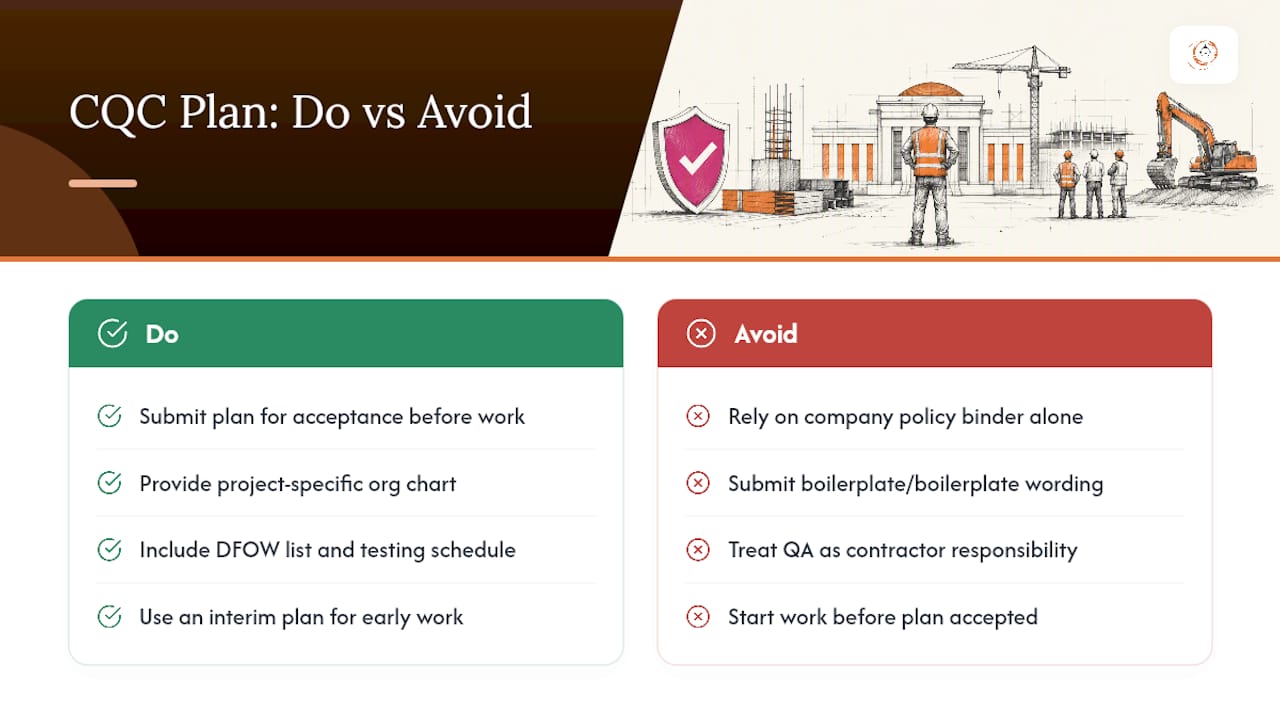
A quality control plan (often shortened to QC plan or CQC plan) is a contract deliverable, not a company policy binder. It spells out exactly how your firm will inspect, test, and document work on one specific project, and it gets tied to the specifications in that contract, not to whatever quality manual your office keeps on a shelf. That distinction trips up a lot of contractors moving from private residential work into public or federal contracting for the first time.
The scope depends on who is buying. On federal work, the contractor performs quality control (CQC) while the government or its representative performs quality assurance (QA), checking your work rather than doing it. UFGS 01 45 00.00 10 lays out this split clearly, and it is the model most state and municipal agencies have borrowed from over the past two decades.
Timing matters more than most contractors expect. Federal specifications generally require the CQC plan to be submitted for acceptance before work starts, and acceptance is conditional. The government can reject sections, demand revisions, or even require removal of QC personnel who aren’t performing, according to UFGS 01 45 00. Many contracts allow an interim plan covering only the first few definable features of work, so mobilization and early site prep don’t stall while the full document goes through review.
Company-level QC and a project-specific plan are not interchangeable. A Project-Specific Quality Assurance Plan (PSQAP) or Project Quality Plan (PQP) references your firm’s standard procedures but customizes the organizational chart, the DFOW list, and the testing schedule to the actual scope, subs, and site conditions on that job. Reviewers can spot a boilerplate plan in about thirty seconds, and it’s usually the fastest way to get a submittal bounced back.
What Should Be in a Quality Control Plan? A Reviewer’s Checklist
Every reviewer, whether it’s a USACE quality assurance representative or a private owner’s rep, works from roughly the same mental checklist. Here’s what they’re scanning for on the first pass:
- Organizational chart showing every QC-related position, reporting lines, and how the QC function stays independent of production pressure.
- QC Manager appointment letter, signed by a company officer, spelling out duties, authority, and qualifications.
- DFOW list that breaks the entire project into discrete, inspectable work packages tied to spec sections.
- Submittal procedures and an initial submittal register showing what’s due, when, and who reviews it before it reaches the government or owner.
- Testing plan and testing log identifying required tests, frequency, referenced spec paragraphs, and the labs performing the work.
- Lab approval documentation, confirming the testing lab is accredited and capable of running the specified tests.
- Three-phase control procedures describing exactly what happens at the preparatory, initial, and follow-up phase for each DFOW.
- Nonconformance and corrective action procedures, including how deficiencies get logged, tracked, and closed out.
- Documentation formats, such as daily QC report templates and Quality Assurance Report (QAR) response procedures.
- A verification statement where the contractor certifies work conforms to contract requirements before requesting government acceptance.
Plan length should scale with project complexity rather than aiming for a fixed page count. FHWA guidance on contractor quality control plans suggests three to six pages plus appendices for a straightforward project, adding roughly two to four pages per major work category on larger or more technically complex jobs. A single-building renovation and a multi-structure water treatment project shouldn’t produce the same plan length, and reviewers notice when they do.
Pro Tip: Keep your narrative sections short and put the heavy lifting into appendices. A concise ten-page plan backed by forty pages of sample forms, checklists, and completed examples reads as far more credible than a sixty-page narrative with nothing attached.
How Do You Write the Three-Phase Control System?
The three-phase control system is the operational core of the plan, and it needs to be addressed separately for every single DFOW rather than described once in general terms. USACE ER 1180-1-6 treats this as the standard against which contractor quality management gets measured on Corps projects, and most large owners have adopted a version of it.
- Preparatory phase. Held before work begins on a DFOW. The QC Manager, superintendent, and relevant sub attend, reviewing submittals, materials on hand, approved shop drawings, and site conditions. This is where you confirm testing requirements and equipment calibration before anyone picks up a tool.
- Initial phase. Performed at the start of actual work on a representative sample, such as the first section of formwork or the first run of conduit. The goal is to establish an acceptable level of workmanship that becomes the benchmark for everything that follows on that DFOW.
- Follow-up phase. Ongoing daily checks throughout the DFOW’s duration, verifying the standard set during the initial phase holds. This phase catches drift before it becomes rework.
Each phase needs its own checklist and sign-off documentation, dated and tied to the specific DFOW. Timing triggers should be spelled out in the plan itself, not left to judgment call. “Preparatory phase held no later than five working days before DFOW start” reads far better to a reviewer than “preparatory meetings will be scheduled as needed.”
The most common field failure isn’t a missing checklist. It’s what practitioners call “inspecting in” quality, meaning defects get caught during the follow-up phase or, worse, during final punch-out, because the preparatory and initial phases were skipped or rushed. A plan that enforces three-phase control on paper but skips it in practice will eventually generate a QAR that documents the gap, and that record follows the project.
How Do You Build the Testing and Inspection Plan?
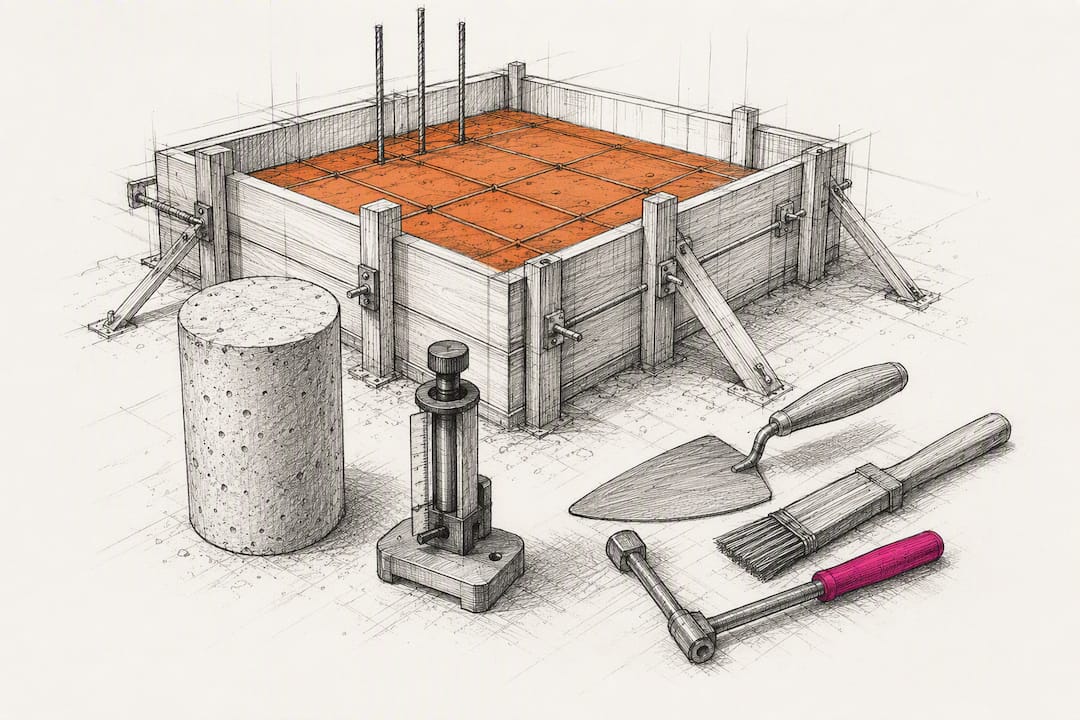
The testing plan is where a lot of otherwise solid QC plans fall apart, mainly because contractors treat it as an afterthought instead of a direct extension of the DFOW list. Every required test should trace back to a specific DFOW and a specific spec paragraph. If your concrete DFOW references Section 03 30 00, your testing log needs to name the compressive strength test, the sampling frequency, the applicable ASTM standard, and the accepted lab, all cross-referenced to that same section.
Test frequency should follow the specification, but a useful rule of thumb for government QA sampling is worth knowing going in: quality assurance testing typically runs at a minimum of about 5% of the contractor’s own CQC testing frequency, verifying your test procedures and results rather than duplicating your entire testing load, according to USACE ER 1180-1-6.
Building the lab section takes more than dropping in a company name:
- List each testing lab by name, address, and accreditation body, along with which specific tests they’re approved to run.
- Attach a capability letter or accreditation certificate rather than a verbal assurance that the lab is qualified.
- Document chain-of-custody procedures for samples, especially on projects where duplicate samples get split between the contractor’s lab and a government-designated lab.
- Note how test results get reported, in what timeframe, and who receives copies.
An equipment inspection program deserves a place here too. Calibration records and inspection intervals for testing and site equipment matter to reviewers, and guidance on equipment inspection requirements is a useful reference for building out that section of your plan with defensible intervals rather than guesses.
What Documentation Do Reviewers Look At First?
Reviewers almost always go straight to three things: the daily QC report, the testing log, and the submittal register. If those three are thin, incomplete, or inconsistent with each other, everything else in the plan gets read with more skepticism.
A daily QC report needs, at minimum, the date, weather, DFOW activity performed, phase of control conducted (preparatory, initial, or follow-up), personnel present, any deficiencies noted, and corrective actions taken. QARs, the government’s written response to observed nonconformances, should be logged with a response deadline and tracked until closed. A testing log needs the test type, DFOW reference, spec paragraph, date sampled, date tested, result, and pass/fail status, all in one running document rather than scattered across separate files.
Appointment letters, lab approval letters, and a handful of sample completed forms belong in the appendices, cross-referenced by tab or section number so a reviewer can jump straight from the narrative to the proof. USACE ER 1180-1-6 notes that filing daily reports and QARs through established project management systems, whether that’s RMS, eCMS, or an equivalent platform, speeds acceptance on larger federal projects because reviewers can pull records without waiting on a paper trail. Note your system of record in the plan itself.
Retain records for the full contract period at minimum, and include a verification statement where the contractor certifies, in writing, that completed work conforms to contract requirements before requesting government acceptance of that DFOW.
Who Needs to Be Named, and What Authority Do They Need?
Your QC Manager is the single most scrutinized name in the entire plan. Reviewers want to see relevant construction experience, any specific certifications tied to your contract type (concrete testing certifications, USACE Construction Quality Management training, and similar credentials), and direct contact information.
Federal contracts typically require the QC Manager to be an employee of the prime contractor rather than a subcontracted or third-party role, according to a USACE Construction Quality Management study guide. That guide is also specific about appointment letters: they must be signed by an officer of the firm and must explicitly assign duties, responsibilities, and authority.
- List the QC Manager’s full name, role, and an alternate who can step in during absences, with the alternate’s qualifications listed just as thoroughly.
- Show reporting lines on the organizational chart so it’s visually obvious the QC function reports independently, not through the production superintendent.
- Draft appointment letters with explicit stop-work authority language. A letter that only assigns “quality oversight” duties without naming stop-work power is a common reason plans bounce back for revision.
- On multi-site contracts or shared QC staffing arrangements, document how coverage works across sites and who has authority when the primary QC Manager is off-site.
Copies of signed appointment letters belong in the appendices, not just referenced in the narrative. Reviewers verify this during their initial plan-in-hand review, and having the signed letter on hand from day one avoids a predictable request for it.
How Do Subcontractors and Suppliers Fit Into the Plan?
A QC plan that only covers your own crews leaves the biggest quality risk unaddressed, since most nonconformances on complex projects trace back to subcontracted work or offsite fabrication that nobody was tracking closely enough.
Decide early which subcontractor QC plans need to be attached in full versus summarized. High-risk trades, structural steel, MEP systems, anything involving specialized testing, generally warrant a full subcontractor QC plan as an appendix. Lower-risk trades can often be covered with a summary paragraph describing how the prime will monitor their work. A subcontractor prequalification checklist is worth building into your process here, since license verification and insurance status belong in the same file as their QC commitments.
Name who on your team reviews and certifies subcontractor submittals before they go to the government or owner. This should be the same person, or a clearly designated alternate, tracking the master submittal register, since split responsibility here is where submittals slip through cracks.
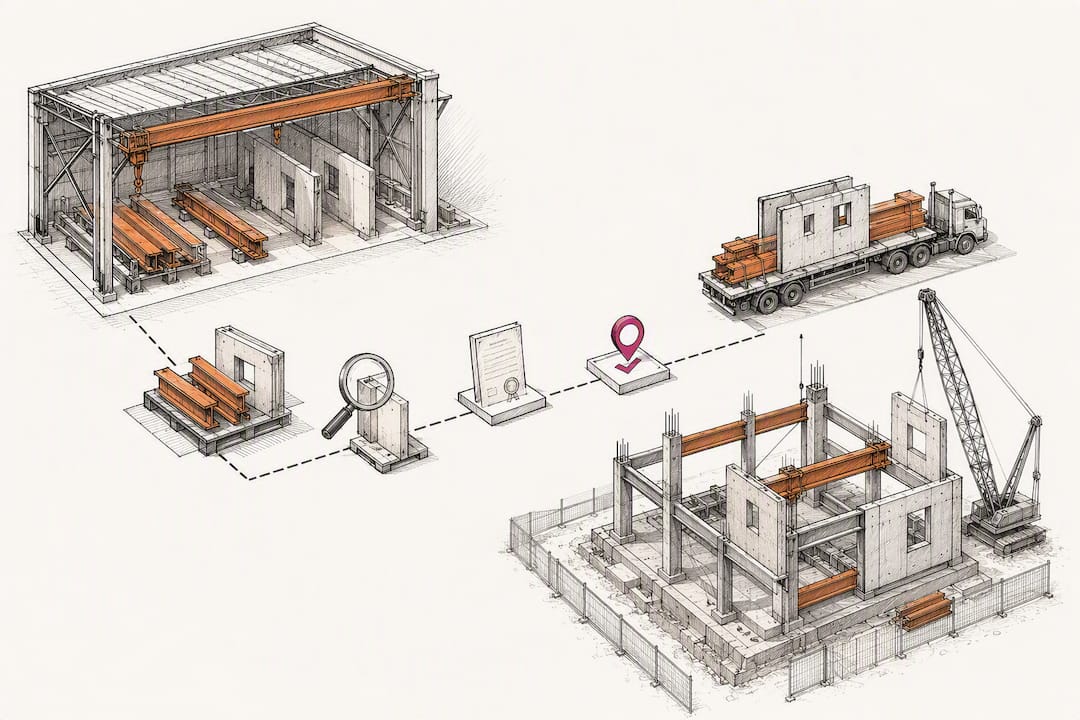
Supplier certifications and offsite fabrication tracking deserve their own line items too. If precast panels or fabricated steel are produced off-site, the plan should state how you’ll verify the fabricator’s own quality control before the material arrives, not just inspect it on delivery. Every subcontractor and supplier’s scope should map cleanly to your master DFOW list, so nothing falls into a gap between the prime’s list and a sub’s separate paperwork.
What Appendices and Sample Forms Should You Include?
Reviewers expect the plan to function, not just describe a function in the abstract. That means appendices carrying real, populated examples rather than blank templates.
- DFOW matrix, listing every definable feature with its spec reference and responsible party.
- Submittal register, showing submittal number, description, spec section, submission date, and approval status.
- Testing log, with at least a few completed rows showing actual test data from early project activities.
- Preparatory, initial, and follow-up checklists, one set per DFOW category, with at least one filled-out example per phase.
- Appointment letters, signed and dated, for the QC Manager and alternate.
- Lab approval letters and accreditation certificates.
Model QC plans built around the FHWA and NETTCP format follow a consistent structure for exactly this reason: reviewers know where to look, and contractors don’t waste time reinventing a format that’s already been vetted. Most reviewers expect two or three completed sample forms per checklist type, enough to prove the system works in practice, not a blank form with instructions to “fill in as needed.” Cross-reference every appendix back to the section of the narrative that introduces it, using consistent tab numbers or letters throughout.
What Mistakes Get QC Plans Rejected?
Most rejected plans fail for a small, repeatable set of reasons, and every one of them is fixable before submission.
Late inspections top the list. If your preparatory and initial phase checklists exist on paper but aren’t actually happening before work starts, it shows up eventually in a QAR, and reviewers start scrutinizing everything else in the plan more closely. Enforce the three-phase sequence for real, not just on the page.
DFOWs that are too broad cause the second most common failure. “Concrete work” as a single DFOW is nearly impossible to inspect meaningfully. Split it into footings, walls, slabs, and any specialty pours, each with its own preparatory and initial phase documentation, as guidance on DFOW planning recommends.
Appointment letters missing explicit stop-work language get flagged almost every time. And submittal registers that go stale, listing submittals as “pending” weeks after they were actually approved, tell a reviewer the plan isn’t being maintained as a living document. Cross-check your register against actual status before every submission.
Where the Federal Rules Actually Live
Reviewers consult specific documents, not general industry practice, when they evaluate your plan.
- USACE ER 1180-1-6 governs the three-phase control system and QA sampling rates on Corps projects.
- UFGS 01 45 00.00 10 specifies the minimum content of the CQC plan itself, from organizational chart to testing protocols.
- FAR 52.246-12 establishes the contractual basis for inspection requirements that flow down into these specs, affecting how and when plans get accepted.
- QA sampling and QAR filing interact directly with your CQC data, since government testers are verifying your numbers, not replacing them.
Some consulting firms work with contractors navigating this stack of requirements, helping translate ER and UFGS language into a plan structure that survives first review.
A Practitioner’s View on What Actually Gets Plans Accepted
The plans that sail through review aren’t the longest ones. They’re the ones where the QC Manager clearly wrote alongside whoever handles compliance, because the checklists match what actually happens on-site instead of reading like they were copied from a different project. Reviewers can tell the difference fast.
Be flexible on format, since minor structural choices rarely sink a submission. Be rigid on substance: stop-work authority, DFOW granularity, and testing frequency are not places to improvise or wait for a QAR to tell you it’s wrong.
— Rowena
How Federal-rconstructionsolutions Helps You Get a QC Plan Accepted
Building a plan that satisfies UFGS and ER 1180-1-6 on the first pass is a different skill than running quality on-site, and most contractors would rather spend their time managing the job than fighting a rejected submittal. Some consulting firms prepare Project-Specific Quality Assurance Plans and Contractor Quality Assurance Plans that map cleanly to the actual DFOW list, organizational chart, and testing program, instead of a generic template that gets flagged on first review.

That support extends into the compliance layer surrounding the plan itself: RFP writing, FAR and Davis-Bacon requirements, and the broader federal procurement compliance picture your QC plan has to sit inside. For contractors specifically targeting Corps work, USACE procurement and QC support covers the ER and UFGS cross-referencing that trips up firms new to that agency’s review process.
If your plan has already been bounced once, or you’d rather have it reviewed before it gets to that stage, request a plan review through Federal-rconstructionsolutions and get specific feedback on where your submission stands against what reviewers actually check.
Sources
- USACE ER 1180-1-6 Construction Quality Management (2025)
- FHWA: Model Quality Control Plan / NETTCP example
FAQ
What Is a QC Plan in Construction?
A QC plan, or construction quality control plan, is a contract-specific document describing how a contractor will inspect, test, and document work to meet the project’s specifications. It differs from a company-wide quality manual because it’s customized to the DFOW list, personnel, and testing requirements of one particular job.
What Is Included in a Quality Control Plan?
At minimum, it includes an organizational chart, QC Manager appointment letter, DFOW list, submittal register, testing plan and log, three-phase control procedures, and nonconformance tracking. UFGS 01 45 00.00 10 lists these as the baseline expectations reviewers check first.
How Do You Build a Quality Control Plan?
Start with your DFOW list, since every other section of the plan references it. From there, build the organizational chart, draft and sign the QC Manager appointment letter, and write preparatory, initial, and follow-up procedures for each DFOW before assembling your testing plan and submittal register.
What Is a Quality Plan in Construction?
“Quality plan” and “quality control plan” are often used interchangeably, though some owners distinguish a broader Project Quality Plan (covering both QC and QA activities) from a narrower CQC plan focused solely on the contractor’s own inspection and testing responsibilities.
How Long Should a Construction Quality Control Plan Be?
Length should scale with complexity. FHWA guidance suggests three to six pages plus appendices for straightforward projects, adding roughly two to four pages per major work category on larger jobs.
Recommended
- Federal Procurement Compliance Checklist for Contractors
- Winning Federal Contracts: A Compliance-First Proposal Playbook
- Why Compliance Failures Disqualify Bids on Federal Contracts
- Steps Entering Federal Construction Market: 2026 Guide
Working in the public sector? One short email a week — prevailing wage, certified payroll, bid protests, agency procurement rules. Free, no pitch. Subscribe.
Free and unconditional. No call required, no obligation, unsubscribe anytime.