
Winning Federal Contracts: A Compliance-First Proposal Playbook
Before you write a single page, read Sections L and M of the solicitation, in that order, twice. Section L tells you exactly how to format and submit your proposal; Section M tells you precisely how the government will score it. Build a compliance matrix that maps every “shall” statement to a proposal page and an owner. Then write a one-page executive summary that states your win themes and backs them with numbers, not adjectives. Confirm your SAM.gov registration and the submission portal are working days before the deadline, and set an internal cutoff at least 24 hours before the government’s.
- Read Section L and Section M before drafting anything
- Build a compliance matrix mapping requirements to proposal pages
- Write an executive summary with win themes and quantified results
- Verify SAM.gov status and portal access with buffer time
Federal contracting is not a niche opportunity. The government awards a meaningful share of its spending to small businesses through set-asides, and construction firms compete for a real slice of that pool every year. Getting the process right matters more than getting the writing clever.
Key Takeaways
Contract proposal writing succeeds when compliance discipline, quantified evidence, and Section L/M mapping outweigh polished but generic prose.
| Point | Details |
|---|---|
| Sections L and M come first | Read both before drafting; they define format, page limits, and scoring weight. |
| Build a compliance matrix | Map every solicitation requirement to a specific page and owner to prevent disqualification. |
| Quantify past performance | Use STAR-format entries with contract numbers, dollar values, and measurable outcomes. |
| Stage your reviews | Run pink, red, and gold team reviews to catch compliance and scoring gaps before submission. |
| Consider expert support | Federal-rconstructionsolutions helps construction firms build compliant proposals through its 5551 Pillar approach. |
Table of Contents
- What Should You Check Before You Start Contract Proposal Writing?
- How Do You Write a Technical Approach That Evaluators Score Well?
- How Do You Choose Past-Performance Examples That Prove Relevance?
- What Belongs in the Management Plan and QC Approach?
- How Do You Build a Defensible Cost Proposal?
- How Do You Write an Executive Summary That Sets the Right Tone?
- How Do You Stay Compliant Through Submission?
- What Are the Most Common Mistakes That Sink Proposals?
- What Do Ready-to-Use Proposal Templates Look Like?
- Who’s Behind This Proposal Playbook?
- Is Compliance or Persuasion More Important in Contract Proposal Writing?
- Get Help With Federal Proposal Writing and Compliance
- Sources
- FAQ
What Should You Check Before You Start Contract Proposal Writing?
Not every solicitation deserves your team’s time. A disciplined bid/no-bid review before you commit to contract proposal writing saves you from chasing work you can’t win or shouldn’t want.
- Confirm NAICS code and set-aside status. Match your firm’s certifications against the solicitation’s stated NAICS code and any small business, 8(a), HUBZone, or SDVOSB set-aside requirements.
- Verify SAM.gov registration is active. A lapsed registration can disqualify an otherwise winning proposal, and renewals sometimes take longer than contractors expect.
- Confirm bonding capacity, clearances, and licensing. Construction solicitations often require specific bonding thresholds or security clearances that take weeks to arrange.
- Gather past-performance data, personnel resumes, and cost drivers early. You’ll need contract numbers, dollar values, and verifiable outcomes before you can write a credible technical volume.
- Set internal deadlines for pink, red, and gold team reviews. Work backward from the government’s due date, not forward from today.
Pro Tip: Run the bid/no-bid decision as a 30-minute team call, not a solo judgment call. A second set of eyes on capability gaps saves weeks of wasted writing later. For a deeper framework on this step, see our bid strategy guidance for contractors.
How Do You Write a Technical Approach That Evaluators Score Well?
Every claim in your technical volume should trace back to a specific Section M evaluation factor. Evaluators score against a checklist, not general impressions, so unmapped content earns zero points no matter how well it’s written.
Open each subsection with the outcome the agency cares about, not your company’s process. Instead of “Our firm uses a five-phase project methodology,” write “This approach delivers substantial completion within the agency’s 180-day window while limiting road closures to weekends.” Lead with value, then explain the method behind it.
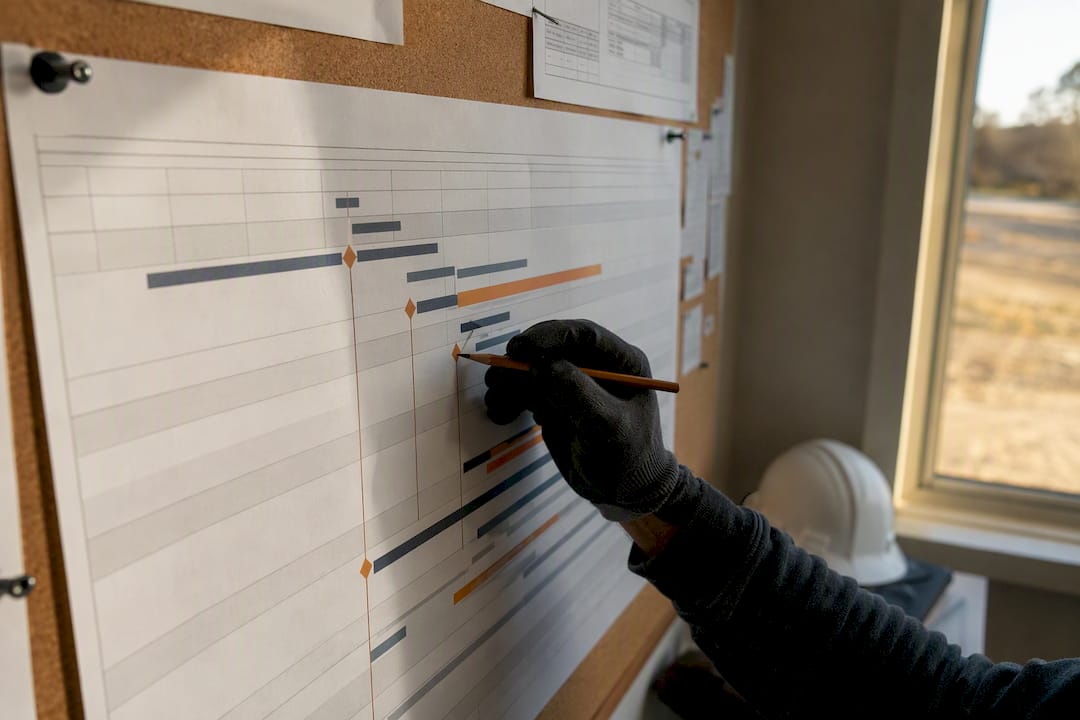
Describe your approach with named milestones, assigned owners, and acceptance criteria the government can verify. Vague statements like “we will coordinate closely with the client” read as filler to a source selection board that has read a hundred similar proposals.
Staffing tables help evaluators quickly confirm you have the right people:
Keep resumes short and outcome-focused: one paragraph per key person, tied to a past project with a measurable result. CAR 1352.215-70 specifically requires proposals to be clearly written and logically assembled, and a scannable staffing table does more for your score than three paragraphs of prose ever will.
How Do You Choose Past-Performance Examples That Prove Relevance?
Evaluators want to see contracts that look like the one you’re bidding on, not your longest or most prestigious project. Pick the three examples that most closely match this solicitation’s scope, complexity, and dollar value, and let the rest go.
- Use a STAR-style format: situation, task, action, result, with the contract number, customer name, dollar value, your role, and a quantified outcome for each.
- Include CPARS ratings and a point of contact when the solicitation allows it, since a verifiable third-party rating carries more weight than your own description.
- State outcomes in numbers: “completed 14 days ahead of schedule” or “reduced change orders by 22%” reads as fact, not marketing.
- Choose three tight, recent examples over six loosely related ones; evaluators reward depth and relevance, not volume.
Pro Tip: If your best past-performance example is more than five years old, pair it with a more recent, smaller contract that shows current capability. Recency signals you’re still executing at that standard today.
What Belongs in the Management Plan and QC Approach?
A strong management volume answers one question for the evaluator: will this contractor actually execute the way they say they will? That means showing structure, not just describing it.
- Provide an organizational chart with named decision authorities, so the government knows exactly who resolves issues and how fast.
- List specific KPIs and the quality control mechanisms tied to them, such as inspection frequency, punch-list turnaround, or safety incident rates.
- Describe how you select and oversee subcontractors, including flow-down clauses for wage and safety requirements.
- Include a short risk register: top three risks, likelihood, and your specific mitigation for each.
A one-page risk register with real mitigations does more to build confidence than five pages explaining your company’s general commitment to safety. Evaluators are trained to look for specificity, and a management plan built around named roles and numbers reads as executable rather than aspirational.
How Do You Build a Defensible Cost Proposal?
Cost realism reviews exist to catch numbers that don’t match the technical approach, and that mismatch is one of the fastest ways to lose an otherwise strong proposal. Break out labor, materials, indirect rates, and fee separately, with a written assumption behind each line.
- Justify your productivity rates with company historical data or published sources, not round numbers pulled from memory.
- Tie every major cost line back to a specific task in your technical approach, so the price tells the same story as the method.
- Explain any tradeoffs, such as a slightly higher labor cost that buys a faster schedule.
- Label every pricing attachment exactly as Section L specifies, including file names and volume numbers.
Federal buyers compare your price against an independent government estimate and against competitors, and construction contracting under FAR Subpart 36.2 carries its own timing and site-inspection provisions that affect how realistic your cost assumptions need to be. A price that looks unusually low without a clear basis of estimate invites exactly the scrutiny that sinks otherwise competitive bids.
How Do You Write an Executive Summary That Sets the Right Tone?
Your executive summary is the first thing a source selection board reads, and it should state the job to be done and the measurable benefit to the agency in the very first sentence.
- Open with the outcome: what the agency gets and by when, in concrete terms.
- List two or three discriminators that map directly to Section M evaluation factors, not generic claims of excellence.
- State your proposed contract value and cite your single strongest past-performance metric.
- Keep promotional language to a minimum; every sentence should carry evidence, not enthusiasm.
One page is usually enough. Two pages is the outer limit unless the solicitation specifies otherwise.
How Do You Stay Compliant Through Submission?
Compliance failures kill more proposals than weak technical writing does, and most of them are preventable with a disciplined read of Section L before you draft anything.
- Extract every formatting requirement from Section L. Page limits, font size, file format, volume order, and required attachments are usually spelled out explicitly; treat each one as non-negotiable.
- Map Section M’s evaluation weighting to your page allocation. If technical approach carries 40% of the score and past performance carries 20%, your page count should roughly reflect that split.
- Build a compliance matrix that tracks every “shall” statement. A compliance matrix is the fastest way to catch fatal errors before submission, because it turns a 60-page solicitation into a checklist you can actually manage.
- Confirm portal access and SAM.gov status days in advance. Government portals slow down near deadlines, and a lapsed registration is one of the most common, and most avoidable, reasons proposals get rejected outright.
- Set an internal deadline at least 24 hours before the government’s. Last-minute portal errors do not count as an excuse for late submission.
| Compliance Step | Where It Lives | Common Failure Point |
|---|---|---|
| Page limits and format | Section L | Exceeding limits with attachments |
| Evaluation weighting | Section M | Misallocating pages to low-weight factors |
| Required attachments | Section L | Missing reps and certs |
| Submission method | Section L / portal instructions | Portal timeout near deadline |
Reading Sections L and M as a paired blueprint rather than skimming them separately is the single habit that separates contractors who consistently make the competitive range from those who don’t. Our federal procurement compliance checklist walks through this process in more detail if you want a working document to adapt.
What Are the Most Common Mistakes That Sink Proposals?
Most losing proposals don’t lose on price or capability. They lose on preventable errors that a structured review process would have caught weeks earlier.
- Missed deadlines. Portal timeouts and last-minute technical issues are not accepted excuses; build in buffer time.
- Noncompliance with Section L. Formatting violations and missing attachments remain among the most frequent reasons proposals get downgraded or rejected outright.
- Boilerplate content. Language copied from a previous proposal that doesn’t match this solicitation’s specific requirements reads as inattention, not efficiency.
- Weak or irrelevant past performance. Examples that don’t match scope or complexity fail to prove you can do this specific work.
- Unrealistic pricing. A price with no basis of estimate, or one that doesn’t match the technical approach, triggers cost-realism concerns.
Staged reviews catch these problems before the government does. A pink team review checks your outline and early compliance against Section L. A red team review simulates the evaluator’s perspective, scoring your draft against Section M as if the reviewers had never seen your company before. A gold team review is the final compliance pass: page counts, attachments, reps and certs, active SAM.gov status, and correct file naming.
Pro Tip: Watch for hedging language like “we will attempt to” or “our goal is to.” Evaluators flag soft verbs as weaknesses because they read as uncertainty about your own capability.
What Do Ready-to-Use Proposal Templates Look Like?
Templates save time, but only if you customize them enough to avoid sounding like every other offeror the evaluator has read this month.
Executive summary template: [Agency] needs [outcome] by [date]. [Company] delivers this through [discriminator 1], [discriminator 2], and [discriminator 3], demonstrated on [past contract] where we achieved [quantified result]. Our proposed price of [$amount] reflects a realistic, fully burdened estimate aligned with our technical approach.
Past-performance STAR snippet template: Contract [number], [customer name], value [$amount], [your role]. Situation: [challenge]. Task: [scope]. Action: [method]. Result: [quantified outcome, e.g., completed 3 weeks ahead of schedule with zero safety incidents].
Short compliance matrix example:
| Solicitation Clause | Where Answered | Evidence |
|---|---|---|
| L Technical Volume | Volume I | Page count confirmed in final QC |
| M Past Performance Relevance | Volume II, Section 2 | Three contracts within 5 years, similar scope |
| Reps and Certifications | Volume III | SAM.gov printout attached |
Notice each template still leaves room for the specific facts of your project. A compliance matrix filled with vague restatements of the clause itself tells an evaluator nothing; the “evidence” column needs an actual page number or document name. For more on adapting language so it doesn’t read as generic, see our technical writing guidance for federal bids.
Who’s Behind This Proposal Playbook?
This guide reflects hands-on federal construction procurement practice, not theory pulled from a regulation textbook. Rowena, our editorial lead, draws on years covering federal contracting processes for construction-focused audiences.
R. Construction Solutions built its reputation helping construction firms secure work like public water infrastructure projects, guiding clients toward a 90% compliance rate on bid submissions through its 5551 Pillar methodology.
That track record, combined with the firm’s parallel work helping clients expand into private sector opportunities, is why this playbook leans so heavily on compliance discipline over clever writing tricks. The tactics here come from watching what actually gets contractors into the competitive range, repeatedly.
Is Compliance or Persuasion More Important in Contract Proposal Writing?
The conventional advice on contract proposal writing spends too much time on persuasive language and not enough on structural discipline. Contractors read guides about “win themes” and “value propositions” and assume the writing itself is what separates winners from losers. It isn’t, mostly.
What the research behind this playbook actually supports is blunter: proposals lose far more often to Section L noncompliance, mismatched past performance, and unrealistic pricing than to weak prose. A technically excellent proposal that misses a page limit or forgets a required attachment scores exactly the same as no proposal at all.
If you take one thing from this article, take the compliance matrix. It’s the least glamorous tool here and the one that prevents the most damage. Persuasive writing matters at the margins, once compliance and evidence are already locked in. Prioritize the matrix first, the narrative second, and the polish last.
Get Help With Federal Proposal Writing and Compliance
Federal-rconstructionsolutions gives construction firms a shortcut past the trial-and-error most contractors go through on their first several bids. Instead of building a compliance matrix from scratch or guessing how to weight your technical volume against Section M, you get a team that has already mapped this process against real solicitations and real award outcomes.
The firm also helps contractors identify which opportunities are worth pursuing in the first place, through services like ConstructConnect-supported lead identification, so you’re not spending proposal hours on solicitations that were never a strong fit.
If you’re preparing your next federal submission and want a compliance-first review before you commit your team’s time, visit Federal-rconstructionsolutions’s federal procurement services to see how a proposal audit or full-service engagement fits your next bid.
Sources
FAQ
What Are the Three C’s of Proposal Writing?
Definitions vary across the industry, but a common version refers to clarity, compliance, and credibility: writing that’s easy to evaluate, follows every solicitation instruction, and backs claims with verifiable evidence.
What Are the Five Main Parts of a Proposal?
Most federal proposals include a technical approach, past performance, management plan, cost/price volume, and an executive summary that ties the other four together with clear win themes.
Can I Legally Write My Own Contract Proposal?
Yes, contractors can write their own federal proposals, though many firms bring in specialized support like Federal-rconstructionsolutions to navigate FAR compliance, Section L and M mapping, and cost realism requirements that carry real disqualification risk.
What Five Things Should Every Proposal Include?
Every compliant proposal should include a clear executive summary, a technical approach mapped to evaluation factors, quantified past performance, a management and staffing plan, and a cost proposal with a defensible basis of estimate.
What’s the Difference Between Section L and Section M?
Section L tells you how to format, organize, and submit your proposal, while Section M explains exactly how the government will evaluate and weight each part once it’s submitted.